By Kyle Orton (@KyleWOrton) on March 5, 2017
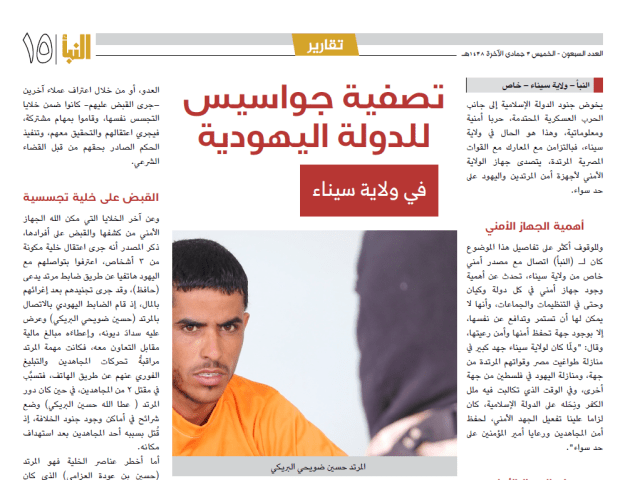
Al-Naba 70, released on 2 March 2017, p. 15. The caption under the picture says: “The apostate Husayn Duwayhi al-Bareeki”
In the 70th edition of Al-Naba, the weekly newsletter of the Islamic State (IS), entitled, “The Liquidation of Spies for the Jewish State” (tasfiya juwasees lil-dawla al-yahudiya), which did include a description of IS’s Wilayat Sinai having eliminated an Israeli spy network, but also included more general information about the IS security structure in Egypt.
“The soldiers of the Islamic State are, alongside the military war (al-harb al-askariya), locked in a raging security (or intelligence: amniya) and information (ma’lumatiya) war”, Al-Naba 70 begins by saying. This general condition holds for Wilayat Sinai, where IS jihadists have to contend with both the “apostate” security forces of Egypt and “the Jews”.
Al-Naba 70 then turns to a “special security source” from Wilayat Sinai, who stresses the importance of the “security apparatus” (al-jihaz al-amniya). The source says that in order to “preserve the safety of the mujahideen and the subjects (ra’eea) of the Commander of the Faithful (Emir al-Mu’mineen) alike” IS has to be serious about counter-intelligence, since it has made “great efforts in confronting the Egyptian taghut and its apostate forces [i.e., anti-IS tribes] on one front, and confronting the Jews in Palestine on another”—and all this “at a time when the nations and sects of disbelief have allied against the Islamic State”.
“As for the tasks that are placed upon the security apparatus, they are many, since it is the backbone (asab) of each state (dawla) and the first line of defence, responsible for searching out the enemy’s security vulnerabilities and moving at the appropriate time to strike a heavy blow against him”, Al-Naba says. The security apparatus protects “the soldiers of the Islamic State and the subjects of the Commander of the Faithful”, tracks and eliminates Egyptian and Israeli agents/infiltrators (umala) and spies (juwasees), monitors suspects, collects information about them, and decides on the order of their priority.
“The Jewish state had expressed concern more than once about developments in the Sinai, and questioned the ability of the Egyptian army to deal with the mujahideen”, says Al-Naba. “The special security source confirmed that the Jewish army was and is still supportive of the Egyptian army in its war against the caliphal state (al-dawla al-khalifa). The warplanes of the Jews have done most of the bombing against the Muslims in the Sinai, killing dozens of them and destroying their homes.”
Al-Naba goes on:
The Jews Recruit Agents and Spies
The Jews were not satisfied with the bombing operations [alone], so they sought to recruit the weak souls and slaves of money (da’af al-nafus wa-abeed al-mal) to be their eyes against the mujahideen and observe their [the jihadists’] movements. However, the security apparatus detected (kushif)—thanks be to God—many of these spies.
As for how the Jews are recruiting spies, the same source says: “This matter is carried out in a number of ways, including making random phone calls among the Muslim common people [in the Sinai], reaching out to the weak souls among them and luring them in. They are lured with money, and some are detainees recruited while in the Jewish prisons in exchange for a commutation of their sentence or release, on condition that they collaborate and act as agents of the Jews immediately upon their release.”
In addition to the foregoing, the Jewish state has been strengthening the broadcasting capacity of the Jewish mobile telephone networks, at the expense of Egyptian counterparts, to facilitate communication with residents in the border areas and monitor their communications.
However, these means and methods were not as effective as their perpetrators had wanted, praise and gratitude be to God, for the inhabitants of these areas often inform the caliphate soldiers about the Jews’ communication with them and reject these offers.
Jewish Bombing (al-Qasf) and the Uncovering of Spies
Recently, there have been bombing attacks by Jewish aircraft on Wilayat Sinai, many of which were conducted based on information provided by agents and spies, The security source indicated that the uncovering of these spies begins by gathering information and clues from the targeted locations, trying to find security gaps (al-thugharat) in the targeted area, and determining whether any of the suspected individuals were present at or frequented the site.
To confirm the suspect’s involvement in espionage on behalf of the Jews or the apostates, they are placed under close surveillance. Evidence is sought of their contact with the enemy, obtained directly or through the confession of other agents that have been arrested from the same spy ring … The suspects are then arrested, interrogated, and the judgment issued against them implemented by a shari’a court.
The supposed security source gives the example of a recent spy cell consisting of three men that was uncovered: “They confessed to communicating with the Jews by telephone through an apostate officer called Hafez. They were had been after being lured with money.”
An Israeli intelligence officer—Al-Naba makes no mention of which service, simply calling him a “Jewish officer”, but we can assume it was MOSSAD—“called the apostate Husayn Duwayhi al-Barayki and offered to pay his debts and provide him sums of money” in exchange for information on the jihadists’ movements, which he allegedly did, getting two of them killed.
Another member of the cell, Ata Allah Husayn al-Barayki, laid down “shara’ih” (something like “disks”, tracking devices) that gave away the positions of IS jihadists in Sinai, getting one of them killed.
The “most dangerous” man in the cell was Husayn bin Awda al-Azzami, says Al-Naba, who “was responsible for recruiting agents and distributing money and shara’ih to them. Praise be to God that the mujahideen succeeded in arresting and liquidating him”.
Al-Naba ends by saying that the security source has a few words for those who have “sold their deen (religion) for a meagre portion of this world” and become the servants of Jews and apostates: they can turn to the truth, they can “repent” (fatubua) and make amends with God, replacing bad deeds with good ones. The source concludes that it is “one of the lies fabricated against us” to say IS does not grant safety to repenters, even those who have fought against the organisation, but the source finishes on a threat to anyone who “persists in his apostasy”: such people will get “nothing but the sword” from IS.
 Kyle Orton's Blog