Monthly Archives: September 2017

Russia Tries To Succeed Where the West Fails in Libya

By Kyle Orton (@KyleWOrton) and Lincoln Pigman on 14 September 2017

Libya, which has been wracked by instability and violence since 2011, is re-emerging as a geopolitical hotspot. With opposing forces fighting for control of the war-torn country—the main two being the U.N.-backed Government of National Accord (GNA) and the Libyan National Army (LNA)—foreign powers have begun taking sides, internationalizing the conflict. For Western observers, the growing involvement of Russia, a major ally of LNA commander Khalifa Haftar, represents a particular concern.

Coming on the heels of the Russian military intervention in Syria, Moscow’s role in Libya’s civil war may seem, at first glance, like déjà vu. Once again, it appears that the Kremlin is working to consolidate the power of a pro-Russian regional strongman and establish a “crescent of Russian influence” across the Middle East. And given the similarities between Haftar and Syrian President Bashar al-Assad, some degree of anxiety is understandable. Like Assad, who has long appealed to foreign governments by referring to Syrian rebels as terrorists, Haftar often frames himself as a bulwark against violent extremism in Libya, where the Islamic State remains active and Islamists have formed powerful militias and entered mainstream politics. Continue reading
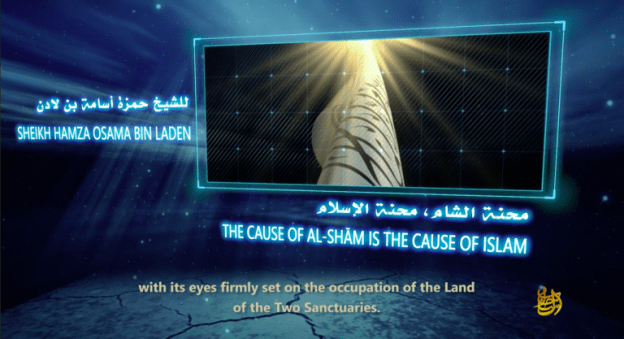
Hamza bin Ladin Uses Syria’s Suffering to Rally Muslims to Al-Qaeda’s Cause

By Kyle Orton (@KyleWOrton) on 14 September 2017

Hamza bin Ladin, son of the late Usama, released an audio message today on behalf of al-Qaeda that placed Syria at the centre of the jihadists’ cause. An English transcript of Hamza’s message, entitled, “The Cause of al-Sham is the Cause of Islam” (or “The Cause of Syria is the Cause of Islam”)—echoing a statement in April by al-Qaeda’s leader, Ayman al-Zawahiri, that “The cause of Syria is the cause of the entire umma (Muslim community”—was produced by As-Sahab Media, and is reproduced below, with some important sections highlighted in bold. Continue reading

Statement by Al-Qaeda Bomb-Maker Ibrahim al-Asiri on 9/11

By Kyle Orton (@KyleWOrton) on 13 September 2017

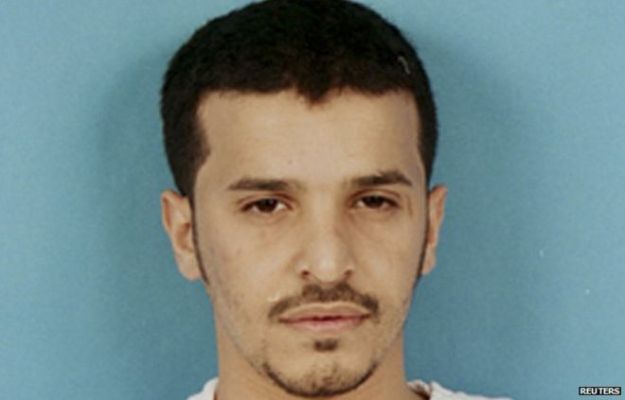
Ibrahim al-Asiri

Al-Malahim Media Institute, the affiliated media outlet for al-Qaeda in the Arabian Peninsula (AQAP), released a statement on 13 September 2017, “The March of Victory and the Defeat of America”, as part of al-Qaeda’s “In Remembrance of the Blessed September 11 Raids” series. The statement, attributed to Ibrahim Hassan bin Tali al-Asiri, the infamous AQAP bomb-maker, is reproduced below with some editions for syntax and spelling. Continue reading

The Islamic State’s Obituary for Abu Ayman al-Iraqi

By Kyle Orton (@KyleWOrton) on 12 September 2017

Ali al-Aswad (Abu Ayman al-Iraqi), al-Naba, 20 July 2017

In the ninetieth edition of its newsletter, al-Naba, released on 20 July 2017, the Islamic State (IS) published an obituary for one of its most senior operatives, Ali Aswad al-Jiburi, much better known as Abu Ayman al-Iraqi, who had been serving as the caliph’s “security advisor” when he was killed on 18 May 2016. Continue reading

The Campaign to Weaken An Al-Qaeda-Affiliated Group in Syria

By Kyle Orton (@KyleWOrton) on 12 September 2017

Abdallah al-Muhaysini and Muslah al-Alyani, two senior clerics in Hay’at Tahrir al-Sham (HTS), the former al-Qaeda branch in Syria, resigned on 11 September 2017 after leaked recordings showed HTS commanders musing about assassinating al-Muhaysini. There is clearly a well-orchestrated campaign underway to weaken HTS by discrediting and dividing it, and the sophistication of the campaign gives every indication of being the work of a state intelligence service, almost certainly Turkey’s. Continue reading

The Chief of Staff of the Islamic State

By Kyle Orton (@KyleWOrton) on 11 September 2017

In his twelfth speech since the founding of “the State,” on 24 September 2008, Hamid al-Zawi (Abu Umar al-Baghdadi), listed the “commander in chief”, or chief of staff, Abu al-Bashair al-Jiburi, as among the top heroes of the Islamic State of Iraq (ISI). Al-Zawi said that Abu al-Bashair had been recently martyred.

In an interview released on 28 October 2008, Abdul Munim al-Badawi (Abu Hamza al-Muhajir), al-Zawi’s deputy and the “war minister” of ISI, said that Abu al-Bashair was an Iraqi and a former colonel in Saddam Husayn’s army. Continue reading

Syria’s Regime Conducted the Khan Shaykhun Chemical Attack, United Nations Concludes

By Kyle Orton (@KyleWOrton) on 9 September 2017

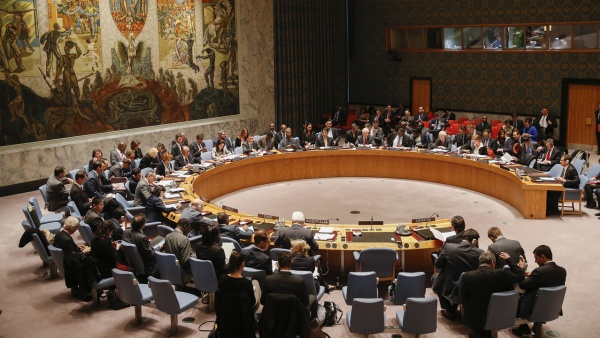
United Nations Security Council (Shannon Stapleton/Reuters)

After the use of chemical weapons of mass destruction (CWMD) in the Syrian town of Khan Shaykhun in April, American and French intelligence publicly assessed that the perpetrator was the regime of Bashar al-Asad, and President Donald Trump acted swiftly to punish the atrocity. The United Nations Independent International Commission of Inquiry on the Syrian Arab Republic released a report on 6 September that ratifies these findings, concluding that Asad attacked the population of Khan Shaykhun with chemical weapons. Continue reading

Coalition Kills Two Islamic State Weapons Engineers in Syria

By Kyle Orton (@KyleWOrton) on 8 September 2017

The U.S.-led international coalition launched airstrikes into eastern Syria on 4 September 2017 that killed “two senior ISIS leaders” involved in “weapons engineering activities” and the external operations wing of the Islamic State (IS or ISIS), according to a statement from U.S. Central Command (CENTCOM) yesterday.
Continue reading

America Sanctions the Islamic State’s Intelligence Chief

Originally published at The Henry Jackson Society

By Kyle Orton (@KyleWOrton) on 3 September 2017

The U.S. State Department on 17 August sanctioned two Islamic State (IS) operatives, Ahmad al-Khald (or Ahmad Alkhald), who was involved in the November 2015 terrorist atrocities in France and the March 2016 bombings in Belgium, and Iyad Hamid Mahl al-Jumayli (Abu Yahya al-Iraqi), IS’s internal security chief. Continue reading

One More Time on Saddam and the Islamic State

Originally published at The Henry Jackson Society

By Kyle Orton (@KyleWOrton) on 2 September 2017

The most recent issue of Perspectives on Terrorism had a paper by Ronen Zeidel entitled, ‘The Dawa’ish: A Collective Profile of IS Commanders’, which was “the first attempt to provide a comprehensive collective profile of commanders and leaders of the Islamic State (IS)”. Based on “an inventory of over 600 names”, the paper assessed the nationality, ethnicity, and tribal origins not just of the very senior IS commanders, but those lower down, a novel and much-needed line of investigation. Zeidel found that these commanders of the IS movement are or were overwhelmingly Iraqi and Sunni Arab, with an important Turkoman contingent.

Zeidel’s findings are important for drawing attention again to the local-revolutionary character of an organisation that gets a great deal of attention for its foreign fighters and external attacks, especially in the West, but which only a recently acquired global reach—and, indeed, only recently needed to: until 2011, the West was easily reachable since it had troops on the ground in Iraq, so the incentive to invest resources in creating a foreign terrorist apparatus was minimal.

One small part of Zeidel’s work has created something of a storm, however. Zeidel gives the occupation held by these commanders and, for those where this was known, 72% of them were former regime elements (FREs) from the dictatorship of Saddam Husayn. This reignited the argument over how important the FREs have been to IS. Continue reading