Category Archives: Jihadi Output

Jihadi Cleric Makes the Case for the Islamic State Leader as Caliph

By Kyle Orton (@KyleWOrton) on January 8, 2015

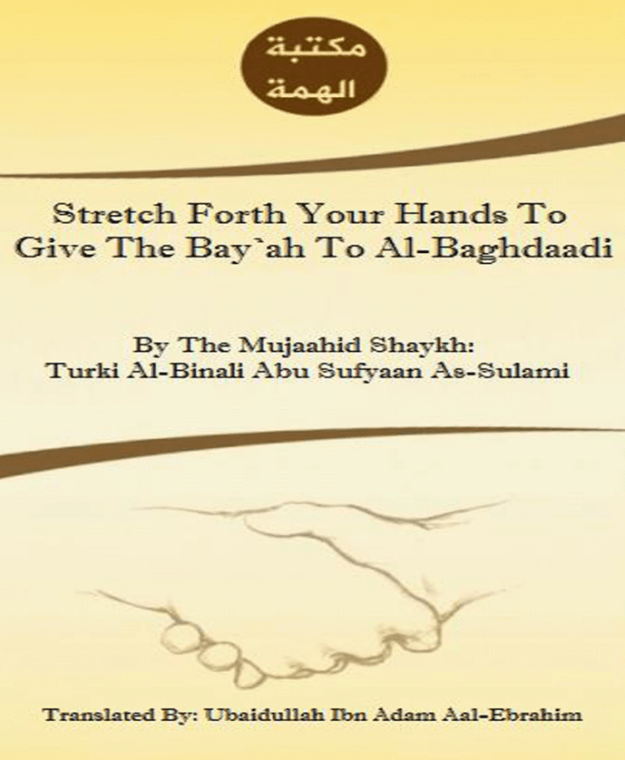
Soon after the public emergence inside Syria of the then-Islamic State of Iraq and Syria (ISIS) in the spring of 2013, a treatise was published by the Bahraini jihadi scholar, Turki al-Binali, which is to date the only official biography of the group’s leader, Abu Bakr al-Baghdadi, and piloted the idea that he was the caliph, i.e. the leader of Muslims worldwide. Al-Binali’s document, “Stretch [Out] the Hands to Give Allegiance to Al-Baghdadi”,[1] first published on August 5, 2013, would be amplified throughout late 2014 after ISIS declared that it had restored the caliphate last June and Abu Bakr took the mantle of caliph. An English translation of the document was produced on December 21, 2014, by someone using the name Ubaidullah ibn Adam al-Ibrahim on the pro-Islamic State Ansar al-Khilafa blog. It is reproduced below, with some editions for syntax and transliteration, to preserve it for study. Continue reading

Al-Qaeda Issues Strategic Guidelines for Jihadist Warfare

By Kyle Orton (@KyleWOrton) on January 7, 2015

Al-Qaeda’s emir, Ayman al-Zawahiri, released a document on 14 September 2013, entitled, Tawjihat ‘Amma lil-Amal al-Jihadi (توجيهات عامة للعمل الجهادي), variously translated as: “General Guidelines for the Work of Jihad” or “General Guidelines for Jihadist Action”. Al-Zawahiri’s document is reproduced below. Continue reading

Former Islamic State Leader Advises on Jihadist Conduct

By Kyle Orton (@KyleWOrton) on January 6, 2015

dabiq-6

The sixth edition of the Islamic State’s English-language magazine, Dabiq, published on 29 December 2014, reproduced a “speech” by Abu Hamza al-Muhajir, entitled, “Advice for the Soldiers of the Islamic State”, which dates from 23 September 2007.[1] It is reproduced below with some editions in transliteration and some important sections highlighted in bold. Continue reading

Abu Bakr al-Baghdadi’s Second Speech as Islamic State Leader

By Kyle Orton (@KyleWOrton) on December 29, 2014

The current leader of the Islamic State (IS), Ibrahim al-Badri (Abu Bakr al-Baghdadi), released his first “proper” speech on July 21, 2012. But this was, in fact, his second public statement: Al-Badri had mourned Usama bin Laden in an audio message released on 9 May 2011 and vowed “blood for blood and destruction for destruction”. The 2012 speech, entitled, “Allah Will Not Allow Except That His Light Should Be Perfected”, was released by Al-Furqan Media and an English transcript—reproduced below—was issued by Fursan al-Balagh Media. Some key parts are highlighted in bold.
Continue reading

The Islamic State Creates Foreign “Provinces”

By Kyle Orton (@KyleWOrton) on December 6, 2014

Abu Bakr al-Baghdadi gave his eighth speech[1] since becoming the leader of the Islamic State (ISIS), entitled, “Even if the Disbelievers Despise Such”, on November 13, 2014. The speech was notable for two things. First, it taunted the American-led coalition about the lack of success their campaign has had against ISIS since it began in June and was extended into Syria in September, and invited the U.S. and other Western states to deploy ground troops. Secondly, the speech accepted the pledges of allegiance from groups outside Syria and Iraq for the first time, from Saudi Arabia, Yemen, Egypt, Libya, and Algeria. In Saudi Arabia and Yemen, the groups that have joined ISIS are unknown. In Egypt, the group is Ansar Bayt al-Maqdis (The Partisans of Jerusalem). In Libya, the group is al-Majlis Shura Shabab al-Islam (The Islamic Youth Consultation Council). And in Algeria the group is Jund al-Khalifa (Soldiers of the Caliphate). These areas will now become wilaya (provinces) of the caliphate, al-Baghdadi says, and ISIS will send a governor to oversee them. An English transcript of the speech was produced by ISIS and is reproduced below with important sections highlighted in bold. Continue reading

ISIS’s Leader Calls for the Syrian Rebels to Cease Attacking the Jihadists

By Kyle Orton (@KyleWOrton) on December 6, 2014

The leader of the Islamic State in Iraq and Syria (ISIS), Abu Bakr al-Baghdadi, gave an untitled speech on January 19, 2014. It was a response to the Syrian rebellion having launched a full-scale offensive against ISIS on January 3, 2014, which had driven them from large swathes of territory in northern Syria and was ongoing at the time. The rebel offensive continued for six months—until Mosul fell to ISIS in June, and the captured resources were fed into eastern Syria, breaking the rebels. Al-Baghdadi struck a relatively conciliatory note, though did accompany this with threats, should the rebels continue resisting the jihadists. A translation of the speech was made by Pieter Van Ostaeyen, and is reproduced below. Continue reading

Islamic State Claims Responsibility for Terror Attacks in Australia, Canada, and America

By Kyle Orton (@KyleWOrton) on November 21, 2014

The Islamic State released the fifth edition of its English-language propaganda magazine, Dabiq, on November 21, 2014. In it, the Islamic State claimed responsibility for the terrorist attacks: in Australia by Numan Haider on September 23, in Canada by Martin Couture-Rouleau on October 20 and Michael Zehaf-Bibeau on October 22, and in America by Zale Thompson on October 23. The Islamic State says these attacks were in response to the call on September 22 by the organization’s spokesman, Abu Muhammad al-Adnani. The article is reproduced below with some minor editions for transliteration and some important sections highlighted in bold. Continue reading

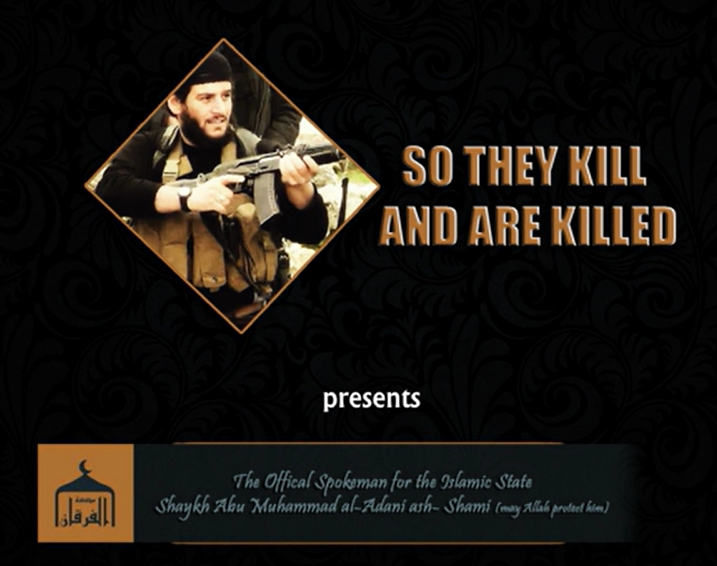
Islamic State Biography of the Spokesman: Abu Muhammad al-Adnani

By Kyle Orton (@KyleWOrton) on November 8, 2014
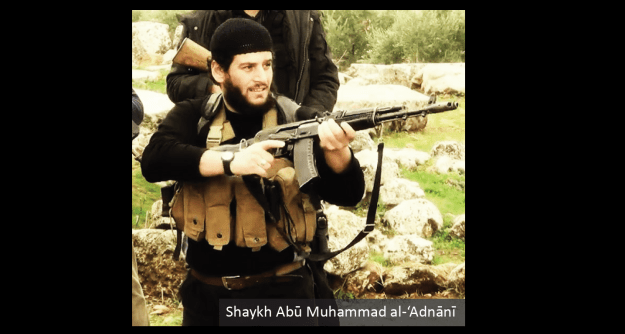
Picture of Abu Muhammad al-Adnani from the second edition of Dabiq magazine (July 27, 2014)

A Bahraini jihadist ideologue, Turki al-Binali, who has become a cleric in the Islamic State, put out a profile of the Islamic State’s official spokesman, Abu Muhammad al-Adnani, on November 1. By this account, al-Adnani took up jihadism in 2000 and was among a small cadre of people who joined the Islamic State’s founder, Ahmad al-Khalayleh, the infamous Abu Musab al-Zarqawi, when he journeyed through Syria on a recruitment-drive in 2002. Learned in Islamic jurisprudence and rigid in doctrinal literalness, al-Adnani was associated with some of the titans of the Islamic State’s legend like Abu Muhammad al-Lubnani and Abu Anas al-Shami. Appointed as emir of a small town in Anbar, Haditha, the first leader after the declaration of “the State” in 2006, Hamid al-Zawi (Abu Umar al-Baghdadi), worked under al-Adnani’s command. Al-Adnani then moved on to be an ideological instructor. Such was al-Adnani’s status, he did not have to consult al-Zarqawi before ordering operations; he only had to brief al-Zarqawi afterwards. Al-Adnani was arrested by the Americans in Iraq in May 2005, thereafter spending six years behind the wire, though never giving up his missionary activity. Indeed, the profile says al-Adnani developed the first full training program, academic and physical, for jihadi inmates. Upon release, al-Adnani took the post of official spokesman and has maintained it ever since. This profile is reproduced below with some minor editions for transliteration, syntax, and spelling. Continue reading

Religion’s Moral Guidance: The Islamic State, the Yazidis, and Mass-Rape

By Kyle Orton (@KyleWOrton) on October 24, 2014

Yazidis fleeing from the Islamic State to Mount Sinjar, carrying their children

Yazidis fleeing from the Islamic State to Mount Sinjar, carrying their children

When the United States finally intervened against the Islamic State (I.S.) in early August the timing, if not exactly the strategic imperative, was determined at least in part by the scenes of Yazidis being starved to death on the side of Mount Sinjar. The Yazidis were forced to choose between descending the mountain and being murdered by the takfiris or remaining and dying of dehydration. As it turns out they were the lucky ones. Continue reading

Al-Qaeda in Syria Condemns Al-Qaeda in Yemen’s Softness on the Islamic State

By Kyle Orton (@KyleWOrton) on October 20, 2014

Maysar al-Jiburi (Abu Mariya al-Qahtani) [source]

Al-Qaeda broke relations with the then-Islamic State of Iraq and Syria (ISIS) in February. In June, ISIS declared that it had restored the caliphate and changed its name to simply the Islamic State (IS). Since then, some jihadist groups, including some affiliated with al-Qaeda, have declared their allegiance to IS. With the beginning of American airstrikes against IS, in Iraq on 7 August and extended to Syria on 23 September, the question of where jihadi-salafists stand with regard to IS has become more acute. It was in this predicament that a statement was released today from a leader of al-Qaeda in Syria condemning al-Qaeda’s branch in Yemen for its statement of solidarity with IS in the face of these U.S.-led attacks. By the lights of al-Qaeda in Syria, the Yemeni branch’s statement was too lenient toward IS and will be misinterpreted as support for an organization that has struck down senior officials of al-Qaeda in Syria and remains actively at war with al-Qaeda in that theatre to this hour. Continue reading