Assad’s Crimes Against Humanity and Trump’s Options in Syria

By Kyle Orton (@KyleWOrton) on February 7, 2017

Satellite picture of Sednaya prison, Syria (source)

Amnesty International released a report today, “Human Slaughterhouse,” documenting the conditions in Sednaya prison, run by the regime of Bashar al-Assad in Syria, which amount to extermination as a crime against humanity. In addition to the deliberately insanitary conditions, routinized torture and maltreatment, there has been—and continues to be—a systematic campaign of extra-judicial massacre in which perhaps 13,000 people have perished. These findings buttress previous findings, and come with some political implications as the new American administration seeks to chart its way forward in Syria. Continue reading

Pro-Al-Qaeda Ideologue on Merging With Non-Jihadi Groups

By Kyle Orton (@KyleWOrton) on February 5, 2017

Abdallah al-Muhaysini at a rally for Hay'at Tahrir al-Sham, 3 February 2017

Abdallah al-Muhaysini at a rally for Hay’at Tahrir al-Sham, 3 February 2017

On 28 January, as a part of its long-term strategy of integrating with, and ultimately co-opting, the Syrian rebellion, al-Qaeda shifted ground again and merged into a wider spectrum of insurgent groups, many of them jihadi in character, but many not, united under the banner of Hay’at Tahrir al-Sham (HTS). One of the non-jihadi groups to join HTS was Harakat Nooradeen al-Zengi, which became infamous in July 2016 after it beheaded one of the Bashar al-Assad regime’s child soldiers on video. This has aroused some controversy in jihadi circles, and today a statement by a jihadi ideologue, Abu Mahmud al-Filistini, who lives in London, was circulating explaining why HTS was right to take in al-Zengi. The statement was entitled, “Clearing the Doubts Regarding Nooradeen al-Zengi Uniting with Hay’at Tahrir al-Sham,” and is reproduced below. Continue reading
How the Islamic State Claims Terrorist Attacks

By Kyle Orton (@KyleWOrton) on February 4, 2017

2

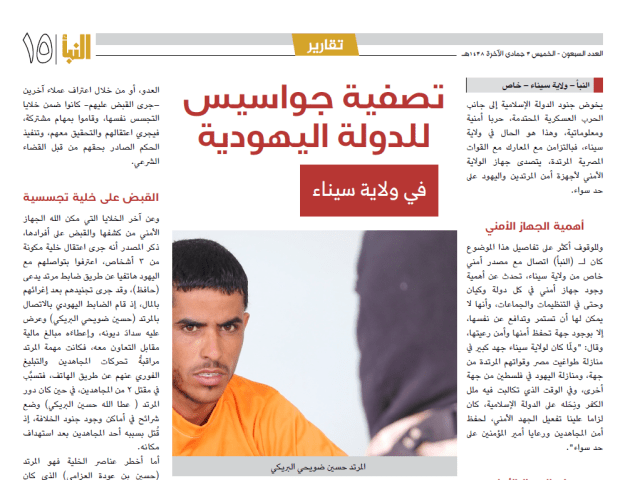
With the attempted terrorist attack using machetes at the Louvre museum in Paris yesterday by Abdullah Reda al-Hamamy, whose social media history shows statements at least sympathetic to the Islamic State (IS), it raises once again the question, making no assumptions about al-Hamamy’s motives, of how connected the organization headquartered in Raqqa is to the attacks taking place around the world under IS’s banner—and how we would know.

As IS’s attacks outside of the statelet it has built in Iraq and Syria increased in frequency over the last year, a rather routinized mechanism has developed for attributing blame: IS claims the atrocities—or attempted atrocities—through Amaq News Agency. Continue reading

Kuwaiti Islamic State Military Official Killed in Syria

By Kyle Orton (@KyleWOrton) on February 1, 2017

abdul-al-taresh-abu-jandal-al-kuwaiti-2

In September 2014, Kuwait undertook a series of raids against terrorists loyal to the Islamic State (IS). It was found by authorities that one of the “great influence[s]” over the jihadi-Salafists in Kuwait was Abdulmuhsin al-Taresh (Abu Jandal al-Kuwaiti). Al-Taresh was an important propagandist-recruiter for IS at this time, and would later become a senior military official. He was killed near IS’s Syrian capital, Raqqa, by the U.S.-led Coalition at the end of December. Continue reading

Adnan al-Suwaydawi: Saddam’s Spy, Islamic State Leader

By Kyle Orton (@KyleWOrton) on January 31, 2017

Adnan al-Suwaydawi (source)

Adnan al-Suwaydawi (source)

A video from the Islamic State yesterday listed a series of prominent past leaders of the organization. One was Adnan al-Suwaydawi,[1] whose full name is Adnan Latif Hamid al-Suwaydawi al-Dulaymi, and who is known most commonly either as Abu Muhannad al-Suwaydawi or Haji Dawud. For a long time, al-Suwaydawi was also mistakenly assigned the kunya “Abu Ayman al-Iraqi”, who was in fact a different IS commander. Al-Suwaydawi was killed on 15 May 2015 by a Coalition airstrike in Anbar Province, western Iraq, but he is credited by the Islamic State with their overrunning Ramadi, the capital of Anbar Province, the next day. A biography of al-Suwaydawi was circulated by IS supporters on or around 21 May 2015; it is reproduced below.
Continue reading

The Man Who Planned the Islamic State’s Takeover of Mosul

By Kyle Orton (@KyleWOrton) on January 31, 2017

Adnan al-Bilawi

Adnan al-Bilawi

Adnan Ismail Najem al-Bilawi al-Dulaymi (Abu Abdulrahman al-Bilawi), the leader of the Islamic State’s Military Council when he was killed on the eve of the Mosul offensive that he had planned in June 2014, was eulogized by IS’s official spokesman, Taha Falaha (Abu Muhammad al-Adnani), explaining his importance to the organization. Below is a profile of al-Bilawi and the section of Falaha’s speech dedicated to al-Bilawi. Continue reading

The Leader of the Islamic State in the 2004 Fallujah Battles: Umar Hadid

By Kyle Orton (@KyleWOrton) on January 30, 2017

Umar Hadid [right] (source)

Umar Hadid [right] (source)

Umar Hadid was a native of Fallujah, hence his kunya, Abu Khattab al-Falluji,[1] and a part of the extremist thread of the Salafist underground in Saddam Husayn’s Iraq. Working as an electrician for a time, Hadid had gone into internal exile years before the invasion after attacking Saddam’s security forces. In the aftermath of Saddam’s toppling, Hadid quickly joined with Ahmad al-Khalayleh (Abu Musab al-Zarqawi), the Jordanian founder of the Islamic State (IS) who had been in Baghdad from May 2002. Hadid rose swiftly in the ranks of the IS movement, and led the insurgency during the two battles with American forces in Fallujah in 2004, being killed during the second of them. Continue reading

The Islamic State’s Profile of Umar Hadid

By Kyle Orton (@KyleWOrton) on January 30, 2017

1

A profile of Umar Hadid, taken from the Islamic State’s “Distinguished Martyrs” series posted to a jihadist forum, is reproduced below with some interesting and important sections highlighted in bold. Hadid—variously known as Abu Khattab al-Falluji, Abu Khattab al-Ansari, and Abu Khattab al-Iraqi—was a native of Fallujah who took up Salafism in the late 1990s during the rule of Saddam Husayn, leading to clashes with the security forces and Hadid going into internal exile. After the fall of Saddam, Hadid quickly linked up with the elite circles of the nascent Islamic State movement, including its leader Ahmad al-Khalayleh (Abu Musab al-Zarqawi), his deputy Umar Yusef Jum’a (Abu Anas al-Shami), the military leader Mustafa Ramadan Darwish (Abu Muhammad al-Lubnani) and Abu Raghd who set up the Rawa Camp in Anbar Province, said to be the first terrorist training facility of the Iraqi jihad, and Abdallah Najem al-Jawari (Abu Azzam al-Iraqi), the chief financier and Anbar governor in 2004 before being appointed emir of Baghdad in 2005. Hadid was the leader of the insurgency in the two battles at Fallujah in 2004, being killed during the second of them. Continue reading

A Turncoat Still Loved By the Islamic State: Manaf al-Rawi

By Kyle Orton (@KyleWOrton) on January 29, 2017

Manaf al-Rawi

Manaf al-Rawi

Manaf Abdul Rahim al-Rawi was the leader of operations in Baghdad for the Islamic State of Iraq (ISI), the predecessor to the Islamic State (IS), between 2008 and his arrest in 2010. Al-Rawi had been with IS from its earliest days and his arrest in 2004 only advanced him through the ranks as he networked in prison. Upon release and assumption of the post of wali (governor) of Baghdad, al-Rawi was responsible for some of the worst atrocities in 2009 and 2010 in that city. Al-Rawi was executed in prison in 2013. Continue reading

Profile of Hudayfa al-Batawi, Former Islamic State Emir of Baghdad

By Kyle Orton (@KyleWOrton) on January 29, 2017

hudayfa-al-batawi-1

Hudayfa al-Batawi was among the Iraqis who joined the Islamic State (IS) movement early after the fall of Saddam Husayn, having been a long-time Salafist extremist. Al-Batawi rose through the ranks and became the emir of Baghdad, involved in some of the worst attacks in that city in 2009 and 2010. Arrested in late 2010, al-Batawi was killed in a prison riot in 2011. Continue reading