Tag Archives: authoritarianism

Crisis and Opportunity for Turkey and America: The Minbij Dispute

By Kyle Orton (@KyleWOrton) on 4 March 2018

A version of this article was published in The Arab Weekly

The YPG/PKK Minbij Military Council (image source)

The city of Minbij in northern Syria has become a source of severe political tension between the United States and Turkey. It might also be the key to reducing tensions and normalising relations. Continue reading

Human Rights Abuses in Rojava and the Anti-ISIS War

By Kyle Orton (@KyleWOrton) on 3 March 2018

Guerrillas from the Sinjar Resistance Units (YBS), the name the Kurdistan Workers’ Party (PKK) uses in Sinjar, Iraq, together with operatives from the People’s Defence Forces (HPG), the armed units of the PKK inside Turkey, holding a picture of PKK leader Abdullah Ocalan. (image source)

The American-led Coalition’s partner against the Islamic State (IS) in Syria, the so-called Syrian Democratic Forces (SDF), presents itself, ideologically and in terms of the governance structure it controls, in universalistic liberal and democratic terms, emphasizing ecological and feminist themes. The reality is that the SDF is under the politico-military control of the Kurdistan Workers’ Party (PKK), a designated terrorist organization that has run a four-decade-long insurgency against Turkey. The PKK has brought some measure of stability to the areas it controls, but it continues to struggle for legitimacy and without locally-legitimate government IS and other jihadi-Salafists will find political room to operate. The PKK’s continued monopolization of power and abusive governance practices undermine the chances for the “Rojava” system to evolve into a long-term solution to the jihadist terrorists that have used Syrian territory to threaten the region and the wider world. Continue reading

Is Britain Cracking Down on PKK Terrorist Activity?

Originally published at The Henry Jackson Society

By Kyle Orton (@KyleWOrton) on 16 December 2017

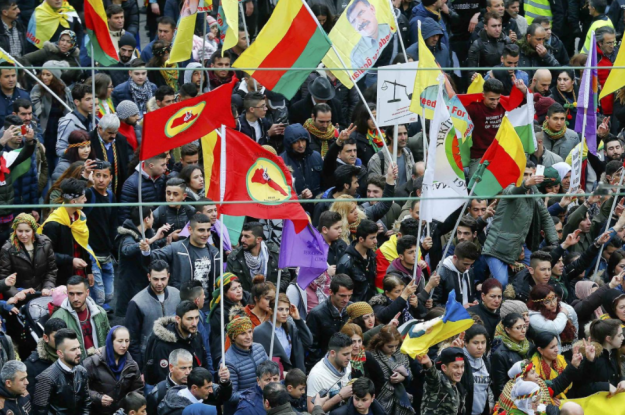
Pro-PKK demonstrators in Frankfurt, Germany, 18 March 2017, REUTERS / Ralph Orlowski

The BBC reported yesterday that on 7 December the Metropolitan Police Service arrested four people—two 17-year-old boys, a 38-year-old woman, and a 50-year-old woman—were arrested in the Haringey area of north London as part of a probe into terrorist fundraising, through money laundering and fraud. The terrorist group at issue is the Kurdistan Workers’ Party (PKK), and those arrested are believed to have contributed to the PKK’s finances through sale and distribution of one of the PKK’s most important propaganda instruments, the Yeni Ozgur Politika (New Free Politics) newspaper. Time will tell if this is a one-off or the beginning of a serious and long-overdue attempt to curtail the PKK’s propaganda-recruitment activity and fundraising in the West. Continue reading

America’s Kurdish Allies in Syria Drift Toward the Regime, Russia, and Iran

By Kyle Orton (@KyleWOrton) on 10 December 2017

Russian soldiers in Efrin, Syria, 1 May 2017 (source)

The American-led Coalition against the Islamic State (IS) partnered with the “Syrian Democratic Forces” (SDF), a political façade for the proscribed Kurdistan Workers’ Party (PKK), as the ground force in Syria. The most ventilated problems with this partnership so far have been the strain it has put on relations with NATO ally Turkey, against which the PKK has run a terrorist-insurgency for more than thirty years, and the deep local suspicion of the PKK’s governing program that might yet reverse the gains against IS and open political space for other jihadists like al-Qaeda. Another of the problems is now gaining salience: the PKK’s long-term alliance with Bashar al-Asad’s regime and the states—Russia and Iran—that keep it alive. Continue reading

A “Syrian Democratic Forces” Defector Speaks About the Role of the PKK and America in Syria

By Kyle Orton (@KyleWOrton) on 3 December 2017

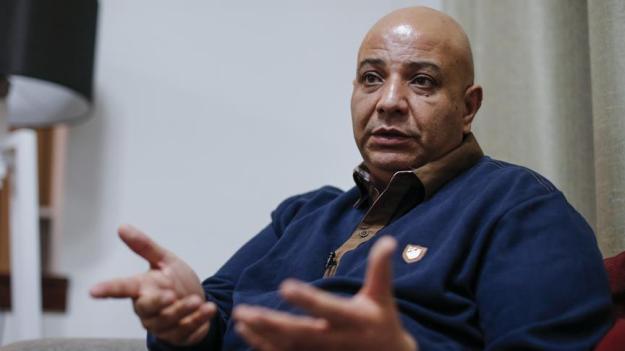
Talal Silo

Talal Silo was the leader of an ethnic Turkoman unit within the Syrian Democratic Forces (SDF), the ground partner in Syria of the American-led international coalition against the Islamic State (IS). Having defected recently, Tilo has now given an interview about his experiences, the nature of the SDF, and the SDF’s links to the Bashar al-Asad regime and its supporters, Russia and Iran. Continue reading

Iran Escalates its Subversive Activities in Bahrain

Post originally appeared at The Henry Jackson Society

By Kyle Orton (@KyleWOrton) on 19 November 2017

Fire at the oil pipeline in Buri village, south of Manama, Bahrain, 10 Nov. 2017. REUTERS/Hamad I Mohammed

Just over a week ago, the major oil pipeline in Bahrain was bombed by operatives the government says were working for the Islamic Republic of Iran. This is the latest in an escalating series of terrorist attacks inside Bahrain. Throughout the year, Manama has also been rolling up terrorist cells that have links to Iran’s intelligence services and Bahraini citizens now in Iran that form part of Tehran’s regional terrorist network. The breakdown in Gulf unity is especially worrying in the face of this intensified Iranian aggression and subversion in Bahrain. Continue reading

Fresh Wave of Repression in the Syrian Kurdish Areas

By Kyle Orton (@KyleWOrton) on 15 September 2017

Kurdish opposition figures arrested by the PYD/PKK on 14 September 2017, NORTHERN SYRIA OBSERVER

The Kurdistan Workers’ Party (PKK), an internationally-designated terrorist entity, currently controls about a fifth of Syria’s territory in the northeast, an area it calls “Rojava”. The PKK works, as I explained in a recent report for The Henry Jackson Society, under the banner of the People’s Protection Units (YPG) and the Democratic Union Party (PYD) while on Syrian territory, and has sought—with Western complicity—to obscure its activities even further by attaching some subordinate Arab units to its forces and calling this supposed-umbrella organization the Syrian Democratic Forces (SDF). The SDF is the principle partner of the seventy-three-member coalition, led by the United States, that seeks to destroy the Islamic State (IS). On 14 September, the PYD/PKK launched a fresh crackdown on the Kurdish opposition, which has been viciously persecuted by the PKK back to 2011 and assaulted with an especial vigour since the spring of this year. The Kurds arrested by the PKK yesterday, and whose demonstration was attacked and dispersed by the PKK this afternoon, were voicing their support for the independence referendum to be held on 25 September by the Kurdistan Regional Government (KRG) in northern Iraq. Continue reading

The Latest Chapter of Syria’s Media War: A ‘Gay Unit’ Fighting the Islamic State

By Kyle Orton (@KyleWOrton) on 31 July 2017

Earlier this month, it was announced that an LGBT military unit had been formed to fight the Islamic State (IS) in its Syrian “capital”, Raqqa city. There does appear to be such a unit in existence, though it is militarily inconsequential and likely has fewer than a dozen members, all of them foreign. The unit’s primary intention was to bolster the ongoing media-political campaign of the Kurdistan Workers’ Party (PKK), which is selling itself to Western audiences as a “progressive” ideological ally in the Middle East. This is the latest chapter in a conflict where the significance of the media war has few precedents. Continue reading

Viewing the Coalition’s Flawed Anti-Islamic State Strategy From Raqqa’s Frontlines

By Kyle Orton (@KyleWOrton) on 19 June 2017

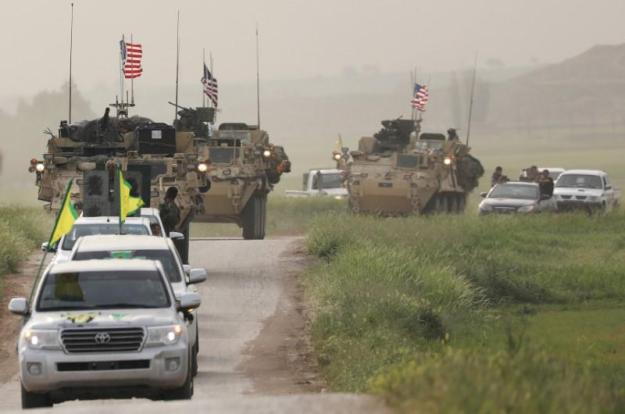
YPG and U.S military vehicles in Darbasiya, northern Syria, 28 April 2017. REUTERS/Rodi Said/File Photo

At the end of May, Christoph Reuter, a journalist with Der Spiegel, embedded with the Syrian Democratic Forces (SDF) as it made its way, supported by the U.S.-led Coalition, toward Raqqa city, the Syrian “capital” of the Islamic State’s (IS) caliphate. Reuter’s report provides snapshots of a number of important—and worrying—dynamics at play that have made the U.S. decision to back the SDF to liberate Raqqa so worrying over the long-term, even on its own terms as a means of sustainably defeating IS. Continue reading

Raqqa Doesn’t Want to Be Liberated By the West’s Partners

By Kyle Orton (@KyleWOrton) on 30 May 2017

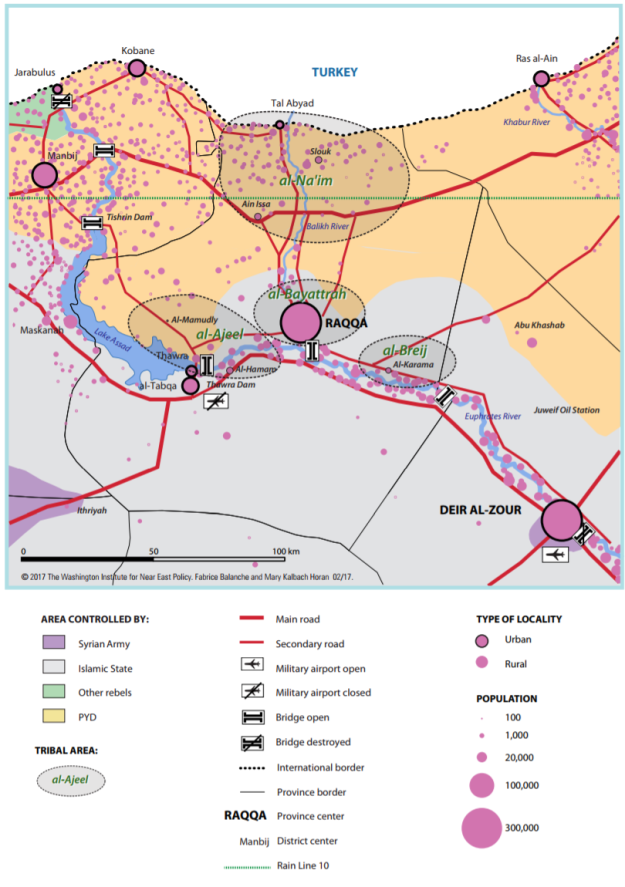
Map of the tribes around Raqqa city (source: WINEP report)

We are now on the eve of the operation to evict the Islamic State (IS) from its Syrian capital, Raqqa, and, as expected, the United States will partner with the Syrian Democratic Forces (SDF), the front-group for the Democratic Union Party (PYD) and its armed wing, the People’s Protection Units (YPG), which President Donald Trump’s administration has committed to directly arming.

Many of the doubts voiced about this course relate to Turkey, since the PYD/YPG is—despite continued efforts to obfuscate the fact—the Syrian department of the Kurdistan Workers’ Party (PKK), the premier internal security threat to Turkey for many decades. The discussion then tends to fall into one of two grooves. Continue reading