Published at The Arab Weekly
By Kyle Orton (@KyleWOrton) on 27 January 2019

Israeli Prime Minister Binyamin Netanyahu and Chadian President Idriss Deby meeting in N’Djamena, 20 January 2019 [AFP]
Continue reading
Published at The Arab Weekly
By Kyle Orton (@KyleWOrton) on 27 January 2019
Israeli Prime Minister Binyamin Netanyahu and Chadian President Idriss Deby meeting in N’Djamena, 20 January 2019 [AFP]
By Kyle Orton (@KyleWOrton) on 8 December 2018
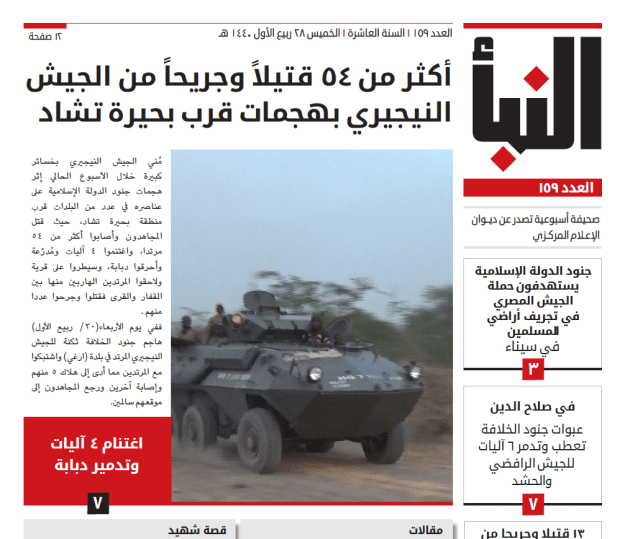
Al-Naba 159
The 159th edition of Al-Naba, the Islamic State’s (IS) newsletter, released on 6 December 2018, had a very interesting story on pages nine and ten about three “repentant officers” (dubat al-tayibeen) from Egypt who joined IS in the Sinai. The two trendlines this story highlighted were: (1) the movement of trained military cadres from the Arab states into IS’s security apparatus, as has been seen with the elements of Saddam Husayn’s fallen regime; and (2) the radicalisation of those Islamists previously prepared to work through the democratic process by the 2013 putsch in Egypt, and the violent crackdown afterwards, which shut down all peaceful paths to change. Al-Qaeda has made this point a staple of its propaganda for some time. Continue reading
By Kyle Orton (@KyleWOrton) on 4 July 2018
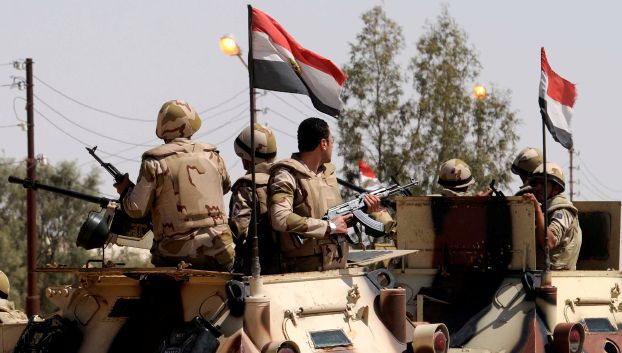
Egyptian soldiers in the Sinai (image source)
Five years on from the military coup d’etat in Egypt that brought to power Abdel Fattah el Sisi, the problems of the country—political, economic, demographic, security—remain as intractable as ever. Indeed, in many cases, the problems are worse than before. Among the problems that are noticeably worse now than in 2013 is security, specifically the Islamic State (Daesh) insurgency in the Sinai. Continue reading
By Kyle Orton (@KyleWOrton) on 26 April 2018
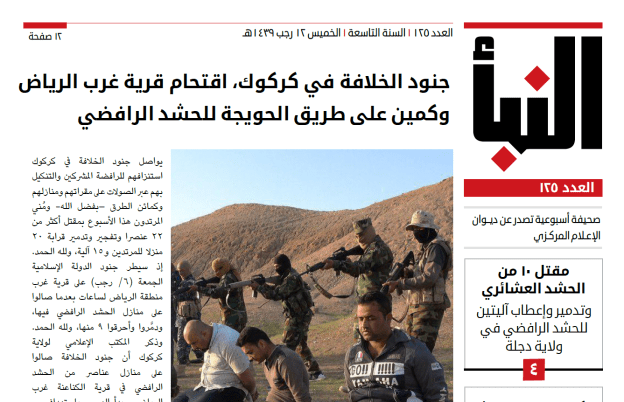
A-Naba 125
The Islamic State (IS) formally turned from statehood to insurgency last October. The 125th edition of Al-Naba, IS’s weekly newsletter, released on 29 March 2018, contained a number of indicators that the jihadists’ guerrilla warfare is gaining considerable steam—and that IS thinks it should gain more. Continue reading
By Kyle Orton (@KyleWOrton) on 18 April 2018

Egyptian ruler Abdelfattah al-Sisi, Saudi King Salman, and President Donald Trump in Riyadh on 22 May 2017 (image source)
Two days ago, The Wall Street Journal reported that President Donald Trump has been exploring plans to replace American troops in the areas of Syria held by the Coalition partner force, the “Syrian Democratic Forces” (SDF), with troops from the Arab states. The problems with this proposal, even in the rudimentary form it is presented, are manifold. It also feeds into the broader problem of Trump’s inconsistent messaging about Syria—or, more precisely, his failed efforts to balance domestic messaging, which calls for what was once referred to as “nation building … at home”, and his foreign messaging that needs to emphasise U.S. constancy to see through the mission to defeat the Islamic State (IS) by, among other things, stabilising and reconstructing Syria. Continue reading
By Kyle Orton (@KyleWOrton) on 15 February 2018
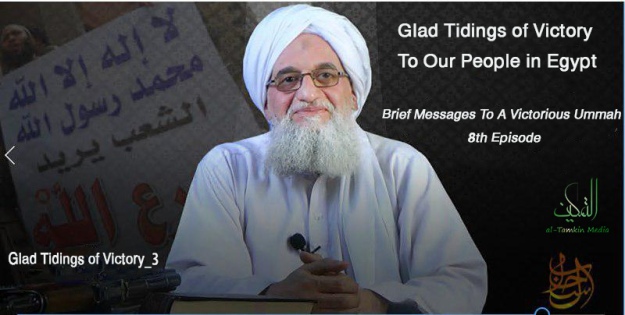
Al-Qaeda’s leader, Ayman al-Zawahiri, released a speech on 15 February 2018, entitled, “Glad Tidings of Victory To Our People in Egypt”. Al-Zawahiri’s address was the eighth episode of the “Brief Messages To A Victorious Umma (Islamic community or nation)” series. Al-Zawahiri reiterated a theme al-Qaeda has used many times, by referring to the downfall of Muhammad Morsi, the first elected president of Egypt, who was deposed in a military coup d’état in July 2013. Morsi, a member of the Muslim Brotherhood, had taken part in elections and had tried to find a compact with the non-Islamist sections of the Egyptian state and society, including the felul, the remnants of the fallen tyranny, notably in the military, police, bureaucracy, and judiciary, plus the media and business class. It had served Morsi no good: severely constrained in his authority, Morsi’s government unravelled quickly when these forces came together with foreign sponsors for a putsch. The old regime was restored in Egypt, with the support of Western countries, despite being more violent than ever. For al-Qaeda, the lesson of this episode is clear: without a violent revolution that creates tabula rasa, Islamist politics will not get a chance. An English-language transcript of al-Zawahiri’s speech was made available by al-Qaeda’s media apparatus and is reproduced below. Continue reading
By Kyle Orton (@KyleWOrton) on 28 January 2018

Al-Qaeda’s leader, Ayman al-Zawahiri, made a speech on 26 January 2018, entitled, “After Seven Years Where Is the Deliverance?” The speech built the case that the “Arab spring” uprisings failed because they tried to make changes within the framework of the nation-state, to be incremental, and to make accommodations with the fallen regimes, rather than radical “purification” by launching coordinated jihadist revolutions that respected no frontier, violently uprooted the old order, and implemented the shari’a. An English transcript of the speech was released by al-Qaeda’s As-Sahab Media station and is reproduced below. Continue reading
By Kyle Orton (@KyleWOrton) on 29 December 2017

The Astana track of Syrian “peace” negotiations began on 23 January 2017, under Russian guidance in the Kazakh capital, with Iran and Turkey also invited as “guarantor countries” of the various sides in Syria. The process, initiated in the shadow of the savage conquest of Aleppo city in December 2016 that signalled the total strategic defeat of the insurrection against the Bashar al-Asad regime, was an attempt by Moscow to convert the military gains it had enabled by Asad and Iran on the ground into political facts that could then be imported into the internationally-recognized Geneva process. This “Astana-isation of Geneva” was Russia’s bid to take control of the political process and redefine it: rather than having Asad’s removal as its end-goal, it would set the terms of reintegration into the Asad state. Abetted by a purblind Western campaign against the Islamic State (IS) and a strategic reorientation in Turkey, the pro-Asad coalition has more or less had its way for the last year. But there are now signs that this approach is beginning to unravel. Continue reading
By Kyle Orton (@KyleWOrton) on 4 December 2017

The decision by Saudi Arabia, the United Arab Emirates, Bahrain, and Egypt to impose a boycott on Qatar this summer was an out-of-character development for the Gulf, where all too much politics is conducted behind closed doors between the ruling families and elites. To go public, the schism between Qatar and the so-called Quartet must have been very serious.
It was the end-point of a dispute that began in the 1990s about Qatar’s foreign policy, which at that point became independent of the Saudi-led Gulf Cooperation Council (GCC), and indeed actively competitive with Saudi interests. Doha wanted to alter the Saudi-oriented status quo and did so by empowering groups—almost invariably Islamists—in its cause. Those Islamists not only had agendas running counter to the other Gulf states’ conception of regional order, but which the Quartet regarded as threatening to their internal security. Continue reading
By Kyle Orton (@KyleWOrton) on 30 November 2017

I released a report today, published by the Henry Jackson Society, Qatar and the Gulf Crisis. The intent was to examine the charges made against the Qatari government by its Gulf neighbours with regard to the funding of terrorism, the hosting of extremists, the dissemination of hate speech and incitement, among other things. Having separated fact from fiction with regards to he accusations against Qatar, the report proposes how Britain might proceed in such a way as to press Doha on issues of concern, while avoiding being drawn into the middle of the Gulf dispute, and trying to foster reconciliation between allies, especially at a time when a united front is necessary to oppose the far larger challenge of the Iranian theocracy. Continue reading
 Kyle Orton's Blog