By Kyle Orton (@KyleWOrton) on 25 May 2018
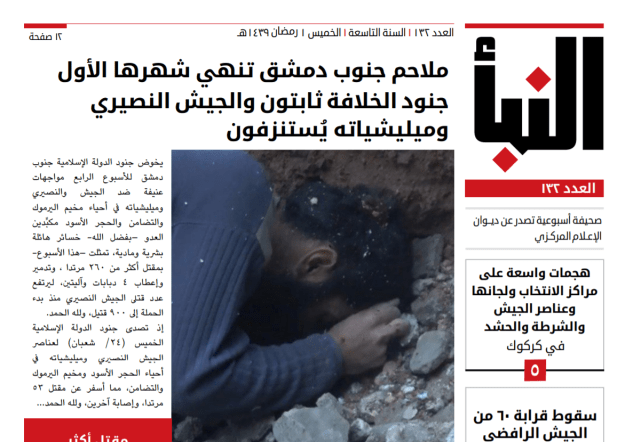
Al-Naba 132
The Islamic State released the 132nd edition of Al-Naba, its newsletter, on 18 May. Continue reading
By Kyle Orton (@KyleWOrton) on 25 May 2018
Al-Naba 132
The Islamic State released the 132nd edition of Al-Naba, its newsletter, on 18 May. Continue reading
By Kyle Orton (@KyleWOrton) on 20 May 2018

Bernard Lewis, the great historian of the Middle East, died yesterday, aged 101.
By Kyle Orton (@KyleWOrton) on 14 May 2018
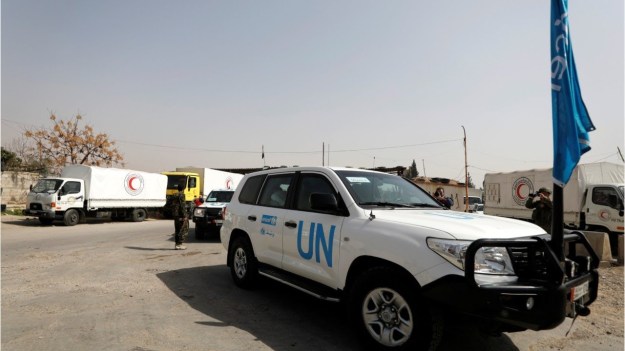
United Nations in East Ghouta, Syria (image source)
At best, the United Nations has been impotent as Syria was destroyed. But when the U.N.’s role is examined more closely it looks more like a collaborator, than a bystander, to that destruction. Continue reading
By Kyle Orton (@KyleWOrton) on 10 May 2018
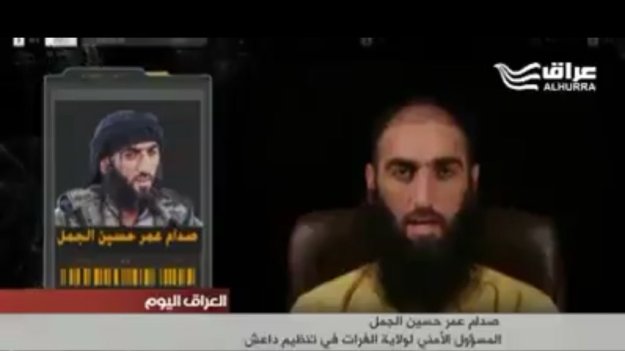
Saddam al-Jamal after his capture, 9 May 2018 (image source)
Saddam al-Jamal, born in al-Bukamal, a town near the Iraqi border in Syria’s the Deir Ezzor province, became a prominent example of a rebel against Bashar al-Asad’s regime who joined the Islamic State in 2013. It has now reported that al-Jamal has been arrested by the Iraqi government after an operation involving Turkey and the United States lured him into a trap. Continue reading
A version of this article was published in CapX
By Kyle Orton (@KyleWOrton) and James Snell on 8 May 2018
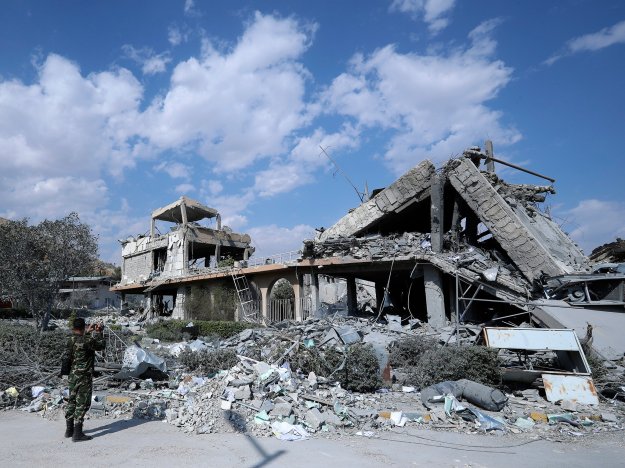
The Barzeh chemical weapons facility in Damascus, Syria, demolished by U.S. cruise missiles on 14 April 2018 (image source)
The United States and its allies, Britain and France, launched over 100 missiles at the Syrian regime of Bashar al-Assad in the early hours of 14 April. This was retaliation for the regime’s use of poison gas in the town of Douma, east of the capital, Damascus, exactly a week earlier, which massacred at least 43 people and wounded 500 more. The military strikes were an important signal and will likely be some deterrent against the future use of chemical weapons in Syria, but ultimately this was another missed opportunity by the West to meaningfully affect the course of the war. Continue reading
By Kyle Orton (@KyleWOrton) on 1 May 2018
Logo of Harakat al-Qiyam from its first video, 15 October 2017
A campaign is underway to destabilise the “Rojava” area of north-eastern Syria, ruled by the Syrian Democratic Forces (SDF), a composite force wholly dominated by the Kurdistan Workers’ Party (PKK), an internationally-designated terrorist organisation whose operatives use the banner of the People’s Protection Forces (YPG) in Syria. The SDF/PKK captured a lot of Arab-majority areas as a side-effect of the American-led war against the Islamic State (IS), which deputised the SDF as its ground force in Syria. It was always clear that these inhabitants did not wish to be ruled by an authoritarian Kurdish nationalist party with Marxist inflections and a cult around its leader, Abdullah Ocalan. There was, however, a chance that the goodwill of that comes with liberation could be converted, with the right adjustments, the SDF model could become a durable settlement. It appears the trendline is now running the other way, toward a disintegration of this structure. Continue reading
By Kyle Orton (@KyleWOrton) on 29 April 2018
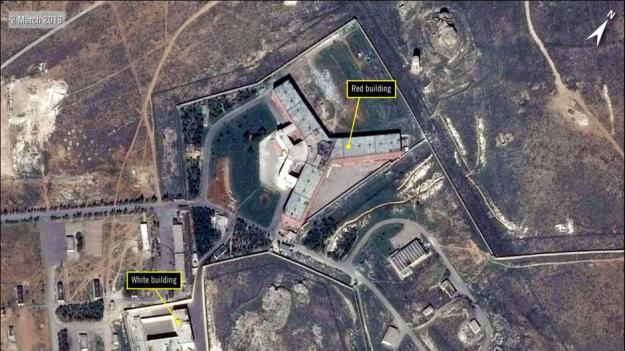
A satellite image of Sednaya prison, about 20 miles north-east of the presidential palace. CNES and ASTRIUM / Amnesty International via AFP
To accompany the release of “Syria’s Slaughterhouses”, a film by TRT World’s “Off The Grid”, I was asked to give an overview of the available evidence of the Assad regime’s crimes against humanity.
The launching of a limited punitive raid against the Syrian regime of Bashar al Assad for the use of poison gas has brought some attention to the regime’s crimes. The regime’s visible crimes are numerous and devastating.
In addition to using weapons of mass destruction, fighter jets have levelled ancient cities, sieges have starved populations into submission, and improvised explosives like barrel bombs have maimed thousands. These tactics are part of what UN investigators have called a “systematic and widespread attack against [the Syrian] civilian population”.
The UN commission recently noted that what the Assad regime has done amounts to crimes against humanity, including extermination, murder, rape, and torture.
What does not get enough attention is the part of Assad’s criminality that is most difficult to see: that which takes place in the prisons, a vast network of concentration camps where torture and murder is routine. Continue reading
By Kyle Orton (@KyleWOrton) on 26 April 2018
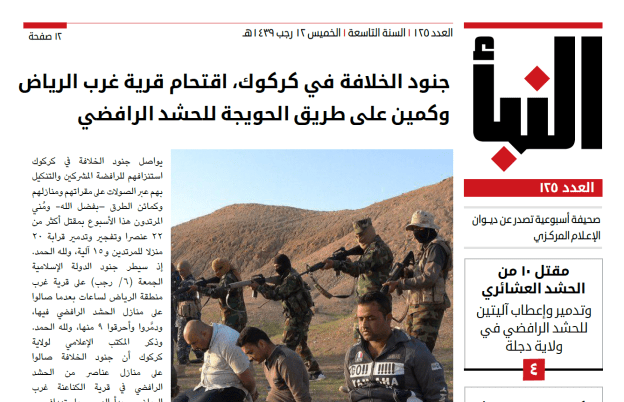
A-Naba 125
The Islamic State (IS) formally turned from statehood to insurgency last October. The 125th edition of Al-Naba, IS’s weekly newsletter, released on 29 March 2018, contained a number of indicators that the jihadists’ guerrilla warfare is gaining considerable steam—and that IS thinks it should gain more. Continue reading
By Kyle Orton (@KyleWOrton) on 22 April 2018

An audio statement by the official spokesman of the Islamic State (IS), Abu Hassan al-Muhajir,[1] was released today. The speech was entitled, “By their example, be guided” or “So From Their Guidance Take An Example”—drawn from Qur’an 6:30. Abu Hassan continued the themes that have been cropping up in IS messaging and propaganda for the last few months that have more firmly reoriented IS away from its foreign attacks campaign toward a more local focus in the Middle East. IS has been stressing its post-caliphate insurgency—concentrated at the present time in Iraq, but with notable operations in Syria—and its war for influence with regional rivals for Muslim loyalty, whether governments such as Egypt and particularly Saudi Arabia, or other Islamist movements like Harakat al-Muqawama al-Islamiyya (HAMAS) in Gaza. Continue reading
By Kyle Orton (@KyleWOrton) on 18 April 2018

Egyptian ruler Abdelfattah al-Sisi, Saudi King Salman, and President Donald Trump in Riyadh on 22 May 2017 (image source)
Two days ago, The Wall Street Journal reported that President Donald Trump has been exploring plans to replace American troops in the areas of Syria held by the Coalition partner force, the “Syrian Democratic Forces” (SDF), with troops from the Arab states. The problems with this proposal, even in the rudimentary form it is presented, are manifold. It also feeds into the broader problem of Trump’s inconsistent messaging about Syria—or, more precisely, his failed efforts to balance domestic messaging, which calls for what was once referred to as “nation building … at home”, and his foreign messaging that needs to emphasise U.S. constancy to see through the mission to defeat the Islamic State (IS) by, among other things, stabilising and reconstructing Syria. Continue reading

