Tag Archives: Jabhat an-Nusra

Yemen and Al-Qaeda’s Long-Term Strategy

By Kyle Orton (@KyleWOrton) on May 10, 2016

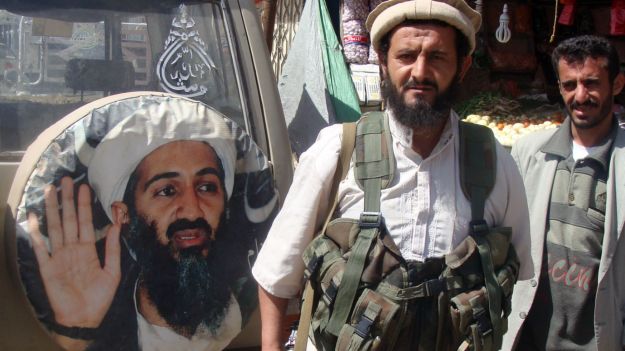
During al-Qaeda's occupation of al-Mukalla, Yemen, April 2015 to April 2016 (source)

During al-Qaeda’s occupation of al-Mukalla, Yemen, April 2015 to April 2016 (source)

In Yemen, at the end of last month, al-Qaeda in the Arabian Peninsula (AQAP) was cleared from al-Mukalla, their major urban stronghold. This ends a year of occupation and brings to a close what is effectively the third emirate or statelet AQAP has either set up or attempted to set up in Yemen since 2011. These projects offer some insights into al-Qaeda’s methodology in getting to an Islamic state, including its rebranding in opposition to the Islamic State (IS). Continue reading

Whose Side is America on in Aleppo?

By Kyle Orton (@KyleWOrton) on May 6, 2016

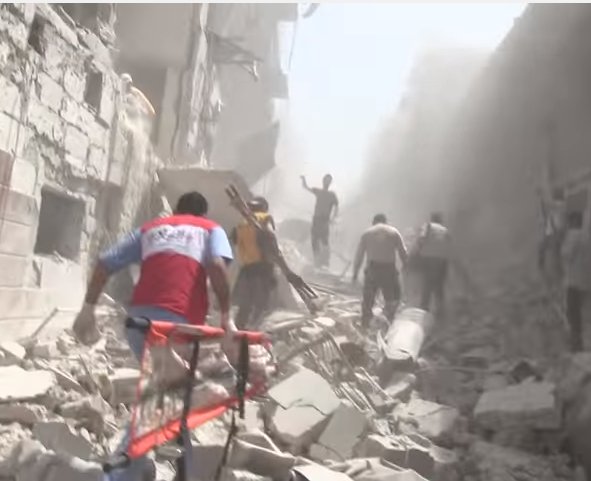
Aftermath of an airstrike by the pro-Assad coalition in Kalasa, Aleppo, 28 April 2016

Aftermath of an airstrike by the pro-Assad coalition in Kalasa, Aleppo, 28 April 2016

Whatever pretence there was left in Syria’s “cessation of hostilities” (CoH)—which was never more than a reduction in hostilities—enacted at midnight on 26/27 February is now at an end. Russia and the regime of Bashar al-Assad have never ceased attempts to militarily weaken the armed opposition and escalated with a concerted campaign of aerial bombardment against Aleppo City on 22 April. The insurgency fully mobilized in response on 5 May with a major offensive south of the city. The dynamics set in place by Russia’s intervention—the bolstering of the Assad regime and the strengthening of extremist forces in the insurgency—have been in full view with this latest crisis, as has the longer-term trend of the United States moving toward the position of Assad, Russia, and especially Iran in Syria. Continue reading

Assad Taking Palmyra Does Not Bring Syria Closer To Peace

By Kyle Orton (@KyleWOrton) on March 29, 2016

Originally published at Left Foot Forward. See also pieces in The International Business Times and The New Arab today on the same subject.

1

The ancient city of Palmyra and the inhabited adjoining town of Tadmor was conquered by the armed forces of Bashar al-Assad’s regime and a consortium of foreign Shi’a jihadists, some of them designated terrorist organizations, and all of them led by the Quds Force, the external operations wing of Iran’s Islamic Revolutionary Guard Corps (IRGC), itself a listed terrorist entity.

While the takeover of Palmyra by the Islamic State (IS) in May 2015 was considered by almost everybody a negative development, the pro-Assad coalition’s capture of the city under the cover of 900 indiscriminate Russian airstrikes has been called “a good thing” by no less an authority than the United States Department of Defence. It was little surprise among that Robert Fisk echoed this sentiment; it was more surprising that Boris Johnson did.

The basic case for regarding Palmyra’s fall to the pro-Assad coalition as a positive development is that, to quote Johnson, “no matter how repulsive the Assad regime may be … their opponents in [IS] are far, far worse,” and this defeat for IS moves Syria closer to peace.

There is nothing in this formulation that stands up to scrutiny. Continue reading

Assad Cannot Keep Europe Safe From the Islamic State

By Kyle Orton (@KyleWOrton) on March 24, 2016

Article published at NOW Lebanon

1

The long arm of the Islamic State (ISIS) has struck again. Tuesday morning, Zaventem airport in Brussels was hit by two suicide bombers and soon after a third man detonated at Maelbeek metro station, not far from the headquarters of the European Union. At least 31 people were slaughtered and around 270 were injured. Belgium has a long history as a hub of global jihadism and some of its citizens were key in forming ISIS’s statelet. In the wake of the attack, as Western governments look for ways to hasten the demise of ISIS, it will likely be said—again—that the quickest way to do that is by striking a devil’s bargain with the regime of Bashar al-Assad in Syria. From Assad’s role in helping ISIS lay its groundwork in Iraq even before the U.S. invasion to Assad’s help, by omission and commission, in nurturing ISIS in the years since the uprising against him began as a means of defeating the opposition to Assad’s deliberate incitement of a sectarian war, there is nothing that could be further from the truth. While Assad remains in power, ISIS will remain alive. Continue reading

History Repeated: Al-Qaeda Attacks Syria’s Rebels, The West Does Nothing

By Kyle Orton (@KyleWOrton) on March 14, 2016

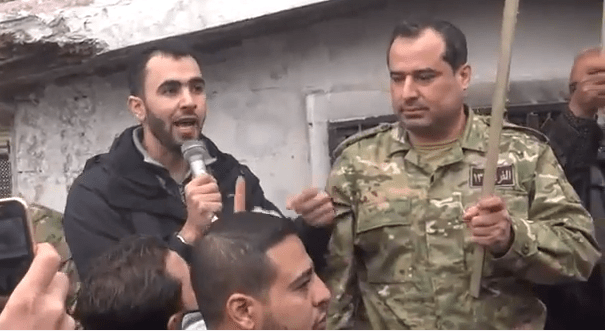
Journalist Hadi al-Abdallah and Division 13 commander Ahmad as-Saoud at an anti-Assad protest in Maarat an-Numan, March 4, 2016.

Journalist Hadi al-Abdallah and Division 13 commander Ahmad as-Saoud at an anti-Assad protest in Maarat an-Numan (March 4, 2016)

Jabhat an-Nusra, the Syrian branch of al-Qaeda, has driven one of America’s oldest allied rebel groups in Syria from its headquarters. Nusra began its assault on Division 13 on Saturday night and by yesterday morning Nusra had looted the rebels’ weapons and Division 13’s leader, Ahmad as-Saoud, was in Turkey. This is the third major such incident, and each time the United States has done nothing to rescue its designated proxies. The U.S.’s rapprochement with the Islamic Republic of Iran has set conditions in Syria that make it easier for al-Qaeda to spread.
Continue reading

Death of a Caliphate Founder and the Role of Assad

By Kyle Orton (@KyleWOrton) on March 10, 2016

Published at Middle East Eye.

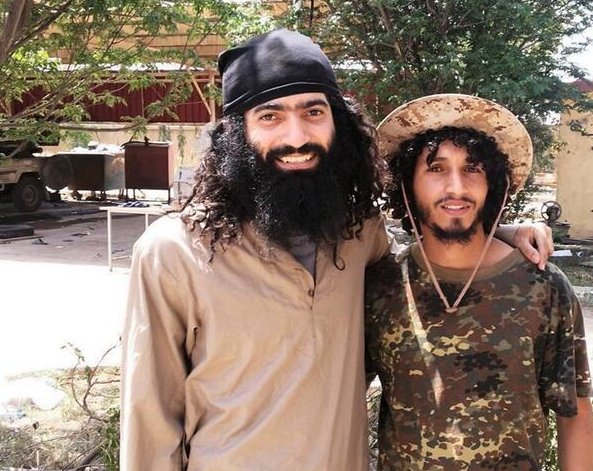
Amr al-Absi on the left

Amr al-Absi on the left

Amr al-Absi, one of the most senior Islamic State (IS) leaders, was killed in an airstrike on 3 March, according to reports on social media and by the SITE Intelligence Group. Al-Absi—better known as Abu Atheer al-Absi or just Abu al-Atheer—exemplified several key dynamics at work in Syria.

Atheer was among the jihadi-Salafists released by the regime of Bashar al-Assad at the beginning of Syria’s uprising in an attempt to make self-fulfilling the regime’s claim that the opposition were terrorists, and was also a seminal figure in making Syria so dangerous for journalists that it allowed Assad and IS to shape the coverage as if Syria was a binary choice between them.

Atheer is among the longstanding ultra-extremists who shape and define IS spiritually, and he was crucial in more concrete terms in IS infiltrating and expanding in Syria, particularly by bringing in foreigners who are among the most ideologically driven category of IS members. Continue reading

Partners in Terror: The Assad Regime and the Islamic State

By Kyle Orton (@KyleWOrton) on March 9, 2016

Article published at NOW Lebanon

1

Last week, a judgment in United States District Court in Washington, D.C., awarded nearly $350 million to the families of two Americans killed in Jordan in 2005 by the predecessor organization to the Islamic State (ISIS). The important point of the case was who the court found liable: the regime of Bashar al-Assad, currently presenting itself to the world as the last line of defense to a terrorist takeover of Syria. This case highlights a neglected history, which began in 2002, where the Assad regime underwrote ISIS and fostered its growth, first to destabilize post-Saddam Iraq and later Lebanon, and since 2011 to discredit and destroy the uprising against Assad in Syria. Continue reading

The Syrian Ceasefire Gives International Sanction to Russia’s War to Save Assad

By Kyle Orton (@KyleWOrton) on February 25, 2016

Article published at Left Foot Forward

1

At midnight on Friday a ceasefire began in Syria. It was billed as a prelude to negotiations that restart on 7 March, and which are supposed to lead to a political transition that will end Syria’s war. The chances of success on either front are slim.

This was the second February ceasefire attempt—the first, on 19 February, failed without even the pretence of starting. The pretence is still being maintained this time around, but the structural problems with the ceasefire’s design—namely that it allows the regime of Bashar al-Assad and his supporters to continue their war against the Syrian population, while restraining the opposition from defending itself—ensure that it will fail and the West’s purported allies within the opposition will be worse-off, both during the period of faux-ceasefire and afterwards.

The Geneva III peace process was a dangerously misconceived effort. After Russia’s intervention in Syria on 30 September the Assad regime was simply too strong. With no US willingness to change the balance of power inside Syria it meant that either the process was preserved and ‘peace’ was redefined as regime victory, or the process was surrendered and peace on some more humane terms was sought by empowering the rebellion to enforce such terms on the regime in future negotiations. The US chose the process.

The US’s emphasis on process over substance can be seen in all kinds of ways. Continue reading

The Sieges of Syria

By Kyle Orton (@KyleWOrton) on March 2, 2016
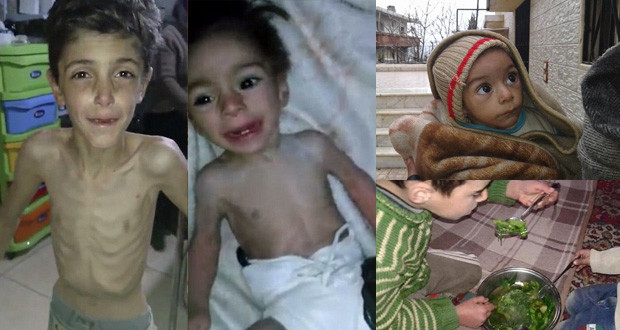
Starving children in Madaya

A website, siegewatch.org, has been set up that tracks the areas under siege in Syria. Siege Watch is a joint project of PAX, an organization that works in conflict zones to foster peace, and The Syria Institute, a non-partisan research centre directed by Valerie Szybala.

At the present time, according to Siege Watch, there are forty-six sieges operating in Syria, forty-three of them (93.5%) imposed by the Assad regime, two (4.5%) imposed by Jaysh al-Fatah, an insurgent coalition that includes Jabhat an-Nusra (al-Qaeda in Syria), and one (2%) by the Islamic State (IS).

Siege Watch also documents the severity of the sieges in three categories. Category one (C1) is the most severe: very little gets in even by smuggling and international aid deliveries are rare if at all; the risk of malnutrition is high. Category two (C2) sieges are porous enough for the black market and/or locals might have some access to locally-grown produce, but prices for basics are extremely high and residents are at “some risk of malnutrition/dehydration”. Category three (C3) sieges require smuggling to get food, but there is a consistent supply, even if home-grown. While risk of malnutrition is low in C3 zones, medical emergencies are likely because of attacks by besieging forces.

All six C1 sieges are imposed by the regime. Thirty category C2 sieges are operating: twenty-nine by the regime and one by IS. The regime is also operating eight C3 sieges and Jaysh al-Fatah is operating two C3 sieges. Continue reading

The Pretend Ceasefire in Syria

By Kyle Orton (@KyleWOrton) on February 25, 2016

This article was originally published at NOW Lebanon

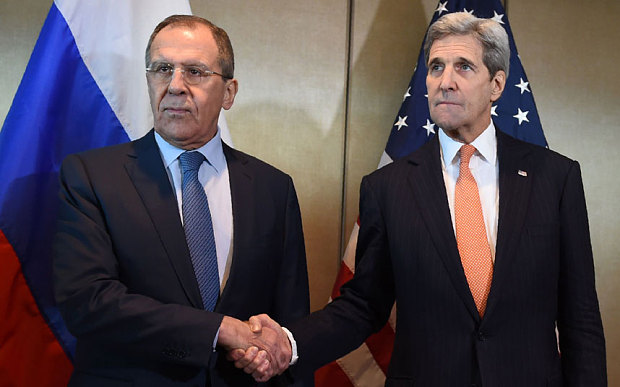
Kerry-Lavrov 'ceasefire'

The Syrian ceasefire, which the United States and Russia agreed on February 12 and which was supposed to take effect on February 19, had seemed to amount to little more than granting Russia a week of internationally-legitimated time to press its aggression against Aleppo and then blame the rebellion for breaking the ceasefire when the rebels refused to freeze the fighting on the new frontlines. Of course, it has turned out worse than that: with the agreement of another ceasefire on February 22, due to take effect on February 27 at midnight, Russia has had two weeks to make gains. Continue reading