By Kyle Orton (@KyleWOrton) on 19 October 2018
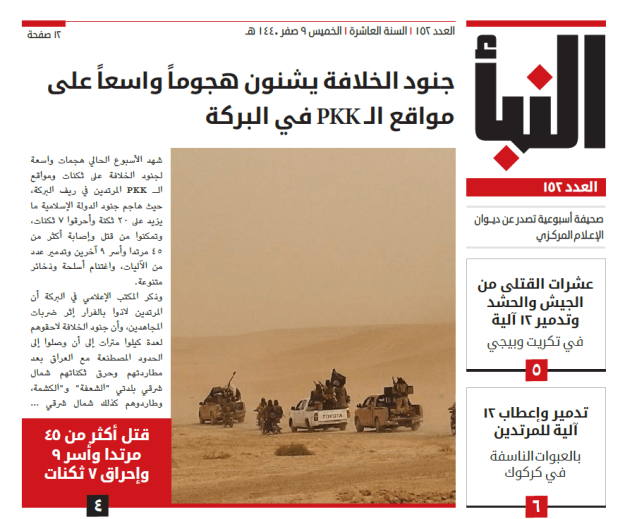
The Islamic State (IS) released the 152nd edition of Al-Naba, its weekly newsletter, on 18 October. Continue reading
By Kyle Orton (@KyleWOrton) on 19 October 2018
The Islamic State (IS) released the 152nd edition of Al-Naba, its weekly newsletter, on 18 October. Continue reading
By Kyle Orton (@KyleWOrton) on 29 August 2018

Two ideas that have become quite prevalent are that the Islamic State is defeated or on its way to defeat and that the Syrian war is winding down. Both are gravely mistaken. Continue reading
By Kyle Orton (@KyleWOrton) on 27 August 2018
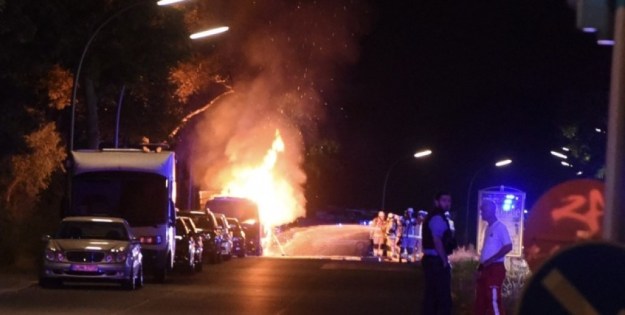
The German Council on Foreign Relations (DGAP, Deutsche Gesellschaft für Auswärtige Politik), a semi-official think tank on the model of Chatham House, to which it is affiliated, was subjected to an arson attack on 22 August. The claimants to the attack, the “Autonome Gruppen” (Autonomous Groups), framed it as in part a response to Turkey driving the Kurdistan Workers’ Party (PKK) out of the Efrin province of north-western Syria. Their message was amplified by PKK propaganda channels. A summary of the message and the original are below. Continue reading
By Kyle Orton (@KyleWOrton) on 21 August 2018
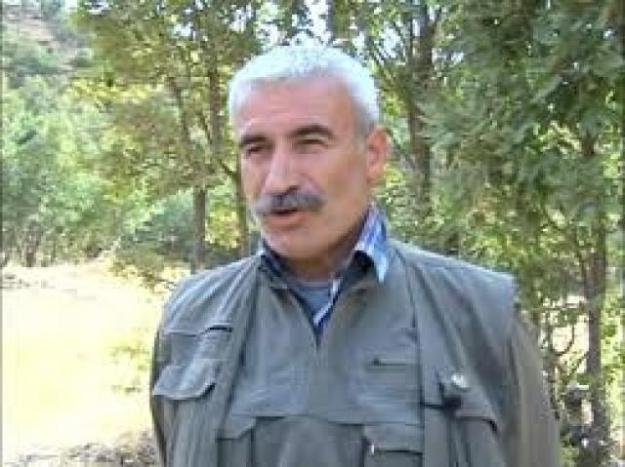
Ismail Özden (image source)
Turkey killed a senior operative of the Kurdistan Workers’ Party (PKK), the internationally-recognised terrorist organisation and narcotics trafficking entity that has been at war with the Turkish state since 1984, in Iraq last week. Turkey launched a wave of airstrikes against PKK targets in Syria and Iraq in April 2017 and for the last several months Ankara has been widening its campaign against the PKK outside Turkey’s borders, particularly in Iraq, where the PKK is not protected by the United States, as it is in eastern Syria. Having feinted in June toward an attack on the historic PKK headquarters in the Qandil Mountains—a somewhat symbolic target at this stage, with the bulk of the PKK’s leadership and resources in Syria—it appears the Turks have opted for a more targeted approach.
This operation underscores the continuance of U.S.-Turkey relations, and the mutual benefits of the relationship, even in its current damaged state, where both sides have a laundry list of legitimate grievances with the other. If a formula for normalisation can be found, the potential to contain and weaken some of the worst, most destabilising elements in the region, saliently the PKK and the Iranian regime, is within reach. Continue reading
By Kyle Orton (@KyleWOrton) on 17 August 2018

Funeral for the victims of the TAK/PKK terrorist attack on the Besiktas football stadium in Istanbul, December 2016. Photograph: Sedat Suna/EPA
The Kurdistan Workers’ Party (PKK), the separatist group in Turkey that is a designated terrorist organisation across much of the West, has always used a vast array of front-groups in the West to raise funds and recruit. After 9/11, with the advent of the War on Terror, the PKK switched tactics in the region to try to conceal its operations and avoid the “terrorism” label. This involved rebranding its operations in Iraq, Syria, and Iran, and setting up a special forces-style urban terrorism wing, the Kurdistan Freedom Falcons (TAK), to deniably carry out its most atrocious activities. The PKK’s rebranding has not been without success. In Australia, however, the government has refused to accept the PKK’s propaganda about TAK and lists it, quite correctly, as simply an alias for the PKK. Continue reading
By Kyle Orton (@KyleWOrton) on 24 July 2018
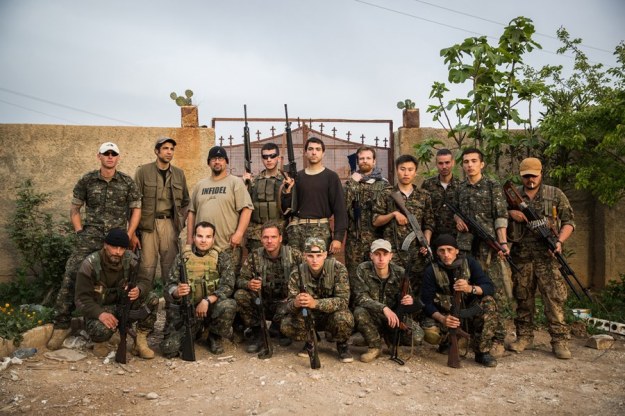
Foreign fighters with the YPG/PKK on the outskirts of Tal Tamr in northwestern Syria, 16 April 2015. UYGAR ÖNDER ŞİMŞEK / AFP / Getty Images
ABSTRACT: The Kurdistan Workers Party (PKK) operates under the names of the Democratic Union Party and the People’s Protection Units in Syria. The PKK is registered as a terrorist group by most Western governments, the European Union and Turkey, where it originated as a separatist organization. Nonetheless, the YPG has been the partner of the United States-led coalition in Syria against the ISIS. The strengthening of the YPG/PKK and its political messaging has brought in a flow of western foreign fighters. Some of these fighters are now returning to their homelands with indications that they are bringing security problems with them.
Article published in Insight Turkey.
By Kyle Orton (@KyleWOrton) on 7 June 2018
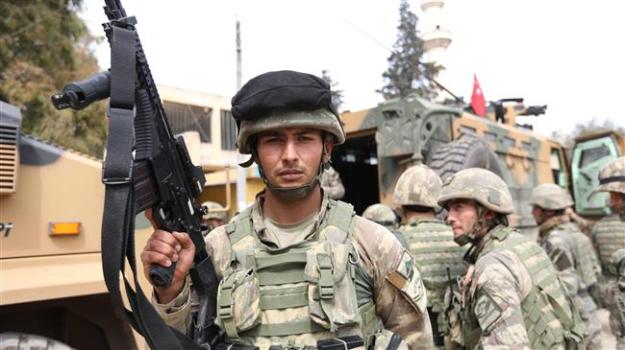
Turkish soldiers and their rebel dependencies in Efrin, 18 March 2018 // AFP
On June 24, for the first time in 15 years, there seems a possibility, however faint, that elections in Turkey will end in defeat for President Recep Tayyip Erdoğan.
It is an uphill battle, not least because of the ongoing state of emergency after the 2016 attempted coup, which has exacerbated the systemic biases against Erdoğan’s political opponents. But the Turkish opposition has managed to overcome its own fractiousness and has a strategic game-plan that makes sense. One card Erdoğan still has to play is foreign policy, and there are signs in Syria and Iraq of advantageous news to come. Continue reading
By Kyle Orton (@KyleWOrton) on 26 April 2018
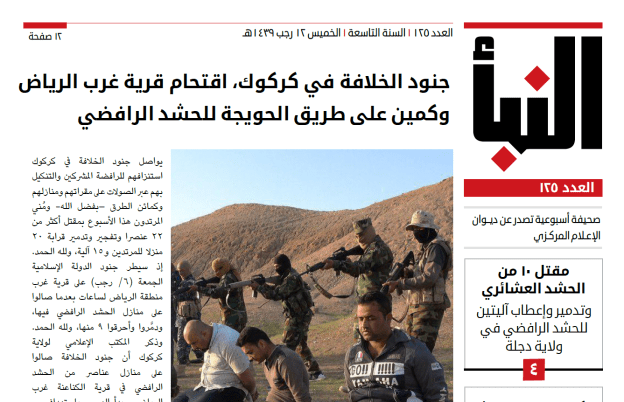
A-Naba 125
The Islamic State (IS) formally turned from statehood to insurgency last October. The 125th edition of Al-Naba, IS’s weekly newsletter, released on 29 March 2018, contained a number of indicators that the jihadists’ guerrilla warfare is gaining considerable steam—and that IS thinks it should gain more. Continue reading
By Kyle Orton (@KyleWOrton) on 23 April 2018
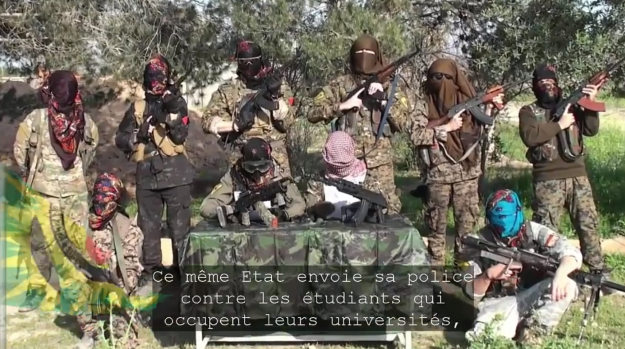
The Facebook group for the Antifascist Forces in Afrin (AFFA) posted a video message and transcript yesterday, which was dated 12 April, threatening terrorist attacks against two NATO states, France and Turkey. AFFA, announced in February, comprises French-speaking Left-wing extremists, who are part of the foreign fighter brigades within the Kurdistan Workers’ Party (PKK) command structure in Syria. A rough translation of the statement (and the original) are reproduced below, with the key sections highlighted in bold. Continue reading
By Kyle Orton (@KyleWOrton) on 22 March 2018
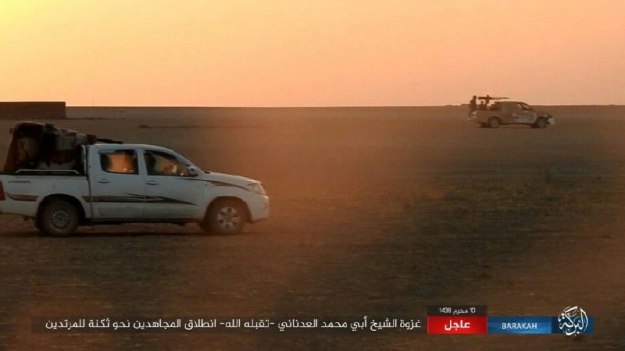
The first leader of the Islamic State (IS) after it was declared in 2006, Hamid al-Zawi (Abu Umar al-Baghdadi), gave a series of twenty-three speeches until he was killed in April 2010. Al-Zawi’s speeches laid out the strategic and ideological vision of the movement. The fifth speech, “And If You Cease, It Will Be Better for You” or “Should You Desist [in attacking the Islamic State], Then That Is Better for You”, was given as an audio statement on 8 July 2007. An English transcript of the speech was released by IS’s Al-Furqan Media and is reproduced below with some important and interesting sections highlighted in bold. Continue reading

