Tag Archives: Taha Falaha

Is This the Beginning of the End for the Islamic State?

By Kyle Orton (@KyleWOrton) on September 8, 2016

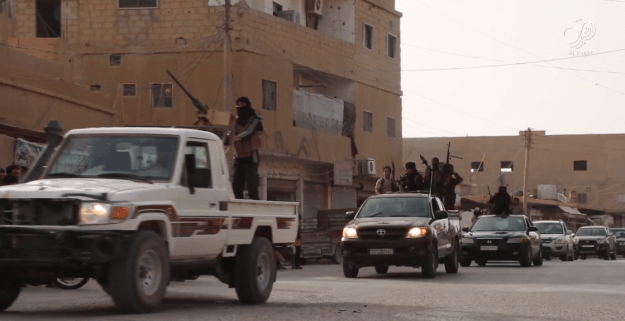
Screenshot of an Islamic State video displaying captured materials from the New Syrian Army, 27 July 2016

Screenshot of an Islamic State video displaying captured materials from the New Syrian Army, 27 July 2016

City AM asked for contributions on the above question, and I took the “no” side. As can be seen from the below, however, this was very much a matter of interpretation since both sides gave roughly the same answer: the Islamic State’s statelet is coming to an end, but the group will survive, morphing back into a prior stage.  Continue reading

The End of the Islamic State by Christmas?

By Kyle Orton (@KyleWOrton) on September 5, 2016

1

Last week it was reported by The Daily Beast that United States defence and political leaders believe they can at least begin the operation to remove the Islamic State (IS) from its Iraqi capital, Mosul, before President Barack Obama leaves office on 20 January 2017. This seems unlikely. More to the point, if it is true it is highly dangerous, both in the short-term and especially over the long-term. Continue reading

The Fall of the Islamic State’s Terrorism Director

By Kyle Orton (@KyleWOrton) on August 31, 2016

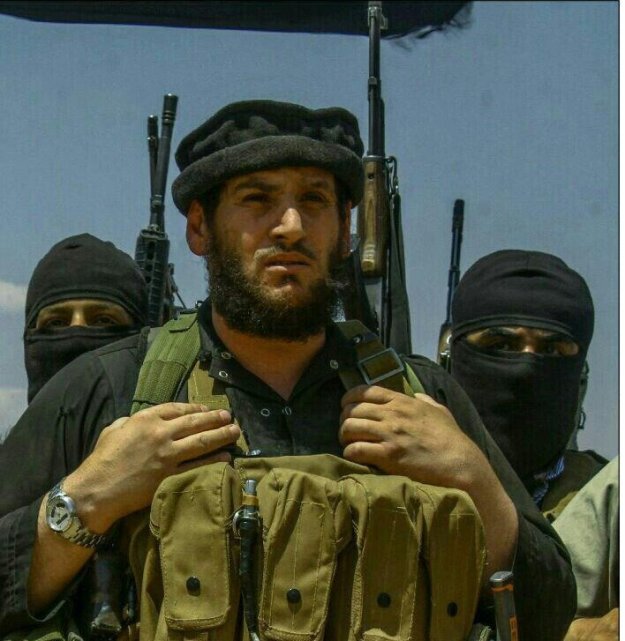
Taha Falaha (Abu Muhammad al-Adnani) in al-Naba

Taha Falaha (Abu Muhammad al-Adnani) in al-Naba

The Islamic State confirmed yesterday, via their “news” agency Amaq, that Taha Subhi Falaha had been killed in Aleppo. Falaha had gained global notoriety under his kunya, Abu Muhammad al-Adnani, after his September 2014 speech calling on Muslims in the West to “kill any disbeliever” in range, and to at least “spit in his face” if one was unable to find a knife or a car or a rock to do murder with.

Falaha was often referred to as the spokesman of IS, and so he was—the voice of the organization since 2011. He was also from the first generation of the organization, recruited before the invasion of Iraq, one of the few within the organization of that stature. But, as I explained recently in a paper for the Henry Jackson Society that compiled what is known of IS’s leadership, Falaha was much more than a figurehead.

Falaha was the governor of IS-held areas in Syria and the man who oversaw the external terrorist attacks. By now he was the caliph’s effective deputy. Heretofore, IS’s impressive bureaucracy has managed to replace individuals with minimal perturbation. IS will experience few perturbations quite like this.
Continue reading

Al-Naba’s Obituary for Abu Muhammad al-Adnani

By Kyle Orton (@KyleWOrton) on August 31, 2016

The United States reported yesterday that it had killed one of the most important officials in the Islamic State (IS), Taha Subhi Falaha, better known as Abu Muhammad al-Adnani. As the Pentagon statement noted, Falaha “served as principal architect of [IS’s] external operations and as [IS’s] chief spokesman.”

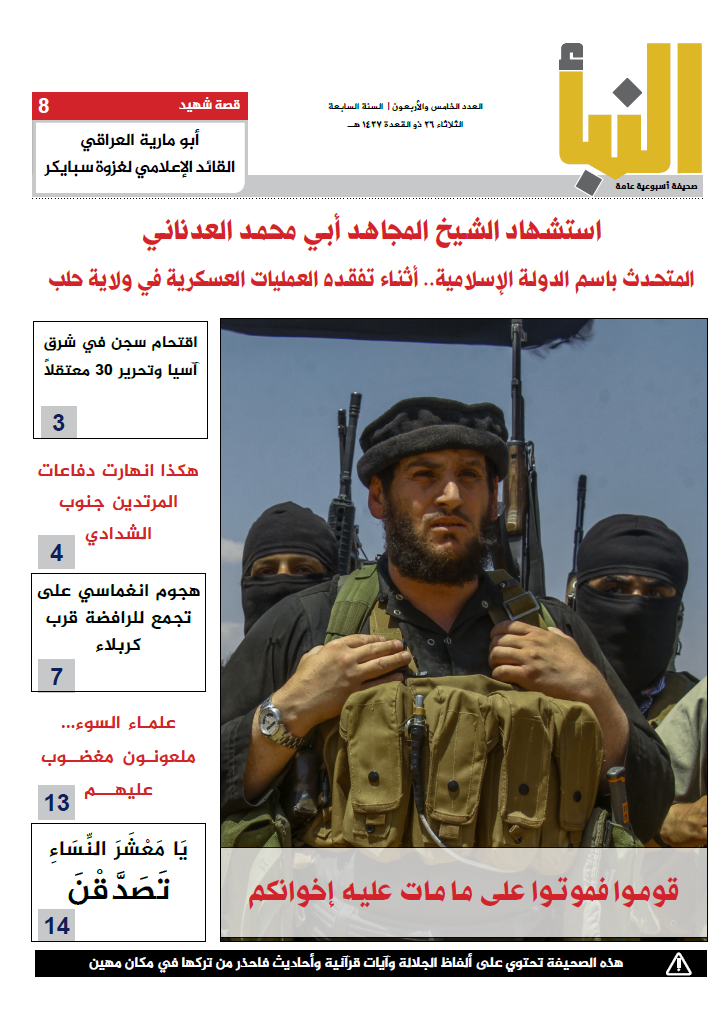
Within hours, IS issued the forty-fifth edition of its newsletter, Al-Naba. The cover of Al-Naba 45 (above) featured a photograph of Falaha, only the second one of him officially released by IS. The second page contained the only other official picture we have of Falaha—published in the second edition of Dabiq magazine on 27 July 2014—and a brief obituary. And the main editorial on page three was framed around Falaha.

Continue reading

Looking At the Islamic State’s Past, Seeing its Future

By Kyle Orton (@KyleWOrton) on August 27, 2016
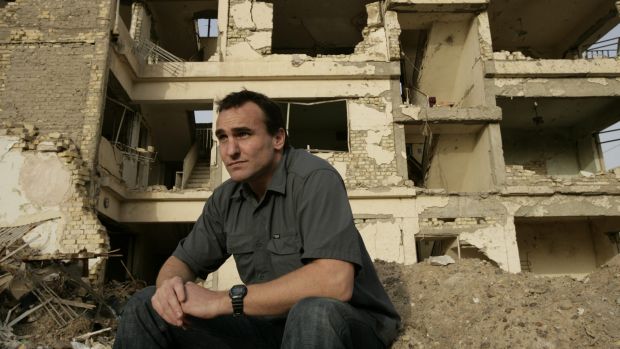
Michael Ware

Michael Ware

Only the Dead documents the experience of Michael Ware, an Australian journalist who arrived in Iraq in early 2003 and spent eleven months-per-year there for seven years. Ware made contact soon after the fall of Saddam Hussein with those resisting the new order, at a time when the Americans were struggling to map such forces.

Ware established communication with the more nationalist-Islamist forces. Once in that milieu, the globalist jihadists, who were working in the shadows, a small, foreign-dominated force towards which even many insurgents were guarded, found him. The leader of the jihadists, Ahmad al-Khalayleh, became something of an obsession for Ware as he stepped onto the world stage with his gruesome tactics as Abu Musab al-Zarqawi. Zarqawi, the “Shaykh of the Slaughters,” would found an organization that became a movement and then burst Iraq’s frontiers, known to us now as the Islamic State (IS).

In tracking Zarqawi and his men, Ware presents some incredible footage and gives some snapshots from the fascinating days, whose effects we are all still feeling, when the Iraqi insurgency was taking root. Continue reading

Governing the Caliphate: Profiles of Islamic State Leaders

By Kyle Orton (@KyleWOrton) on July 29, 2016

A new report by me for the Henry Jackson Society (accessible here) is out today. It looks at those governing the statelet held by the Islamic State in parts of Syria and Iraq, and those who are orchestrating IS’s foreign terrorist attacks, including in Europe. The wave of attacks over Ramadan has been described as a “lone wolf” epidemic by many, but IS is coordinating this mayhem through its Amn al-Kharji, foreign intelligence service, and the report looks at who staffs this institution and the dangers of writing-off these attacks as the work of lone radicals with no connection to each other or IS.  Continue reading

‘Lone Wolf’ Attacks in Europe Are Nothing of the Sort

By Kyle Orton (@KyleWOrton) on July 29, 2016

Published in The Telegraph

Muhammad Riyad (Wurzburg) [top left], Mohammed Daleel (Ansbach) [top right], Adel Kermiche (Normandy) [bottom left], Abdelmalik Petitjean (Normandy) [bottom right]

Since early 2014, at the latest, the Islamic State (IS) has been plotting terrorist attacks in Europe. There has been a tendency, including during the wave of attacks in the last month in Europe, to favour the “lone wolf” explanation for IS-claimed terrorist attacks, where the killer’s only connection to IS is to be “inspired” by their online propaganda, but in reality the institutions of the caliphate stand behind this campaign.

The infiltration of IS’s enemies for the purposes of espionage and terrorism, whether this is government-held areas of Iraq and Syria or Western Europe, is led by Amn al-Kharji, the foreign service within IS’s sophisticated intelligence apparatus, as explained in a new report by The Henry Jackson Society. Continue reading

Long-Term Islamic State Operative Carries Out Suicide Bombing in Ansbach

By Kyle Orton (@KyleWOrton) on July 27, 2016

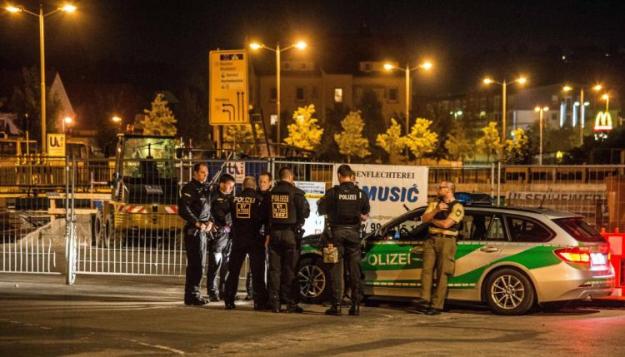
The German police secure the area surrounding the crime scene after the suicide attack in Ansbach

The German police secure the area surrounding the crime scene after the suicide attack in Ansbach

In Ansbach in Bavaria State, southern Germany, a suicide bomber blew himself up at a wine bar not far from the Ansbach Open music festival during the final concert around 22:10 on the evening of 24 July 2016. Fifteen people were injured, three gravely. The suicide-killer, who had wandered around the entranceway with a backpack, was soon identified as a twenty-seven-year-old Syrian refugee, Mohammad Daleel, who came to Germany in 2014. Daleel “lived in an old hotel that was converted into a refugee shelter”. Daleel had been rejected as an asylum seeker in Germany, where he was known to the authorities for petty criminality. Daleel was scheduled to be deported to Bulgaria within thirty days, though the deportation had been temporarily suspended while Daleel underwent a medical evaluation, and had been placed in a psychiatric clinic. Daleel had allegedly tried to commit suicide twice before the bombing. Continue reading

The Caliphate at Two

By Kyle Orton (@KyleWOrton) on July 16, 2016

A version of this article was published at Radio Free Europe/Radio Liberty, “Under the Black Flag

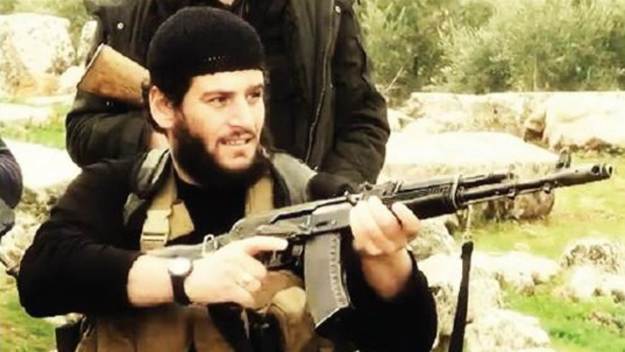
Islamic State's spokesman and Syrian governor, Taha Subhi Falaha (Abu Muhammad al-Adnani)

Islamic State’s spokesman and Syrian governor, Taha Subhi Falaha (Abu Muhammad al-Adnani)

The extremist group now known as Islamic State (IS) first claimed statehood, with clear pretentions to a new caliphate, in 2006—and eight years later made it explicit.

“Now the dream has become a reality,” Taha Falaha (Abu Muhammad al-Adnani) said in his speech on June 29, 2014, declaring that the territory IS held in Syria and Iraq constituted the rebirth of the caliphate. “The State will remain.”

Two years later, this looks like an unsafe proposition. Continue reading

The Islamic State’s Newsletter Prepares for the End of the Caliphate

By Kyle Orton (@KyleWOrton) on June 9, 2016

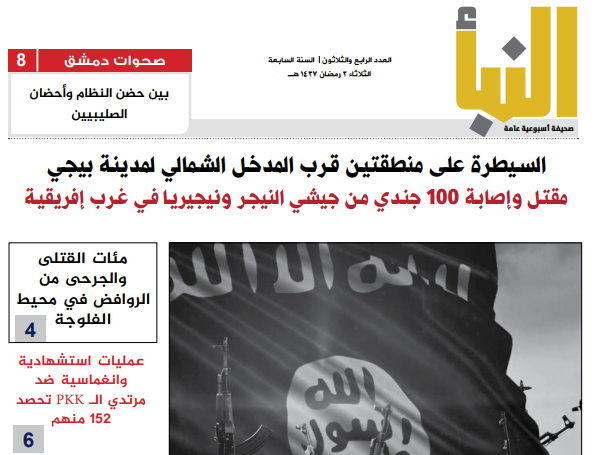
First page of the 34th edition of the Islamic State newsletter, al-Naba

The Islamic State’s (IS) spokesman, Taha Falaha (Abu Muhammad al-Adnani), gave a speech on 21 May that prepared the ground ideologically for the end of IS’s statelet and a return to the deserts where the organization survived after the surge-and-sahwa drove it from the urban zones of Iraq in 2007-08. Al-Naba, IS’s newsletter, is printed within the caliphate on Saturdays and distributed online on Tuesdays. Al-Naba’s 34th edition, published within the territories on 4 June and put on the internet on 7 June, echoed Falaha’s theme that the caliphate was a cause that would outlast the loss of territory since it was now embedded in the hearts of a generation of Muslims, and al-Naba also took a swipe at al-Qaeda and jihadi groups like Ahrar al-Sham that believe the path to an Islamist polity is bottom-up, through the building of popular consent. The Naba editorial is reproduced below with some important sections highlighted in bold.
Continue reading