By Kyle Orton (@KyleWOrton) on 3 October 2017
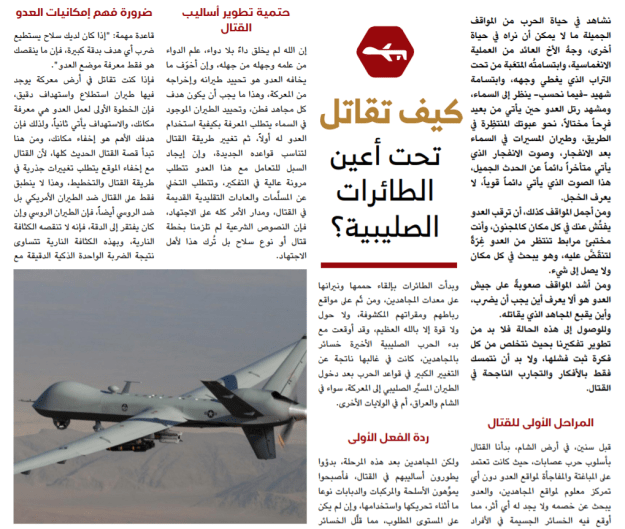
Hassan Hassan wrote in The National on 20 September 2017 about the Islamic State (IS) having issued a public statement on its adaptions to the U.S.-led Coalition air campaign against it in Iraq and Syria. This statement appeared on pages eight and nine of the ninety-seventh issue of Al-Naba, IS’s newsletter, on 14 September. A rough translation is republished below.
* * * * *
How Do You Fight Under the Eyes of the Crusader Aircraft?
In the life of war, we witness beautiful moments that we could never see in any other life: the face of the brother returning from the inghimasi operation, and his tired smile beneath the dust covering his face; the smile of a martyr—as we reckon—looking up at the sky; the sight of the enemy convoy coming from afar, cheerful and boastful, heading straight towards the IED you planted on the road; the drones circling in the sky after the blast; and the sound of the explosion, which always comes late, delayed from the beautiful moment that caused it, arriving with force and knowing no shame.
Among the most beautiful moments to watch, too, is the enemy searching for you everywhere like a madman, while you are hidden, lying in wait, watching for a lapse from the enemy to pounce upon him. He scours every place and finds nothing.
Among the most difficult moments for the enemy army is when he does not know where to strike, or where the mujahid who is fighting him is hiding.
To reach this state, we must refine our thinking so that we rid ourselves of every idea proven to have failed, and we hold fast only to the ideas proven successful by experience in combat.
The Early Stages of Fighting
Years ago, in Syria [Bilad al-Sham], we began fighting using the method of guerrilla warfare [lit. “warfare of the bands” (harb al-isabat)], which relied on ambushes and surprise attacks on enemy positions without any known fixed positions for the mujahideen. The enemy [i.e., Bashar al-Asad’s regime] searched for its opponent and could find no trace of them, resulting in the infliction of heavy losses on them in terms of both personnel and military equipment.
After the land was purified of the filth of the Nusayris and their followers, and after a geographical separation from the enemy [was established], the method of combat shifted from guerrilla warfare, which relies on concealment and ambushing the enemy, to the tactic of direct confrontation, establishing ribat lines [fortified ‘border’ watch posts or sentry points] and positions for the mujahideen. From that point, the gradual attrition [or exhaustion or depletion: istinzaf] of the mujahideen’s manpower began, due to the enemy’s possession of superior strength in firepower. We held to this method for a long time in fighting against the Nusayris and the apostate Sahwa forces.
Then came the battles in Ayn al-Islam [Kobani], and our method of fighting was as usual with the Nusayris and others: deploying heavy and medium firepower and [military] equipment, without taking any consideration for the intervention of American aircraft with precision capabilities. It was only a matter of days before armed drones began to fly over the mujahideen’s positions in the countryside and outskirts of Ayn al-Islam. The aircraft began to drop their lava and fire on the locations of the mujahideen’s equipment, then on their ribat [frontline] positions and exposed headquarters—and there is no power and might except with God the Almighty. At the start of this latest Crusade, losses were inflicted on the mujahideen, resulting for the most part from great changes in the terms of war after the entry of the Crusader aircraft into the battle, whether in Syria, Iraq, or other wilayat [provinces (of the Islamic State)].
First Reaction
However, after this stage, the mujahideen began to develop their tactics. They started to camouflage [or disguise or conceal: al-tamwih] their weapons, vehicles and tanks while moving and using them. Even if this was not up to the required level, it was done in a way that clearly reduced casualties. Thankfully, the soldiers were able to train in new combat tactics to counter the presence of the Crusader jets. Some combat groups have mastered these methods, while others have not been trained as required.
We write this series of articles to alert the Islamic State soldiers to some of the methods used by the enemy in combat to trap the mujahideen, as well as to share some of the methods used by the mujahideen that have succeeded in evading the presence of the warplanes while fighting. In fact, some of the combat methods that were recently experimented with under the supervision of some of the military experts proved that the high-precision of the crusader planes in hitting their targets can be turned into a major weak point that paralyses the enemy’s own ability to fight, or can be manipulated to have the enemy fight themselves, with the success granted by God, the All-Knowing..
The Inevitable Necessity of Developing Combat Methods
God did not create any disease without a cure—those who know it, take it; those ignorant of it, do without it. What the enemy fears the most is the neutralisation of its aircraft, and this must be the goal of every mujahid. Every fighter must understand how the enemy uses the sky, then change their methods to adapt to these new rules. Finding ways to deal with this enemy requires significant imagination, and a departure from traditional assumptions and old habits of warfare. The whole matter is grounded in ijtihad [independent reasoning in jurisprudence] since the legitimate texts do not obligate any specific battle plan, nor type of weapon.
As soon as the mujahideen began to ijtihad to disguise its artillery and vehicles at the end of the battle for Ayn al-Islam, the enemy likewise began to make alterations in order to maintain the effectiveness of their aircraft—virtually the only weapon that has proven effective in the latest Crusader campaign. The enemy increased the number of reconnaissance aircraft in the skies, and their thermal imaging can locate weapons when they are used. When artillery was fired, its location was easily determined and targeted. At the time, many mujahideen slept on the rooftops of buildings, not knowing thermal imaging depicts them and their weapons. There were losses in that period caused by this lack of knowledge of how the Crusader aircraft operates and its capabilities.
The Need to Understand the Capabilities of the Enemy
An important rule: “If you have a weapon that can hit any target with great precision, all you need to know is the position of the enemy.”
So if you are fighting on a battlefield where there is aerial surveillance and accurate targeting by aircraft, the enemy’s first step is knowing your location and the second is targeting. Therefore, your primary goal is to hide your position. And here begins the whole story of modern warfare, because fighting while hiding your location requires drastic changes in the methods of warfare and planning. This not only applies to combat against American aircraft, but also Russian ones. Russian aircraft, though lacking in accuracy, do not lack in firepower capacity—and with such firepower, the result of one smart and precise strike equals that of a thousand dumb and imprecise strikes. Regardless, the basic principle is always the same: “Fight from a location unknown to the enemy, and change place immediately if the enemy discovers it.”
The Enemy Also Evolves
When the soldiers of the Islamic State began to hide their artillery and themselves from the enemy’s air power, the enemy began in turn to develop methods of avoiding losing its advantage in air superiority by increasing the number of aircraft operating. The enemy also noticed a new element to the war. The apostate PKK used to always try to hold its ground, not wanting to lose a single village. If they got raided or lost territory, they would send reinforcements to retake it. The mujahideen would inflict heavy human losses on them, and at that time the aircraft were not operating efficiently against the mujahideen.
The mujahideen had also made this same mistake, by holding on to some territory without inflicting any attrition [nikaya] on the apostate militia. Then the Crusader enemy began to use special forces to take advantage of their air advantage against the mujahideen, coming down to the ground with a greater presence of Americans to lead and direct the stupid leaders of the apostates [i.e. YPG/PKK]. Here, a new chapter of modern warfare began.
How Do They Fight Us?
The special unit that advances ahead of the apostate PKK forces and the Crusader troops is not a combat force in any real sense. Rather, it is a guidance system to direct the airstrikes—its sole purpose is to call in the airplanes and tell them exactly where to hit. That is why the vanguard of the apostate forces carries only light weapons. Their real weapons are their communications gear and laser-designation devices. The main purpose of their firearms is to provoke the mujahideen into coming out [from their hiding places] and engaging.
The apostate forces always carry out deceptive advances, shooting only to draw the mujahideen out of their hiding places to return fire at the apostate forces, allowing the air force to detect and target the mujahideen. Alternately, the apostates give the coordinates that they want the aircraft to bombard.
A member of these forces was recently captured with only two magazines [of ammunition] for his rifle. When asked about this, he said that they were not combat forces; they were only advancing so they could determine the places where the mujahedeen were located, which does not require much ammunition.
Therefore, the greatest mistake would be for the mujahideen treat them [the YPG/PKK] as a combat force. They are weak forces used by the Crusaders as a bait for the fish. The mujahid must never take the bait. The best way to proceed is for the mujahid not to reveal his position to the enemy until the enemy is within shooting range and then, and only then, should the mujahideen fire on an enemy target, before immediately changing location.
In order for this to succeed, it is essential to be disciplined and not to fall into the trap of the enemy, which tempts the mujahid to shoot from a long distance, and to prepare the new places of ribat in advance, camouflaging their entrances, so that there can be a smooth transition to new defensive positions.
The enemy method that we have described, which we are fighting, is today called “reconnaissance by fire” [al-istitla al-nari]—a term that means firing before the enemy position is identified with the intention of getting a response that allows you to determine and target their location. The mujahid involved in these modern wars must understand this trick well, because understanding it is the key to success in modern warfare, by God’s grace.
In modern warfare, with precision weapons in play, everyone tries avoid direct engagement in order to minimize losses. Therefore, reconnaissance by fire is used extensively. It is a trick used by everyone to get the coordinates of the enemy and then target them with artillery, airstrikes, or even a martyrdom attack. Knowing the enemy’s location is the most important piece of military information about him. There is no successful military action without this step.
The Nusayri enemy’s reconnaissance by fire is conducted by means of rapid mock invasions to identify the size of the [insurgent] forces present and the types of weapons they have to prepare the appropriate size of the force needed to attack the area.
As for the soldiers of the Islamic State, they used to send small drones made of polystyrene [filleen] into the enemy territory, then lower their altitude so they could be heard by the enemy soldiers. The shooting [from the regime soldiers at the drone] was enough to know everything about the enemy—their locations and their weapons—which helps in preparation for a coming invasion or to repel a hostile force that has advanced into our areas.
This type of reconnaissance does not require firing at the enemy, but only alerting him to the danger. The apostates will come out of their holes and begin shooting towards the small drone that is filming all of them and their weaponry, which can be identified from the size of the muzzle flash and from the sound. The tactic never fails because, even if the enemy knows about it, their soldiers are mostly not trained to hide, and do not know how much it hurts them to give away the types and locations of their weapons on the battlefield.
How Do We Fight Them?
So if you, my mujahid brothers, have come to understand this type of military trickery, then you must not fall into this old, repeatedly-used trap, and hold fast to the golden rule of a war against air power or any precision weapons: “The enemy’s objective is to know where you are, and the mujahid’s objective is to hit the enemy without revealing his location”.
An article has already been published in al-Naba about camouflage and the different types of imaging, and how to conceal oneself from them.
Therefore, the plan for ribat should be clear. The location of the mujahideen must stay hidden and there must be no negligence in concealing ribat locations. Rather, the number of times food is supplied should be reduced and movement between ribat points should be eliminated. Preparing each ribat point so that the mujahid does not need to leave it and other measures along these lines are among the most important means by which the mujahideen can neutralise the role of air power in the battle. Courage alone is not the solution for combat under the warplanes. Bravery has to be combined with the proper precautionary measures.
It is a fatal mistake in a battle under aerial bombardment to gather large numbers of fighters at advanced ribat points near the lines of contact with the enemy. Whether the number is large or small does not matter; the enemy is always waiting for these obvious targets so it can pave the way for progress on the ground. This method must not be used in defence. After the entry of the aircraft into the battle it became obsolete. What is effective is keeping the positions of the defending force hidden, at least until the enemy gets very close, so the aircraft cannot target it. Engagement at close-quarters prevents the warplanes intervening because the mujahideen and the enemy are mixed together. It takes time to tell apart the mujahideen and the enemy, time the warplanes will not have if the mujahideen are constantly moving.
One of the biggest mistakes in fighting under aerial surveillance is to look at the ground only and to forget that the war is not only on the ground, and that the enemy has the ability to target you from above. For example, if we besiege enemy forces somewhere, like a building or a house, and then the enemy starts coordinating with the aircraft through the communications devices they carry, they will be able to target the mujahideen despite the small distance between them and the enemy. In such situations, the mujahid must know that if he cannot immediately strike the besieged enemy, he must leave, go into hiding, and reappear to attack from a new place. A siege will not be to his advantage. If he remains exposed, he will be destroyed from the air. In these cases, the aircraft knows the location of the soldiers it wants to rescue, and it will strike anything else.
Finally, remember this rule: “They do everything they can to discover your location; do whatever you can to hide from their eyes”. Praise be to God, Lord of the Worlds.
* * * * *
In Al-Naba 98, released on 21 September 2017, there was a follow-up article to the above, appearing on page 12:
How to Fight Under the Eyes of the Crusader Aircraft (2)
In the last article of this series, we talked about the importance of al-tamwih [camouflage, disguise, concealment] and hiding the positions of the mujahideen and their movements from the eyes of the enemy, especially the aircraft equipped with the latest surveillance and targeting capacities. In this installment, we will present unconventional examples of camouflage that rely more on motion than stillness. These are drawn from the experiences of your brothers on the battlefronts in the path of God).
Camouflage [Al-Tamwih]
While the camouflage of our forces serves to conceal them from the enemy, decoy targets work to exhaust [istinzaf] the enemy and reduce its confidence in the information it obtains [or gathers]. The result of using both methods together is a reduction in the enemy’s combat effectiveness.
Infiltration Camouflage
In every infiltration operation, it is essential to camouflage the bodies of the soldiers and their weapons. Without effective camouflage, the infiltrator cannot reach his target—unless God wills otherwise. Camouflage takes various forms: sometimes it is done by evading surveillance [i.e., not being detected at all], while other times it involves appearing as the enemy until you get close enough to launch an attack [i.e., letting the enemy see you, but presenting as friendly forces]. War is deception, and in such cases a method must be devised for our soldiers to distinguish themselves so they do not mistakenly attack one-another due to their resemblance to the enemy.
Concealing Weapons
Ribat requires keeping heavy weapons ready at points close to the lines of contact with the enemy, and this in turn necessitates concealing these weapons so they are not targeted by the warplanes. Simply covering the weapons is not enough. One must conceal the muzzle flashes that emerge from the barrels when firing, as a flash can be detected easily and precisely by thermal imaging from a very long way away, unlike sound or vibration.
Here is a funny story: during the battles of Ayn al-Islam [Kobani], the brothers hid a tank inside a house. It would fire at the enemy intermittently while remaining well-concealed. Despite the intensity of the Crusaders’ air operations, they were unable to pinpoint the tank’s location precisely. After the tank had exhausted the enemy with its strikes, the Americans began targeting the entire area, house by house, until they finally managed to hit the tank. Do you understand now why Ayn al-Islam was reduced to piles of rubble? Do you understand how you can drive your enemy to madness?
There are many techniques for concealing weapons, the most important of which are flash suppressors of various sizes. A suppressor [silencer] is also a means of concealing a weapon. The nature of today’s battles requires us to conceal every kind of weapon as much as possible. Firing heavy weapons from beneath a roof can hide the muzzle flash from most angles, and this is possible on many battlefields. Often, a car garage can be found that allows the weapon to be positioned in a way that hides the flash from aircraft when firing.
As for portable machine guns, there are flash suppressors available for each type. Although their size can be a bit inconvenient, their benefit is great.
Defensive Camouflage (Ribat) [Tamwih al-Difa (Al-Ribat)]
One of the most important things to conceal and camouflage is the defensive ribat points. The best way to do this is to add fake ribat points, and occasionally shoot at the enemy from these decoy positions when the warplanes are absent. This camouflage tactic will confuse the enemy and reduce their confidence in the intelligence they gather. As for the real ribat points, it is imperative they be kept hidden, whatever it takes—even if it means giving up a food delivery truck, which is so often what exposes our positions. What is more important: preserving our defensive lines or eating hot food? Would a mujahid accept being killed just because he insisted on good food? By God, no. A mujahid must be willing to endure stored rations in exchange for keeping his position hidden from the warplanes.
Food waste and bags must not be thrown near the ribat position. In desert environments, water tanks must also be well camouflaged against thermal imaging and placed at a good distance from the ribat point. The tanks should be large, so they only need refilling at infrequent intervals.
In many cases where the ribat is in caves or grottoes [i.e., artificial caves, magharat], multiple entrances must be dug, camouflaged carefully, and covered with trees or other materials to protect them. Also, gatherings in front of these cave entrances must be avoided, as the enemy’s discovery of a ribat area will lead to intensified surveillance of that zone and constant targeting with random or cluster airstrikes. Parking vehicles near these entrances is a serious violation of protocol that must be dealt with strictly and decisively.
Communication antennas must also be placed as far as possible away from where the brothers are located, and hidden from thermal imaging. These antennas become quite hot due to signal transmission and are therefore clearly visible in thermal scans. Additionally, their radio signals can be geolocated from several kilometres away.
Decoy Targets
One of the most effective tools used by the mujahideen to exhaust the enemy, drain its resources, and undermine its confidence in its intelligence has been the use of decoy targets. Constructing wooden or cardboard vehicles helps distract and confuse the enemy, especially when preparing for attacks and assaults. These targets consume a significant amount of the enemy’s time, and cost it money and effort to strike, while camouflaged forces, if the camouflage is done properly, can [us the opportunity to] reach and attack their targets without being detected.
The mujahideen have previously used human dolls—those typically used for displaying clothing [i.e., mannequins]—filled with warm water, at the temperature of the human body, and spread them throughout targeted locations. In response, Crusader aircraft strafed the area with machine gun fire and missiles. Repeating this tactic is always beneficial, as thermal imaging cannot distinguish between real body heat and a decoy if the temperatures are the same.
Attack Camouflage
Camouflaging attacks of all kinds is one of the most crucial requirements of modern warfare, as it helps reduce losses and scatter the enemy’s defensive strength. Using a diversionary force to draw the enemy away from the actual point of attack is a tactic that is indispensable in many real-world scenarios. And due to the use of aerial reconnaissance, deploying decoy forces on the ground easily feeds the enemy all the false information you want it to act upon—provided you know how to construct fake units using personnel and weapons, and can deploy them at the right time and in the right place.
It is always easy to leak information about a fake attack [i.e., disinformation] through radio or internet communications, as the enemy is constantly eavesdropping and analysing the information it intercepts. A small number of clever individuals can craft convincing messages for the enemy intelligence apparatus about the false attacks they want the enemy to respond to. Such a deception [operation] provides significant benefit for the real attack, and the cost in resources to camouflage is minimal. We have intelligent wounded brothers available, as well as brothers who speak every language on earth. A scenario, story, and roles can be scripted and then played out [by these brothers] in the areas where the staged event is to unfold. The enemy cannot help but direct itself to the scene. This method was used many times in ancient wars, and it was even one of the decisive factors in certain battles of the Second World War.
* * * * *
A Russian Special Forces operative discussed how the Islamic State adapted to the operations against it in an interview with Izvestia, published on 24 October 2017.
The officer explained that he had done several rotations in Syria and “each time the [IS] militants changed” the way they were operating. IS acquired increasingly sophisticated hardware over time, according to the officer, specifically night-vision goggles and thermal imaging equipment. The Special Forces officer was dismissive of how effectively IS had put this equipment to use, though noted that it meant that sentries had to be very careful even at night now.
On IS’s use of drones, the Russian officer said, “Basically, they make them by hand”, buying the parts from the internet and elsewhere. After assembly, IS has used the drones to plant small improvised explosive devices that could be detonated by remote-control and were capable of derailing cars to enable an ambush. IS also used drones to drop small bombs that can cause serious injury or death inside Russian bases if people are stood too close to the blast.
The Russians tracked IS down to buildings where they had gathered to relax, according to the officer, and attacked this concentration of jihadists at night. This shocked IS and allowed the Russians Special Forces to overcome their perimeter easily. But IS recovered quickly and began seemingly coming out of the woodwork, acting in a “daring” manner and swarming to repel the Russians, even coming around behind the Russian Special Forces. IS communicated effectively via secret channels and directed accurate fire at the Russians in the dark to force them to fall back.
The Russian officer is sympathetic to the Asad regime’s army and its position, though he is not complementary about its competence. There are some “battle-hardened” regime soldiers, says the Russian, but even with coordination mechanisms in place—Syrian soldiers embedded with the Russians and Russian officers left at headquarters—the Russians have to “instruct [the Syrians every time] not to fire on us when we return from the mission”. And “sometimes, under fire, you tell one of them ‘run,’ and he can’t move from his spot—his legs have turned to jelly. Sometimes they start to cry.”
[UPDATE (20 APRIL 2018): Oved Lobel has collected a lot of primary evidence about the experience of Russian soldiers, and Iran’s jihadists, fighting alongside Asad’s troops. The testimony is unanimous in expressing contempt for the capacity of the regime’s army, and the Russians express this in particular detail and in the colourful way only Russians can.]
Post has been updated
 Kyle Orton's Blog
Thank you M. Orton for this service.
LikeLike
Pingback: Islamic State Officially Gives Up the Caliphate, Returns to Insurgency | The Syrian Intifada
Pingback: The Controversial End of the Islamic State in Raqqa | The Syrian Intifada
Pingback: Trump’s Syria policy - Iranian American Forum
Pingback: A “Syrian Democratic Forces” Defector Speaks About the Role of the PKK and America in Syria | The Syrian Intifada
Pingback: By Strengthening Iran, the Coalition Has Ensured the Islamic State’s Survival | The Syrian Intifada
Pingback: United Nations Documents Human Rights Abuses By the “Syrian Kurds” | The Syrian Intifada
Pingback: Turkey’s Afrin Operation and an American Opening in Syria | The Syrian Intifada
Pingback: Islamic State Newsletter Tells the Story of Transition Between Statehood and Insurgency | The Syrian Intifada
Pingback: Turkey's Afrin Operation and an American Opening in Syria | Kyle Orton's Blog