By Kyle Orton (@KyleWOrton) on 3 March 2026
Gavriil Korganov, whose name is sometimes Anglicised as Gabriel Korganov, was born on 3 May 1880 in Tiflis in the Russian Empire, what is now Tbilisi, the capital of the Republic of Georgia. Korganov was from a military family and joined the Tiflis Cadet Corps in 1897. Two years later, Korganov enrolled in the Mikhailovskaya Military Artillery Academy in Saint Petersburg and went on to the General Staff Academy. Korganov would become a General in the Imperial Russian Army, and at some point joined the Freemasons. Korganov was to be a significant player in the First World War.
Even before war broke out, Korganov was down in the Caucasus organising the Armenian volunteers—both Russian-Armenians and Ottoman-Armenians, some of them deserters from the Ottoman Army—who were conducting a rebellion against the Ottoman government. Once the Ottomans were officially at war in November 1914 and Russia invaded the east of Empire, the emboldened Armenian guerrillas expanded their activities yet further and in time became organised into conventional military units that fought as auxiliaries of the Russian Army.
The Bolshevik coup in Russia in November 1917, and the Communists signing the Treaty of Brest-Litovsk with the Germans who brought them to power in March 1918, took Russia out of the Great War and opened space for the formerly-Russian-backed Armenians to proclaim their own Republic in May 1918. Korganov served this Armenian State, but it did not last long. In a joint invasion at the end of 1920, the new Turkish Republic took parts of western Armenia and the Soviet Union conquered the remnant, turning it into a “Socialist Republic”, which gained independence when the Soviet Enpire collapsed in 1991 and is the territory of Armenia as it exists today.
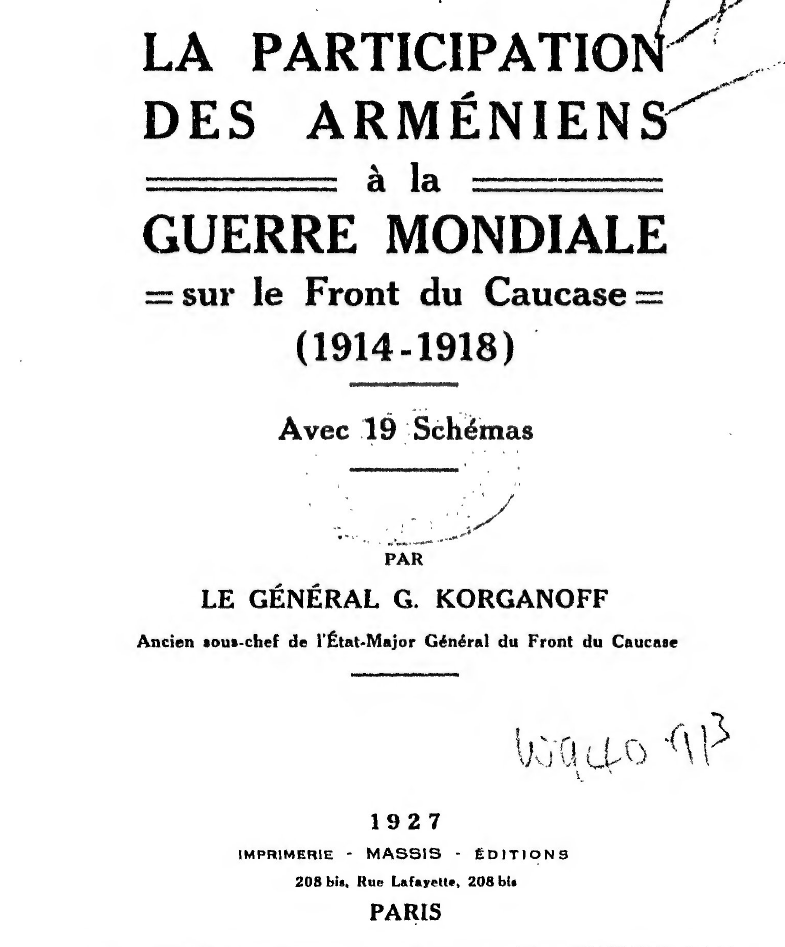
Korganov wrote a memoir of his involvement in these events in 1927, while in exile in France, entitled, La participation des Arméniens à la guerre mondiale sur le front du Caucase (1914-1918) avec 19 schémas. The book was originally published in French and Emanuil Egiaevich Dolbakyan created a Russian translation. A rough English translation is available over at Substack.

