By Kyle Orton (@KyleWOrton) on 15 November 2017
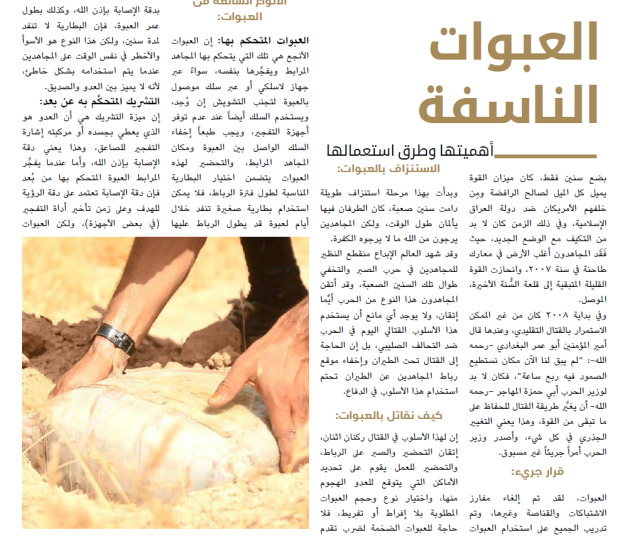
Al-Naba 101, page 8
In the 101st edition of the Islamic State’s weekly newsletter al-Naba (page 8-9), released on 12 October 2017, the organisation gave some fascinating details about how they responded to the “defeat” inflicted on them in 2007-08 by the American surge and the tribal Sahwa (Awakening) forces. The article describes how IS switched wholly to insurgent-terrorist tactics, dismantling its conventional fighting units and even its sniper teams in March 2008, and training in hit-and-run bombings. The leadership at that time, the emir Hamid al-Zawi (Abu Umar al-Baghdadi) and his deputy, the “first minister” and the “war minister” Abdul Munim al-Badawi (Abu Hamza al-Muhajir), encountered some initial scepticism, but the rank-and-file soon came on board when they saw its effectiveness. IS says that it is time to return to this form of warfare. In short, IS marked a switch in al-Naba 101 entirely from the statehood and governance phase of its revolutionary warfare, back into insurgency mode. The article is reproduced below.
This has long been telegraphed by IS. Nearly a year-and-a-half ago, with the famous last speech of Taha Falaha (Abu Muhammad al-Adnani) and in al-Naba itself just after, IS served notice that it knew the time of the caliphate as territory was limited, but that the organisation was a cause and so long as the purity of its belief and methodology were maintained, it would continue to a victory that God has preordained. This was a repeat of what al-Zawi had said in 2007 and 2008, at the nadir of the IS movement’s fortunes—statements that look vindicated in retrospect. And in an al-Naba article in September, IS noted its de facto abandonment of any form of conventional warfare. In the article in September—themes of which recur in the 12 October article below—IS said the emphasis had to be on avoiding the U.S.-led Coalition’s aircraft: the Coalition’s “partner force” is an ineffective militia, IS write, which acts primarily to draw IS’s fire so that the jihadists’ positions get exposed and can then be destroyed by airstrikes.
The immediate meaning of this is that the recent “victories” against IS—in Deir Ezzor city, Mayadeen, al-Qaim, Raqqa itself, and soon in al-Bukamal—should not be taken as evidence of the organisation’s collapse, but of a strategic decision made by it. In 2010, the U.S. demolished IS’s infrastructure in Baghdad and captured the city’s emir, opening a trail that led to the killing of al-Zawi and al-Badawi. In three months in early 2010, the U.S. eliminated eighty-percent of IS’s leadership, a decapitation strike it had seemed IS would never recover from. But IS did recover, because it was working with different metrics that saw the war as a long-term project, while the Americans did not recognise that the surge was a process that had to be maintained and tried to pocket it as a done deal, which meant they could leave. This short-termism has been on ample display this time around. This is especially worrying since IS is nowhere near as weak now as it was last time and operates in a social-political environment that is so much more favourable than in 2008.
* * * * *
[Improvised] Explosive Devices [al-Ubuwat al-Nasifa]:
Importance and Methods of Use
Just a couple of years ago, the balance of power was entirely tilted in favour of the Rafida [derog. Shi’is] and the Americans behind them, and against the Islamic State of Iraq. At that time, the new situation had to be adapted to. Most of the land [held by the Islamic State] was lost in the fierce fighting in 2007, and the small remaining [jihadist] force had retreated to the remaining fortress of the sunna: Mosul.
At the beginning of 2008, it was impossible to continue fighting in the conventional way. It was then that al-Emir al-Mu’mineen [the Commander of the Faithful], Abu Umar al-Baghdadi (may God have mercy on him), said: “We have no place where we can stand for even a quarter of an hour.” It was here that the War Minister, Abu Hamza al-Muhajir (may God have mercy on him), made an unprecedented and bold decision, instituting radical, fundamental changes in everything to preserve the remaining forces.
The Bold Decision
The remaining detachments of fighters, snipers, and other units were eliminated starting in the third month of 2008, and everyone was trained to use IEDs. Within a short time, the mujahideen were convinced of the new way. Instead of clashing with the heavily-armed U.S. Army with our few troops and limited equipment, the fighting in the cities [or urban warfare] took on an entirely new form: one detachment would manufacture explosives in a house; another would make detonation devices; a third detachment would be trained in how to camouflage and plant IEDs in the streets used by the apostates’ and crusaders’ vehicles and patrols; and another detachment would be trained in surveillance and detonation. All of these units operated in secrecy. A mujahid could lie in wait at an IED site for many days without being noticed [before the bomb was set off]. This [avoiding detection] was one of the most important requirements of the new operational method.
Exhaustion Through Explosive Devices [or Depletion/Attrition by IED: al-Istinzaf bil-Ubuwat]
Thus began a long phase of attritional warfare between the two sides that lasted over several difficult years. Both sides suffered constantly, but the mujahideen placed their hope in God, hopes the disbelievers did not share.
The world witnessed the unparalleled creativity of the mujahideen in the war of patience and concealment [or stealth] throughout those difficult years. The mujahideen mastered this type of war to a remarkable degree. This is the kind of warfare needed today against the crusader alliance. Indeed, there is an additional necessity for this method in defence now, since we are fighting under aerial surveillance and we need to keep the locations of the mujahideen hidden from the warplanes.
How We Fight with IEDs
This method of warfare has two pillars: mastery of preparation and patience on ribat. Preparation for action is based on determining where the enemy is likely to attack, then selecting the appropriate type and size of IED, without excess or negligence. There is no need for a large IED to stop advancing infantry or unarmoured vehicles, but, when the enemy is expected to use armoured vehicles or tanks, larger devices are appropriate and must be prepared and placed correctly. It is here that the role of the experienced military operative is necessary, to predict the enemy’s movement and method of advance. After choosing the type and location of the IED comes the stage of selecting the optimal method of rigging. At this point comes the role of the engineering corps to plant the device, whether it is a simple mechanical rigging or an electronic rigging. A careful distinction has to be made between the two. If there is an error in using mechanical rigging where electronic rigging is needed, or vice versa, it will lead to poor results, and might even hinder the movement of the mujahideen rather than halting the enemy’s progress.
Common Types of IEDs
Manually-Controlled IEDs: The most effective IEDs are those controlled by the mujahid on watch [al-murabit], who detonates it himself, whether by a wireless signal or a wire connected to the IED to avoid interference [or jamming]. The wire attached to the explosive device must be hidden, of course, since it leads to the mujahid’s position. The preparation for this kind of IED includes the selection of the appropriate battery [for the detonator] so that it lasts the full length of ribat. A small battery that drains within days cannot be used if the IED might remain in place for a month. The mujahideen must be prepared for extensive patience, not moving away from his IED and keeping his eyes and thoughts focused on the roads leading to a planted device at all times. Those engaged in tasbih [praise of God] and dhikr [remembrance or mindfulness (of God)] are well-suited for such a task. Just as important [as being prepared for the delay beforehand] is that a mujahid not delay detonation when the optimal moment arrives.
Booby Traps [al-Tashrik], also called “the Fool’s Traps” [Masa’id al-Mughafalin]: These are uncontrolled IEDs, the most well-known of which are called al-mistara [the ruler] and al-misbaha [the rosary]. The principle of these is simple: when the enemy steps on the mistara, misbaha, or other form of trigger […] the IED explodes on him. This type of device is known for its precision, by God’s permission, and also for its long lifespan: the battery can last for years. But this type is simultaneously the most dangerous to the mujahideen themselves when used incorrectly, because it does not distinguish between friend and foe.
Remote-controlled IEDS:
The advantage of a booby trap is that it is the enemy himself—with his body or vehicle—who triggers the detonation, meaning it is highly precise. But when the mujahid detonates a manually-controlled IED from a distance, the accuracy of the strike depends on the clarity of the view of the target, and some devices also have a delayed detonation. That said, manually-controlled IEDs allow freedom of movement around the device without the risk of accidental detonation.
For this reason, some brothers invented a method that combines the advantages of both systems. It is simply this: there are two switches between the battery and the detonator. One switch is activated by the mujahid when the enemy approaches. The second switch is activated by the enemy himself, by stepping on a misbaha or other triggering method. In other words, the booby-trap is a secondary switch that does not result in detonation unless the mujahid has already activated the primary switch himself. Thus, the device remains safe, by God’s permission, so long as the switch in the mujahid’s control remains open
Incorrect Booby Trapping: The worst practice is laying uncontrolled IEDs in the ground in an open area to create a minefield. This allows the enemy, if they have experienced engineering units, to easily dismantle the IEDs. As soon as the first device explodes, the enemy will realise that there is a minefield and remove the other devices freely, especially if the area is not under the fire control of the mujahideen—whether with snipers, heavy machine guns, or other means. This tactic has rarely succeeded in repelling the enemy for long. Moreover, if the locations of these IEDs are not accurately recorded, it will backfire on the mujahideen by making movement difficult in that area.
Proper Booby Trapping: Laying uncontrolled IEDs can be useful in two situations:
First: when booby traps are laid within range of our firepower, and thus the enemy cannot dismantle the minefield or advance through the area because the IEDs will dramatically slow down his progress and increase his losses. The engineering teams cannot disassemble bombs under fire.
Second: when the goal is to prevent the enemy from advancing along a specific, defined route. Here, two components are essential for success: documenting the location of the IEDs so we can remove or avoid them later if necessary; and camouflaging the devices very well so disassembly and avoidance of them is difficult for the enemy.
Safety Considerations When Handling IEDs
[This section gives technical details on which wires go where and dealing with the sensitivities of detonators. There is no legitimate purpose to reproducing these paragraphs—and good reason not to.]
An IED is Assembled in Three Precise Steps, the Order Strictly Followed:
[This section gives technical details on how detonators connect, the length of fuses, and the length of time batteries need to last, among other things. There is no legitimate purpose to reproducing these paragraphs.]
The Largest Error
[This section gives technical details about the installation of the battery in an IED, which the author contends is the most delicate point in creating an IED.]
Who Works on IED Placement?
The benefit of IED-based watch posts [ribat] necessitates that all mujahideen learn how to use them. There is no ribat point that cannot benefit greatly from planting IEDs against the enemy to stop his advance and inflict losses on him. IEDs are so easy to use and their utility so great, it makes learning about them appealing to everyone. However, there are steps to working with them that must be followed without improvisation or recklessness.
A Successful Example of the Creative Use of IEDs
In the battles in Aleppo’s northern countryside, a team of mujahideen prepared a wonderful fireworks show for the Awakening apostates. Working for days with rare ingenuity, they rigged a whole village before withdrawing. They booby trapped everything up in the village and disguised the IEDs so that they could not be discovered. They did not confine themselves to the usual booby traps—in the streets, [those that look like] rocks, and in pits—but [also] put bombs in bricks in the walls of houses, under stairs and door thresholds, on bicycles, even inside wardrobes and home furniture. When the apostates attacked, as expected, the brothers briefly resisted them, and then fell back to villages that were close by, allowing the apostates the illusion that they had been able to enter as a result of a spectacular defeat [inflicted on the Islamic State]—one we still laugh about to this day.
The camouflage of the IEDs was completely successful and the devices were prepared to active several hours after the first entry of the apostates, not upon their first moments of entry. The apostates combed and searched the village and found nothing, then settled into the houses to celebrate, play, film, and sleep. From afar, the brothers who planted the IEDs waited for the harvest hour.
At night, while the apostates were asleep the IEDs were woken up [i.e., activated], becoming ready to react to any touch or movement, and when the morning came, the disbelievers discovered a bloody day. Everything was ready to explode. One stepped on a doorstep and never took another step; part of his feet were found stuck to the ceiling. Another opened a closet, and nothing of his body was ever found. Then they began to run in confusion, detonating themselves with every movement. In a short time, the loud party ended, and none of the attendees made it out. Those who were killed did not know how their lives ended, nor did they find enough time to tell anyone what had happened.
Reasons for Success
The most important rule to understand is: “The real moment of action is at the time of laying the IEDs.” Everything after that is the time of the harvest, not the time of planting. So ensure that the more attention is given to the moment of planting the IED than any other phase [of using one]. Choose the correct place [to plant the bomb], the right camouflage, and the appropriate method of detonation, then you will reap a good harvest, God willing.
Successful workers in this field are characterised by frequent dhikr and their strong attachment to God, perhaps because of the lengthy periods of ribat needed.
Compensating for the Firepower Gap
As has been made clear, even a heavily-armed force can be annihilated if IEDs are used properly. A single mujahid, who is proficient and has mastered their workings, can, with the help of God, repel the greatest force advancing into his defensive zone. If the mujahid manages to remain hidden, the enemy’s advantages in aircraft and ground firepower will be neutralised.
IEDs provide the opportunity to strike the enemy from unexpected directions. In this situation, it means that the mujahid does not need to change places after executing an IED attack. He only needs to control his nerves and not to reveal his position by falling for the enemy’s tricks. He must not fire at the enemy and forget what his main weapon is. His rifle and pistol are for personal defense only, to be used if the enemy reaches him. The normal situation is that he should not need them.
 Kyle Orton's Blog
Pingback: Defining Freedom Fighters and Terrorists in Syria (and Beyond) – Straturka
Pingback: The Islamic State Says the Loss of the Caliphate Does Not Mean Defeat | The Syrian Intifada
Pingback: Trump’s Syria policy - Iranian American Forum
Pingback: Islamic State Claims its Switch to Insurgency and Terrorism is Working | The Syrian Intifada
Pingback: The Official Declaration that Made Abu Bakr al-Baghdadi Leader of the Islamic State | The Syrian Intifada
Pingback: The Islamic State Was Engaged in Insurgency Long Before the Caliphate Collapsed | The Syrian Intifada
Pingback: A Defection and the Dictatorship in Syrian Kurdistan | The Syrian Intifada
Pingback: The End of the Line for “The Beatles” of the Islamic State | The Syrian Intifada
Pingback: Islamic State Recommends More Gentleness in Dealing With Sinners | The Syrian Intifada
Pingback: US foreign policy paved the way for an Islamic State resurgence | World Affairs 7
Pingback: ISIS, Insurgent and Resurgent | James Snell
Pingback: The Islamic State Spokesman Directs His Fury At Regional Governments | The Syrian Intifada
Pingback: As its Insurgency Gathers Pace, Islamic State Wants to Further Intensify Operations | The Syrian Intifada
Pingback: Islamic State Newsletter Tells the Story of Transition Between Statehood and Insurgency | The Syrian Intifada
Pingback: Turkey's Syria policy and the June elections - Turkey Agenda
Pingback: Defining Freedom Fighters and Terrorists in Syria (and Beyond) | Kyle Orton's Blog
Pingback: The Death of the Caliph’s Son | Kyle Orton's Blog
Pingback: Islamic State Profiles the Godfather of its Media Department | Kyle Orton's Blog
Pingback: The Leaders of the Islamic State in Afghanistan | Kyle Orton's Blog