By Kyle Orton (@KyleWOrton) on 30 December 2017
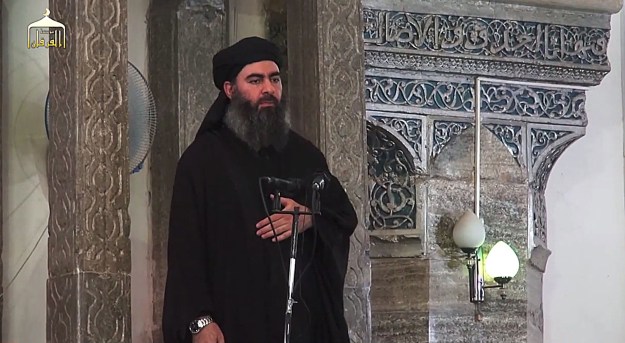
The leader of the Islamic State, Ibrahim al-Badri (Abu Bakr al-Baghdadi), speaking at the Zengi Mosque in Mosul, 4 July 2014 // AP Images
The current leader of the Islamic State (IS), Ibrahim al-Badri (Abu Bakr al-Baghdadi), was appointed as al-amir al-mu’mineen (the commander of the faithful or prince of the believers) on 16 May 2010, after his predecessor, Hamid al-Zawi (Abu Umar al-Baghdadi), was killed on 18 April 2010 in the company of his deputy and “war minister”, Abdul Munim al-Badawi (Abu Hamza al-Muhajir). The official statement appointing al-Badri is reproduced below.
Al-Badri accession to office has been the subject of considerable interest because of claims by ostensible defectors from IS, “WikiBaghdady” and “Abu Ahmad”, that al-Badri was installed by Samir al-Khlifawi (Haji Bakr), a former intelligence official in Saddam Husayn’s regime who went on to be the leader of IS’s Military Council, planning its expansion into Syria, among other things. This version of events gained currency as part of a narrative that IS was really the Ba’thist “party of the return” using religious iconography as part of a political ploy. Quite a debate continues to this day on this point. In the case of al-Khlifawi, there is no evidence he manipulated IS’s executive committee, al-majlis al-shura (the consultation council), to have al-Badri made caliph, and on the broader matter of al-Khlifawi’s ideology, the timeline very strongly suggests he was among the Islamized military-intelligence officers of the fallen regime who joined IS early on.
The major point of interest about the statement itself, from this vantage point, is the mention of Abu Abdullah al-Hassani as al-Badri’s deputy. Al-Hassani’s name is intended to mark him as a descendant of Prophet Muhammad’s grandson, Hassan (d. 670), the son of Ali, the fourth caliph, and the older brother of Husayn, who fell at Karbala in 680. It was also noted that al-Hassani was from the Quraysh tribe, a traditional qualification to be caliph.
After this statement, however, al-Hassani virtually disappeared. Taha Falaha (Abu Muhammad al-Adnani), in his first speech as the official spokesman, “The Islamic State Remains” (Dawlat al-Islam Baqiya), on 7 August 2011, mentioned al-Hassani in passing, and in early 2015 Wael Essam reported that al-Hassani was on the IS consultation council.
The mystery is somewhat deeper, though, because al-Badri’s first deputy was believed to be the new war minister, Numan al-Zaydi, variously known as Abu Ibrahim al-Ansari, Abu Sulayman al-Nasser, and Al-Nasser Lideen Allah. In July 2010, when Usama bin Ladin wrote to his chief of staff, Jamal al-Misrati (Atiyya), this was the structure as he understood it. Al-Zaydi was killed in February 2011, as confirmed in Falaha’s inaugural speech that summer. That Falaha mentioned al-Hassani and al-Zaydi, very close together, indicating explicitly that al-Hassani was alive and al-Zaydi was dead, decreases the chances that they are the same person, i.e., that al-Hassani is another kunya for al-Zaydi.
Now, it is possible that al-Hassani was the deputy and al-Zaydi was the war minister between May 2010 and February 2011, even if this was unusual since war minister and deputy tended to be synonymous, and soon definitely would be again with al-Khlifawi replacing al-Zaydi and restructuring IS’s military apparatus. Likewise, Bin Ladin being mistaken about internal ISI arrangements would not be surprising. But even if this were true—and it requires a lot of evidence-free assumptions that cut against the grain of what we know of how IS functions—it leaves most of the mystery intact.
If al-Hassani was still deputy in February 2011 when al-Zaydi as war minister was killed, why was he removed soon after and replaced with al-Khlifawi, since if that was the set-up it means the deputy and military emir roles had already been split? Did the roles remain split, at least for a time: Falaha was speaking of al-Hassani as deputy in the summer of 2011, after all? But if so, it only moves the timeline in asking why al-Hassani was replaced. Was the split an experiment that was abandoned, the two offices being recombined with al-Khlifawi some time later in 2011 or in 2012? Perhaps the switch in caliphal deputy was hidden for operational security reasons as al-Khlifawi undertook his restructure of IS’s military apparatus, which could explain the origins of the policy of concealing al-Khlifawi’s existence that was ultimately never changed during his lifetime.
Had the offices never been split and al-Hassani was dismissed and replaced with al-Zaydi a couple of months after his appointment? If so, why? Such an abrupt change and al-Hassani’s disappearance from IS outputs thereafter hints at major scandal or death. It would be understandable if IS kept quiet about the former, but if al-Hassani was, say, implicated as a traitor, this would surely survive in memory within IS: why has no defector, honest or malignant, ever mentioned al-Hassani? If al-Hassani was killed, why has there been no death notice from IS all this time later? If al-Hassani is still alive, why has he not shown up on a Coalition kill list?
As the IS movement reverts to insurgency mode with the collapse of its caliphate, these can be added to the list of questions.
* * * *
A Statement from the Consultation Council of the Islamic State of Iraq
Praise be to God, the Almighty, the Wise, who said: “Consult them about the conduct of affairs. Then, when you have decided, put your trust in God. God loves those who put their trust [in Him]” [Ali Imran (3): 159]. Peace and blessings upon the Prophet of battle and mercy, the illiterate Qurayshi, who said: “I am enjoining you to do five [things] that God has commanded me [to propagate]: [remaining attached to] al-jamaa [the community], al-sam’ wa-ta’a [listening and obedience], hijra [migration], and jihad in God’s cause, since anybody who separates himself by even a hand-span from the community has taken the rope of Islam off his neck [i.e. broken his connection with Islam], unless he returns; and he who preaches the call of jahiliyya [pre-Islamic ignorance], there is no doubt he is bound for Hell”.
As for what follows:
After the incident, which was destined by God to kill the two noble shaykhs [al-shaykhayn al-jalilayn], the Commander of the Faithful [Emir al-Mu’mineen] of the Islamic State of Iraq, Abu Umar al-Baghdadi, and his First Minister [al-Wazir al-Awal], Abu Hamza al-Muhajir, may God have mercy on them and accept them among the highest ranks of the martyrs, the Islamic State Consultation Council [or Shura Council: Majlis al-Shura] was directly convened to resolve the issue of the Emirate of the State, which was made possible by God, according to that which the two shaykhs had planned for such special circumstances.
The Consultation Council has been in constant session throughout the last period to meet with the ministers of the State, its governors [wulat], ahl hall wal-aqd and those of insight among them, to select the best from among the umma of Islam and choose from them those of a mujahid nature. At the forefront of these are the shaykhs of the umma and the leaders of jihad everywhere, and they agreed upon pledging allegiance [bay’a] to the shaykh, the mujahid, Abu Bakr al-Baghdadi Husayni al-Qurayshi, as the Commander of the Faithful in the Islamic State of Iraq, as well as the appointment of the shaykh, the mujahid, Abu Abdullah al-Hassani al-Qurayshi, as his First Minister and deputy..
These two virtuous shaykhs are among those well-versed in al-ilm and were among the earliest in da’wa [calling people] to the deen of God and jihad in His path. We ask God to preserve them, grant them firmness, and protect them from every evil and scheme. May He bless their efforts, grant them success, and enable them to bear what the two noble shaykhs [Abu Umar and Abu Hamza], the martyrs, bore in raising the banner of jihad and striving to establish the rule of the shari’a of God and build an honourable [or respected or mighty: aziza] Islamic state.
“God has full power over his affairs, but most men know not” [Yusuf (12): 21].
The Consultation Council of the Islamic State of Iraq
2 Jumada al-Akhira 1431 [16 May 2010]
* * * *
UPDATE:
It was reported in Arab media on 1 December 2010, from a source in the Iraqi counter-terrorism agencies under the Interior Ministry, that “the ‘Security Minister’ in the Islamic State of Iraq, named Hazem Abdul Razzaq al-Zawi, who was arrested in Ramadi ten days ago, revealed during interrogation the true identity of the leader of Al-Qaeda in Iraq, Abu Bakr al-Baghdadi, and his war minister, Al-Nasser Lideen Allah Sulayman.” Hazem al-Zawi was a cousin of Hamid al-Zawi (Abu Umar al-Baghdadi), the emir whom Abu Bakr had replaced. The source went on: “what [Hazem] al-Zawi confessed to, and what has been verified, is that Abu Bakr al-Baghdadi is a person named Dr. Ibrahim Awwad Ibrahim al-Samarrai, and his nickname is Abu Du’a. As for the ‘War Minister’ nicknamed Al-Nasser Lideen Allah Sulayman, he was the organisation’s wali of Anbar previously, under the name Abu Ibrahim, and his real name is Nu’man Salman Mansour al-Zaydi.” The source pointed out that “al-Samarrai and al-Zaydi were both detained in Bucca Prison in Basra, and they had absorbed takfiri ideology from the leaders of the organisation who were detained at the [same] time.”
By the next day, Al Sumaria, an Iraqi satellite channel, had published the prison mugshots of al-Zaydi (left) and Ibrahim Awwad/Abu Bakr (right):
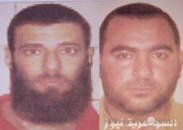
The interest here is two-fold. First, it means the real identity of the current IS leader has been in the public domain from six months into his tenure, even though it only came to broad attention three and more years later, after IS itself named “Caliph Ibrahim” for one and all in mid-2014. This follows the pattern with Abu Umar, who was named on jihadist message boards in July 2007, about nine months into his reign, and then had his real name widely reported in the Arab press in May 2008, but the U.S. military and Western media were still seriously wondering whether Abu Umar was a fictional character well into 2009 and the controversy only really resolved when the U.S. had Hamid al-Zawi’s body in April 2010. Second, it increases the likelihood that Abu Abdullah al-Hassani was removed and replaced as the caliph’s deputy soon after May 2010. Assuming that is what happened, why remains as much a mystery as ever, but the answer would probably go a long way to explaining where al-Hassani is now.
 Kyle Orton's Blog
Pingback: Islamic State’s First Leader Denies He Has Been Captured, West Wonders If He Exists | The Syrian Intifada
Pingback: The Islamic State Creates Foreign “Provinces” | The Syrian Intifada
Pingback: Abu Bakr Al-Baghdadi – Quo Vadis
Pingback: Islamic State Leader Says the Show Goes On | The Syrian Intifada
Pingback: Islamic State Leader Threatens Saudi Arabia and Israel | The Syrian Intifada
Pingback: Islamic State Leader Urges Patience as the Path to Victory | Kyle Orton's Blog
Pingback: Islamic State’s First Leader Denies He Has Been Captured, West Wonders If He Exists | Kyle Orton's Blog
Pingback: Abu Bakr al-Baghdadi’s Second Speech as Islamic State Leader | Kyle Orton's Blog