By Kyle Orton (@KyleWOrton) on 22 November 2021
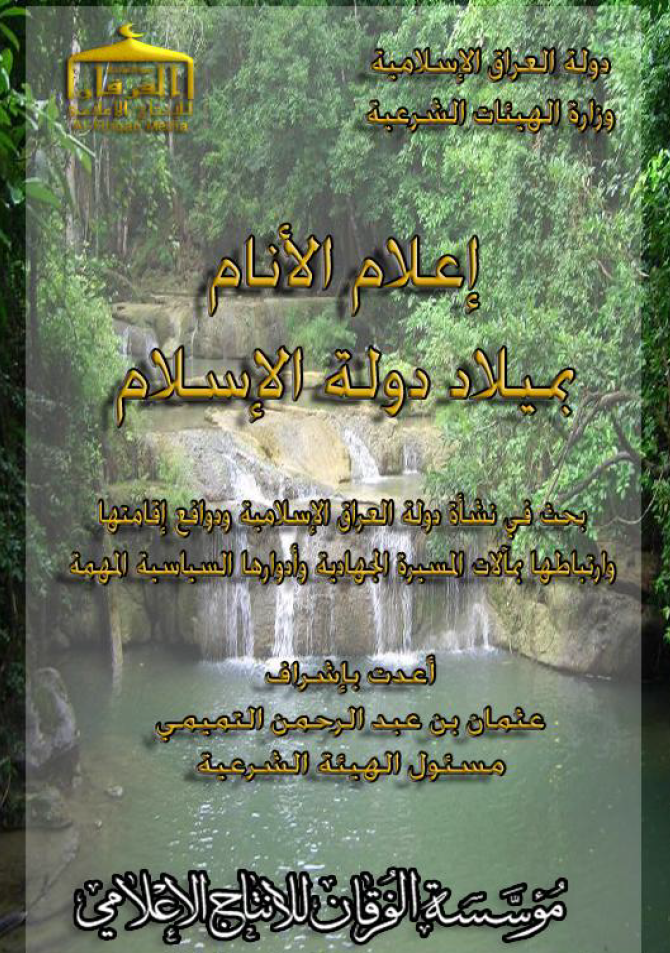
The Islamic State movement published an 87-page book, “Informing Mankind of the Birth of the Islamic State” or “Informing the People of the Birth of the Islamic State” (I’lam al-Anam bi-Milad Dawlat al-Islam), on 7 January 2007. The document was released by Al-Furqan Media Foundation, the central Islamic State propaganda institution, and first appeared on the World News Network website. A rough translation of the book appears below.
CONTEXT
The founder of the IS movement, Abu Musab al-Zarqawi, arrived in Baghdad in May 2002, joined up with the powerful Salafi underground in Saddam Husayn’s Iraq, and set down networks in Syria, with the assistance of Bashar al-Asad’s regime, that would bring in foreign fighters and suicide bombers after the Anglo-American invasion in March 2003. Zarqawi called his organisation Jamaat al-Tawhid wal-Jihad (JTJ) and publicly announced its existence in January 2004. In October 2004, Zarqawi swore a bay’a (oath or pledge of allegiance) to Usama bin Laden, refashioning JTJ as Al-Qaeda in Mesopotamia (AQM), and by the end of 2005 the Zarqawists overshadowed the Ba’thi-Islamists in the insurgency.
From this dominating position, Zarqawi moved to prepare the ground for the declaration of an Islamic State with caliphal associations in Iraq. In January 2006, AQM was joined to several other jihadi-Salafist groups in the Iraqi insurgency under the banner of the Mujahideen Shura Council (al-Majlis Shura al-Mujahideen). Having released many audio statements, Zarqawi appeared publicly for the first time in a video on 25 April 2006. The unedited video—captured ten days earlier in a British raid that arrested Zarqawi’s deputy, Abd al-Rahman al-Qaduli (Abu Ali al-Anbari), and posted on the internet on 5 May 2006—showed Zarqawi saying: “We expect, by the permission of Allah, that three months from now the environment will be ready for us to declare an Islamic emirate”. Zarqawi was killed on 7 June 2006, which disrupted this timetable—but not by much.
Zarqawi was succeeded as head of AQM/MSC by Abd al-Munim al-Badawi (Abu Hamza al-Muhajir). On 12 October 2006, MSC released a video showing its ranks being expanded, with three more insurgent groups and “many sincere tribal shaykhs” taking Hilf al-Mutayibeen (the Alliance of the Scented Ones). This merger was the stepping stone for the proclamation of the Islamic State of Iraq (ISI)—or the Islamic State in Iraq, an ambiguity with consequences—three days later, on 15 October. The leader of this Islamic State, named only as Abu Umar al-Baghdadi, was announced to be “the Commander of the Faithful” (Emir al-Mu’mineen), a title unmistakeably meant to imply he was the Caliph. A month later, on 10 November, Abu Hamza transferred his bay’a to Abu Umar, becoming the deputy and “war minister” of the Islamic State, and formally dissolving Al-Qaeda on Iraqi territory. Abu Umar introduced himself in an audio speech on 23 December 2006, the first of nearly two-dozen speeches over the next three-and-a-half years, which form a corpus of ideological and strategic guidance for the Islamic State.
The Informing Mankind document was released two weeks after the proto-Caliph had made his call for Iraqi insurgents to render under his leadership.
INFORMING MANKIND
The authorship of Informing Mankind is not completely clear. The introduction—signed by “the Official Spokesman” of the Islamic State, i.e., Muharib al-Jubouri (who had then-recently replaced Abu Maysara al-Iraqi)—says the book originated as a private initiative from an enthusiastic emir, who wrote to his superiors about the need to counter the jihadist arguments against the IS movement. The emir had made a start on this project in his letter, which was then forwarded to the Shari’a Committee, according to the introduction, and they took things from there. The introduction insists that the emir undertook this effort out of sincerity and not for his own personal reputation, hence he is not named, and that this emir dramatically killed himself in a suicide bombing to protect his “brothers” before the book was published. The front cover of Informing Mankind says it was “prepared under the supervision of Uthman ibn Abd al-Rahman al-Tamimi”, and it is not a wild supposition that the emir and Al-Tamimi are one and the same, but we cannot know this for sure.
The argument of the book eschews idealisation of the IS’s project of circumstances, very much in the vein of The Management of Savagery, which had appeared in 2004 attributed to one “Abu Bakr Naji”—probably Egyptian Al-Qaeda official, Muhammad Khalil al-Hakim, who was based in Iran. However, where The Management of Savagery was a tactical how-to manual of creating a jihadist polity, Informing Mankind is much more focused on the theological justifications for an Islamic State, with the most immediate audience being rival Islamist insurgents in Iraq who are hesitant to surrender their autonomy to the Zarqawists, and the broader jihadi-Salafist population. Jihadists had always had the Caliphate as their ultimate goal, but from Bin Laden on down there was never much precision on the timeframe for its realisation. What the Zarqawists were attempting was so novel and bold, it would require persuasion to win-over other jihadists, and this is what Informing Mankind is intended to do.
Informing Mankind starts with the general point that the Qur’an and the Hadith mandate Muslims to select a leader, even when they are few in number, and that the ideal form of leadership is an Islamic State that protects (and enforces) the deen, the lifeway of Islam. The author then makes the case that ISI should appoint the Imam of this State because it has the correct manhaj (methodology, doctrine) and has actually administrative structures across a swathe of territory, clearing it of shirk (idolatry) and other deviant practices, subduing non-Muslim minorities, and providing itself to have the military capacity to defend the territory from the “Crusaders” and the “apostate” Iraqi government. Pre-empting the argument that ISI’s territorial conquests are insufficient for a State, the book claims the ISI has more territory than the Prophet Muhammad did when he created the first Muslim State in Medina, a step up from the argument Muharib made three months earlier that the ISI had equal tamkeen (lit. “empowerment”, governed territory) to the Medina State.
In terms of how to appoint an Imam, Informing Mankind says there are three methods: (1) via a bay’a from ahl al-hall wal-aqd (lit. “the people who loose and bind”), the people in classical Islam who had the authority to elect and depose a caliph; (2) if an Imam was the chosen successor of a prior Imam, or was chosen by ahl al-hall wal-aqd from several candidates designated by the former Imam; and (3) by sheer force, “when tribulations appear and the time is devoid of an Imam, and the ahl al-hall wal-aqd are prevented from choosing him”. In these circumstances, a man who establishes himself “by his sword” and receives the bay’a “becomes an established ruler over the believers”, “must be obeyed and his authority cannot be challenged”. The author cites from the vast amount of Islamic legal and historical writings that stress the preference for any leader who can bring order over chaos, even if there is no consultation in his appointment.
In effect, the ISI claims to have carried out the first and third methods. Having established that it would be legitimate for the ISI to have an Imamate simply by force of arms, as the most powerful insurgent group, Informing Mankind claims the Islamic State in Iraq was created using the first method, by consensus of a representative ahl al-hall wal-aqd, constituted in the MSC and especially Hilf al-Mutayibeen, which is claimed to be much larger than it appeared because many tribal shaykhs “cannot declare their support or show their loyalty due to security concerns, since they are [in areas] under the control of the American occupier or its apostate government agents”.
What is notable is that all the Hadith and other Islamic literature citations relate to the process for appointing a Caliph, and “the Caliphate” is mentioned numerous times, heavily implying that what ISI is doing is resurrecting the Caliphate, but the ISI does not quite claim that its Islamic State is the reborn Caliphate. ISI generally uses terms like “Imamate” for its project throughout Informing Mankind.
Informing Mankind goes on to set out in great detail the virtue and competence of its fighters and administrators, and their achievements in combatting the enemies of the faith, upholding the shari’a in the zones they have captured, including the fixed punishments (hudud), and serving the Muslims they rule over—protecting their property and wealth, providing services, resolving disputes, and so on. Political justifications are offered: an Islamic State is a massive blow to the Americans and “apostates”, unifies the ranks of the mujahideen, and ensures that the “fruits” of the jihad are not reaped by corrupt and self-serving actors.
Almost the entire second half of the book is devoted to countering arguments that will be raised against the Islamic State. The first is the idea that the ISI does not have the proper trappings of sovereignty, especially full control of its zones, many of which are under attack. One of Informing Mankind’s responses, interestingly, references the Arab States neighbouring Israel—which is referred to as such, not as the “Zionist Entity”—who have been subject to intrusions by Israel, and yet the governments are recognised. Moreover, Informing Mankind argues, Palestinians recognise the PLO and HAMAS systems as their governments, and yet Israel imposes vast limitations on their sovereignty. The Medina parallel is again raised.
Another of the objections is that ISI cannot meet the standards of a modern State, and this is frankly conceded, but the argument made is that the eternal contest between Dar al-Islam and Dar al-Harb does not justify the Muslims doing without a State, no matter how much momentum the infidels have at any one time. Then there is the issue of ISI having only declared its State over part of Iraq: Informing Mankind is forthright about the practical reality that such a State can only take root in the Sunni Arab areas, but cites many authorities saying Muslims are not expected to attempt to do things which are impossible. Rather, the ISI has set out to establish an Islamic State that is attainable, and in line with Islam’s conception of statehood—which does not have hard borders as modern nation-States do—this will become a firm base to continue the jihad and expand the frontiers over time.
It is in the counter-arguments section of the book, in a set-aside segment on the need to unify around an Imam (pp. 55-57), that the infamous Islamic State flag is curtain-raised, with the actual design published a few days after Informing Mankind.
The last few pages are a call for an end to Muslim division and a recognition of the religious duty to join the Islamic State project, which again exploits the ambiguity of the ISI’s name by addressing an Iraqi audience very directly, while heavily hinting very broadly that the message is for the entire umma (worldwide Muslim community).
REACTION
Opposition to the declaration of the Islamic State in 2006 and the attempt by ISI to monopolise control in the Sunni Arab areas of Iraq quickly manifested, and was, as we now know, the trigger for a major backlash from the tribes and other insurgents. This “Awakening” (Sahwa) would be combined with an American “Surge” to dismantle the IS movement’s territorial holdings in 2007 and flush the group from its sanctuaries, bringing the ISI to its nadir in 2008. However, as we also now know, this was short-lived: by mid-2009, the ISI was beginning a counter-stroke and even the killing of “the two shaykhs”—Abu Umar and Abu Hamza—in April 2010 and the virtual decapitation of the ISI by June 2010 did not derail this recovery, which was well-advanced by mid-2011, months before the U.S. troops left Iraq. Through 2012 and 2013, the Islamic State continued its rise, whittling down the Sahwa and finally eliminating it—with the unintentional assistance of the sectarian Iraqi government—by 2013. ISI’s venture into Syria after 2011 gave it additional resources and strategic depth. The jihadists’ capture of Fallujah in January 2014 was the undeniable marker the group was back, and five months later it conquered a third of western and central Iraq and a similar proportion of eastern and northern Syria, territories that were overtly declared a Caliphate in June 2014.
By the time of the Caliphate declaration, Al-Qaeda had decisively repudiated the Islamic State, ending more than seven years of ambiguity. It is in the context of this intra-jihadist schism that it is so interesting to look back to what Al-Qaeda’s leadership actually said in the wake of the Islamic State being declared in 2006 and the Informing Mankind book appearing. The short answer is that Al-Qaeda unanimously supported the State project.
Jamal al-Misrati (Atiyya (Abd al-Rahman)), Bin Laden’s indispensable Libyan deputy, writing two days before Informing Mankind was published, had some words on the complexities of the use of “State” rather than “Emirate”, but Atiyya offered his wholehearted support for the ISI’s choice of the former and for the general course ISI was pursuing. Mohamed Hassan Qaid (Abu-Yahya al-Libi), Al-Qaeda’s operational military leader, released a video statement in April 2007 lauding the ISI, joining in its anti-Shi’a incitement, calling for all Sunni Iraqis to unite with the ISI, and looking forward to the jihad being extended into Saudi Arabia. Ayman al-Zawahiri, Al-Qaeda’s overall deputy, made his support for “the State” plain in a pseudo-Q&A published on 16 December 2007, and two weeks later Usama bin Laden himself set out in considerable detail his satisfaction with what the ISI had done and was doing.
It is true that Al-Qaeda had already privately registered some apprehension. Atiyya and Dr. Al-Zawahiri had written to Zarqawi in late 2005 complaining about the direction he was taking, especially against the Shi’a, and Al-Zawahiri was very exercised about Zarqawi’s video beheadings and general revelling in atrocities. But in public the united front was maintained, and only in 2013-14 would Al-Qaeda try to retroactively criticise what the Islamic State did in 2007-08. By then it was too late.
* * * * *
* * * * *
[FRONT PAGE]
Top Right: Islamic State of Iraq / Ministry of Shari’a Committees (Wizarat al-Hay’at al-Shar’iyya)
Title in Centre: Informing Mankind of the Birth of the Islamic State
Subtitle: A study on the emergence of the Islamic State of Iraq, the circumstances surrounding its establishment, its connection to the course of the jihad, and its important political roles.
Beneath that: Prepared under the supervision of / Uthman ibn Abd al-Rahman al-Tamimi / Head (Mas’ul) of the Ministry of the Shari’a Committees
Bottom: Al-Furqan Media Foundation for Islamic Media Production
[PAGE 1]
In the name of Allah, the Most Merciful, the Most Compassionate.
Introduction of the Information Ministry [Wizarat al-I’lam].
Praise be to Allah alone, and prayers and peace be upon the one after whom there is no prophet.
To proceed:
Allah the Exalted has said: “Among the believers are men who were true to what the covenanted with Allah. Some of them have fulfilled their vow [by death in jihad], and some of them are still waiting, but they have not changed [their determination] in the least” [Qur’an Al-Ahzab: 23].
The origin of this book was a latter written by one of the sons of the Shari’a Committee, on his own initiative, when he heard some doubts being spread by tongues without evidence from anything in the shari’a or reality. He was struck by concern and sorrow, which pushed him to advise the commanders of jihad and the generality of the umma, and then he submitted it to the Shari’a Committee.
When he returned to his place of work, where he was an emir over one of the regions, he fell into an American ambush and clashed with them. Then he charged at them with his explosive belt, blowing himself up in the path of Allah, giving his blood to protect his brothers behind him, who were able to escape. He poured his blood over his book like musk that gives off a fragrant scent and proclaimed loudly: we are proceeding upon the truth, and we are holding fast to the path of guidance.
We ask Allah to record this deed of his among the approved [acts] and make it weigh in the scale of his good deeds on the Day of Judgment. “And sufficient for us is Allah, and He is the best disposer of affairs” [Al-Imran: 173].
The Official Spokesman,
In the name of the Islamic State of Iraq.
[PAGE 2]
Preface
In the name of Allah, the Most Merciful, the Most Compassionate.
All praise is due to Allah; we praise Him, seek His help and forgiveness, and we seek refuge in Allah from the evil of ourselves and the evil of our deeds. Whomever Allah guides, none can misguide, and whomever He leads astray, none can guide. I bear witness that there is no deity but Allah, alone without partner, and I bear witness that Muhammad is His slave and messenger.
To proceed:
Writing these lines was prompted by a surge of emotions that I could not conceal, an outpouring of feelings, and the trembling of my senses. This was a result of my amazement and awe at the idea of the Islamic State, which has not left the heart of any sincere Muslim who yearns for the rise of this deen and grieves over its downfall. Indeed, this is one of the most precious hopes that lives in the soul of a Muslim and is seen as the dawn of the implementation of sharia and the end of humiliation and disgrace, both within and outside. It is the dream of the soul in every form and way, along with all the accompanying hopes and desires.
The idea of the Islamic State has struck deep in the minds of the many oppressed, and the dreams that used to be imagined by the dreamers and the idle have now found a platform where the sincere believers place their hopes. Every sincere person from the umma, when witnessing the collapse of the tyrants and the widespread corruption, longs for a reality that lifts them from the whirlpool of pain to the realm of work and realization. But joy today is not simply born from an emotional outburst or from fluid sentiments, nor is it the result of mere slogans and fiery sermons or theoretical foundations or speculative doctrines. Rather, it is the joy of a sincere reality and a hopeful dawn that many of the Muslims awaited—a real embodiment that draws a clear path and a wide gate to renewed jihad for the sake of Allah.
My separation from them stirred my emotions to speak of a joy that knows neither hesitation nor retreat. It is the joyous outpouring over this persistent hope which we have lived with on the land of jihad in Iraq. After a battle that lasted more than three years against the Crusaders and their apostate agents, the mujahideen have become certain that the birth of the Islamic State in Iraq is a matter of undeniable reality. The news of the martyrdoms and the daily glad tidings from jihad operations have not ceased, and the blessed raids have continued, and the banner of jihad and the mujahideen has spread. The reins of initiative in many of the battlefields have shifted into the hands of heroic champions—by the grace of Allah. The land has become the possession of the bearer of the black banner, and a base firmly established for the sincere vanguard of jihad. This has made the land open in many parts of Iraq under the control of
[PAGE 3]
the mujahideen and their factions. Thus, it was appropriate to seize this opportunity to take the initiative by unveiling the upcoming plans and the direction of the jihadist path in Iraq. A focused and comprehensive discussion of the topic is presented here on the potential outcomes of the efforts made by the mujahideen, which have begun to ripen and mature, and which today are visibly manifest in the form of a project for the birth of a rising Islamic State.
It is understood that such a project will undoubtedly provoke internal and external controversy within the umma, and it will face much debate, participation, criticism, and discussion regarding its elements.
This study is not a theoretical treatise; rather, it relies on what the mujahideen have established in laying the blessed foundations, starting from the legal and realistic political premises. It reveals the reasons and motives that led to the favourable circumstances for the emergence of this project and the return of its idea at this time, and the urgency of accelerating its announcement in accordance with legal and political necessities. It finally concludes with a response to the suspicions and objections that may face the Islamic State project in this stage, and a clarification of the relationship between the blessed state and the rest of the jihadi factions.
This research was written with a realistic view of the current situation of the umma and its future horizon, and upon the certainty that the Islamic State project is not a theoretical hypothesis, nor merely an ambition that fluctuates with emotions and returns to its former withdrawal. Rather, the purpose of this research, as apparent from its chapters, is to practically accompany the ongoing effort to complete the structure of the state in its foundational and executive dimensions. Its anticipated goal is the issuance of a legitimate legal ruling on the project of the Islamic State by the Shura Council of the mujahideen.
[PAGE 4]
Chapter One: The Importance of the State and the Umma’s Need for It
The Obligation of Establishing the Muslim State
It is narrated from the third caliph, Uthman ibn Affan (may Allah be pleased with him): “Indeed, Allah restrains through authority what He does not restrain through the Qur’an.”
This statement conveys the immense role played by the Muslim state in implementing the sharia and realising its presence through the authority of the state and its mission, which imposes the building of the Islamic system and enforces its pillars upon societies through the exercise of public authority in directing people to the sharia and compelling them to adhere to its apparent rites, alongside rectifying and correcting those who deviate from it. This is especially necessary in light of the phenomena of deviation and misguidance that hinder religious practice and undermine stability and guidance.
The discussion on the obligation of establishing the Islamic State is among the foundational principles of the sharia. However, given the urgency and weight of this subject, it is worth presenting a brief summary of the textual evidences supporting this:
Allah the Exalted said: “And when your Lord said to the angels, ‘Indeed, I will place upon the earth a vicegerent.’ They said, ‘Will You place upon it one who causes corruption therein and sheds blood, while we declare Your praise and sanctify You?’ He said, ‘Indeed, I know that which you do not know’” [Al-Baqara: 30].
Al-Qurtubi said in his tafsir: “This verse is the origin in appointing an imam, a caliph who is heard and obeyed, so that people may gather under him and carry out the rulings of the caliph, and there is no disagreement among the umma or the imams about that.”
He concluded with the verse from al-Nisa: “O you who believe, obey Allah, and obey the Messenger and those in authority among you” [Al-Nisa: 59].
The aspect of evidence in the verse is that Allah commanded obedience to those in authority and made it follow obedience to Allah and His Messenger. And the understanding of that is that obedience cannot be fulfilled unless the leadership (imara) is established through which those in authority appear, and they are the rulers, politicians, and scholars. Without the establishment of the Islamic State, the appointment of these rulers is not possible, and without their appointment, obedience to them cannot be fulfilled—thereby failing to realise a great objective of the objectives of the sharia.
Al-Shirazi said in Al-Bahr (7/407): “We said what is meant by ‘those in authority’ in matters of the world, preparation, expeditions, and detachments, and other such things. And the proof is that He specified with ‘those in authority’ what pertains to preparation of armies and management of affairs.” End quote.
[PAGE 5]
Allah the Exalted said: “Indeed, We have revealed to you the Book in truth so that you may judge between people by what Allah has shown you; and do not be an advocate for the treacherous.” [al-Nisa: 105]
The indication from the verse: Allah revealed His Book to be a judgment and a standard by which the lives of people and their deen are established, as ordered by His Prophet (peace and blessings be upon him). And that cannot occur except through strength and authority—embodied in sovereignty and power—through which the apparatuses of the judiciary and executive authorities operate, and through which a state arises that upholds authority, implements commands, and aligns them with the pleasure of Allah.
Allah the Exalted said: “And judge between them by what Allah has revealed, and do not follow their desires, and beware of them lest they tempt you away from some of what Allah has revealed to you. And if they turn away—then know that Allah only intends to afflict them with some of their sins. And indeed, many among mankind are defiantly disobedient. Is it the judgment of [pagan] ignorance they seek? But who is better than Allah in judgment for a people who are certain?” [Al-Maida: 49]
And His saying the Exalted—three successive verses in Al-Maida:
“And whoever does not judge by what Allah has revealed—then they are the disbelievers.” (verse 44)
“And whoever does not judge by what Allah has revealed—then they are the wrongdoers.” (verse 45)
“And whoever does not judge by what Allah has revealed—then they are the defiantly disobedient.” (verse 47)
The aspect of indication in them is as mentioned above in the previous verse.
And the mass-transmitted hadiths regarding the obligation of obeying the leaders are numerous, and they indicate the obligation of establishing a state that oversees the various political authorities. Among them is:
What was reported by al-Bukhari from the hadith of Anas, raised (as marfu): “Listen and obey, even if a slave whose head is like a raisin is appointed over you, as long as he upholds the Book of Allah.”
And in the two Sahihs from the hadith of Abu Hurayra, from the Prophet (peace and blessings be upon him): “Whoever obeys me has obeyed Allah, and whoever disobeys me has disobeyed Allah. Whoever obeys the ruler has obeyed me, and whoever disobeys the ruler has disobeyed me.”
And in the two Sahihs also from the hadith of Ibn Umar, from the Prophet (peace and blessings be upon him): “It is upon the individual to listen and obey in what he likes or dislikes, unless he is commanded with disobedience. If he is commanded with disobedience, then there is neither hearing nor obedience.”
And the hadiths in this regard are many indeed.
Shaykh al-Islam Ibn Taymiyyah said in Majmu al-Fatawa (28/390-392): “It must be known that the appointment of a leader over the people is among the greatest obligations of the deen. In fact, there is no establishment of the deen or dunya except through it. For the children of Adam do not achieve their objectives except through gathering and cooperation.
[PAGE 6]
The Prophet (peace and blessings be upon him) said: ‘If three set out on a journey, let them appoint one of them as a leader.’ And Imam Ahmad narrated in his Musnad from Abdallah ibn Amr that the Prophet (peace and blessings be upon him) said: ‘It is not permissible for three people to be in the open lands of the earth without appointing one of them as a leader.’ So the Prophet (peace and blessings be upon him) made it obligatory to appoint a leader even in a small gathering during travel. This indicates that all types of gatherings must have a leader, since Allah the Exalted has enjoined enjoining good and forbidding evil, and that cannot be accomplished except through strength and authority. Likewise, everything that Allah has obligated—such as jihad, justice, establishment of pilgrimage and gatherings, support of the oppressed, implementation of punishments—none of that can be accomplished except through power and leadership. To the extent that it was said: ‘Sixty years under a tyrannical leader are better than one night without a ruler.’ For drawing near to Allah is achieved through obedience to Him and obedience to His Messenger, and there is no doubt that leadership is among the greatest means to fulfil that.”
The end.
The Messenger of Allah (peace and blessings be upon him) said—as narrated by Ahmad from Abdallah ibn Amr: “It is not permissible for three people to be in the open lands of the earth without appointing one of them as a leader.”
And the Messenger of Allah (peace and blessings be upon him) said: “If three go out on a journey, let them appoint one of them as a leader.”
Narrated by Abu Dawud from Abu Sa’id, and Abu Hurayra has a similar narration.
Al-Shawkani said in Nayl al-Awtar (9/157): “(Chapter: The obligation of appointing judges and leaders, etc.)—and after mentioning the previous hadiths, he said: If this is legislated for three who are in the open lands of the earth or traveling, then it is more appropriate and obligatory for those who dwell in villages and towns, who need the removal of oppression and the establishment of justice and other matters. And in that is evidence for the statement of he who said: It is obligatory upon the Muslims to appoint an imam, a ruler, and a judge.” End quote.
Abu al-Ali al-Juwayni said in Ghayath al-Umam (1/105): “The appointment of an imam to the best of one’s ability is an obligation.” End quote.
Al-Mawardi said in al-Ahkam al-Sultaniyya (1/5): “The imamate is established to succeed prophethood in guarding the deen and governing the worldly affairs. Establishing it upon the umma is obligatory by consensus.” End quote.
Al-Allama al-Qala’i said in Tadhib al-Riyasa wa Tartib al-Siyasa (p. 74): “The umma has unanimously agreed upon the obligation of appointing the imam absolutely. And even if they differed about his attributes and conditions, they did not differ about the obligation of the matter itself. It is not fulfilled except through an existing imam, and if one does not exist, it must be sought.”
[PAGE 7]
The obligation of the imamate: the absence of it would lead to continuous disagreement and division until the Day of Judgment. If the people did not have an obeyed imam, the honour of Islam would be lost and its status diminished. End quote.
The Importance of the Islamic State
The supreme objective for which Allah sent His Messenger is to dedicate worship to Allah alone. Allah the Exalted said: “And I did not create the jinn and mankind except to worship Me.”
Worship in its reality is the submission of the human being to Him and the liberation of oneself from submission and subjugation to anything besides Allah the Exalted. And this is the reality of “There is no god but Allah”—it is the means of liberating humanity. Among the causes of humiliation and slavery in its reality is the struggle between belief and disbelief over the right of Allah to be the ultimate authority on earth—“and His command descends between heaven and earth” [Al-Zukhruf: 84]. And there is no doubt that achieving servitude to Allah the Exalted and fulfilling the call of monotheism can only be completed by removing the sovereignty of mankind over people and returning sovereignty and authority to Allah alone.
For this reason, the sharia has commanded the establishment of a state to realise this great objective. Because such a goal cannot be achieved through individual conduct and personal behaviour alone, rather it requires the power of authority to protect monotheism, spread it, and enforce the sharia limits with strength and rule.
Ibn Taymiyyah (may Allah have mercy on him) said in Majmu al-Fatawa (28/66): “All leadership positions in Islam are intended to ensure that the deen is entirely for Allah, and that the word of Allah is supreme. Indeed, Allah (glorified and exalted be He) created creation for that purpose, and for it He revealed the books, sent the messengers, and obligated striving upon the messengers and the believers.” End quote.
Allah the Exalted said: “Is it the judgment of [pagan] ignorance they seek? But who is better than Allah in judgment for a people who are certain?” [Al-Maida: 50]
Sayyid Qutb (may Allah have mercy on him) said in Fi Ẓilal al-Qur’an (4/905-904): “The meaning of jahiliya (ignorance) is defined by this text—jahiliya, as described and defined by Allah in His Qur’an, is the rule of man over man, because it is the enslavement of people to people, and departure from the worship of Allah, and the rejection of Allah’s lordship. Affirming this lordship requires rejecting the lordship of some humans over others. Wherever and whenever people rule by something other than the sharia of Allah—they are in jahiliya. If they rule by the sharia of Allah, and accept it and submit to it fully, then they are in the deen of Allah.
[PAGE 8]
But if they rule by something man-made—even in the form of pictures—and accept it, then they are in jahiliya, and not in the deen of Allah.
And whoever does not accept the ruling of Allah, then he accepts the rule of jahiliya (pre-Islamic ignorance); and whoever rejects the law of Allah, accepts the law of jahiliya. And this is a fork in the road—Allah saves the people through it, and those after that perish …” End.
This issue is the foundational issue upon which the deen stands: “sovereignty belongs to the Lawgiver.” For Allah did not send messengers, nor did He send down the Scriptures, except to be worshipped alone through that concept which Allah Almighty desires—not the concept that the jahili societies want to impose. For indeed, servitude to Allah in its true sense is submission to Him—Glorified is He—in the apparent and hidden, and affirming His oneness—Glorified is He—in creation, management, legislation, and command. Worship is a comprehensive term for all that Allah loves and is pleased with of words and deeds—apparent and hidden. And the shari’a did not come except to direct the servant toward following what the shar’ requires.
Therefore, it was inevitable—legally and rationally—that someone be appointed to rule, who would realise this critical principle on earth, and complete the path in light of the hereafter-focused and religious goals tied to it.
Looking at this from the perspective of shar’i requirements as the foundation of Islam: there is no value or sanctity in the shar’ for one who does not acknowledge that a system not founded on the basis of Islam is a system of jahiliya—even if it appears upon the surface to carry the title of Islamic rule and is carried out by people of knowledge and piety.
But it is known that this reality—embodied in legislating what Allah, Exalted and Blessed, did not permit and replacing His law with another—was not unknown to the umma in previous ages. And for that reason, their words did not respond to the arguments of those who advocate for it, except with two short sentences: He did not know a government operating under shar’i rule.
Indeed, our history has known a ruler of Palestine who split two claimants, but he did not know a government operating under a different shari’a. They accepted another shari’a. And perhaps the state the umma is heading toward now, as desired by those who imposed the shari’a of the jahiliyeen, is the closest thing to the current state of the umma.
[PAGE 9]
Chapter Two: The Legitimacy of the Establishment of the Islamic State of Iraq
The project of the Islamic State is, in itself, an obligation from the encompassing Islamic obligations upon the necks of the Muslims. And assuming it is related to the ability [to carry it out], it leads—in the reality of the matter—to the required legal reference, linked closely and precisely with the foundational jurisprudential principle: “Ruling upon a thing is derived from the ruling upon its prerequisite.” Thus, whoever is appointed to establish it bears the obligation, and the obligation is delegated to the capable ones. Those who turn away from this obligation while being able to fulfil it and being among the most knowledgeable and trustworthy regarding the implementation of the judgement of Allah in this duty, and that the legal truth is present and they know it, then they must act to implement this understanding on the ground in a manner clearly evident in representing the truth of that knowledge and its implications. Allah the Exalted said: “Indeed, the worst of creatures in the sight of Allah are the deaf and dumb who do not reason.” And He the Exalted said: “O you who believe, why do you say what you do not do? It is greatly hateful in the sight of Allah that you say what you do not do.” (al-Saff 2-3). And this is what is known among the people of knowledge as the methodology of knowledge and action, which is the methodology upon which the Salaf of the umma proceeded in establishing the deen and realising it in reality and conduct, not just words and slogans.
But it is necessary, when implementing the conditions of action and its applications, to compare the realities that define the ruling and weigh them by the scale of the shar’i conditions and descriptions. The most important of those conditions and descriptions is that the realities conform and align with the image of the intended legal ruling to be applied. And this is what is known among the scholars of usul as: conformity of the reality to the description of the shar’i ruling that is to be applied. It is also what is known among the scholars of jurisprudence as: any legal obligation upon a legally accountable Muslim must be presented to the scales of the shar’ to determine its conformity or misalignment in the reality on the ground.
And the project of the Islamic State of Iraq was, in its implementation, a practical application of an important obligation and legal duty, and it arose from circumstance and necessity, until it became a reality requiring ijtihad, and the reality was critical and suitable in its subject matter and ripe for taking its place and launching from it the jihad which the mujahideen relied on in their media and which they made a central axis for many truths derived from the Qur’an and Sunnah and the words of scholars and legal precedents—establishing it on the field of practical experience. And in this chapter we will mention the evidences and the foundations upon which the project of establishing the Islamic State of Iraq was built, as a legal ruling based on the ijtihad of the mujahideen who emerged with it in the field of confrontation.
The project of establishing the blessed state, based on the pioneering experience being undertaken by the mujahideen on the land of Iraq. Indeed, the state that was established by the Messenger of Allah, peace and blessings of Allah be upon him, does not carry all the specifications that are now looked at as among the characteristics of the modern state in its political, administrative, and economic structure. The state that Islam aspires to
[PAGE 10]
is the one that establishes the deen first—before any other consideration—and at the forefront of that is the implementation of the shari’a, which takes into account the meanings of the rulings and their aims. The state that the shar’i requires is a state based on the creed of tawhid, arising from it. It rules according to the shari’a in foreign policy and relations, just as it rules according to the shari’a in internal systems and policies.
Therefore, the state that was established by the Prophet, peace and blessings of Allah be upon him, took into account first and foremost the rights of the residents and their needs, and even beyond that, the interests of other religious minorities, in contrast to the view of states, governments, and policies of the modern era. And this will be seen as an ideal model in the biography of the Prophet, peace and blessings of Allah be upon him.
Ibn Ghaldun, may Allah have mercy on him, said: “The caliphate is not distinguished from the rest of the Muslims except in being a representative enforcing judgments and a guardian of the deen.”
When we speak about the Islamic State being established on the land of Iraq, we must consider a number of matters that played an essential role in determining the stages of this declaration, the method of its emergence and establishment—based on the circumstances and conditions surrounding this declaration and its appearance:
- The nascent state is carving its path through hardship. It is on the front lines of confrontation with the cross-worshipping Crusaders and the apostates in Iraq, and those who knew with certainty that their goals could only be achieved by toppling any Islamic attempt seeking to implement the shari’a and raise the banner of tawhid. This is the enemy that the blessed state will face with much of its strength.
- The nascent state did not receive from the state that preceded it any ready-built structure; rather, it inherited what was, in fact, the initial stages of the Islamic State that the Prophet, peace and blessings be upon him, established. It arose in the midst of jahiliya rule, which governed Iraq by an entirely disbelieving regime. After the Crusader invader departed, they left behind their poisonous legacy to spread disbelief in the region and to consolidate, alongside the modern jahiliya, a democratic system whose structure is built upon disbelief and the rejection of shari’a.
Thus, the state was born from nothing, and it rose from zero—as it bears the cost of establishing all the administrative, military, and social structures from scratch, just as the first state did.
What I mean here is that the new Islamic State will not be like any modern state that enjoys complete stability and economic, political, and social security—of course, this is in its early stages—due to the previously mentioned considerations, which are likely to obstruct many efforts in this path. However, despite this, the inspiring principle that allows the mujahideen to build the foundational base
[PAGE 11]
of their hoped-for state, according to the lowest levels at the very least and in accordance with the possible and available capability, is the application of the principle: “What cannot be fully achieved should not be entirely abandoned.”
But what is it that calls us to declare the Islamic State in Iraq? Has the time come for that? And have the mujahideen reached the required level that qualifies them to shoulder the burdens of tamkeen and its responsibilities?
We say: Our answer does not stem from purely theoretical visions as is usually the case in the writings of those affiliated with knowledge, da’wa, and thought. We are an active movement, moving forcefully in the field, engaged in confrontation with all its challenges and struggles, and branching out in our programmes and projects according to what the interests of the jihadi project dictate. We possess sufficient boldness to bear the burdens and responsibilities, whatever they may be and must be. The sons of this methodology have sacrificed much of their blood and souls until the situation reached what people now see of glory and tamkeen by the grace and bounty of Allah. And our answer to any questions raised about our plans and programmes will certainly emerge from our actual circumstances and the position that serves the jihadi interest first and foremost, and which ensures the continuity of jihad and the increase of its gains and fruits. The answer is not so much a legal ruling as it is a vision that reflects the jihadi leadership’s view of reality and contains within it the most suitable solutions for the jihadi project within the minefields it navigates, and the obstacles and hardships it overcomes.
And to those whose souls have slipped and who rushed to attack and stir up confusion over the initiative of the blessed state—by Allah’s permission—we say: We are aware of the complications of reality and its harsh and difficult circumstances. The jihadi decision that determines any battle is undoubtedly a difficult and fateful decision. We believe in that and are certain of it. But the battle is for the worthy and those who engage in its depths. And Allah has granted a group from the sons of the Mujahideen Shura Council the unmatched boldness to confront the Crusader aggression in Iraq and thwart very many of the conspiracies and plots targeting Islam and the Muslims. This was a clear reason for their holding the reins of initiative in many matters. And despite the difficulty of the circumstance and the severity of the battle, the fateful decisions remain in the hands of those to whom the reins and core of affairs have ended. And though the most appropriate and correct way in law and reason is that matters proceed otherwise—as will appear in the manner of appointing the imamate—the circumstances of the battle impose an emergency course of action in many areas and directions. It becomes necessary for the leaders of jihad and the notable ones of the victorious group on the battlefield to take a decisive and influential role, as they are the most active and powerful, and the most qualified in decision-making and guiding the arena. In clearer terms: they are the people of authority in practical reality, and this is a bounty from Allah that He has bestowed upon them. So it is no surprise
[PAGE 12]
that decisions should form in accordance with their visions and plans. And they proceed in this based on the principles of interest, which are measured and assessed by those with experience in the field and the people of power and strength to whom the matters ultimately return.
The bottom line is that the embarking upon this difficult vessel, and the adoption of this arduous path, comes as a result of a set of assessments, anticipations, and visions of the reality of events and their future. It is a step we do not consider to be any less severe, wounding, or compelling to our enemies than what we have made them taste before. Rather, even if it lacks the distinctive military programme, it will constitute a major political blow and great shock to the enemy following the realisation of what he feared most, while gasping his final breaths on the land of Iraq. This will, as we see it, lead to an unprecedented failure in the structure of strategic objectives for which the enemy has exerted his utmost material and human resources to achieve. “And Allah is dominant over His affair, but most people know not” [Yusuf: 21].
A Brief Summary on the Legally Sanctioned Method for Appointing the Imamate
The scholars have agreed that the imamate is established through three methods (see al-Ahkam al-Sultaniyya by al-Mawardi and Ghayat al-Umam by al-Juwayni):
First: Through the bay’a [pledge of allegiance] by ahl al-hall wal-aqd from among the Muslims to a man whom they choose and who possesses the qualifications of eligibility required for the imamate.
Second: Through the appointment (ahd) of a previous imam to a man after him, or the appointment of several people among the ahl al-hall wal-aqd, and one of them chooses an imam.
Third: Through force and domination by the sword, when tribulations appear and the time is devoid of an imam, and the ahl al-hall wal-aqd are prevented from choosing him. Then, a man takes the leadership of the Muslims by his sword, calls for the bay’a, shows strength and authority, and becomes an established ruler over the believers, he must be obeyed and his authority cannot be challenged.
According to the consensus of the scholars, all three methods are legitimate, i.e., they were affirmed by scholars despite the irregularities in each. Their general opinion is that most of their statements revolve around the first two methods: the bay’a by the ahl al-hall wal-aqd and appointment by a previous imam. As for the third method, it is not an original method for establishing the imamate or sustaining the state, but rather a method that arises to meet a need imposed by prevailing circumstances and unfolding events. Therefore, this method becomes a practical reality through apparent force and domination, not a legislative choice,
[PAGE 13]
but rather an outcome of the pressures and realities that shaped the motivations for establishing the Islamic State in Iraq. Through this, one will discover the desired path for understanding this reality, as will be explained.
Many of the scholars have stated the legitimacy of following the third method [of leadership appointment] in cases of necessity and crises, taking into account the interests of the deen, which would not be upheld except by a group that supports and reinforces it—even if it is an individual who outwardly appears with strength. Otherwise, chaos and disorder would prevail due to the abundance of opinions, the conflict of desires, and the divergence of interests—making the establishment of the state a matter more distant than the stars in the sky, and more difficult than threading a camel through the eye of a needle.
Imam Ahmad ibn Hanbal said: “Whoever overcomes them by the sword until he becomes caliph and is called Commander of the Faithful, it becomes impermissible for anyone who believes in Allah and the Last Day to spend a night without considering him as an imam—whether he is righteous or wicked.” This is the statement Imam Ahmad made, as transmitted by Ibn al-Mundhir with consensus. See Fath al-Bari (1/177).
Al-Qurtubi said in his Tafsir (1/302): “If someone overpowers who possesses the qualifications of the imamate and takes it by force and domination, then it is said that this is a fourth method.”
And Sahl ibn Abdallah al-Tustari said: “What is incumbent upon us is to submit to whoever overpowers our lands—so long as he is called to by someone commanding right and forbidding wrong, and as long as you are able to fulfil his rights, do so. Do not reject his action nor flee from it. If you are entrusted with a secret by one in power, do not reveal it.”
Ibn Khuzayma said: “And if someone takes power over the matter, and someone righteous judges that it is suitable for him without consultation or choice, and the people give him the pledge of allegiance and he pledges allegiance—then it is valid.” And Allah knows best. The End.
Note: It is important to draw attention to the fact that the previously cited texts from the scholars regarding the permissibility of the bay’a to one who gains dominance by force over a certain land were speaking about a general and known scenario in the context of the rotation of authority and its transfer from one caliph to another—or in the case of a particular dispute over power between Islamic parties who do not agree among themselves on a single opinion regarding the imam who ought to be appointed. So if someone emerges who compels the umma to obey him and pledge allegiance to him due to his display of power, then it becomes obligatory to follow him—so as to resolve the disagreement and ward off tribulation.
And in the general case, it becomes clear that the first two methods [of appointment] are the most appropriate according to the shari’a for establishing the emirate—if the circumstances allow for the presence of the ahl al-hall wal-aqd (those qualified to appoint) and their ability to choose, or the presence of a previous imam who appoints another. However, there is another scenario that differs from the above: it emerges during times of calamities and severe crises when the umma loses its authority and leadership and becomes without a guide or director. This usually occurs when the enemies seize the lands of the Muslims and place them under their rule. In such cases, the status of the territory transforms into one of temporary disbelief (kufr tari) due to the enemy’s control over the land and his domination over it—as was the case with the domination of original disbelievers [al-kuffar al-asliyyin] over the lands,
[PAGE 14]
as occurred in Palestine, Afghanistan, and Iraq—or due to the domination of apostates, as is the case in the rest of the Muslim lands. In this scenario, the conditions and descriptions required for following either of the two previous methods are no longer present: due to the complete absence of the imamate, and because the circumstances do not allow for the presence of a specific body of ahl al-hall wal-aqd possessing their required qualifications—or because they are delayed in acting, while being weak and fragmented.
It is most evident to say that the active and striving faction engaged in fighting under the banner of the correct shar’i methodology and striving in the path of establishing the deen and implementing its rulings, is the one that truly deserves the attribute of ahl al-hall wal-aqd among the people, because they are the most deserving to be described as the people of religious justice, just as the Prophet, peace and blessings be upon him, informed about the characteristics of the saved group in the times of estrangement. He said: “There will not cease to be a group from my umma fighting upon the command of Allah, overpowering those who oppose them until the Hour is established, and they will remain in that state.” Narrated by Muslim.
Thus, the inability to meet the conditions of the first two methods for establishing the state becomes clear, and the necessity to follow the third path arises, one that deals with the actual situation and fulfils its rightful needs. This corresponds to the reality of the hardship and crisis the umma lives through due to the loss of the caliphate and the emirate, and the absence of ahl al-hall wal-aqd able to carry out this blessed legal project. Just as the previous imam would appoint the imamate to someone after him, and no such person is now present, then the practical picture in Muslim lands does not allow the choice to always fall on the first two options. Rather, the absence of consensus and the lack of a specific body of ahl al-hall wal-aqd—except rarely—makes the matter of appointing an imam in such times subject to necessity. This necessity is imposed by the absence of an imam and the dominance of those who disrupt the deen and corrupt it, as well as the urgency to consider public interest, which cannot be delayed. It becomes imperative to drive away harm and protect what can be secured. Perhaps the clearest explanation of this concept is what Imam al-Juwayni mentioned in Ghayat al-Umam, in the chapter where he discusses the necessity of leadership when time is devoid of an imam, along with the difficulty of appointing one and establishing the state as quickly as possible. He says (1/233):
“If, in a given time, there is no one who possesses the full qualifications of the people of selection [ahl al-ikhtiyar], and there arises one who calls to be followed with the proper shar’i conduct, then if he manifests strength and takes up the imamate, he is a true imam. He holds the status of both the one granting the contract and the one being granted it. The evidence for this is that the need for an imam is evident, and the one suitable for the imamate is one—while the era is devoid of ahl al-hall wal-aqd—so there is no justification for suspending the time [i.e., leaving the era] without a guardian to defend the sanctity of Islam and protect the territory. This is decisively established, and not hidden to anyone who comprehends the foundations of governance.”
[PAGE 15]
And he said: “If one is taken in a time and emerges as fit for the matter of leadership, then there is no need for the appointment of a contractor or an explainer. What clarifies the truth in this is that if it is imagined that choice is given to him by someone who sees him in this situation, that he should pledge allegiance to him, follow him, and be satisfied with him—even if others refrained from the imamate despite being qualified—then there is no meaning to requiring selection. And it is not necessary for one to be designated as a selector or a chosen one in this case.”
So this statement shows that appointment and designation can originate from an individual. And the meaning of this speech is fulfilled by two points being mentioned. The first is that the man is suitable for leadership. The second is that he manifests strength, support, and calls the community to unite and obey. If he does this, then he is the imam—over the cooperative, the obedient, and even the people of division, conflict, and dissent.
And we say: If the number of those qualified to appoint an imam diminishes, and the crisis lengthens, and hardship spreads to the corners of the Kingdom, and the reasons for necessity appear, and a person emerges who is fit for the imamate—calling himself to it, gathering people under his leadership, and repelling aggressors—then his appearance is not to be judged based on greed, sin, or desire. If he appears with apparent strength, then his presence by sheer numbers and ability will suffice. That is not to be considered a deviation or lawlessness. So if that happens, and it is a justified act and not done in vanity or for corrupt purposes, then the Muslim must follow him, and it will be considered a valid appointment at the hands of those present.
Chapter: On the Explanation of the Statement
About the First Method of Appointing the Imam
What is the Bay’a of Ahl al-Hall wal-Aqd
What is meant by the choice of ahl al-hall wal-aqd is that they select a man who is suitable for the imamate. Imam al-Nawawi transmitted the consensus (ijma’) on the validity of the imamate by selection (ikhtiyar) (Sharh Muslim, 12/205), and it is the most common method among the majority. This is because approval is achieved through it, and both of them (i.e. the choice and approval) originate from ahl al-hall wal-aqd, who are the most knowledgeable among the people regarding what is in their best interest, and the most diligent in realising it. The scholars have disagreed over their number which causes the imamate to be considered valid through their selection.
The first opinion is: consensus of all the Muslims. And this is the saying of Ahmad in the narration of Abdus ibn Malik and Ishaq ibn Mansur. He said: “If someone takes charge of the caliphate, and the people agree upon him and are pleased with him…” [Minhaj al-Sunna, 1/112] And Ahmad was asked about the hadith: “Whoever dies without having pledged allegiance to an imam dies the death of jahiliya,” what does it mean? He replied: “Do you not know what an imam is? The imam whom the Muslims agree upon—if this occurs, then this is what it means.” [Al-Sunna by al-Khallal, 1/108]
[PAGE 16]
And al-Lalaka’i said: “And hearing and obeying the imams, and the commander of the believers—the righteous and the wicked—and whoever is entrusted with the caliphate, and the people gather upon him and are pleased with him.” (I’tiqad Ahl al-Sunna, 1/160)
And this is the statement of Hisham al-Fuwati and Abd al-Rahman al-Usfuri—and they are from the Mu’tazila. See Maqalat al-Islamiyyin.
It is their statement regarding the doctrine of dignity (al-milal wa al-nihal). And it is necessary to respond to this statement that it is based on an excuse.
And if the consensus of the ahl al-hall wal-aqd was based entirely on one person, how can it be binding upon all Muslims if the conditions themselves were corrupted as previously mentioned?
The second opinion is: consensus of ahl al-hall wal-aqd altogether. And this is the statement of Ahmad in the narration of Ishaq ibn Ibrahim. He said: “The imam is the one upon whom the ahl al-hall wal-aqd collectively agree.” (al-Ahkam al-Sultaniyya, p. 23). However, many scholars did not object to this statement.
Ibn Hazm, may Allah have mercy on him, said: “As for the one who said that the imamate is not valid except by the appointment of the eminent among the umma in the various regions, then this is false. Because it is a burden beyond what is possible to bear. And what is beyond one’s capacity is the greatest hardship. And Allah, Exalted is He, does not burden a soul beyond its capacity.” And He, the Exalted, said: “And He has not placed upon you in the deen any hardship” [Al-Hajj: 78].
And there is no difficulty or impossibility greater than recognising a consensus of the notable figures from al-Mawlatan and al-Mansura to the land of Mahra, to Adan, to the furthest reaches of the land of al-Musammadah, to Tantaha, to the islands of the sea, to the coasts of Al-Sham [Syria], to Armenia and Mount al-Fath, to Asmar and Farghanah and Awsarushnah, to the farthest parts of Khurasan, to Jurjan, to Kabul, to al-Mawlatan, and the rest of the cities and villages. And it is necessary to manage the affairs of the Muslims before one could even gather a fraction of a hundred from the notables of the people of these lands. This invalidates that corrupt claim, even if we were to assume its possibility—because it is a claim without evidence. [al-Fasl fi al-Milal wa al-Ahwa wa al-Nihal, 3/84]
Rather, al-Juwayni mentioned the lack of requirement for consensus of the ahl al-hall wal-aqd, and said: “What is decisive is that consensus is not a condition in the contract of the imamate.” [al-Ghayathi]
And al-Juwayni justifies the lack of this condition by saying: “The aim of appointing the imam is the preservation of the religious sanctuary and attention to urgent matters of Islam, and most of the critical issues do not allow for delay or deliberation, and in some instances, matters arise that require urgent resolution without being anticipated.”
He then supports the impossibility of making consensus a condition in establishing the imamate by citing what Umar said in his sermon: “The bay’a of Abu Bakr was a sudden event.” (al-Bukhari 6830) And this supports the statement of al-Juwayni.
[PAGE 17]
But Allah protected the Muslims from its evil. [Al-Bukhari narrated it and others], meaning that the bay’a of Abu Bakr took place in a moment. And it may be that in such a moment great matters occurred, but Allah granted peace.
Third: The bay’a of those from the ahl al-hall wal-aqd whose gathering is feasible is sufficient. And likewise the statement of al-Nawawi: “The scholars and prominent figures among the people, whose gathering is feasible.” [See al-Rawda and Ghayat al-Ikhtisar and the elite of the people whose authority is recognised, whether by knowledge or otherwise] (Hawashi al-Shirwani 9/76)
And he said in the commentary on Muslim: After mentioning that Ali delayed in giving bay’a to Abu Bakr, may Allah be pleased with them both—this delay does not indicate any flaw in the bay’a nor in the one who was pledged to. As for the bay’a itself, the scholars have agreed that it is not a condition for the validity of the bay’a that every single one of the ahl al-hall wal-aqd give it, nor all the scholars and notables. Rather, it is sufficient that it is given by those whose gathering is feasible.
And al-Shawkani transmitted from Abu Muhammad al-Juwayni, the father of Imam al-Haramayn: [al-Ghayathi, p. 126, the first edition from the Library of Commerce], and it is understood from the words of al-Mawardi that whoever becomes imam in a land in which the contract of the imamate becomes widely recognised customarily and not legislatively, his imamate is valid—so long as he is from those who are suitable for the caliphate, and the majority of those fit for the caliphate in that land accept him. [Al-Ahkam al-Sultaniyya, p. 6]
And al-Qalqashandi said: “And it is the most correct view among our Shafi’i companions” (Ma’athir al-Inafa, 1/44).
Fourth: It is established by forty, by analogy with the Friday prayer (jum’a), and this is the opinion of some Shafi’i scholars, including al-Halimi in al-Minhaj. He said: “If the conditions of the imamate were not gathered for an imam before him, and there was a need to appoint an imam for the Muslims, and forty just men from among the Muslims gathered, and they were people known to judge among the people, and they appointed a man who fulfilled the conditions mentioned, and after a proper examination and consideration his imamate was established and his obedience became obligatory” (as quoted from al-Nawawi in Nihayat al-Arab, 6/3; see also Turuq Intiha Wilayat al-Hukm, 156-157).
And this is based on the Shafi’i position requiring the condition of forty for the Friday prayer. And if the weakness of conditioning a certain number in Friday prayer becomes apparent to you, then you will understand the weakness of this view, which is based on nothing but what is determined by the collective group. This weakness is acknowledged by the statement of Ibn Abd al-Haqq: “The number in Friday prayer has no effect in its rulings.” [See my book al-Jum’a: Adab wa Ahkam, pp. 85-89].
Fifth: It is established by five, and this is the view of most jurists and theologians. Among them is the judge Abd al-Jabbar (d. 415 AH), and they inferred this from the fact that the bay’a of Abu Bakr was conducted by five individuals, and they were: Umar, Abu Ubayda, Bashir ibn Sa’d, Salim the freedman of Abu Hudhayfa, and Usayd, in the presence of Umar,
[PAGE 18]
and that Umar made it a council of six to conclude it with the satisfaction of five.
And the response is that the bay’a of Abu Bakr was not concluded by these individuals alone, as will be explained. As for Umar’s appointment, it was only for the electors (a term in the accusative, not the doers).
Sixth: It is established by four, by analogy with the highest form of testimony, which is the testimony for adultery, and this view is transmitted from some of the Mu’tazila. Yet the reasoning on which this analogy is based is not known—so what is the basis for this strange analogy?
Seventh: It is established by three. This is a view mentioned by some Kufan scholars, as cited by al-Mawardi. The reasoning is that they are a group, so it is not permissible to go against them, and one of them could act as judge and the other two as witnesses, as in a marriage contract which is valid with a guardian and two witnesses.
Eighth: It is established by two. Al-Juwayni mentioned it without attributing it to anyone or citing any proof. If what is intended is two who both agree, then it is the same as the third view above.
Ninth: It is established by one from the ahl al-hall wal-aqd, and this is the view of Abu al-Hasan al-Ash’ari as mentioned by al-Baghdadi, and Ibn Hazm (al-Fisal, 3/85), and it is also the view of al-Iji (al-Mawaqif), and al-Qurtubi (al-Jami li-Ahkam al-Qur’an, 1/269), and al-Balqini. They argued using the case of the bay’a of Abu Bakr, since it was Umar who gave him the pledge of allegiance.
And al-Abbas said to Ali on the Day of al-Saqifa: “Extend your hand so that I may pledge allegiance to you, and the people will say: the Messenger of Allah’s uncle pledged allegiance to his cousin, so none will dispute with you.” And that a contract by one person is binding, and the judgement of one is effective.
Ibn Hazm likewise used as evidence that those of the shura to whom Umar entrusted the decision had delegated the choice to one person and made him the sole decider.
Abd al-Rahman ibn Awf said: “Indeed, their consensus upon the imamate being concluded by one is established.” (previous reference)
And the response to the claim that Abu Bakr’s bay’a was concluded by Umar alone is that it was only initiated by Umar, and the majority of the Companions accepted it. Ibn Taymiyya said: “And as for Umar initiating the bay’a to Abu Bakr, no bay’a is valid except with the one being pledged to actually receiving it.”
And as for al-Abbas’ statement, it is not proven to be authentic. And even if it were established, it is the opinion of one Companion against the rest, so it is not a proof. It may be that his meaning was that the caliphate would be established by the people’s satisfaction and not merely by al-Abbas’ selection.
Abu Ya’la cited this statement with the hadith: “Whoever desires the spaciousness of Paradise, let him adhere to the jama’a (community), for indeed the Shaytan is with the one, and he is farther away from the two.” (A sound hadith. Reported by Ahmad in the Musnad: 114, 177; and al-Nasa’i in al-Sunan al-Kubra: 9219—both with authentic chains. Also reported by al-Tirmidhi in Kitab al-Fitan—Chapter: What Has Been Reported About Clinging to the Community.
[PAGE 19]
In it is al-Nadr ibn Isma’il: he is not strong. Also reported by Ibn Hibban: 7254, 5586, 4576, 6728; and al-Hakim: 387, and he authenticated it according to the conditions of the two Shaykhs, and al-Dhahabi agreed with him; and al-Bayhaqi in al-Sunan al-Kubra: 13299; and al-Diya’ al-Maqdisi in al-Mukhtarah: 96, 98, 155, and he said: its chain is sound. All of them reported it from the narration of Umar, may Allah be pleased with him.)
I said: the hadith has been transmitted as marfu (attributed to the Prophet) and mawquf (stopped at a Companion), and the mawquf version is more sound—and Allah knows best.
As for the statement that his judgement is binding: it is not a contract, but rather an agreement through mutual consent between the two parties.
As for Ibn Hazm’s inference that the people of the shura delegated the matter to Abd al-Rahman ibn Awf, Abd al-Rahman ibn Awf did not assume it independently. Rather, he remained for three nights asking the people and consulting them, and then he said to Ali: “O Ali, I have looked into the people’s view regarding the matter, and I did not find them to prefer anyone over Uthman. Do not make a path for yourself.” So he said: “Extend your hand, O Abd al-Rahman,” and he pledged allegiance to Abd al-Rahman, and the people pledged allegiance to him—the emigrants, the supporters, the commanders of the armies, and the Muslims. (Narrated by al-Bukhari—Kitab al-Ahkam, chapter: How the people give the pledge of allegiance to the imam, no. 6781; and Kitab Fada’il al-Sahaba, chapter: The Story of the Bay’a and Agreement upon Uthman, no. 3497-3493)
Thus, Ibn al-Tin said: “And the silence of those present from the shura, the emigrants, the supporters, and the commanders of the armies is evidence of their confirmation of what Abd al-Rahman said and of their approval of Uthman.” (Fath al-Bari, 13/197)
Indeed, Abd al-Rahman did not initiate the matter of the caliphate on his own, and consultation with the remaining elders did not occur through autocracy, but with the agreement of those present. And those who argued that the imamate is valid with the pledge of allegiance by only one person did not clarify or explain.
And what indicates that it is not concluded by one person is the sermon of Umar in the presence of the masses of Muslims in the mosque of the Messenger of Allah, peace and blessings be upon him—and it will come—and it is a consensus, correctly established and without doubt.
Tenth: It is concluded by one, on the condition that strength (shawka) is attained through his bay’a. This is the opinion of al-Juwayni and al-Ghazali. Al-Ghazali says: “And if Umar had not given him the pledge of allegiance, and the rest of creation were opposed to him, or were divided into equally matched groups such that none clearly outweighed the other, then the imamate would not have been valid. For the condition of the commencement of the contract is the establishment of force and the alignment of hearts to the leadership.” [Fada’ih al-Batiniyya, 172-177]
And al-Juwayni said: “However, I condition that the one giving the bay’a must be someone whose pledge brings about protection and dominance.” (al-Ghayathi, p. 72) Even though both al-Ghazali and al-Juwayni say that it [the imamate] is established by one person, al-Ghazali said: “What we choose is that one person is sufficient to establish the bay’a for Abu Bakr,
[PAGE 20]
and this is what is transmitted from our shaykh Abu al-Hasan, namely that the imamate is established through the bay’a of one man from the ahl al-hall wal-aqd.” However, he conditions what we previously mentioned about the attainment of shawka (force/dominance), and adds: “If one prominent man, who has many followers and supporters and is obeyed among his people, gives the pledge—and his bay’a brings about what we alluded to—then the imamate is established.” (al-Ghayathi; Fada’ih al-Batiniyya, ?) And al-Juwayni said: “The closest of the madhhabs is what was approved by Qadi Abu…”
Eleventh: What is considered is the bay’a of the majority of the ahl al-hall wal-aqd, those through whom shawka (military strength) and power are realised. This is the view of Ibn Khaldun (al-Muqaddima, p. 259), and of al-Nawawi, Ibn Taymiyya, and others—may Allah have mercy on them.
Ibn Taymiyya said: “And if it is established—i.e., Abu Bakr’s [imamate]—by the bay’a of the majority of the Companions, who were the people of authority and shawka, and Sa’d ibn Ubada, may Allah be pleased with him, did not invalidate it by dissenting, because that does not harm the objective of leadership and the wielding of power by those who establish the interests of the imamate.”
That was achieved by the consensus of the majority on this matter. So whoever says that an imam is established by the agreement of one, or two, or four, who are not of those capable of shawka, has erred. Just as anyone who thinks that the dissent of one, two, or ten undermines it is certainly mistaken.
[Minhaj al-Sunna, 1/141]
The words of Imam al-Nawawi were mentioned earlier when discussing the definition of ahl al-hall wal-aqd.
This opinion is the strongest of the views, as supported by the evidences mentioned earlier, and it can be considered as a return to the third view, so compare them.
And the tenth view is not devoid of force, except that it returns to two matters: the first is partial, and the second is total.
As for the first: it is what al-Bukhari narrated (Book of Hudud, chapter: Stoning of the pregnant woman for zina), and others, from the sermon of Umar when it reached him that a man had said: “If Umar were to die, I would give bay’a to so-and-so. Was not the bay’a of Abu Bakr just a sudden event?” Umar became angry and said: “Indeed, might a man say: ‘If Umar were to die, I would give bay’a to so-and-so. Was not the bay’a of Abu Bakr just a sudden event?’ Yes, the bay’a of Abu Bakr was a sudden event, but Allah protected the Muslims from its evil. And there is no one among you whose necks are cut for like Abu Bakr. So whoever gives bay’a to a man without consultation of the Muslims—neither he nor the one who gave him bay’a is to be followed. They have risked being killed.” What this means is that whoever gives bay’a to someone without consulting the Muslims is endangering himself and exposing himself to death. In this is an indication that Umar required for the validity of the bay’a that it be conducted with the consultation of the people of opinion among the Muslims, and that the bay’a of one person to another is not valid. And the Muslims agreed with him on that in the mosque of the Messenger of Allah, peace and blessings be upon him—thus it was a consensus.
[PAGE 21]
Second: What is predominant in terms of strength is that it lies with the majority of the ahl al-hall wal-aqd, and it is rare for it to lie with just one. The shari’a bases its rulings on what is predominant, not on the exceptional. So, conditioning the contract upon the majority of ahl al-hall wal-aqd is in line with the foundations. This also clarifies the strength of the eleventh opinion. And Allah knows best.
And Allah granted success to the brothers in Hilf al-Mutayibeen, which represents the majority of ahl al-hall wal-aqd in this land. This council entered into the shura of the mujahideen, and it is composed of seven jihadi groups with ranks, commanders, soldiers, and positions that are known. It is not acceptable for some people to say: “I do not know them or their presence.” By Allah, let us not slaughter our credibility and then lie to the people.
Indeed, consultation was carried out with more than seventy of the elders of the Sunni people in the region where the mujahideen are present, and we saw acceptance and consultation. Thus, the matter proceeded—praise be to Allah.
We also listened to the consultation of some senior leaders of other jihadi groups and attempted to meet with their leadership, but Allah did not make that possible due to the difficulty of the circumstances. So it was necessary for us to proceed with the contract based on whatever level of ahl al-hall wal-aqd and consultation we could attain under these difficult conditions. The contract was completed—praise be to Allah—after full consideration, by the majority of the ahl al-hall wal-aqd, and praise be to Allah for the completion of the matter.
Next: In the clarification of the detailed statement.
On the Second Method for Appointing the Imam
Which Is Appointment of a Man After Him
And it is that the caliph appoints during his life—whether he is ill or in good health—a man, and entrusts him with the succession after him. Therefore, this method is called the method of appointment (ahd). Imam al-Nawawi said: “The scholars have agreed that if the caliph is present and death approaches him, then it is permissible for him to designate a successor, and it is also permissible for him to leave the matter without designation. But if he does designate someone, then he has followed the example of the Prophet, peace and blessings be upon him, in this; otherwise, he has followed the example of Abu Bakr.” And they agreed that the caliphate may be concluded by appointment (istikhlaf). [Sharh Muslim, 12/205]
Al-Mawardi also mentioned the consensus on the legitimacy of the imamate being concluded through istikhlaf (al-Ahkam al-Sultaniyya, p. 10), and he argued from this that Abu Bakr, may Allah be pleased with him, entrusted the matter to Umar, and the Muslims accepted that.
Likewise, Umar entrusted it to the members of the six-member council (ahl al-shura), and the Muslims accepted that. This is the essence of his statement.
[PAGE 22]
And among the evidences for the permissibility of appointment (istikhlaf) as well is what Muslim narrated from the hadith of Aisha, may Allah be pleased with her. She said: The Messenger of Allah, peace and blessings be upon him, said: “Call for me your father and your brother so that I may write a document, for I fear that someone who desires (leadership) will wish for it and say, ‘I am more deserving,’ while Allah and the believers will not accept anyone but Abu Bakr.” (Muslim—Kitab Fadail al-Sahaba, Chapter: From the Virtues of Abu Bakr, 2387) And the Prophet, peace and blessings be upon him, did not intend by ima (except) anything other than what is permissible.
First
The Legal Motivations for the Establishment of the Islamic State of Iraq
After the previous clarification of the concept of the Islamic State and the characteristic it must possess, the method of analogy and comparison becomes closer to application and use. And our discussion, which is supposed to revolve around a pioneering experience in contemporary jihad, is the jihadi experience on the land of Iraq. It is what every worker in the Islamic field should reflect upon deeply, for the lessons derived from it have influenced jihadi planning programmes in a clear and tangible way. The visions and thoughts have become more precise, serious, and realistic. And what proves that is the reality of the matter we are addressing. Three years later, and more, the mujahideen were able to declare an Islamic State on the land of Iraq—and that was only after achieving significant qualitative leaps in the level of jihadi performance, in its military, administrative, media, and political aspects. This was due to the grace and care of Al-Bari [the Creator], the glory of men, and the guidance and great success accompanying this blessed ta’ifa [group]. What is intended now, after describing that, is to present the set of essential facts that form a shar’i [legal] foundation of proofs and evidences through which the project of the Islamic State of Iraq becomes detailed and clarified. A project to establish the Islamic State in a region of the land of Iraq, by a ta’ifa from the people upon that land. And I mean by that the Mujahideen Shura Council. May Allah grant them goodness and open the way for them.
Firstly: The Mujahideen Shura Council is Outwardly Manifesting Great Strength and Shawka [Military Power], Exerting Control Over the Land.
[PAGE 23]
This is the reality of the situation imposed by the battlefield alongside the Crusaders and apostates in Iraq. For when Allah, the Mighty and Majestic, enabled His slaves, the mujahideen, who carry arms and move in the field of jihad and struggle, He honoured them with the gift of tamkeen and the establishment of their feet in many areas and locations. This was a natural result and a deserved outcome for the mujahideen following their steadfastness and sacrifice. The field thus became wide spaces in the land that came under their control, and their concept of strength and shawka and sovereignty was realised, such that al-Zarqawi said: they became in control of the controlled regions, and they became the primary decision-makers. And they obtained the shawka and mana’a (protection) which are the foundation of the state and the imamate.
So the fundamental knowledge in establishing the Islamic State is the emergence of manifestations of dominance, tamkeen, and shawka. And the evidence:
1. The saying of the Exalted: “[Those] who, if We establish them in the land, establish prayer and give zakah and enjoin what is right and forbid what is wrong; and to Allah belongs the outcome of matters.” (al-Hajj: 41)
Al-Qurtubi said (9/494):
Allah made commanding the right and forbidding the wrong a distinction between the believers and the hypocrites. So it shows that the most specific trait of the believer is commanding the right and forbidding the wrong and calling to Islam and fighting over it. Then, commanding the right is not established by anyone unless he has authority. And part of authority is the establishment of hudud [prescribed legal punishments] and strengthening what is right according to his view, and restricting and prohibiting what is wrong, drinking, and fornication. So he appoints a righteous man in every town as a trustworthy authority, and he appoints some people to confront evil without increase or addition. End.
Abu al-Su’ud said (6/1006):
“Those who, if We establish them in the land, establish prayer and give zakah and enjoin what is right and forbid what is wrong.” Allah, the Mighty and Majestic, described those whom He expelled from their homes due to their good conduct as being given tamkeen by Him, settling them in the land, and granting them authority over legal rulings. [Zam al-Ahkam]—End.
These noble verses clearly point to the sign of the birth of the Islamic State, which is tamkeen that occurs based on an operative, striking shawka (military power) in the land. Its presence leads to an established structure of statehood, whose features of sovereignty and symbols of Islamic governance manifest clearly—as has already been seen in the words of al-Qurtubi.
And the establishment of hudud (legal punishments), enforcement of judicial rulings, and commanding right and forbidding wrong are the essence of the deen. If it weren’t for the achievement of tamkeen and shawka, the appearance of the state’s features would not be realised, and benefit would be lost.
[PAGE 24]
2. The Exalted said: “Allah has promised those among you who have believed and done righteous deeds that He will surely grant them succession in the land just as He granted it to those before them, and He will surely establish for them their deen which He has approved for them, and He will surely substitute for them, after their fear, security. They worship Me and do not associate anything with Me. But whoever disbelieves after that—then they are the defiantly disobedient.” (al-Nur, 55)
So Allah, Glorified and Exalted, made tamkeen in the land and the appearance of the symbols of the deen a sign of succession (istikhlaf), which manifests with the establishment of authority and the emergence of the traits of the state that controls that land, wherever and however large it may be.
3. The Exalted said: “And We will surely settle you in the land after them—this is for those who fear My station and fear My threat.”(Ibrahim: 14)
And settling in the land, tamkeen in it, and its transformation into their own possession—“And We made your lands and homes inherit it after them as We did to those before them.”
And the address in “We will settle you” is to the messengers and those who believe in them. So it is not necessary that the messenger lives in the land of his enemies, but rather, it is sufficient that he has authority over it, and that the believers dwell in it, as Allah empowered His Messenger over Mecca and the land of the Hijaz and caused the believers to inhabit it after its conquest—that is, the mark of dominance and manifestation was their authority over the land and the implementation of ruling within it according to the law of Allah.
4. The Exalted said: “And We caused the people who had been oppressed to inherit the eastern and western parts of the land which We had blessed. And the good word of your Lord was fulfilled for the Children of Israel because of their patience. And We destroyed what Pharaoh and his people were producing and what they had been building.” (al-Araf, 137)
This verse speaks of the empowerment that occurred for the Children of Israel after the destruction of Pharaoh, and the quality that characterised them inheriting the land and gaining dominance over it. That is the empowerment Allah intended for them by His will and power: “And We wanted to bestow favour upon those who were oppressed in the land and make them leaders and make them inheritors. And establish them in the land, and show Pharaoh and Haman and their soldiers what they had feared.” (al-Qasas, 5)
So this empowerment was the achievement of supremacy for the Children of Israel and the emergence of their might and their establishment in the land.
5. The Prophet, peace and blessings be upon him, and his noble Companions, established the first Islamic State in Medina, and it was in a small patch of land. That was merely due to the attainment of clear dominance, and the availability of numbers, supporters, and followers who had acquired shawka (military strength), dominance, and complete control over a patch of land—even if it was small or lacking. Hence, the study of the stage that accompanied the establishment of the state of Medina shows, even if it was a small area, that control over it had been achieved.
[PAGE 25]
A group was established by the efforts of the Ansar and followers who had attained shawka (military strength) in their lands after seizing power by force and strength. Ibn al-Qayyim says in Zad al-Ma’ad:
Jabir narrated: The Prophet, peace and blessings be upon him, would stay in Mecca for ten years, presenting himself to the people in their dwellings during the seasons, saying: “Who will shelter me? Who will support me so that I may convey the message of my Lord, and for him will be Paradise?” But no one would accept him. Until a man would come from Yemen or Egypt or wherever Allah willed, to his people, and they would say to him: “Be cautious of the young man of Quraysh. Do not let him tempt you.” Thus, he would walk among them in that state until Allah sent us to him and gathered us for him in our land. We heard him, believed him, supported him, and fulfilled what he brought. So we and others from our people came to him, and we said: “O Messenger of Allah, for how long will you be rejected in the valleys of Mecca and feared?” So we came to him during the season and met him at al-Aqaba. He said to his uncle al-Abbas: “O uncle, do you know these people?” He said: “O my nephew, I have reflected, and they are from Yathrib. They have gathered around you from among their people. So when we sat with the man—he had two men beside him and al-Abbas was watching them—he said: ‘O people of Khazraj, do you know what you are pledging allegiance to this man upon?’ They said: “Yes.” He said: “You are pledging to him to war against the red and the black of mankind (i.e., all people), and to endure hardship and ease, activity and lethargy, expense in times of wealth and poverty, to command the good and forbid the evil, and to speak the truth for Allah without fearing blame.” He said: “So we said to him: O Messenger of Allah, what do we receive if we fulfil that?” He said: “Paradise.” So we gave him our pledge.
t appears from the words of Jabir that the group which supported the Prophet, peace and blessings be upon him, from the people of Yathrib and gave him their pledge to establish Islam and support his call did not exceed seventy men. Yet this group attained the quality of dominance and shawka (military strength) as they bore arms and committed to fighting and defending the Prophet, peace and blessings be upon him, from the enemies of the da’wa (call). Thus, the matter was settled for the Prophet, peace and blessings be upon him, in Medina due to the presence of shawka in it,
[PAGE 26]
represented by this group from the people of Yathrib. It is worth noting that most of them were not from the well-known notables. Indeed, al-Abbas said about them—he being well-informed about the people and leaders of Yathrib: “O my nephew, I do not know who these people are who have come to you. I am a man well-acquainted with the people of Yathrib…” Then when al-Abbas looked at our faces, he said: “These are people we do not know. These are young men!” So it is not a condition that power and dominance lie with particular individuals, nor with known notables. The group that established the first Islamic State was mostly composed of unknown youths, as al-Abbas said to the Prophet, peace and blessings be upon him.
And the mujahideen in Iraq today are in control of a portion of the land, by the grace of Allah, similar to the early phase of land controlled by the weak Companions upon which the Prophet, peace and blessings be upon him, established his first state. So the legal condition (shar’i) for establishing the state is fulfilled by the presence of the meaning through which the first state was established, which is tamkeen over a portion of land—even if it is smaller than that on which the first state arose. Al-Sarakhsi said in al-Mabsut (10/140): “From the story of Yusuf, peace be upon him, is evidence that rulership is not shown unless tamkeen and power are manifest in the land.”
And no doubt, the land of Iraq today has become a land of war, because rulings of polytheism have become dominant, and the tyrannical systems have taken control over it. So any situation in which the rulings of polytheism and strength for the disbelievers are manifest, then that land is considered dar harb (a land of war). And every situation in which the rulings of Islam and strength for the Muslims are manifest, then that land is considered dar Islam.
Thus, this shows that the basis for judging a land is the dominance of ruling upon it. If the disbeliever rules it with laws of disbelief, then it is ruled by the rulings of disbelief; and if the Muslim rules it with the rulings of Islam, then it is Islamic. In clarifying this principle, Ibn Hazm said (may Allah have mercy on him): “The land is not attributed based on those who conquer it, but rather upon the ruler who governs it and holds possession over it.” (al-Muhalla 1/200)
Additionally, it must be known that there is no explicit legal text in the Book or the Sunnah that sets a specific minimum for the size of land required for establishing an Islamic State. Rather, the issue revolves around what we mentioned of the characteristics whose presence proves the reality of tamkeen and manifestation of Islamic rule. And everything that meets that standard or reflects those descriptions is an Islamic land, whether large or small, near or far, as long as the rulings of Allah are manifest within it. And whoever says otherwise has no proof from the Book of Allah. Rather, it is mere interpretation without foundation.
And there is no basis to say that the Prophet, peace and blessings be upon him, established his state in Medina due to its size. For it was not the size of the land that was the reason for the establishment of the first Islamic State, but the manifestation of Islamic rulings and the presence of strength, regardless of how limited or scattered it may be. Even if the Prophet, peace and blessings be upon him, had concluded a pact with the people of a land smaller than Medina, or even narrower, as long as the shari’a was manifest therein, that would have sufficed as the beginning of the Islamic State.
Al-Sarakhsi said in al-Usul (2/98):
[PAGE 27]
The scholars (may Allah have mercy on them) said: “The action of the Prophet, peace be upon him, whenever it is clearly stated for us in the Qur’an and that action occurred in a particular time or place—then usually the clarification lies in what he did and in the description of the doer. As for the time and place, they are not stipulated conditions.” End.
Note also that Islamic sovereignty in Medina was not complete at the beginning. Medina at that time was a major stronghold for the gatherings of the Jews, who enjoyed considerable military and economic capacity that could not be disregarded in the region. In addition to the presence of enemies and those lying in wait for the da’wa from both within Medina and outside it. Yet, this sovereignty began to reach completion and expansion after the legislation of jihad, which gave the fledgling state growing momentum in power and influence, eventually leading to the consolidation of its pillars and the establishment of its foundations.
Abu al-Ma’ali al-Juwayni said in Ghiyath al-Umam (p. 56): “Indeed, the foundation of the imamate is based upon outward manifestation of mana’a (protection) and shawka (power and military might), and this is absent in one who does not possess it.” End quote.
Note: The Shura Council is supported by a popular majority that cannot openly express its support for fear of the brutality of the Crusader-apostate strike force, which is wielded by the hands of the media, satellite channels, and collaborators. This is among the bitter facts that cannot be ignored. The Council’s connections are wide-reaching, and we have verified this by measuring the reality on the ground, which confirms the presence of a vast base of support and influence for the Shura Council, spreading across different segments of the Iraqi people, and under various covers and banners. Many of those cannot declare their support or show their loyalty due to security concerns, since they are under the control of the American occupier or its apostate government agents. Therefore, many of them prefer to remain silent while continuing to provide secret support and backing. This does not negate their cooperation and sympathy, which aligns in due time with the opportunity for announcement. It should not be forgotten that those brothers in the Shura Council are bearing the burden of many fronts and parties. What permits the council to take the initiative is the presence of supporters and followers, and the outward manifestation of shawka and mana’a, as previously noted.
Secondly: The Mujahideen Shura Council as a Model of Unity and Coordination
We are not exaggerating in the least when we say that the Mujahideen Shura Council in Iraq is the ideal model that embodies the cooperation of the ahl al-hall wal-aqd and the union of their factions who were previously scattered and divided by differing interests. This council emerged in a distinguished previous phase when the mujahideen unified their vision and strengthened their decision, transforming the scattered efforts of groups
[PAGE 28]
and military formations into a united army operating under central command, with joint plans defined by a single strategic vision.
The council established a centralised military leadership that has played a major role in the massive coordination of efforts and cohesion of military ranks, alongside the administrative order that now covers a wide geographic area and rests upon a well-developed structural framework. The council, through this, has established for itself a first word on the ground in most areas of Iraq, and its message has become widely heard. The council’s ranks have gathered senior figures from among the most prominent Muslims known for their sound opinions, and who possess broad influence and notable effect. It has brought together tribal leaders and their followers, as well as military commanders, wise men, and those known for their sound judgment, along with jurists, judges, scholars, preachers, and individuals with various qualifications.
The council is, in our view, a true image of what is known as the ahl al-hall wal-aqd, and those who are described by the scholars as being the ones whom the Muslims refer to when giving bay’a and pledging loyalty. The evidence for this lies in the practice of the Companions (may Allah be pleased with them) at the time of appointing the caliph after the death of the Prophet, peace be upon him. The matter was decided through a Shura among certain individuals from the senior advisers, which ended with Umar ibn al-Khattab appointing the caliphate to Uthman ibn Affan (may Allah be pleased with him). Al-Mawardi said in al-Ahkam al-Sultaniyyah (p. 13): “The bay’a of Uthman was given by the Shura, which included those into whom the imamate had entered and consensus was reached on them, so the imamate was valid through their agreement.” And the imamate can be concluded by the decision of a specific Shura body, without requiring the entire ahl al-hall wal-aqd. If two or more complete the process, it is sufficient for the imamate, as long as they are qualified.
And if we closely examine the descriptions of the Council and its true nature, we would find that what we observe aligns with the conditions and attributes of the ahl al-hall wal-aqd that are recognised. Indeed, if we do not know of others among the ahl al-hall wal-aqd in this time, then it is they.
Al-Mawardi said in al-Ahkam al-Sultaniyyah (p. 6): “As for the people of selection, the conditions considered valid in them are three: the first is collective justice that meets the required criteria; the second is knowledge that enables them to know who deserves the imamate, based on the recognised conditions; and the third is sound judgment and wisdom that leads to selecting the most suitable for the imamate and the most capable in managing interests.” End.
Al-Qalqashandi said in Ma’athir al-Inafah (1/42): “And the eighth—and it is the most correct view according to our Shafi’i companions, may Allah be pleased with them—is that the pledge of allegiance becomes valid with the presence of whoever is able to attend from the scholars and leaders and other notables among the people, described with the qualities of witnesses, even if the ahl al-hall wal-aqd is reduced to one person who meets the condition.” End.
Abu al-Ma’ali al-Juwayni said in Ghiyath al-Umam (5):
[PAGE 29]
“So if we suppose that a man of great stature was appointed, and then a pledge of allegiance was given to him for a righteous purpose in secret, and the imamate was confirmed through this cause by the greatness of shawka [military might], then I do not see the invalidation of the imamate, and this situation is certainly valid.” End.
And if that is the case, then the Shura Council is more deserving in appointing the imamate, announcing the state, and taking charge of its affairs and implementing its policies, and voicing its sovereignty. The statements of the scholars in regard to the assumption that one man of high status gives the pledge of allegiance—if he is seen as capable of bearing the burden of the imamate and fulfilling its requirements—then what would be said about the likes of these virtuous Muslims who are experienced in sacrifice, struggle, and good conduct in trials?
The one who contemplates carefully the circumstances of the Council and observes its upright course and sound path will surely know that those who narrated on its behalf are people of justice, fulfilling the two conditions required for the description of ahl al-hall wal-aqd in the matter of appointing the imam. Even if their trustworthiness had not been firmly established, it would have been enough that they were those who stood in the face of the Crusader aggression, and its apostate allies, and even against the conspiracies and plots in the region. How could it not be enough, when they are the people of deen and shari’a, the supporters of tawhid and the callers to the Sunnah?
This is what history will not forget, nor will it neglect: that the Council, as is well known, was established on the basis of shura (consultation), the exchange of efforts and experiences, and the achievement of an exemplary coordination of legitimate cooperation and Islamic solidarity, the like of which is rare under the dire circumstances prevailing in Iraq and among its people. The Council did not take a step on its path until it announced a clear call to the Muslim notables in Iraq—scholars, virtuous individuals, leaders of jihad, and various factions—to join the blessed arena of the Council.
This was confirmed on the tongue of the eloquent shaykh and valiant leader, our shaykh and beloved Abu Musab al-Zarqawi—may Allah accept him among the martyrs and gather us with him in His Gardens of security. He was one of the voices that echoed the call of the Council. His speech—may Allah have mercy on him—was a promising seed, and a blessed sprout planted for an Islamic State to come in the days ahead. This is indeed a fruit that has ripened in our time and is ready to be eaten … and its shade is pleasing to those who sit under it.
Thus the Council, since its beginning, has achieved what many working on the ground could not. It has demonstrated that it is capable of surpassing the limits of desire and selfishness, navigating trials with sincerity of intention, and maintaining steadfast patience and firm resolve in the face of danger, misfortune, leadership, and difficult circumstances. So let it rejoice, for in that is success and the fragrance of a path filled with the banners of victory and the perfumes of virtue and honour.
And the point to be taken from the statement is that the Council had invited the notables and those suitable to hold the position of shura from among the people of Iraq to join and unify. The last of the blessed steps was the announcement of the formation of Hilf al-Mutayibeen, which called upon the notables and virtuous ones from among the people of Iraq—scholars, tribal leaders, and jihad commanders—and those who responded did so with goodness and brought blessing.
[PAGE 30]
As for those who did not, then their burden is upon their own shoulders; they have no share in the responsibility, and they have no acceptable excuse for their delay and withdrawal from the union and coming together that the shari’a demands and urges through every means—especially with the existence of a bond through which the ahl al-hall wal-aqd (those qualified to decide and bind) can unite and close ranks.
Thirdly: The Shura Council and then Hilf al-Mutayibeen Stood in Place of Proclaiming the State Due to the Absence or Delay of Those Qualified to Appoint It
Its appointment:
This is the reality of the situation. For many of those who ascribe themselves to Ahl al-Sunna chase after fruitless efforts like chasing a mirage in a barren land, until he comes to it and finds nothing. So despite many political experts and their servants putting in effort, and despite promises of finding solutions to achieve the successes and interests of Ahl al-Sunna in Iraq, and dictating to the listeners many misleading and delusional slogans that are good for nothing but the marketplace of deception and deceit—and their flattery to the sons of the umma and dragging many of them into elections and parliamentary seats—they gained nothing from it.
Rather, they have continued to wallow in the mud, and signs of retreat began to appear in some movements and groups affiliated with jihad or what they call resistance. Some of them openly declared—the “Islamic Army”—that it was ready to negotiate with the Americans under declared or undeclared conditions. The confirmed matter is that those who are active in the field but delayed the appointment of the state, either did so because of deficiency in their performance or in their failure to fulfil their duties and reach the level of mana’a and shawka (force and power), which is the basis of the imamate.
It has already been mentioned that Abu al-Ma’ali al-Juwayni spoke on this obligation and the delay of the ahl al-hall wal-aqd regarding it. He said:
“And we say in it: if the people qualified to appoint [a leader] fell short and delayed presenting an imam, and the period dragged on, and hardship intensified, and the edges of the Kingdom frayed, and causes of disorder appeared—then someone might come forth calling to the imamate, trying to insert himself and publish what appears of the conditions of force. If what appears is complete in equipment and his attributes include open immorality and disobedience and rebellion, then his emergence bears not virtue but vice. And if it came to pass and someone other than him was appointed, and his appointment led to tribulations and grave matters, then the proper path is that what aligns with and suits the Muslims should be entrusted to the hands of the able ones.”
Thus, the legal (shar’i) solution in this reality is to hasten to fulfil the duty of establishing the state with the utmost effort and capacity, and in accordance with the conditions available and what seems to be the most achievable and beneficial course, acting upon the saying of Allah the Mighty and Majestic: “So fear Allah as much as you are able” [al-Taghabun 64:16],
[PAGE 31]
and His saying: “Allah does not burden a soul beyond its capacity” [al-Baqara 2:286], and the saying of the Prophet: “When I command you with something, do from it as much as you are able” (agreed upon, reported in al-Sahihayn).
So, beyond that, the Shura Council was the foremost precedent in establishing the state and declaring it in the absence of others who were qualified, and the custom of the shari’a in giving preference did not depend on resolving conflicts over authority. Indeed, it has been confirmed in the two Sahihs from Abu Hurayra, from the Prophet, that he said: “The children of Israel used to be governed by the prophets: whenever a prophet perished, another would succeed him, and there is no prophet after me, but there will be caliphs, and they [the companions] said: What do you command us to do? He said: Fulfil the pledge to the first, then to the one after him; give them their due, for Allah will ask them about those He put under their care.”
And Allah the Exalted said: “And the forerunners—the first of the muhajireen and the Ansar—and those who followed them with excellence, Allah is pleased with them and they are pleased with Him, and He has prepared for them gardens beneath which rivers flow, wherein they will abide forever—that is the supreme success” [al-Tawbah 9:100]. So He gave precedence to the forerunners over those after them.
And He said: “Indeed, the first House [of worship] established for mankind was that at Bakkah—blessed and a guidance for the worlds” [Al-Imran 3:96]. So He made its precedence in time the basis for guidance to mankind, because it was the first House established by the guidance of the sacred precincts, from the traces of guidance brought by the prophets to the First House.
And He said: “A mosque founded on righteousness from the first day is more worthy for you to stand in; within it are men who love to purify themselves; and Allah loves those who purify themselves” [al-Tawbah 9:108]. So He made its virtue tied to its being founded upon taqwa from the first day.
And likewise precedence in leading the prayer: it has been confirmed in the Sahih that the Prophet said: “The people should be led in prayer by the one who recites the Book of Allah most proficiently. If they are equal in recitation, then the most knowledgeable in the Sunnah. If they are equal in the Sunnah, then the one who emigrated first. If they are equal in emigration, then the eldest among them.”
So the imam is given precedence for scholarly merit, then for practical merit, and precedence is given to the general public by the Qur’an, then to the general public by the Sunnah, then to the one most senior in the deen by virtue of his selection, then to the one most senior in age.
Fourth: The Shura Council and Then the Hilf al-Mutayibeen is Attested for its Merit and the Excellence of the Leading Figures of the Umma:
So among the privileges the council achieved, during a critical period of war, was the unification of a single form of action for the factions and jihadi groups on the land of Iraq. The council was blessed with visible support and favour from the shaykhs of jihad.
[PAGE 32]
And at the head of them, our shaykh, the father, and our commander the mujahid Abu Abdallah Usama bin Laden, and his companion on the path and twin in spirit, the shaykh mujahid Ayman al-Zawahiri. They did not tire in earnestly advising the workers and mujahideen, stressing the necessity of unity and cohesion, and calling them to follow the blessed council’s steps with the salve of reconciliation and abandoning division, conflict, and schism. And that was a confirmation of the council’s role in leading the movement and march, and the embodiment of shura that the shari’a desires in times of turmoil and great fear, and in preparation for establishing the Islamic State and taking up its responsibilities.
Ahmad narrated in his Musnad from Ibn Masud that he said: “What the Muslims see as good is good in the sight of Allah, and what they see as evil is evil in the sight of Allah.”
Al-Qari said in al-Mirqat: “The intended meaning by ‘Muslims’ is their elite and leaders, and your pillars are the scholars, the righteous, the ones grounded in the Book and the Sunnah, and those far removed from doubt and the unlawful.” End quote.
So based on the apparent meaning of his statement “Muslims are the ones entrusted,” it means the entrusted are from the elite of the Muslims now—those among the people of knowledge and jihad who are the cream of the umma’s core. They do not sell their deen, and they preserve its honour. This cream has testified to the virtue of their brothers in the Shura Council, and blessed their actions.
Fifth: The Shura Council and Then the Hilf al-Mutayibeen, with its Blessed Factions, Represents a Blessed Model for the People of Knowledge and the Victorious Jihad.
And we testify, based on what we have seen and witnessed in the arenas of awareness, that the blessed council strives with every effort to represent the methodology of prophethood in knowledge and action. It establishes its structure and foundational principles upon the pure base of tawhid, adheres to the path and motions of the noble Sunnah, and works earnestly to spread it among the people through da’wa and good exhortation.
It does not neglect the path of commanding the good and forbidding the evil—rather, it excels in that. The council has exerted utmost care in preserving the domain of the shari’a and ensuring the implementation of its rulings whenever circumstances allow it to adjudicate between disputants and litigants. This is what makes it a true manifestation of what others have not attained, as we see and witness.
This is affirmed by the saying of the Prophet, reported by Uqbah bin Amir, may Allah be pleased with him: “I heard the Messenger of Allah say: ‘A group from my umma will continue to fight upon the command of Allah, overpowering their enemy. Those who
[PAGE 33]
oppose them will not harm them until the Hour comes upon them while they are upon that’.”
So the council fights upon the command of Allah and upon His shari’a and deen, and it does not accept the method of compromise and trading the creed, and it has become today manifestly dominant over its enemy in many regions of Iraq—by the grace and bounty of Allah. Meanwhile, we see the working groups and factions in the field are no more than one of three categories:
Apostate factions: they have apostatised from Islam by aligning themselves with the Crusader goals and adopting the democratic method of the infidel, participating in the plans of the client state, supporting it in its ministries and governmental functions. These factions have no share in the Islamic State because their disbelief denies Islam and does not uphold its law.
Deviant factions: they have not aligned themselves with the Crusader plan nor supported the apostate government, but they adopt corrupt and deviant methodologies in their understanding of Islam. Their ranks are saturated with doctrinal innovation and deviance, and their followers spread false conceptions contrary to the pure Sunnah. They are unable to establish the law as Allah wishes, and according to the prophetic methodology.
Righteous mujahid factions: they have fought the enemy with honour, engaged in raids, and endured trials and demonstrated valour, but they continue to act alone, fighting independently of the lines of unity and convergence. Some of these factions have delayed in responding to the Council’s repeated calls for joining and uniting upon this blessed project. Accordingly, their loss of virtue becomes clear.
It is thus clear that the pioneers of the Mujahideen Shura Council are the most deserving of this precedence, due to their qualification for it both in terms of the shari’a [i.e., legitimacy] and intellectually, and due to others falling short of matching them in terms of both legal and tangible gains and advantages. This opened wide the door for them to declare their blessed state—may Allah grant it victory and strengthen its foundations.
Sixth: The Advancement of the Mujahideen in the Level of Preparations and Various Competencies:
By Allah and then by history, the reality that the umma must be aware of regarding its sons in Iraq is this: After more than three years of jihad in Iraq, the mujahideen, by the success granted from Allah, were able to reach a worthy level of organisational, military, administrative, economic, and media capacities, which they had never attained before. It is a grace from Allah upon them, and a historic opportunity that they must utilise and invest in fulfilling one of the greatest Islamic duties and obligations of this era—namely, the establishment of the desired Islamic State.
[PAGE 34]
Such a state would form a vibrant and excellent framework to employ these capacities and energies in the service of Islam and the Muslims, to expel the Crusader invasion and its agents from Iraq, and to build the new Islamic Iraq upon the foundation of a pre-existing Islamic base, represented by the emerging Islamic State. And while we say this, we fully realise that the basis adopted by Al-Qaeda, which relied upon the Prophet (peace and blessings be upon him) in establishing his first state, did not consist of the possessors of knowledge [or those endowed with the sciences: dhawi al-ulum] and worldly specialisations, nor of the highest material capabilities at the time. Rather, most of its men were destitute and had fled from their enemies.
There is no doubt that this precedent is a great source of reassurance, and a great motivator not to halt the march of the state or question its legitimacy. Rather, if its enemies had anything to stop this project, they would have done so long ago.
As the Almighty said: “Indeed, there was a sign for you in the two armies that met—in one fighting in the way of Allah, and another disbelieving, whom they saw with their own eyes as twice their number. And Allah supports with His victory whom He wills. Indeed, in that is a lesson for those with insight” [Al-Imran 13].
And He, Most High, said: “And Allah had already given you victory at Badr when you were few in number, so fear Allah that you may be grateful”
[Al-Imran 123].
It was narrated by al-Tabari in his tafsir (3/420) from Ibn Ishaq: “And indeed Allah gave you victory at Badr while you were few in number, lesser in force and fewer in strength.”
And He, Most High, said: “Now Allah has lightened [the burden] for you, and He knew that there is weakness in you. So if there are from you one hundred [who are] steadfast, they will overcome two hundred by permission of Allah. And Allah is with the steadfast” [Al-Anfal 66].
That is, the weakness and scarcity of material capabilities, as was observed in the early stages of the Prophetic State, but the greater focus was placed on establishing piety in souls and planting the features of this deen and its doctrinal foundations in the hearts in order that its followers would not hesitate to establish it with their own limbs, even if they were not among the possessors of worldly specialisations and peripheral technical disciplines.
Thus, the establishment of the blessed state was not hindered by this. Rather, the condition for establishing the Islamic State is the uplifting of the matter of the deen and resolving its issues before resolving worldly affairs and concerns. This is what the noble verse points to, where He, Most High, said: “Allah has promised those of you who believe and do righteous deeds that He will surely grant them succession upon the earth just as He granted it to those before them, and that He will surely establish for them their deen which He has approved for them, and that He will surely substitute for them, after their fear, security—[so] they worship Me, not associating anything with Me. But whoever disbelieves after that—then those are the defiantly disobedient.” (al-Nur, verse 55)
Seventh: The Obligation of Managing the Affairs of the Muslims.
[PAGE 35]
In the midst of the raging battle in the various regions of Iraq (especially the Sunni areas in particular), vast areas have formed suffering from a political vacuum and the absence of any sovereign authority therein. The American enemy cannot appear before the people to impose its agents and supervise their affairs through institutions and councils directly run by it (i.e., its presence). Thus, it is not possible to speak of many Sunni areas of Iraq—especially the bad ones—except that the enemy does not enter them unless for combat and withdrawal. It is struck without permission, exposed, and appears before the fires of the mujahideen. In return, reliance upon filling this vacuum is on the apostate agents from among the faces of the traitorous Iraqi government. And by the grace of Allah, it will not be due to weakness and the rotten yeast that afflicts this government, let alone its lack of any effective presence or equipment within the Sunni regions currently under the authority of the mujahideen and their influence. This was a reason for the direct contact between the mujahideen and the people to fill this vacuum, and the people knew that the mujahideen are most worthy of filling this gap. Thus, the mujahideen, by the grace of Allah, assumed the role of the judiciary councils, established some boundaries, organised public affairs in the areas… the administrative, economic, and social. So their standing became stable upon that land by the success of Allah, and no longer hidden. Rather, the declaration of the state became necessary to reveal the good to the people and push away the dangers of the looming political chaos.
And the shari’a demand that indicates the necessity of establishing a state is summarised in the following points:
Among these [obligations] are the establishment of hudud (legal punishments), the resolution of disputes and conflicts, the achievement of security, and the pursuit of criminals and the disobedient.
Allah the Exalted said: “Indeed, We have sent down to you the Book in truth so that you may judge between the people by what Allah has shown you. So do not be an advocate for the deceitful.” (al-Nisa’, 4:105)
And He said: “And We have sent down to you the Book in truth, confirming that which preceded it of the Scripture and as a criterion over it. So judge between them by what Allah has revealed and do not follow their desires away from the truth that has come to you.” (Al-Maida, 5:48)
And He said: “But no, by your Lord, they will not believe until they make you judge concerning what they dispute among themselves, and then find within themselves no discomfort from what you have judged and submit in full submission.” (al-Nisa’, 4:65)
And He said: “Let there be [arise] from among you a nation inviting to all that is good, enjoining what is right and forbidding what is wrong, and those will be the successful.”
[PAGE 36]
Allah the Exalted said: “Indeed, the penalty for those who wage war against Allah and His Messenger and strive upon earth [to cause] corruption is none but that they be killed or crucified or that their hands and feet be cut off on opposite sides or that they be exiled from the land. That is for them a disgrace in this world; and for them in the Hereafter is a great punishment.” [Al-Maida, 5:33]
Abu al-Ma’ali al-Juwayni said in Ghayath al-Umam (p. 245):
“If the attributes of power and awe no longer gather and it becomes impossible for the monarchs and rulers to be disrupted, and a single individual emerges with readiness, domination, strength, widespread support from the lands, and all means of power have come together—then what is permitted for him by means of seeking istikharah (divine guidance) is no longer valid, for he has seized control and the affair has shifted and stabilized. Thus, the meaning here necessitates the closure of obedience and victory. The example of the overpowering king shows how the matter overturns and settles. The ruler who is entrusted with implementing judgments and cutting disputes must rise, and this is obligatory for the imam to fulfil the pillars of Islam. Even if he is under threat of the arrows of accusations amid doubts about the imamate, and he possesses sufficient strength to bear this responsibility—then the burden lies upon him to establish the rule. If the truth becomes clear to him with its proof and evidence, and an obligation is issued, he must not delay. May Allah have mercy on one who sees the truth and follows it.” End.
So controlling the security situation was among the strongest motives for mobilisation and encouragement, and the mujahideen, by Allah’s grace and the long night in organising this file, had a precedence—since the early days of jihad the mujahideen took it upon themselves to monitor the security chaos, pursue criminals and punish them, foremost among them banditry, highway robbery, terrorising Muslims, and intimidating them, as well as violating properties, and the manifestations of lewdness and immorality that erupted in the aftermath of the Crusader invasion.
And it is well known that controlling this file requires strength and authority with effective control powers, detention, punishment, and enforcement. This is precisely what the mujahideen are practicing on the ground. They are the people of authority in their territories, they impose their authority to ensure their dominance, and for people to accept them and trust their hands and truthfulness of their approach, which calls again for the blessed announcement of the state, for the manifestation of the sovereignty of the mujahideen over the land.
This is a reason that compels the declaration of the state due to the established realities of sovereignty and control by the mujahideen, to avert evil and the harm that results from failing to exercise the powers of sovereignty and authority, as is evident.
Managing the Living Situation:
[PAGE 37]
No one is unaware that the American invasion of Iraq has caused total disruption in the facilities of a country considered one of the largest in the region. This was a devastating reason for the destruction of the capabilities of the Muslim people in Iraq, and it handed over the keys of affairs exclusively to the American administration, and at the top of that is the economic and living situation, which is managed through heads and committees, where blessings and trust are purchased. This caused a serious deterioration in the general life of Muslims due to the lack of provision of basic economic necessities, and the absence of a sound economic system that meets the needs of people and their requirements.
Many reports and investigations by monitoring bodies have revealed that the misfortune is that this looted fortune has gathered in the hands of institutions and bodies affiliated with the Iraqi government, which are specific to the Shi’ite component in its majority, and that this wealth has been seized over the resources of this country, and stored and sold abroad for the benefit of their special interests under the cover of official positions and green cards, all with the silence of the American administration, which in turn did not lift a finger to mitigate the severity of the harsh and miserable situation.
Hence, this situation left Muslims in severe distress and apparent tribulations, which prompted some noble and honourable mujahideen to take some administrative arrangements that mitigated the intensity of the harsh living situation, and they supervised the distribution of many foodstuffs, money, fuel, and gas among other things that helped reduce the suffering of people and provided for the needs that contributed to alleviating people’s suffering. And the mujahideen stepped into the context of carrying responsibilities and costs, which calls urgently and decisively for taking the step of declaring the blessed Islamic State as a serious platform for acting in the service of Muslims’ affairs and addressing the deteriorating situations with a sound economic system that cannot be established without the establishment of a state and the exercise of sovereignty and authority that supervises public interests from the perspective of Islamic legal responsibility, just as the Prophet said: “Each of you is a shepherd, and each of you is responsible for his flock. The imam is a shepherd and is responsible for his flock; a man is a shepherd in his household and is responsible for his flock; a woman is a shepherd in her husband’s house and is responsible for her flock; a servant is a shepherd in his master’s wealth and is responsible for his flock.” (Narrated by al-Bukhari and Muslim).
Eighth: The Unification of Muslims in Iraq upon a Shared Word Under a Single Islamic Banner
[PAGE 38]
And this is among the greatest motives that drove the sons of the Shura Council to proceed with the project of the blessed state, after it became clear that the Crusader coalition was bent on dividing the Sunnis and tearing apart their groups by sowing disagreements among them. They exerted great effort in that in the last months—because the Islamic moment was easy to exploit—and that partition and division projects and isolation could be decided over the Muslims and the mujahideen. And so, this blessed state came to foil those plans and strike a blow against them, frustrating the Crusader’s hopes and their apostate aides from the Rafidites and others who had allied with the occupiers against the Muslims.
The greatest aims of the shari’a are realized by gathering the Muslims together on a common word, establishing the principle of mutual aid and cooperation between Muslims—especially the mujahideen among them. The declaration of the Islamic State will be a cause, by the will of Allah, for the unification of jihad groups and factions to become, under the banner of the new state, the striking political power in the region, enabling it to build this blessed structure and firmly establish it. With the knowledge that the comprehensive unity will not exist without this blessed and broad project, which seeks to bring together every sincere Muslim and mujahid, and that this unity will achieve the words of Allah the Exalted: “And cooperate upon righteousness and piety, and do not cooperate upon sin and transgression” (Al-Maida 2), and from the standpoint of the well-known legal maxim “That which is necessary for the fulfilment of an obligation is itself an obligation,” and because we know that if the state is not established, the people will remain like scattered livestock with no shepherd—and this is what Islam and shari’a are averse to.
So if the Muslims do not appoint an imam, then appointing the imam is an obligation in itself, and this gathering of the Muslims is what the Companions hastened to after the death of the Messenger of Allah (peace and blessings be upon him) before even burying him. They gathered and took the pledge of allegiance to Abu Bakr so that the deen would be upheld, the Muslims would be organized, and the affairs of the umma would be in order. And the word of Ibn al-Qayyim: “The word of the people of the temporal world [dunya] is more severe than that of the disbelievers and apostates,” and this is what requires that the imam be appointed without delay. And the evidence of that is the saying of Allah: “Indeed, Allah commands you to render trusts to whom they are due and when you judge between people to judge with justice” (al-Nisa 58), and the imamate is the greatest trust. And the Messenger of Allah (peace be upon him) said: “Whoever dies without having pledged allegiance to an imam dies a death of ignorance,” narrated by Muslim.
And there is no doubt that fighting the Crusader invaders and their agents from the apostate government is an obligation. And since fighting is not valid except with a leader (qa’id), an imam, and a group that acts according to counsel, opinion, command, and decision, then appointing an imam for jihad is an obligation beyond doubt. It is not permissible for people to fight divided and differing without an imam and a system, for this leads to failure, defeat, and loss. This is a matter known by the self-evident judgment of reason.
[PAGE 39]
Likewise, it was from the guidance of the Messenger of Allah (peace and blessings be upon him) and the caliphs after him to appoint an imam for the Hajj, under whose leadership the people would act and to whom they would return. Hajj is an act of worship that is not valid except with an imam. Likewise, zakat is an act of worship that is not valid except by giving it to the imam and distributing it according to a system, as Allah the Exalted said: “Take from their wealth a charity” (al-Tawba 103). The Messenger of Allah (peace and blessings be upon him) was commanded with this, and the caliphs used to appoint in every region someone who would collect zakat from the wealthy of the land and distribute it to its poor. Thus, it is the imam who takes and distributes the zakat, and the Messenger did not leave it up to the people to distribute zakat however they wished. Rather, it had to be collected by the local governor and then distributed according to its proper sharia allocations.
And the evidence is that zakat, Hajj, and prayer are acts of worship that are not valid except with a group and an imam. Likewise, fasting is not valid except with someone to determine the start of the month by seeing the crescent and confirming it. The Muslim must adhere to the opinion of the imam, and the masses must follow him and fast and break their fast based on his declaration, as the Messenger of Allah (peace be upon him) said: “Fasting is on the day you fast, breaking the fast is on the day you break the fast, and al-Adha is on the day you offer sacrifice”—narrated by al-Tirmidhi from Abu Hurayra.
All of this indicates that these great acts of worship, which are pillars of Islam, are not valid except with the group and adherence to the opinion of the imam and acting according to a system. If a person were to go against the congregation in any of these acts of worship, it would be void. So whoever prays apart from the congregation without any valid reason, his prayer is not valid. Whoever gives his zakat far away from the authority of the established ruler, his zakat is not valid. Whoever fasts or breaks his fast alone has neither fasted nor broken the fast properly. Whoever performs Hajj alone, assigning for himself a day to stand [at Arafah], his Hajj is not valid.
And thus we know that the congregation is essential for these acts of worship. There is no doubt that jihad requires the group, and that jihad cannot be valid except by the order of a commander and an imam. There is no obedience to a group without obedience to an imam, as Allah the Exalted said: “Indeed, the believers are only those who believe in Allah and His Messenger…” (al-Nur: 62).
And the meaning is that it is not permissible if a group were to go out with the Messenger of Allah (peace be upon him) for jihad except by his permission. So it is not permissible to leave the Messenger of Allah (peace be upon him) and his position in the army without his permission. And likewise, after the death of the Messenger (peace be upon him), it is not permissible to go out for jihad except with the permission of the imam. So if someone goes out for jihad without the permission of the imam, he has left the obedience, and his jihad is invalid. As Allah the Exalted said: “Let those who oppose his command beware, lest a trial strike them or a painful punishment befall them.” (al-Nur: 63)
Just as division and discord are rejected in the shari’a, al-Qurtubi mentioned in his tafsir (exegesis) on the saying of the Most High: “And who is more unjust than one who prevents the name of Allah from being mentioned in His mosques…” (al-Baqara: 114). He said: “It is not permitted to prevent the building of mosques except when the intention is discord and disagreement, such as when they build a mosque next to or near another mosque
[PAGE 40]
with the intent of dividing the people of the first mosque, ruining it, and causing division in the word (unity). In such a case, the second mosque is to be demolished, and its construction is to be prohibited. Therefore, we have said: it is not permissible for there to be two congregational mosques (jami’) in the same city, nor two imams in one mosque, nor for two congregations to perform prayer in the same mosque.” End quote.
Shaykh Muhammad ibn Abd al-Wahhab mentioned in his book Masa’il al-Jahiliyya (“Aspects of the Days of Ignorance”): “The second [aspect] is: they were divided, and they considered hearing and obedience to be humiliation, and they rejected the command of Allah and His Messenger regarding unity.” They understood unity to mean disgrace and disgraceful submission. Allah the Most High said: “And hold fast, all of you together, to the rope of Allah, and be not divided among yourselves; and remember Allah’s favour upon you—when you were enemies, and He joined your hearts together, so that by His grace you became brothers…” (Al-Imran: 103) And He said: “Do not be like those who became divided and differed after the clear proofs had come to them.” (Al-Imran: 105) End quote.
And there is no doubt that division and disagreement in the fields of jihadi action cause weakness, delay, loss, and disappointment. It is incumbent upon Muslims to unite upon one word and proceed upon one path, under one leadership, in obedience to Allah and His Messenger, and to avoid division and dispute. Allah the Most High said: “And obey Allah and His Messenger, and do not dispute and lose courage, and your strength would depart; and be patient. Indeed, Allah is with the patient.” (Al-Anfal: 46)
And it is known that the enemy’s control over Muslims is because of their division and disagreement. And from what has come in the hadith: “Do not turn back after me as disbelievers, striking the necks of one another.” And it is not hidden that if they were to gather for a breaking of the fast (iftar), and one of them were to break his fast a little earlier, the rest would rebuke him. This is despite the harshness and darkness of the situation, which is only to be remedied by unity among the Muslims. And division, as mentioned, is a cause for the enemy’s dominance over them. Among the evil consequences of division is the invalidation of righteous deeds and the abandonment of righteous action. Division is a punishment capable of annihilation. Allah the Most High said: “And do not be like those who became divided and differed after the clear proofs had come to them. They are the ones for whom there is a great punishment.” (Al-Imran: 105) And He said: “And they did not become divided until after knowledge had come to them—out of mutual jealousy and resentment between them.” (Al-Shura: 14) And He said: “Indeed, those who divided their deen and became sects—you are not associated with them in anything…” (Al-An’am: 159).
And this division, if it arises from differing in desires and opinions, then the remedy is by holding fast to the Book and the Sunnah. Allah the Most High said: “If you disagree in anything, refer it to Allah and the Messenger…” (An-Nisa’: 59) And He said: “And He brought their hearts together. If you had spent all that is in the earth, you could not have brought their hearts together, but Allah brought them together…” (Al-Anfal: 63) And He said: “And be not like those who became divided and differed…” (Al-Imran: 105)
Abu Ja’far said in his tafsir of Allah’s saying: “And they will not cease differing except those upon whom your Lord has bestowed mercy.” (Hud: 118) He said: “Except those upon whom your Lord has bestowed mercy—they are the ones who do not differ in that which He made obligatory upon them.”
[PAGE 41]
And in this is evidence that those who unite after division are a people accepted by Allah, and this is what we bear witness to—by Allah, as martyrs—regarding our brothers in the Majlis Shura al-Mujahideen. For Allah has brought their hearts together after scattering and united the word and call of the Muslims through them. Their resolve did not falter, nor did their spirits weaken. They are cutting across valleys and distances, engaging in dialogue and negotiations with their Muslim brothers from the tribes, clans, factions, and groups.
So much so that many mosques and writers began to follow the council and imitate its influence, which is, by Allah’s grace, a sign of divine acceptance and mercy that has encompassed them from above seven heavens. This leadership alone is sufficient to push forward the glad tidings of the birth of the Islamic State. The foundation of the Shura Council has become firmer, and its people more numerous and well-equipped. Their ranks, works, and projects increase day by day—by the grace of Allah, the Guide to the straight path.
Section: On the Legal Duties of the Imam
and the Establishment of the Mujahideen Shura Council in that Capacity
The legal objective behind appointing the imam—generally speaking—is the reform of the people’s condition in their deen and their worldly life. Or it is said: the reform of the condition of the subjects and their affairs, and the matter of their deen being at the head of their concerns. This is in general terms. As for the details:
First: Preserving the Deen Upon its Established Foundations and What the Salaf of the Umma Unanimously Agreed Upon.
Included within that:
1. Restoring the side of tawhid to the land and purifying it from shirk. Indeed, Iraq has turned—by Allah’s bounty and grace—into one of the most clearly monotheistic lands on earth. So the side of tawhid has become fortified, with no shrine being visited except that it is unknown, and no sorcerer having an intent, and no callers to shirk whether in divinity or lordship. The one who would have once called for it now fears the disappearance of the deen and the rise of disbelief. This is deeply tied to the mujahideen slaves of Allah.
And included in this is our prevention—by the grace and power of Allah—of the callers to Ba’thism, Qadariyyah [rejectors of predestination and believers in free will], and Communism, and every possessor of innovation. And among the pitiful absurdities is that some of the caretakers of the graves, when the brothers blew them up, said: “By Allah, we knew they neither harmed nor benefited.” Then he began selling what remained of them—doors, glass, and columns.
[PAGE 42]
2. Restoring the Islamic Shari’a to the Position that Allah Placed It In, Which is the Position of Authority Over Actions, Individuals, Groups, Customs, Systems, and Policies.
This is because there is no Islam where the reference is not to the shari’a of Allah the Mighty and Majestic. Allah the Exalted said: “But no, by your Lord, they will not believe until they make you, [O Muhammad], judge concerning that over which they dispute among themselves and then find within themselves no discomfort from what you have judged and submit in [full, willing] submission” [al-Nisa: 65]. And He said: “And judge, [O Muhammad], between them by what Allah has revealed” [Al-Maidah: 49]. And He said: “But whoever does not judge by what Allah has revealed—then it is those who are the disbelievers” [Al-Maidah: 44]. And He said: “And do not dispute and [thus] lose courage and [then] your strength would depart” [al-Anfal: 46]. And He said: “And it is not for a believing man or a believing woman, when Allah and His Messenger have decided a matter, that they should [thereafter] have any choice about their affair” [al-Ahzab: 36]. And He said: “It is not for any of the partners to be associated in His judgment” [al-Kahf: 26].
All of this and what is beyond it from the clear texts that the scholars have unanimously agreed upon, confirm that ruling by other than what Allah has revealed is disbelief (kufr) that expels one from the faith [millah]. Ibn Kathir said: “Whoever leaves the shari’a brought by Muhammad ibn Abdallah, the Seal of the Prophets, may Allah’s blessings and peace be upon him, and resorts to other laws from abrogated legislations, has committed disbelief. How then about one who resorts to the laws of the Mongols and prefers them?! Whoever does that has committed disbelief by consensus of the Muslims.” [Al-Bidayah wal-Nihayah, 13/119]
And are we fighting today, sacrificing our souls and our blood, except for this?
Second: Implementing Rulings Between Disputants, Or in other words: “Resolving Raging Disputes, and Cutting Off Heated Conflicts”. Included in This is the Appointment of Judges and Rulers, As Will Be Discussed.
Indeed, Allah has favoured the mujahideen in the Islamic State by resolving disputes that had raged for centuries and that the disbelieving Ba’athist government could not resolve despite all its force, domination, and tyranny. The enemies of Allah, the occupiers, tried to resolve some of them in an effort to draw close to the tribes—and it [all] went … with the winds.
But Allah granted your brothers, the mujahideen, success in a matter of hours to resolve many of these disputes. Both parties came out extremely pleased and happy, to the point that one of them once said: “By Allah, I have never rejoiced in my life like I did today.” That is because the sons of the two tribes had joined ranks in one line and one group—the group of the Islamic State—just as the Aws and the Khazraj had joined in one line and one group, so what had been difficult in the rancid jahiliya became easy by the grace of Allah
[PAGE 43]
Third: Appointing Judges and Rulers
First: Definition of the Judiciary, as Ibn Rushd Defined It:
“Informing of a legal ruling in a binding manner.”
And binding differs from issuing a fatwa (legal opinion), because issuing a fatwa is also informing of a legal ruling, but it is not binding. So the one issuing a fatwa does not bind his listener, and the matter is referred to the one asking the question. As for the judge, he binds the disputants with his ruling. If the one ruled against refuses to comply, he is punished until he complies.
Second: It is Obligatory Upon the Imam to Appoint a Judge:
It is obligatory upon the Imam to appoint a judge, and it is not permissible for the people to remain without a judge if they have access to scholars. A scholar must be assigned to judge the people. And the Prophet used to judge among his Companions, as established in the sound narrations from the Sunnah—whether in the case of Salamah or others.
And it is reported that he said: “Indeed, I am only human, and you bring to me your disputes, and perhaps some of you are more eloquent in presenting their case than others. So I judge based on what I hear; whoever I judge in his favour but he takes the right of his brother, let him not take it.” (Reported by al-Bukhari—Book of Witnesses, Chapter: Whoever establishes a judge after the Prophet, 2533; and the chapter: If two men come to him, and one of them dies before his case is ruled upon, then the case is to be ruled based on the evidence of the remaining party alone—2534).
And Muslim also reported it in the Book of the Virtues of the Imam (1748), and in the Book of Judgements—Chapter: The obligation of ruling with apparent evidence and oaths (1713). And Abu Dawud—Book of Judgements—Chapter: If the judge makes a mistake (3583); and al-Tirmidhi—Book of Judgements—Chapter: What came regarding the judge who judges and errs. And al-Nasa’i—Book of the Etiquettes of the Judges—Chapter: Ruling with the apparent evidence (5439); and the chapter: The judge is to rule based on what cuts off the dispute. And Ibn Majah—Book of Judgements—Chapter: The judge is not to say “This is permissible and this is forbidden” (2317).
“And the Prophet sent Ali and Mu’adh to Yemen as judges.” As for the sending of Ali, may Allah be pleased with him, it was reported by Ahmad, 1280-1283.
The rightly guided caliphs at the beginning of their rule used to undertake the judiciary themselves, as was the case with Abu Bakr, may Allah be pleased with him, and likewise Umar at the beginning of his caliphate. Then he appointed Abu al-Darda’ as a judge over Medina, and shared the role over Basrah
[PAGE 44]
with Abu Musa al-Ash’ari, and sent him a letter. Later, the principles of the judiciary were compiled in the books, and this became, after that, the foundation for referring back to the jurists and the specialists and authors in the jurisprudence of the judiciary and others.
Indeed, Allah has blessed the mujahideen of the Islamic State with establishing the implementation of shari’a rulings in the lands of the Rafidites, to establish the rule of Allah on earth by establishing the hudud punishments and legal retribution, just as He commanded every man, and the judges practiced and taught the judiciary with that by which they worship Allah, and to Him belongs all praise.”
Fourth: Freeing Captives, Preserving Honour, and Protecting the Sacred.
Your brothers in the Islamic State have ransomed the blood of captives time and again, and they strove with their souls to rescue their brothers from the hands of the enemies before being dragged to the execution fields—captivity. And Anas al-Shami, may Allah have mercy on him, testified to this. And al-Bukhari, may Allah have mercy on him, narrated from Abu Musa, may Allah be pleased with him, that the Messenger of Allah said: “Feed the hungry, visit the sick, and free the captive.”
Freeing the captives is an original aim of the Islamic shari’a. We raided Abu Ghraib three times, and the headquarters for fighting terrorism in Baghdad twice, and from it, Allah blessed us with freeing prisoners from several places of detention. Among them were the police stations of al-Amil, al-Ghazaliyya, Diyala, and others. That was a grace from Allah upon us, without us having to make any concessions in exchange, and without falling into their traps—despite their propaganda that the captives were the largest and most serious cause for us and our objectives!!
And from preserving honour is ensuring security and as some of the scholars said: “Preserving the Muslims from aggression.” And the Islamic State has cleansed the lands of Islam from the people of immorality—meaning the people of harm and corruption—like thieves and highway bandits.
So the judge and the religious scholar know that the mujahideen of the State were holding the roads and enforcing upon them the rule of Allah, the Exalted, to cut off the roots of corruption. And to Allah belongs all praise.
Fifth: Establishing the Hudud:
What follows from this is the implementation of punitive deterrent penalties against the people of immorality and indecency. The establishment of the hudud is among the greatest reasons for blessings and abundance in provision, because the hudud deter people from committing many forbidden acts that cause blessings to be withheld and livelihoods to be constricted. That is why the Prophet said: “Carrying out one hadd on the
[PAGE 45]
earth is better for its people than if it were to rain for forty mornings.” (Narrated by Ahmad, 2/203, and al-Nasa’i in “al-Mujtaba”—the Book of Hudud—the chapter on encouraging the implementation of hadd, 490; and reported as marfu by thirty of the companions word for word, and forty at night. And Ibn Majah—the Book of Hudud—chapter on the obligation of the hudud, 2538, from the hadith of Abu Hurayra as marfu.)
Therefore, the imam must look with the light of Allah and know that the establishment of the hudud is one of the most important solutions to the economic problems of the country, such as corruption, inflation, and unemployment. As for the modern-day exiles whose thoughts are poisoned with Western materialist ideologies and whose hearts are affected by the West, they describe the establishment of the hudud as savagery and backwardness—especially when society has become subject to international law and a testing ground for crises. Here appears the trial through which truth is distinguished from falsehood, and the path forked so that the true character of men is exposed and their inner reality revealed. Therefore, scholars have stipulated for the one who implements the hudud to have courage, such that he does not fear blame for the sake of Allah. As for those who are held back from implementing them by what they call “the reaction of society” or “international backlash,” or who abstain due to savagery or failure to observe human rights—let them despair of any goodness, for they have not governed by the sharia of Allah, nor sought the benefit of His creation.
And among the manifestations of establishing hudud in the land of the Rafidites: One of the sons of the disobedient came in a state of fornication, and he was severely affected—may Allah disgrace him—and he begged the one administering the hadd to delay the execution until the signs of pregnancy became apparent. He then confessed to the act of fornication, and it was a clear confession. On the day of Friday, the speaker gave the khutba about the honour of implementing the hudud on earth. Then the man was brought forward and the hadd was carried out—praise be to Allah. Many sorcerers, liars, and deceivers repented and turned to Allah as a result of that, in numbers too great to count.
Sixth: Repelling the Enemy and Fortifying the Frontiers:
This is in order to protect the borders of the abode of Islam from the ambitions of the disbelievers or apostates. This is the worship of ribat (stationing at the frontiers), which Allah the Exalted has made among the greatest acts of worship. A day of ribat in the path of Allah is better than a month of fasting and standing (in prayer). Whoever dies in a state of ribat, the reward of his deeds continues until the Day of Judgement, and he is safe from the trials of the grave. His provision is guaranteed, and every virtue regarding this is firmly established in the authentic hadiths. (As for the first three points, Muslim has reported them in the Book of Imarah—Chapter on the Virtues of Ribat, 1913, and al-Tirmidhi in the Book of the Virtues of Jihad—Chapter on the Virtue of Ribat, 1665, from the hadith of Salman). As for the fourth point, al-Tirmidhi also reported it in the Book of the Virtues of Jihad—
[PAGE 46]
Chapter on the Virtue of Fighting in the Path of Allah, 1629, and he said: This hadith is gharib (unfamiliar); we do not know it except from the hadith of Shayban ibn Razin, and he is close in reliability to those whose hadiths al-Bukhari reported.
Shaykh al-Islam Ibn Taymiyyah said in Majmu’ al-Fatawa (28/358): The jurists of the dependent madhahib differed over whether it is permissible to fight a group that has abandoned the established Sunnah, such as abandoning the fajr prayer for two months. So how about a group that has abandoned the obligations and prohibitions of the deen clearly and openly, such as failing to establish the prescribed prayers, refusing to pay zakah, not fasting during Ramadan, not praying in the mosques, or committing flagrant immoralities, or marrying sisters simultaneously, or consuming intoxicants, or assaulting Muslims in their lives, wealth, and honour?
Such people must be fought once the proof has reached them and they refuse to accept it. If the Muslims begin to fight them—as mentioned above in the issue of fighting those who block the roads and follow the disbelievers and apostates—then it becomes obligatory on the rest to join. It becomes a collective obligation (fard kifaya), but if no one begins the obligation, then initiating it is an individual obligation (fard ayn). If some fulfil it, the obligation falls from the rest, and the preference is for the one who does so first, as Allah the Exalted said: “The ones who sit back [from battle] are not equal to those who strive in the path of Allah with their wealth and their lives…” [al-Nisa’, 95].
So if the enemy intends harm upon the Muslims, then pushing him back becomes an obligation on all those targeted, and upon all others able to aid, as Allah the Exalted said: “And if they seek your help in deen, then it is upon you to help them…” [al-Anfal, 72]. Unless the Muslims and the enemy are bound by a treaty. And if an enemy enters a Muslim land—regardless of whether the man is among the conscripts or not—then it becomes obligatory upon him, to the extent of his ability, with his own self, wealth, mount, and weapon, as was the case during times of intense fear. The Muslim must go out with what he possesses and strike at the enemy who invaded his territory, even if that means leaving behind his wife and children.
So this is the repelling of the aggressor, which is from the rulings of necessity, and this is like the ruling of fighting the apostates and declaring jihad against them, and frightening them is like leaving off the obligations and so forth.
Seventh: Collecting Zakah and Safeguarding the Spoils of War, Alms [Sadaqat], and Other Resources of the Public Treasury [Bayt al-Mal]:
[PAGE 47]
That is, collecting wealth from its various sources, the foremost of which is zakah; and that is because it is the third pillar of Islam after the two testimonies and the prayer. So the primary obligation of gathering and distributing it lies with the imam, due to the saying of Allah the Exalted and Majestic: “Take from their wealth a charity by which you purify them and sanctify them” [al-Tawbah: 103].
Therefore, the scholars unanimously agreed—among the Companions and those after them—that the imam must fight those who withhold zakah. Abu Bakr al-Siddiq (may Allah be pleased with him) did fight them, and the Companions (may Allah be pleased with them) all referred back to his view and unanimously agreed upon it.
Imam al-Qurtubi said: “Allah said: ‘Take from their wealth,’ so it is not to be limited to one type of charity only, and whoever comes after him must carry out his role, and thus the ruling remains in effect.” And if you are among those who interpret the Qur’an regarding zakah, do you not see that Abu Bakr al-Siddiq, along with a group of the Companions (may Allah be pleased with them), fought those who denied it?
The Islamic State, may Allah grant it victory, has opened locations in every region to collect zakah and receive alms. Therefore, it is incumbent on all Muslims—those paying zakah and those giving alms—to pay when their wealth reaches the nisab threshold. And they must know that in the view of Islam, it is the unified state that collects alms and that it is not to be given to any Muslim other than it.
Eighth: Financial Aid To the Families of the Martyrs and Prisoners, and Those Who Have No Means, and Supporting the Fighters:
Indeed, Allah has blessed us with many of the families of martyrs and prisoners who have no provider or income, and we—by the grace of Allah and His kindness—strive to provide for their needs and take care of them, and Allah is the One who grants success.
We likewise sponsor—by the grace of Allah—many orphans and the impoverished among the children of Ahl al-Sunnah, and those who have no connection to jihad.
As for the military register, it is—praise be to Allah—extremely well-organised in terms of the number of fighters, including those who are combatants and those engaged in logistical support, movement, and other roles. They are all certainly covered with care, and this sponsorship allows them the freedom to dedicate themselves to the obligation of jihad in the path of Allah.
Ninth: Entrusting Roles to Trustworthy Individuals:
As al-Mawardi said: “Choosing trustworthy individuals and delegating roles to them” (al-Ahkam al-Sultaniyyah, 166). The criterion for that is strength and trustworthiness, as Allah Almighty said on the tongue of the daughter of Shu’ayb: “Indeed, the best one you can hire is the strong and trustworthy.”
[PAGE 48]
Al-Qasas 26: The combination of strength and trustworthiness is rare among people, and for that reason Umar (may Allah be pleased with him) used to say: “O Allah, I complain to You of the weakness of the trustworthy and the boldness of the wicked.”
So, the imam must choose the most suitable individual for each position according to its nature. For the leadership of war, one should appoint the bold and courageous—even if his knowledge and piety are deficient. And for the judiciary, one should appoint the most knowledgeable and most pious—even if he is not a brave fighter or skilled in warfare. And thus, refer to the collection of fatwas 28/254.
Second: The Political Motivations
First of All: Delivering a Shattering Blow to the Crusader and Apostate Enemies:
There is no doubt that the coming of the American Crusader invasion to the region was not without purpose. From the start of the global campaign against Islam (“terrorism”), the invasion declared that it would fight every manifestation of Islamic sovereignty, which it labels as fundamentalism. It insisted that it would prevent any emergence or empowerment of the Islamists in authority. Indeed, its madness and hatred reached the point that it made the Iraqi taghuti constitution stipulate the illegality of establishing a religious state [dawla deeniyya] in Iraq. Democracy permits everything—except Islam. That is what the Americans meant when they came to Iraq, claiming they were coming to confront the front line of global “terrorism” terrorism.
In a press briefing that took place on Wednesday the 19th of Ramadan [11 October 2006], Bush affirmed three times during an extended press conference in the White House: “America’s presence in Iraq is to prevent the establishment of a Caliphate state, which would be capable of building a strong state that threatens the interests of the West and threatens America in its own backyard.” He confirmed that the Muslim “extremists” want to spread the ideology of the Caliphate, which does not recognise liberalism or freedoms. “That is why they want us to leave. But we are staying until we do not regret it. Let the American people know then that our presence in Iraq was worth the risk and the wager. These extremists want to terrorise the rational and the moderates, overturn their system, and establish the Caliphate state. The gamble of withdrawing from Iraq is very dangerous. It means abandoning part of the region to the extremists and radicals who will glorify their victory over the United States, and this region
[PAGE 49]
we vacate will give them the opportunity to conspire, plan, and attack America, and to exploit resources that will enable them to expand the territory of the Caliphate state.”
[President Bush does mention the Caliphate in three places and Informing Mankind gets the essence of what he said, but the exact quotes are:
“The strategic goal [of America] is to help this young democracy succeed in a world in which extremists are trying to intimidate rational people in order to topple moderate governments and to extend the caliphate. The stakes couldn’t be any higher, as I said earlier, in the world in which we live. There are extreme elements that use religion to achieve objectives. And they want us to leave. And they want to topple government. They want to extend an ideological Caliphate that has no concept of liberty inherent in their beliefs. They want to control oil resources and they want to plot and plan and attack us again. That’s their objectives. And so—and our strategic objective is to prevent them from doing that.”
“We’ve got to deal with these problems before they come to—before they come to our territory. I understand that some are saying, ‘Well, he’s just trying to scare us.’ My job is to look at the intelligence and to—and I’m going to tell you that there’s an enemy out there that would like to do harm again to the United States, because we’re in a war. And they have objectives. They want to—they want to drive us out of parts of the world to establish a Caliphate. It’s what they have told us. And it’s essential that we listen to the words of the enemy if we want to protect the American people.”
“The fundamental question is: Will this country help this young democracy succeed? And the answer is: We will. We’ll change tactics when we need to change tactics to help this young democracy succeed. But the stakes are high if we were to leave. It means that we would hand over a part of the region to extremists and radicals who would glorify a victory over the United States and use it to become—use it to recruit. It would give these people a chance to plot and plan and attack. It would give them resources from which to continue their efforts to spread their caliphate. The stakes are really high.” — KO]
And the liar spoke the truth about that! But matters did not proceed according to the desires and whims of the Americans. The American strategy in Iraq was struck at its core, and the set of declared objectives of the Crusader war is collapsing like the leaves of a departed autumn. Now, the spring of jihad and the mujahideen rises over the skies of Baghdad, Anbar, Mosul, Salah al-Din, and Diyala, to realise the greatest dream the Muslims have longed for over decades, and to seize the souls of the Zionist-Crusader illusions in the region by establishing the Islamic State of Iraq. It is important to note that the American army has reached an unprecedented state of exhaustion and fatigue. It is, in truth, breathing its last breaths—especially with what has recently circulated in some Sunni areas: that the American forces are pleading with the local people not to attack them, claiming they are peaceful and will soon flee from Iraq in panic, rushing toward their homelands and families. Thus, the step of [declaring] the blessed State comes [at an opportune moment] to assault the Crusader programme in the region with the most intense political force—one it fears and dreads the most—especially after the failure of its cursed global campaign.
Secondly: Refuting the Claims of the Agent [or Traitor: Al-Ameela] Iraqi Government and Exposing its Falsehoods:
The relentless propaganda and the wretched media, which the sons of Iraq have come to reject, concerning the capability of the Iraqi government, its activities, and the effectiveness of its security and military apparatuses: declaring the Islamic State serves to expose these false and worn-out claims. The ordinary people have come to realise, without [any help in] analysis, that yes, the Iraqi government does exist—but only within the fortified boundaries of the Green Zone. Beyond that, the government has no presence at all in the beloved land of Iraq. This is expressed by our people in Iraq in their popular saying: “There’s no government, uncle!” [“maku hukuma, yaba”, a colloquial Iraqi expression, where “maku” is a dialectical form of “ma yujad” and “yaba” (lit. “uncle”) is used as “man” or “dude” would be in English.]
We, in turn, are fully aware that what is falsely and slanderously called “the Iraqi government” has become weaker and more fragile than at any previous time. This provides a successful political opportunity for the declaration of the Islamic State—not in order to topple that distorted entity, for in our view it has already fallen long ago—but rather to strip it bare and expose it before the eyes of the world. It possesses no standing and no weight in the areas under the control of the mujahideen, as is evident. In other words, as the saying goes: “It is neither part of the [trade] caravan nor sounding the trumpet [for war]” [i.e., it is useless in all circumstances, for peace or war: la huwa fi al-ir wa-la fi al-nafir].
Thirdly: Filling the Political Vacuum
[PAGE 50]
And just as our predecessors stated, it is a legal requirement and represents a dynamic role within the jihadi practice as it evolves through its phases and matures in its stages, climbing in levels of operational and military success, thereby qualifying the practice to take shape in reality as one of the forms of legitimate politics. On the authority of Abu Huraira, he said: The Messenger of Allah (peace and blessings be upon him) said: “The children of Israel used to be governed by the prophets. Whenever a prophet died, another would succeed him. But there will be no prophet after me; rather, there will be caliphs and they will be many.” They said, “What do you command us?” He said, “Fulfil the pledge of allegiance to the first, then the next; give them their due rights, for indeed Allah will ask them about their subjects.” (Reported by al-Bukhari and Muslim)
Ibn Hajar said in Fath al-Bari (6/497): “In it is an indication that leadership must be entrusted to someone who can carry it out upon the path of justice and grant the oppressed their rights from the oppressors.”
And legitimate politics is built on the basis of overseeing and realising benefits and completing them. The vacuum that results in this area will lead without doubt to the loss and squandering of benefits. The Crusader enemy is betting on this vacuum to divert attention and distract from the reality of the battle. It seeks diligently to win over the people and preoccupy them with reconstruction projects and services, thereby achieving political gains on the ground. The role that will accompany the declaration of the Islamic State will be sufficient to thwart the Crusader plans of playing with the minds of the sons of the Sunnis by recruiting them into the army, police, and guard forces for the Crusader American project—so they become mere tools moving according to its signals.
The declaration of the state will constitute a clearly defined political transfer of Islamic identity based on a sincere jihadi experience established by the best sons of Iraq, along with your brothers the muhajireen [emigrants, foreign fighters]. It will result in the new project acquiring a legal historic legitimacy deserving of struggle, confrontation, and sacrifice. It will play its role in becoming a firmly rooted Islamic pole that gathers around it the sons of Muslims in Iraq, and assembles their factions around it, moving them away from falling into the consequences of apostasy and betrayal, and pushing away the circle of collapse and dissipation. This role includes standing firm, presenting lists of demands, refusing humiliation and begging from the apostate client government, whose scene will appear naked—stripped of legitimacy and credibility—without support or assistance from any of the sons of Muslims. Its structure will quickly erode and collapse in the face of the advance and rising of the blessed Islamic State.
Fourth: Forming a Unified Islamic Political Front
[PAGE 51]
That is, opening the door wide for the Islamic and jihadi forces to form a unified political line that encompasses the sincere and devoted among the sons of the Muslims, and ends the state of division and individualism among the forces and jihadi groups. This, in turn, will prepare an unprecedented Islamic condition in which the goals, energies, and future projects are crystallised, within a single framework that works for the establishment of Islam and the service of its aims and concepts, and does not compromise on the cause of jihad, its gains, and its methodology. The fortress for all of that would be a unified Islamic State.
Fifth: Reaping the Fruits of Jihad that the Mujahideen Have Earned Before Others
According to our estimates of the current situation in Iraq, and after more than three years, the jihadist gains have become significant, clearly visible to the blind and resonating across all political, economic, and social domains. These gains have come before the arrival of any appointed authority or chosen leader, before the time of confusion and nights of uncertainty, before some outlandish and deviant pretender could emerge, claiming rights without merit and pushing himself forward in a matter they have no knowledge and qualification to bear. It is the usual pattern that when victory and success arrive, many jump in to claim the spoils.
Before it came to this, it was incumbent upon the mujahideen to take the necessary steps to preserve their gains, to defend their gains, and close the doors to the opportunists who wish to seize their accomplishments and throw their corpses to the wind. As Allah said: “The laggards will say when you depart to take spoils: Let us follow you. They wish to change the words of Allah. Say: You shall not follow us. Thus did Allah say before” (al-Fath: 15). They will say: You are envious of us. Rather, they do not understand much.
Al-Uraydi said in Ruh al-Ma’ani (26/101): “Allah Almighty promised the people of al-Hudaybiyyah that if they were to go forth to the location of Khaybar, they would find much spoils. And Allah confirmed that none of them would lag behind at the time of their release except those who would say of Allah that which is not true. And He specified that these people, when the trial of spoils arrives, will see the weakness of the enemy and perceive its exposure, and will think that we are being led by desires and judgment. So they wish to change the word of Allah, and they testify with their tongues that Allah would have them share in the spoils with the people of Hudaybiyyah. But the outcome is that they want partnership without supporting the deen or raising the word of Allah the Exalted.”
A number of historical and contemporary experiences have informed us of the role of beggars at the tables of victory in causing the jihadi project to fail in reaching its goals. After the invaders depart and withdraw,
[PAGE 52]
comes the turn of hypocritical factions who wish to pluck the ripe fruit in its fullness, claiming a right to authority and promoting their alleged role in jihad and confrontation—despite being completely cut off, in lineage and presence, from the field and the battleground. This occurred exactly when the French withdrew from the lands of Syria and Algeria, and likewise when the British withdrew from Egypt and Iraq. Authority was then seized by a handful of hirelings and agents who had worked with the departing occupiers. This handful co-opted the jihadi gains under the names of nationalism, pan-Arabism, and independence. They seized the reins of power and diverted the nations from the path of Islam and its shari’a. From that point onward, the foundations of the well-known Arab ruling regimes were established. So that the blood not be wasted, nor efforts lost, nor authority entrusted to those unworthy of it, the time for reaping must be hastened—for the best of good is what is hastened—given the immense benefit in placing victory in the hands of those who deserve it. The current opportunity paves the way for this matter and opens the space for the people of sacrifice and generosity to take their positions before others, before the phenomenon of begging spreads and prevails.
Sixth: Circumventing the Traders in the Name of Jihad
Amidst the bleak conditions that Muslims in Iraq experienced during the invasion, various groups of people with diseased souls and selfish desires rose up to play upon the string of jihad and ride its wave in pursuit of a handful of worldly scraps, or a morsel of wealth or status. They exploited the rise of the name of jihad and the mujahideen in Iraq to profit from it—whether in money, goods, or prestige—hiding behind the claim that they were the people and masters of jihad. But jihad and the mujahideen are free from them. It should be noted that these individuals do not represent anything noteworthy on the ground, for they are no more than scattered individuals and groups. However, their harm lies in the damage they cause to the reputation of jihad through their unethical and irresponsible behaviour. Some of them even claimed responsibility for military operations and attacks with which they had absolutely no connection. But it is envy, wickedness, and a crooked soul—there is no power and no might except with Allah.
This is what was made possible to write and record after contemplating and reflecting on the ideas, regarding the motives and causes that push the mujahideen to declare their blessed state. It outlines the clear and fundamental lines of this direction, although the matter is not without other motivations that time and energy did not allow us to mention. Perhaps what has been stated fulfils the intended purpose, and upon Allah is reliance—He is sufficient for me and the best disposer of affairs.
[PAGE 53]
No Banner Alongside the Banner of Tawhid
The fundamental basis from which the actions of the Shura Council and its various programmes emanated is its adherence—both in its legal methodology and operational course—to the established foundations grounded in the Book of Allah and the Sunnah of His Prophet (may Allah’s peace and blessings be upon him). Therefore, the declaration of the Islamic State in Iraq did not depart from these established foundations, which are rooted in the methodology of the two Revelations.
This means that the methodology upon which the nascent state is founded is not an opinion-based methodology built upon a mix of conflicting and contradictory views and ideologies, as is the case with the secularism of Iraq and other secularisms that find no stability due to quarrels and divisions. Rather, the Muslim state is founded upon a unified legislative methodology prescribed by the shari’a and established by legal evidences and known principles recognised by the scholars.
This means that it is impermissible to merge or integrate or form a single front with parties or organisations that raise banners, flags, or goals in life that contradict the objectives and methodology of Islam, such as communism, Ba’athism, and the like of irreligious, atheist parties. Nor is it permissible to cooperate with parties run by irreligious atheists or polytheistic pagans. Rather, the people of Islam and tawhid must raise their own independent banner, even if it is carried by a single man; and they must declare their independent creed, even if they have no supporters at all. This is because the shari’a does not accept an alliance in which tawhid is placed alongside shirk, or faith alongside disbelief—for there will necessarily be compromise on some truths, and turning a blind eye to some falsehoods, or even affirming and promoting it.
Moreover, separation at some stage is inevitable, because such a situation would resemble a man marrying a woman while each is hoping to inherit the other’s wealth. How can such a marriage be imagined? Undoubtedly, each would lie to the other, try to betray him or her for money, and wish the other’s death before their own—maybe even kill them if circumstances allowed, to seize their inheritance. This is exactly what usually happens when Islamic parties unite with others that adopt a creed opposed to Islam. These parties aim to spread disbelief to survive and keep their followers, while the Islamists are eager to spread Islam to expand their base. Each tries to deceive and outpace the other, and separation is inevitable.
Often, the Muslims are exploited and become a mount for these deceivers, because the adherents of worldly, infidel parties are more capable of lying, scheming, spinning, and manoeuvring. Their principle is that the end justifies every means, no matter how low or vile. Treachery runs in their veins in the name of politics. Therefore, beware of raising any banner alongside the banner of tawhid—be it one of shirk, disbelief, paganism, or atheism. Nor should we become a mount for the people of falsehood to reach their falsehood and deception.
[PAGE 54]
Chapter Three
What Will We Be Accused Of, and How Will We Respond?
After discussing the motivations and preparatory reasons, surveying the current circumstances and conditions, reviewing them repeatedly, probing their depths, and discerning their contours—according to the standards of the required interest, and deriving from the noble frameworks of the shari’a, while observing its principles, objectives, and known interests—the promising result was that the land of Iraq is ready to give birth to a nascent Islamic State.
This result may not please many groups of people, and some will be quick to become loudmouths, hurling accusations and raising banners of hostility, engaging in dispute and argument with falsehood.
The coward sees that incapacity is wisdom / And that is the deception of the vile in his nature.
Knowing that much of what we clarified in our previous chapter is nothing more than part of the clear and evident truths spread across eastern and western Iraq, denied only by those with blind eyes, and disputed only by every argumentative, quarrelsome, half-blind, and diseased individual—about whom the poet said:
The eye may deny the light of the sun because of infection / And the mouth may deny the taste of water due to sickness.
And yet, our chest remains wide open for what may be said or circulated around a matter whose majesty and reverence one cannot deny. Even if it is more difficult than crossing wastelands and deserts, and ascending barren peaks, it is a matter that must be faced—realities and events do not wait for anyone, and history does not open its gates except to those who knock; the enemy shows no mercy, and envy thrives on division and separation.
Clarifying the truth is a legal obligation, a divine covenant, and a trust we have no excuse to neglect. “And [remember] when Allah took the covenant of those who were given the Scripture [saying], ‘You must make it clear to the people and not conceal it.’“ [Al-Imran: 187]
So here I am, presenting some of the discussions raised around the declaration of the Islamic State of Iraq, striving—within what I claim to be the lifting of confusion and the dissipation of doubts, which may cloud understanding and obscure truth—and I say: “O Allah, Lord of Jibril, Mika’il, and Israfil, Creator of the heavens and the earth, Knower of the unseen and the seen, You judge between Your servants in what they dispute. Guide me, by Your permission, in that over which they have differed, to the straight path.”
So the fundamental principle according to all the observers from the people of Islam is to refer [matters] in case of dispute to Allah and His Messenger. Allah the Exalted said:
[PAGE 55]
“O you who have believed, obey Allah and obey the Messenger and those in authority among you. And if you disagree over anything, refer it to Allah and the Messenger if you believe in Allah and the Last Day. That is better and more suitable for final determination” [al-Nisa: 59].
So referring back to Allah and the Messenger is to the Book of Allah and to the Messenger in his life and to what is transmitted from him after his death. And about His saying: “that is better and more suitable for final determination,” Qatadah says: “that is the best reward and the best consequence”. Reported by Ibn Jarir and Ibn al-Mundhir.
So the witness of truth in matters of knowledge of the Book and the Sunnah, and there is no validity for the testimony without their collection, completeness, and lack of deficiency or disrespect. And every mistake in the fundamentals or branches, its source is either the absence of the witness or its being taken with other than its meaning. Ibn al-Qayyim (may Allah have mercy on him) said: Understanding the speech of the Lawgiver—there is no bearing it for what it does not include, nor falling short in understanding His aim and intent from guidance and clarification. Indeed, many have fallen into that and deviated from the truth due to misguidance and injustice, and the injustice is only from poor understanding of Allah and His Messenger.
Every innovation and misguidance that arose in Islam is based on an error in the fundamentals and branches, especially if to that is added bad intent in the follower. So poor understanding coincides with bad intent, and misguidance appears in some matters of the deen. And Allah is the One whose help is sought [al-Ruh 1/263]. So the people of the Sunnah are the happiest of people with the truth when they gather upon the texts and make the understanding of the Salaf the scale—thus the umma is saved from corruption!
And based on that, rejection of the Book and the Sunnah—whether totally or partially—is a cause of confusion and turmoil. And everyone who rejects shares in the saying of Allah the Exalted: “And whoever opposes the Messenger after guidance has become clear to him and follows a path other than that of the believers—We will give him what he has taken and drive him into Hell, and evil it is as a destination” [al-Nisa: 115]. Al-Hasan said: “No people abandon the truth except that their affair becomes confused and agitated.”
And among the issues in which there has been much taking and rejecting in these days is the issue of the Islamic State and the extent of its legitimacy and validity. Examining that matter requires two perspectives: the first—whether the actual reality is correct, and the second—whether the actual reality is legally valid. And we hope that we have completed what we intend in this study. And Allah is the One whose help is sought, and upon Him is reliance. There is no power and no strength except with Allah.
Section on the Obligation of Unity under the Banner of Truth with a Single Leader
The texts of the Book and the Sunnah have indicated the obligation of unity and the prohibition of division and disagreement. Allah the Exalted said: “And hold fast all together to the rope of Allah and do not be divided;
[PAGE 56]
and remember the favour of Allah upon you when you were enemies and He joined your hearts together, so by His favour you became brothers; and you were on the edge of a pit of the Fire, and He saved you from it. Thus does Allah make clear to you His signs that you may be guided” [Al-Imran: 103].
And Ibn Jarir narrated with his chain from Abdallah ibn Masud—may Allah be pleased with him—who said: “O people, you must adhere to obedience and the group (al-jama’a), for indeed it is the rope of Allah which He commanded [us to hold to]. And what you dislike in the group and obedience is better than what you like in division.”
And Muslim narrated in his Sahih from the hadith of Abu Hurayra—may Allah be pleased with him—that the Prophet said: “Indeed, Allah is pleased for you with three things and displeased with three things: He is pleased for you to worship Him and not associate anything with Him, and that you hold fast all together by the rope of Allah and not divide, and that you advise those whom Allah has placed in authority over you.” The hadith. Ibn Taymiyyah said: This hadith gathers the foundations of the deen and its principles, and gathers the rights due to Allah and His slaves, and organises the interests of this world and the Hereafter. All the jurists have agreed—may Allah have mercy on them—upon His saying the Exalted: “And hold fast all together by the rope of Allah and do not divide. [Al-Imran: 103]. Qadi Jalal al-Din said: He is Islam, and before the Qur’an, and before His worship, and before obeying His command, and before the community of the Muslims, and every one of these is true. That is, there is no contradiction in the variety [of interpretations], only complementarity.
Among the evidence for the obligation of unity is the Prophet’s command to appoint a leader during travel, as the absence of an emir in a temporary gathering is a cause of division, and the command to appoint a leader is a command to unite. Imam Ahmad narrated in his chain of transmission from the hadith of Abdallah ibn Amr that the Messenger of Allah said, “It is not permissible for three people to be in a desert land without appointing one of them as their leader”, and there are other hadiths commanding the appointment of a leader during travel.
Ibn Taymiyyah (may Allah have mercy on him) said: “It must be known that the governance of the people is among the greatest obligations of the deen. Indeed, there can be no establishment of the deen and worldly affairs except through it [appointing a leader]. For the children of Adam cannot attain their interests except by the gathering of the community, one with another, and there must be, when they gather, a head. The shar’i [(Islamic) lawgiver or legislator, i.e., God] has made it obligatory even in a small, incidental gathering [to have a leader], as an indication [that this applies] for all types of gatherings.”
The command of jihad, the enjoining of what is right and the forbidding what is wrong, judgment [on disputes] between people, uniting for that purpose, and appointing an Imam to oversee it—nothing could be more emphatic [in the shari’a], more beneficial, and more obligatory. The obligation of the Imamate in this case is an additional obligation, beyond the intrinsic obligation. And Allah knows best.
Therefore, the true raya [flag or banner] under which people unite—its singularity, clarity, the strength of the consensus upon it, and the comprehensive gathering of the umma around it—is one of the objectives of the shari’a. In fact, the shar’i has made the perfection of jihad, enjoining what is right, forbidding what is wrong, and the call [da’wa] to Allah dependent upon it. For Muslim narrated in his chain from Abu Hurayra (may Allah be pleased with him) that the Prophet said: “Whoever leaves obedience and separates from the umma and dies, he dies a death of jahiliya. And whoever fights under a blind banner [or ignorant flag: raya amiyya], motivated by asabiyya [group/social solidarity, loosely “tribalism”], or calling to asabiyya, or supporting asabiyya, and is killed: his killing is a death of jahiliya”.
[PAGE 57]
So the raya is the goal [or objective: al-maqsid], and blindness [umayya] is mentioned in Al-Nihayah: “It is in the pattern fa’ila from ama [blindness, misguidance], like qital [fighting], due to asabiyya and whims. Some have reported it with the ‘ayn’ pronounced with dammah (u). Among them is the hadith of Al-Zubayr: ‘So that we do not die a death of blindness,’ meaning a death of tribulation and ignorance.” (al-Nihāyah, vol. 3, p. 304) And included in this is everyone who fights for the sake of homeland, tribe, or nationalism, or any call from the calls of the ancient or modern jahiliya.
Accordingly, the legitimate Imam who is installed under the banner of truth [raya al-haq], with a group and strength, must be given allegiance, and one must discharge the obligation of the shari’a. If he does not exist, it becomes obligatory upon the umma, or a faction thereof, to establish the strength by gathering under the banner of truth and to appoint for it an Imam. Otherwise, they are sinful.
This is necessitated by what was reported in Muslim from Ibn Umar (may Allah be pleased with them both), who said: “I heard the Messenger of Allah (peace and blessings be upon him) say: ‘Whoever removes his hand from obedience will meet Allah on the Day of Resurrection with no proof for himself; and whoever dies without a bay’a on his neck dies the death of jahiliya’.”
Suspicions:
1) It will be said: Your declared state lacks legitimacy because it is missing the most important element of statehood, which is land. You contradict thereby the Sunnah of your Prophet, who only established his state after he was able to gain control of land and acquire shawkah (strength) for it in Medina, which was a clear and defined region. But we do not see any clear borders for you, nor a visible emergence, as is presumed in contemporary sovereign states?
We say: It is correct that land (iqalim, i.e. territory) is among the fundamental components for the establishment of a state, and it is one of the pillars upon which the concept of statehood is built. But the concept which suffers from disorder and instability, what is meant by the phrase “control over land” [al-saytara ala al-ard], to what extent can we describe a situation as falling under the concept of “control” in the first place?
The matter returns in reality to how one conceives of the region as an area falling under the authority of a particular group whose collective authority and influence is clearly spread over that area.
And after presenting the idea, for further clarification: Given the entanglement of forces and the emergence of new and artful methods of exercising power and expanding it, speaking in modern terms about the traditional concept of control becomes something lacking reality. Modern wars have begun to tear apart the classical pattern of fighting battles across open fronts
[PAGE 58]
and straight lines of regular warfare. Thus, the apparent battle scene no longer reflects the actual outcome of the battle, and therefore does not reflect the true results and victories. This is clearly evidenced by the modern wars of guerrilla groups that have exhausted the regular armies of today. The clearest proof is the condition of those guerrilla wars, which we observe through careful reflection, showing clearly the situation of the groups—especially those led by the mujahideen—who innovate in them and show creativity. From a military standpoint, the side that holds the initiative controls the outcome, and this is due to its success in using the element of overwhelming surprise, veiled by engineering techniques that allow wide freedom of movement, dominance, strikes, shifting, rebellion, and containment. Thus, the ability to grasp and comprehend such an emerging image calls for reconsidering: Who defines, for example, that the phantom government “controls the land”?! So who determines what “control over land” means—controlling the people or the soil?
It is known that we witness many states suffering from unrest and instability, and that does not prevent them from being considered states in the eyes of the people. The closest example to what we are saying is the neighbouring states to the Jewish state of Israel; they are called states according to international custom, as far as we know. And yet we find that these states are deeply threatened at their core by the Israeli air force, which does not delay in seizing any opportunity to penetrate the airspace of those states and to exercise sovereignty over their skies and above their lands. And while we are certain that Israel is capable of striking any target it wishes inside those states at any time it chooses—in military terms, the territories of the states neighbouring Israel are suffering from threat and aerial violation—and this is what renders the control over those lands by their governments deficient and superficial.
We can add to this picture other elements that influence the so-called control and tug at it. For example, satellites are now used by the great powers on a wide scale without respect for the sovereignty of states or their supposed influence over land. That is, most of the world’s states that do not possess similar power are subject to the influence and power of the great powers, and consequently, they have incomplete sovereignty to varying degrees, perhaps. But to what extent can such a deficiency in sovereignty be acceptable such that we still call an authority a “state”? This is what lacks evidence and proof. In fact, the current examples in the contemporary world provide strange models regarding this concept. Take for instance the current Palestinian government established by HAMAS—and even its predecessor as well—and assess this concept: how much did this government exercise a sovereign role over the land? And how much area actually fell under its effective control such that it would be considered a state among the ranks of nations?
[PAGE 59]
We have repeatedly seen clear and repeated scenes of violations of sovereignty by the Israeli enemy, to the extent of assassination, killing of ministers and prime ministers belonging to the government in their headquarters, while that government remains in the eyes of the people … a government.
And more appalling than that is what is called the current Iraqi government, which is a feeble, withered distortion—its limbs and powers slack. I do not say it lacks influence, but rather that it lacks presence altogether in many areas of Iraq. Even Baghdad, the capital of this so-called government, at critical and sudden moments, becomes outside of control and far from any Crusader or apostate influence—except for that diseased and plague-ridden enclave in which the notables and politicians of the government reside, known as the Green Zone—may Allah curse it with blackness.
On another front, the reality imposes itself. We have already previously pointed out a certain and definitive criterion for the establishment of the state in the beginning of the previous section, namely tamkeen [empowerment]. So to what extent can we describe the condition of a people as being empowered—or not empowered—bearing in mind that there is no legal text from the Qur’an, Sunnah, or sayings of the Salaf that determines the area of land upon which the state must arise?
Those who carry weapons and display them openly, they certainly have control over the land on which they stand. Whereas others may also carry weapons, but do not display them—standing on the same land—yet the concept is that the authority of the first is effective due to the appearance of his strength and might, and the second is not, due to his lack of firm establishment over that area and his instability upon it.
Let me strike an example for clarification—which is closer to inference than simple analogy: When the Prophet entered Medina and established the first Islamic State, his control over the land was not of the kind intended by many of those living in contemporary states. At the beginning of the new state’s era, the people of the da’wa (call) perhaps did not constitute the majority in the city. There were the munafiqeen (hypocrites), the Jews, and those lying in wait to see how matters would turn out.
All of these—according to what historical sources and biographies inform us—were armed from among the people of the city and its surroundings, especially the Jews, who formed separate enclaves with distinct military and civil structures within the area of the Prophetic city.
Despite that, it did not prevent the declaration of the Islamic State on the land of Medina, even though it constituted a narrow zone relative to the vast expanses of the Arabian Peninsula. That is, the Prophet declared the state within limited boundaries, inhabited by a group of people who varied in their levels of support and loyalty to the nascent state: among them were enemies in secret like the munafiqeen and the Jews, and among them were the hesitant who had not yet made up their minds, and others who were sympathetic, loyal, or supportive.
All of these segments were present in that small patch of land,
[PAGE 60]
and they were certainly armed. Despite that, the new condition was rightfully called the first Islamic State. And this truth is confirmed by what al-Qurtubi narrated in his tafsir (12/272) from Abu al-Aliyah, who said:
“The Messenger of Allah remained in Mecca for ten years after revelation had come to him, afraid—he and his companions—calling to Allah in secret and in public. Then he was commanded to migrate to Medina, and they were in it fearful, waking and sleeping with weapons. So a man said: ‘O Messenger of Allah, will there not come upon us a day in which we will be secure and lay down the weapons?’ He said: ‘It will not be long before a man among you will sit in a great open space reclining without having any iron upon him.’ Then this verse was revealed, and Allah made His Prophet victorious over the Arabian Peninsula, so they laid down the weapons and felt secure.”
This confirms that the Prophet and his noble companions were not completely safe during the early Medina period. Rather, they carried weapons while afraid—that is, their control over the new society was incomplete at the beginning of the matter. Yet despite this, it was called an Islamic State by consensus of the scholars.
Add to this that this state, in its earliest formation, was subjected to harsh shocks represented by the early wars which the Prophet and his companions undertook. In the Battle of the Confederates (al-Ahzab), the enemies of Islam converged upon Medina from every direction and surrounded it as a bracelet surrounds the wrist—until even the Jewish quarters and districts fell out of control. Allah the Exalted said: “O you who have believed, remember the favour of Allah upon you when armies came to you and We sent against them a wind and armies you did not see. And Allah is ever Seeing of what you do. [9] When they came at you from above you and from below you, and when eyes swerved and hearts reached the throats and you assumed about Allah [various] assumptions. [10] There the believers were tested and were shaken with a severe shaking. [11] And when the hypocrites and those in whose hearts is disease said, ‘Allah and His Messenger did not promise us except delusion.’ [12] And when a faction of them said, ‘O people of Yathrib, there is no position for you [here], so return [home].’ And a group of them asked permission of the Prophet, saying, ‘Indeed, our houses are exposed,’ while they were not exposed; they only wished to flee.” [al-Ahzab: 9-13]
So what then of the mujahideen on the land of Iraq, upon whom Allah has bestowed control over areas many times greater—if compared—to the area of the Prophetic city (Medina)? Take for example the Sunni province of al-Anbar, the largest of the Sunni provinces. It includes a number of cities and vital facilities and is certainly larger than what is known as the state of Lebanon, for example, or the so-called elected Palestinian government (according to their claim). Both near and far know that the province is under the control of the mujahideen. So what then when a significant number of other areas and regions of Iraq, which are under jihadi authority and influence, are added to it? The matter is clear—there is no doubt in it. And if we consider land to be the primary element in establishing a state, then it is more than sufficiently present in the case of the Islamic State on the land of Iraq.
[PAGE 61]
The real-world proof of the truth of what we say is witnessed in reality and not merely within the folds of these pages. Nothing demonstrates that more clearly than the so-called meeting between al-Maliki and some of the apostate tribal leaders in al-Anbar to strike at the firmly established jihadi authority in the province. Also, the statement of the American general that American forces had lost control in al-Anbar, and that Al-Qaeda was trying to fill the political vacuum in the region—all are decisive facts confirming what we say and refuting any doubts about the new state.
2) It will be said: Your declared state lacks legitimacy because it was established alongside the presence of an occupying force on the land. So if you had waited until its withdrawal from Iraq, then carried out your objectives, it would have been more proper and more fitting for acceptance!
We say: The presence or absence of the occupier is a condition that does not relate to any shar’i ruling that prevents the establishment of the Islamic State or necessitates it. This matter has no connection whatsoever with the establishment or non-establishment of the state from the perspective of the shari’a. The point of confusion arises from the assumption that the presence of the occupier necessarily leads to the loss of sovereignty and authority—those concepts we circle around throughout this treatise. We constantly point out that the foundation and fundamental pillar of the state is what it stands upon. If it is possible to understand that there exists a situation in which an occupier is present, while authority and influence rest with a faction of the Muslims whose strength and dominance on the land is assured, then the confusion is removed—by Allah’s help.
In my view, such an objection stems from a false understanding of the reality of establishing the Islamic State. The objector perhaps assumes that the condition of the state is that it must be established over all of Iraqi territory at once, and this is not correct. It is not based on any principle from the principles of the shari’a or its jurisprudential rules. Rather, it is a mistaken understanding, entrenched over years due to the deepening of artificial borders created by Sykes-Picot. These are not boundaries laid down by the shari’a or imposed by it. It is not a condition for the state to be established over the entirety of the land area of Iraq defined by that wretched agreement. Instead, the shari’a rules guide us to act according to what is possible and attainable in all affairs of the deen, according to the legal maxim: “There is no obligation except with capability.”
From there, the matter can be completed—by expanding the state’s influence and authority—into the rest of Iraq after the proper conditions are met and completed. If Iraq was indeed occupied by hostile invading forces, then by Allah’s grace they were not able to control all of Iraq. Due to the blessed jihad effort made by the sons of jihad, they were able to remove the enemy’s control and influence from many areas, and the enemy—most of the time—was broken and defeated in its remote desert bases. It may still try to assert its presence through air raids or night operations—something not impossible in any land.
[PAGE 62]
Even the city of the Prophet was subjected to raids and night attacks by enemy detachments. So, the conclusion is that a large portion of the land has returned to its rightful owners, and the desired Islamic State is to be established on those regions that are under complete or near-complete control of the mujahideen.
On another front, as we clarified in our discussion of political motivations: the step of declaring the Islamic State is a politically embarrassing confrontation for the enemy after years of assault on Islam. The declaration of the state will cost the enemy severe political losses, and that is more likely to cause the retreat of its military campaign in Iraq and the shattering of its strength—by Allah’s permission. This may hasten its exit from this blessed land, bringing about great Islamic and jihad-related gains. In that situation, the enemy will be restricted and pressured by the state and its military policy. If we were to delay the establishment of the state, that would only give the Crusaders extra time to devise plans, arrange affairs, and act according to what suits their interests. They would certainly consider, as a first step, plotting and laying traps to prevent the emergence of any blessed Islamic harvest.
Waiting until that time would give the enemy an opportunity to plan and scheme in comfort and calm. This is what the declared state in this blessed month prevented—may Allah complete its construction and strengthen its foundations by His power—amen. This suspicion goes back to the claim that the land is dar harb (a land of war and conflict), and that it is not possible under such conditions to appoint an imam and call the people to pledge allegiance to him. To clarify further: claiming that the land must be dar islam (abode of Islam), empowered, and free from occupation is a condition that itself requires proof—just as it came in the authentic narration from Aisha (may Allah be pleased with her) in the story of Barirah, that the Prophet said: “Every condition not found in the Book of Allah is void.” Some of the objectors also mentioned freedom, then explained it as meaning that the land must not be dar harb—indicating that the objector is speaking ignorantly of what he does not understand, and showing off knowledge he does not possess. We do not know where the claim came from that the enemy must not be present in the land in order to appoint an imam and establish the caliphate [khilafa]. Say: “Bring your proof, if you are truthful.” Rather, the Muslims have never refrained from establishing the caliphate—even before strength and power were complete. Rather, strength is acquired gradually, stage by stage. It has never been narrated from any Muslim scholar that the imamate of an imam is invalidated due to weak or incomplete power and protection—and the examples of this are numerous.
And thus, the presence of the occupier alongside the existence of a mujahid faction that resists and fights him is something that confirms the appointment of the imam and makes it obligatory upon every fighting faction to pledge allegiance to him. This obligation becomes even more confirmed if the pledge is given by those among the fighters and tribal shaykhs who possess shawkah (military strength) and power, along with the presence of mana’a [protection] and tamkeen [empowerment] for the shari’a of Allah in some areas, and people therein are compelled toward the truth.
If we hypothetically concede and say that the land is dar harb (a land of war) and that there is no land of complete tamkeen to which we can retreat, does this mean we abandon the shari’a of Allah while strength, protection, and might exist?
[PAGE 63]
Moreover, the scholars of the various jurisprudential schools have differed on the rulings of dar al-harb in relation to the implementation of hudud (legal punishments), and their rulings vary between dar al-harb and dar al-Islam—so what then of the imama (leadership), which is an obligation upon the umma, and of the jama’a (community), within which the implementation of Allah’s limits is more complete and His law is more firmly established?
It was stated in Takhrij al-Furu’ ‘ala al-Usul: “The issues regarding the difference between the two realms—that is, dar al-Islam and dar al-harb—do not, according to al-Shafi’i (may Allah be pleased with him), require the rulings to differ. He argued that the realms, places, and dwellings have no ruling of their own whether it is dar al-baghi (land of rebellion) or dar al-harb. The ruling is only for Allah the Exalted, and the call to Islam is general upon the disbeliever, whether he is in his own land or elsewhere.” But Abu Hanifa (may Allah be pleased with him) held that the two realms do require a variation in rulings. He argued that the difference between the realms is real and legal, and likened it to the case of death—saying that death nullifies ownership, and so too the distinction between the realms necessitates differing rulings.
All of this applies to dar al-harb (a land of war) in which strength (shawkah) and protection (mana’a) belong to the disbelievers, and the Muslims in it are either resisting invaders fighting the disbelievers, or subdued and entering under a pact of security. But all of this contradicts the current reality of Iraq today. The land is not an originally disbelieving land; rather, disbelief arose in it due to the dominance of the apostates and the entry of the occupier thereafter—while there exists resistance and repulsion against them. The apostate today does not have an enforceable shari’a, and his power has been broken—praise be to Allah. In fact, it is almost confined to the Green Zone, which is narrowed upon him. The Islamic State has already broken the power of his soldiers and police and others in many areas, and the occupier found no avenue to assert his control and influence except through these apostates—whose state is already known. So the land is not entirely dar harb in such a way that the implementation of the law of Allah becomes entirely impossible. Rather, the state of the Islamic State in many areas is less fearful than what the Prophetic Islamic State faced under its leader Muhammad on the Day of al-Ahzab. So if the law of taghut is not being enforced over the people, and they also lack anyone to govern them by the law of Allah, is it permissible for the umma, especially those with power and strength among them, to leave them without authority and without an imam to lead them by the deen and the shari’a of Allah?
The strength (shawkah) is not entirely absent like in the case of the dead, nor is it complete in all of its forms. Thus, the Hanafis justified the non-obligation of establishing hudud (legal punishments) in dar al-harb due to the absence of the imam’s authority therein. It is mentioned in al-Bahr al-Ra’iq [5/18]: “Because the objective is deterrence, and the authority of the imam is severed in it, so the obligation becomes void of benefit.” This is regarding the establishment of hudud and the enforcement thereof when the imam’s authority is nullified due to the absence of shawkah—which differs from the situation of one who has many soldiers, followers, and numerous supporters. In that case, the benefit is not void due to the presence of the imam. Rather, his presence becomes necessary, and the appointment of the imam in such a situation is an obligation upon the umma. And the soundness of the ruling depends on the soundness of the understanding—so take heed.
[PAGE 64]
3) It will be said: Your declared state does not deserve to be called a state, for the first duty of a state is to maintain security and provide its means. Yet you see the lack of security in many areas. In fact, you are still exposed to fierce attacks from the Crusader enemy, and the battles of advance and retreat are still ongoing between you and them. So how could you speak of an Islamic State!?
And we say: Yes, the security you speak of was lost the moment the Crusader forces entered the land of Iraq. Everyone knows the widespread failure that befell the country, which led to the collapse of all aspects of public life. The primary party responsible for the loss of security is the Crusader invasion and its apostate agents. In this context, as we have previously alluded to in discussing causes and justifications, the mujahideen have exerted their utmost to fill this vacuum since the beginning of the jihad. Their actions and projects have varied in dealing with this problem, depending on the prevailing circumstances and conditions. In many instances, the areas under the mujahideen turned into real, bloody battlefields. Certainly, the rulings of war differ from the rulings of peace. Despite this, the mujahideen proceeded along the same path they had outlined: assisting the local population and achieving security to the extent possible. They exerted efforts in pursuing crime and injustice to the point that people began requesting the mujahideen to adjudicate their disputes and rule on their cases, and they sought refuge with them when fearing harm.
This prompted the mujahideen to hold judicial councils and resolve legal matters, which expanded their presence and elevated their reputation among the people. It reinforced their authority and influence over the land, as is evident, and this was a step toward the sought-after security, not away from it. To support this path and strengthen its resolve, it became necessary to define the course toward the Islamic State, which would provide a wide and legitimate umbrella for the mujahideen’s actions and projects in this field. How could it not, when they govern among the people and rule over them with strength and authority—does this not count as tamkeen? And if not, then what is tamkeen?
As for the fact that we are still subject to attacks and repeated strikes by the enemy, that is from Allah’s bounty upon us—that we have not given in concerning our deen. Our feet remain firm on this path, despite its trials and harsh days, and the situation has only increased us in steadfastness and assurance.
Thus, we declared this blessed announcement knowing that a state of war is a natural state in the life of the Islamic State—whether at its inception, before it, or after it. The matter is the same throughout. Its enemies will not leave it alone, as the lessons of history and today’s indicators teach us. We have already presented to you a noble insight from the words of Abu al-Aliyah (may Allah have mercy on him), which clarify how the Companions in their early days in Medina were afraid, insecure, and carried weapons. Our aspiration is to resemble their condition if we cannot match it.
[PAGE 65]
Even the city of the Prophet was subjected to invasion, as in the Battle of Uhud, and to siege and restriction, as in the Battle of the Trench. It suffered plunder and attacks from the detachments of the polytheists, and internal conspiracies and disturbances orchestrated by the hypocrites and the Jews—repeatedly. Yet none of this stripped it of the designation of statehood and sovereignty. Indeed, it could not have emerged from the womb of that complex and thorny jahili reality except by treading this path and enduring it with burdens of patience and perseverance.
And we also say that from a general view regarding what establishes the social structure for the concept of the state in jurisprudence, we see that the discussions related to it are of the type of defined causality (illah mundabitah), not of the unstable wisdom (hikmah mudtaribah), and the difference between them is established among the verifying scholars of the science of legal principles (‘ilm al-usul). Therefore, the Lawgiver indicated this by attaching the ruling to the defined and consistent meaning, not to the confused and unstable one. Al-Bukhari narrated in his Sahih from the hadith of Ibn Umar—may Allah be pleased with them both—who said: the Messenger of Allah said: “This matter will remain among Quraysh as long as two remain.” And in the narration of Muslim: “As long as two remain from among the people.” So Qurayshi is a defined attribute that the shar’i affirmed, unlike number, protection, empowerment, or the possibility of retreat, for these are matters that come gradually, little by little. Rather, he affirmed the non-attachment of the ruling to the vague cause by his saying: “as long as two people remain.” Thus, whatever establishes the shawkah (force) by which the imamate and the caliphate are realised suffices for their establishment, even if it is not complete. Saying that the Lawgiver set a limit for this and attached the ruling to it and made it revolve around it approaches assigning responsibility for what cannot be borne, since the understandings of the legally accountable differ regarding the meaning of shawkah and mana’a. Moreover, the shawkah and mana’a in our current situation are sufficient for the appointment of the imam.
And if it is said that it necessarily follows from saying that the mere presence of the category of shawkah, or something from it by which the imamate can be established, suffices—that we must apply some consequences that do not yet exist as causes, such as ruling the children and women of the apostates to be apostates because they did not join us—it is said that those consequences and similar things are only binding with the completion of shawkah and the possibility of retreat, and that there is no imam except with complete shawkah and a land of protection to which one can retreat and take shelter. This is a meaning in addition to the basic shawkah and mana’a by which an imam may be appointed for the Muslims, and by which the legal responsibility is fulfilled. It then becomes obligatory upon anyone outside of his powerful group to give him allegiance and exit from the liability of a time being devoid of a group with shawkah and an imam who leads them by the Book of Allah. On this basis, the hadith of al-Bukhari: “Indeed, the imam is a shield behind whom one fights and by whom one seeks protection” points to this meaning. The imam is an offshoot of the existence of a group possessing shawkah and mana’a, and the consequences and rulings linked to that group are dependent on the degrees of shawkah and mana’a, in strength and weakness—and this is evident to the one who has cast off the yoke of whim and blind imitation.
[PAGE 66]
4) It will be said: One of the foundations of a state is the existence of institutions, governmental bodies, and known state facilities as we see them today. But your state, which you have declared, presents nothing of the sort and—so far as we can see—lacks the sovereign features we observe in modern states…!!
And we say: The fundamental source to which we return in our decisions and plans of action is the Book and the Sunnah, and the considered statements of recognised scholars from among the Salaf (early generations) and Khalaf (later scholars). And we do not know of any description in these foundational sources that defines the Islamic State as requiring the existence of specific institutions as envisioned by the modern world with regard to governments, nor is there any known proof that stipulates the presence of agencies and facilities patterned after modern states, whose structures were mostly developed through the disbelieving West and its political legacy.
This is not a denial on our part of the role of such institutions and the effectiveness of facilities that help organise the state’s operations and contribute to the achievement of its functions. But our emphasis is on rejecting the requirement that the contemporary model of states in their structure and administration be imposed upon the aspired Islamic State.
We say: there is no proof in the shari’a specifying a particular type of organisation or administration that an emerging Islamic State must follow. Rather, the matter is entrusted to the people in authority leading this state, to choose what is most beneficial for the Muslims and most suited to their condition in terms of administrative systems, structure, and procedures that activate the state’s functions and channel its capabilities and resources in a way that pleases Allah the Mighty and Majestic. Accordingly, there is no present necessity to insist on manifesting official state facilities for the Islamic State, for in the current situation, this would be nothing more than a weak media appearance—such as that of the puppet Iraqi government, which is publicly visible in media but has effectively collapsed in its institutions and administration.
By contrast, the state of the mujahideen may not have visibly apparent facilities, but it is present on the ground, in contact with the people, and in strong interaction with their realities and needs. From another perspective, the model of declaring the state as we have described is not unfamiliar to the world, whether ancient or modern. History—both past and present—has witnessed the emergence of states and governments of this nature, until they grew, expanded, and firmly established their foundations …
The first Prophetic State was similar to this situation, if not identical, in its early phases, when the Prophet (peace be upon him) arrived in Medina and began organising the affairs of the people. He did not gain full control until after disturbances occurred from the Jews and hypocrites within the city:
The Banu Qaynuqa
[PAGE 67]
One of their men assaulted a Muslim woman and wanted to force her to uncover her face. He tied the end of her garment to a nail, and her private parts were exposed. She cried out to the Muslims, so one of the Muslims came and killed him. Then another Jew rose and killed the Muslim. After that, the Messenger expelled them from Medina.
Banu al-Nadir:
They wanted to drop a rock on the head of the Messenger of Allah while he was sitting with them beneath one of their houses, discussing a matter with them. But Allah the Exalted informed His Messenger of what they intended, so he left and later prepared an army and returned to fight them. After he besieged them, they asked him to expel them and allow them to take their belongings without their weapons, and he agreed. They departed Medina, and al-Hashr was revealed concerning them.
Banu Qurayzah:
They broke their pact with the Messenger of Allah during the Battle of the Trench when they assisted Quraysh in entering from their direction, even though they had agreed not to allow entry from their dwellings. When the Battle of the Confederates ended, the Messenger hurried to settle the account with them. After the siege, they surrendered, and Sa’d ibn Mu’adh ruled that their men be killed, their wealth distributed, and their women enslaved. The ruling was carried out on approximately 700 of their men, and their story is mentioned in al-Ahzab.
The Jews of Khaybar:
These also broke their pact with the Messenger of Allah during the Battle of the Trench. The Messenger besieged them. Khaybar was their largest fortress, and the siege was prolonged. They were among the most numerous of the Jewish tribes at that time. After the long siege, they requested a treaty. The Messenger accepted this, but they broke it again. So the Muslims enslaved their women and children, divided their wealth, and agreed with the Messenger that they would remain and cultivate the land and share its produce between them and the Muslims—until the caliph Umar ibn al-Khattab, may Allah be pleased with him, expelled them from the Arabian Peninsula when they again plotted treachery to kill Ibn Umar, may Allah be pleased with them both.
All of this happened during the time of the Prophet after he had declared the state in Medina and was exercising authority therein—what is known in modern language as internal unrest. Yet all of this was not a reason to stop the exercise of authority or to restrict the powers of the state due to the disturbance of one of its conditions or the loss of one. The Battle of the Confederates is the best witness to this, for the enemies of the Islamic State came from every direction, some of its subjects, the Jews, turned against it, and the state was on the verge of collapse in the modern sense,
[PAGE 68]
due to the loss of manifestations of sovereignty and control in a number of areas, especially the Jewish quarters. Yet this was not an obstacle to the continuation of the state or the preservation of its functions.
As for the course of our Islamic history, in many particular cases—such as during the difficult periods following the fall of a caliphate and the rise of another, or during times when the umma was exposed to external attacks such as the Tatar invasion and the Crusader attacks—during such difficult periods, such administrations arose, and some of them advanced to the establishment of small emirates, then gathered to establish a caliphate or a state.
The clearest example of this is the period of the Crusader wars. The attentive reader of that historical period sees that the Muslims repelled the Crusaders through small groupings and scattered, distributed organisations. One fortress was governed by a family that gathered under its command a faction of people. Another village accepted the rule of a leader from among them and fought jihad with him. Another scholar was joined by a group of his students who accepted his leadership, and so on.
The role of great leaders such as the Zengids and Ayyubids was to unite these factions and organisations into one collective and one organisation, which later manifested in the form of a state that began to expand and grow stronger.
Among the historical examples of regions administered in a way resembling a state for a period of time is the movement of the Imam al-Sayyid that renewed the call of tawhid and jihad from al-Murabba al-Sanini in the regions of India, Kashmir, Pakistan, and Afghanistan. It succeeded in managing the country militarily, economically, and socially—it implemented the hudud (penal laws), distributed wealth and resources, established jihad, and spread amal (agents) and loyalty. However, it did not bear the features of the modern state with its administrative apparatus and systems.
This is with regard to the Muslims. As for the disbelievers, there are dozens, even hundreds, of examples of states established by the disbelievers in Europe, Africa, and the rest of the continents in past eras.
And in the modern era:
There are many examples of contemporary groupings, whether Islamic or otherwise, such as:
The fighting factions in Afghanistan during the early stages of jihad and the early stages of the Taliban movement, until its move to establish its state. That occurred through successive temporal phases in which the influence and authority of the movement gradually increased over expanding regions and territories.
[PAGE 69]
The Palestinian government formed by the HAMAS movement on the Palestinian lands of Gaza does not constitute a clear sovereign manifestation of a modern state. It also lacks much of the administrative structure found in modern states and their governments.
Likewise, the factions of the Islamic Courts and other Islamic factions that have recently moved in Somalia and overthrown the current government now live in a state resembling a quasi-state, and they lack much of what equips the administrative, political, and media facilities of modern states.
Also, some time periods in some regions of the republics of the former Soviet Union—chief among them the Republic of Chechnya—which did not enjoy Islamic support before it was international.
The movement of John Garang in southern Sudan, called the “Sudanese People’s Liberation Front”.
The leftist movements in Central and South America, which represent cases closer to the kinds of states we are speaking about. In fact, some of them actually established full-fledged states.
Finally, the global political arena is witnessing various forms of what is known as governments-in-exile and shadow governments, which carry out their roles far from the full apparatus of the state, and which lack or are entirely deprived of sovereignty and decision-making power—yet they are met with acceptance and welcome from various intellectual and political entities.
5) It will be said: A modern state cannot be established except with wealth and resources that uphold its foundations and support its construction. Your declared state possesses neither sources of wealth, nor major means of funding, nor fixed and known economic resources. In that, you are bringing to the people warnings of poverty, misery, and hardship. It would be more proper for you to reconsider and consult your reason before such audacity and initiative.
And we say: The Muslim state is distinguished from other systems of governance and administration in that it possesses its own unique and effective economic system, which ensures the fulfilment of the needs of the state and the people. This is a known and well-explained matter in the books of jurisprudence, operating according to Islamic principles that are now abandoned. Restoring these principles to practical existence and the arena of life will surely bear fruit—without doubt. Hope is attached to the blessed Islamic State to revive and reactivate these neglected laws and systems, and to bring them back to life after their features were buried beneath the rubble of the taghut-ruling systems in the lands of the Muslims. Moreover, we add that the experience is indeed new and unique without doubt, and it awaits much from the sons of Islam to contribute to its advancement and support in its various departments and institutions. Far from patchwork and makeshift solutions, the mujahideen did not establish their state to promise the people luxury and economic prosperity of the sort worldly people constantly chatter about.
[PAGE 70]
Muslims are people of aqeeda and iman. They know that provision comes only from Allah alone, without partner. The group of truth and victory is one that senses honour in its weakness and possesses wealth of heart in its poverty. They may be tattered in clothing, scant in possessions, poor in material condition—yet as they lean on their weapons and whisper to their horses, they are granted victory by the grace and power of Allah. This group will not cease to exist, and it will not vanish, nor will it stop, and it will not be stopped. For indeed, a person only stops fighting and communing with the battle and its engagements when his manhood has been stripped from him—after the meanings of honour connected to this mighty deen have been taken from him. But the victorious group is not like that—by the permission of Allah the Exalted.
And Allah has promised that whoever obeys Him and establishes His law, He will provide him with good and wholesome provision. The Most High said: “And whoever fears Allah—He will make for him a way out” [al-Talaq: 2]. And He said: “Whoever does righteous deeds, whether male or female, while being a believer—We will surely cause him to live a good life, and We will surely reward them according to the best of what they used to do” [al-Nahl: 97]. And the hadiths that speak about the weakness of resources and abilities return to the shortcomings of mankind and their weak planning—yet this also goes back to the fixed provisions decreed by amount, which will not be missed by the servant until he has fully received his provision and its appointed time.
And when observing the Prophetic guidance in establishing the first Islamic State, we find that the Prophet did not promise the people economic luxury or material prosperity. Rather, he did what he could in distributing wealth, spreading charity and alms, and implementing it with justice—according to what was possible and available. In fact, he used to take wealth from the people in order to use it for jihad and for the needs of the Islamic State. The state is the state of the Muslims; it exists for their interests and governs their affairs. The foundational principle is that they should offer what they can to establish this structure through which Islam and the Muslims are honoured—not the reverse. The Prophetic era witnessed remarkable examples of sacrifice and generosity in service of jihad and its state, despite the hunger and hardship the Prophet and his noble companions used to face.
In the Battle of Tabuk, the Muslims raced to spend wealth and offer charity. Uthman ibn Affan had prepared a caravan to Syria—two hundred camels with their gear and saddles—and two hundred uqiyyahs (silver coins), and he gave them in charity. Then he gave another hundred camels with their saddles and gear. Then he came with a thousand dinars and scattered them in the lap of the Messenger of Allah. The Messenger of Allah began turning them over in his hand and said: “Nothing will harm Uthman after what he did today.” Then he kept giving and giving until the amount of his charity reached nine hundred camels and one hundred horses, not counting the cash.
[PAGE 71]
Abd al-Rahman ibn Awf came with silver coins. Abu Bakr came with all of his wealth and did not leave anything for his family except Allah and His Messenger—and it was four thousand dirhams—and he was the first of those who came with his charity. Umar came with half of his wealth. Al-Abbas came with a large amount of wealth. Talhah, Sa’d ibn Ubadah, and Muhammad ibn Maslamah all came with wealth. Asim ibn Adiyy came with ninety sa’s and a wasq of dates. The people followed one another with their charities, some small and some large—until among them were those who gave a handful or two, not being able to give more.
Women sent what they could, such as their belts, sleeves, anklets, and rings. No one withheld their hand, and no one held back his wealth—except the hypocrites. About them was revealed the verse: “Those who criticise the contributors among the believers concerning [their] charities, and those who find nothing [to give] but their effort, so they ridicule them—Allah will ridicule them, and for them is a painful punishment” [al-Tawbah: 79].
In the Battle of al-Ahzab, when the Prophet intended to make peace with Uyaynah ibn Hisn and al-Harith ibn Awf—the two leaders of Ghatafan—on one-third of the produce of Medina, so that they would withdraw along with their people and lift the siege from the Muslims, the assisting confederate force of Ghatafan which had chosen to separate and lay siege repeatedly. The Prophet consulted the leaders of the Muslims on that, and they said: “O Messenger of Allah, if this is a command from Allah, then we listen and obey. But if it is something you are doing for our sake, then by Allah, we will not give them anything but the sword. We and these people were on polytheism, and worshipping idols and trees—they would not eat a single date unless they bought it or were guests—and then Allah honoured us with Islam, and we are not giving them anything but the sword.” The Prophet smiled and said: “Indeed, it is something I am doing for your sake. If you have seen what the Arabs have seen, I have proposed it for you. But now I see that you are of one opinion.”
The Prophet wished to use people’s wealth in the interests of jihad and achieving its aims—and if that does not occur in such hardship, then when? The Prophet combined between action and legislation. It is narrated by Abu Ubayd in al-Amwal (p. 302) from Zayd ibn Aslam, from his father, that Abu Ubayd said: “When we conquered a fort from the forts of Al-Sham, we found in it the treasury of the al-Qastantiniyah [i.e., Byzantines].” And upon that, a group from among the Companions of the Prophet gathered—among them Khalid ibn al-Walid, and they cast into the treasury their armours, swords, and helmets. Then Abu Ubayd said: “Indeed, these are spoils of war.” A man from among the people said: “No! Rather they are reaching their hands to it.” So Abu Ubayd said: “Indeed, this verse was revealed concerning this: ‘Allah has already given you victory in many regions’.”
Then the Prophet came out and showed Islam and its people, saying: “Spend in the path of Allah, and do not throw [yourselves] with your hands into destruction…” i.e., into refraining from spending for the sake of Allah and from supporting it. So, if you are invited to spend and support jihad, do not hesitate or delay.” Then Abu Ubayd said: “It was revealed concerning the burial of wealth in the treasury of al-Qastantiniyah.”
[PAGE 72]
Al-Bukhari and Muslim narrated from Sa’d ibn Abi Waqqas, his statement: “By Allah, I am the first man among the Arabs who shot an arrow in the path of Allah, and we used to go on military expeditions with the Messenger of Allah, and we had no food to eat except the leaves of the acacia tree and this samur tree, to the point that one of us would defecate like a sheep. Then Banu Asad now reproach me about the deen? I have certainly failed and my deeds have been lost—if that is the case.”
This was the generation of the Companions who established the first Islamic State. They worked, struggled, and built it while in hardship of life, with little food and drink—so much so that one of them would relieve himself like a sheep from the severity of deprivation. Yet they never said to the Prophet, “The Islamic State you established does not provide us with a luxurious life or a comfortable living.” Because the Prophet did not promise them such ease and prosperity, but rather he promised them Gardens wherein there is lasting bliss. That is, the Prophet did not possess the material resources that some people dream of today, or that others think are a necessary condition for the establishment of the Islamic State.
So where does this leave the Prophet of the first Islamic State, who could not even find food to feed his soldiers and relieve their hunger while they were waging war and confronting the enemy? Was the first Islamic State then unqualified due to its lack of resources and its limited material means? One of the shining moments in the history of this deen—recording the hardship and intensity of the early Islamic State—was when the Messenger of Allah was digging the trench, and he and his Companions were exhausted from hunger and fatigue.
Muslim narrated in his Sahih from Jabir ibn Abdallah who said:
“When the trench was being dug, I noticed severe hunger upon the Messenger of Allah, so I turned to my wife and said: ‘Do you have anything? For I have seen severe hunger upon the Messenger of Allah.’ She brought out a small bag containing a sa’ of barley, and we had a small sheep. I slaughtered it and she ground the barley. When she had finished and I had cut up the meat in the pot, I returned to the Messenger of Allah.
She said to me: ‘Do not disgrace me before the Messenger of Allah and those with him.’ I went to him and spoke to him privately, saying: ‘O Messenger of Allah, we have slaughtered a small sheep and ground a sa’ of barley we had—so come with a few people with you.’ The Messenger of Allah called out: ‘O people of the trench, Jabir has prepared a feast for you, so welcome!’ Then the Messenger of Allah said: ‘Do not lift your pot nor bake your dough until I come.’ So I came and the Messenger of Allah came ahead of the people, and I came to my wife and she said: ‘Woe to you! You did what you were told not to!’ I said: ‘I did what you told me.’ So she brought out our dough, and he spat in it and blessed it.
[PAGE 73]
Then he went to our pot, spat in it, and blessed it. Then he said: “Call the baker to bake with you, and ladle from your pot but do not lift it.” They were a thousand people, and by Allah, they all ate and left, and our pot was still boiling as it was, and our dough—as al-Dahhak said—was still baking as it was.”
6) It will be said: We have conceded to you the legitimacy of the objective you have sought, and the necessity underlying what you have announced. However, the Islamic State, as the jurists have stipulated, requires certain conditions for the assumption of its leadership and attributes for those qualified to hold it. Have you fulfilled those conditions and qualities that the state requires in terms of complete eligibility and firmly established characteristics?
And we say: We do not disagree with you regarding the conditions and qualities cited by the scholars and jurists. However, our discussion revolves around what is possible in the time that is possible. The reality we live in on the battlefronts has, through its shifts and turbulence, produced a strong faction that fights for its deen and works for its victory by every means. Among the blessings Allah has singled out for this group is the birth of jihadi leadership from the womb of the frontlines and the heart of battlefields—qualified through appropriate practical and field experience, along with what is necessary of adherence to the shari’a and its essential rulings in the jurisprudence of movement, politics, and jihad.
They also possess practical experience with efficient and agile administrative methods. In sum, what this mujahid group has attained in this regard is within the realm of what is possible and does not exceed the limits of available energies and capacities in the field. It is among the best that currently exists, according to what we hold as our deen—by those who are recognised for virtue, righteousness, wisdom, and success.
Accordingly, Allah does not burden a soul beyond its capacity. When the conditions of completeness cannot be fulfilled in any domain of the deen, the legislative principles of Islamic interests guide one to the best available option in that area. Obligatory duties and legal requirements are not abandoned for lack of a perfect fulfiller, but rather fulfilled to the extent of what is possible, in accordance with the jurisprudential maxim: “There is no obligation except with capacity.” Perhaps the idea becomes even clearer with this concise and eloquent expression from the words of Shaykh al-Islam Ibn Taymiyyah in al-Fatawa (28/252).
“If this is understood, then only the most suitable among those available should be appointed, and it may be that among those present there is no one truly fit for that authority. So the best of what is available is to be chosen in every position, according to its suitability. If that is done after thorough effort (ijtihad) and taking the authority in accordance with its right, then he has fulfilled the trust and carried out the duty in this regard, and he will be, in this position, among the just leaders and the equitable in the sight of Allah—even if some matters become imbalanced due to the fault of someone else—if nothing else was possible. For Allah says: ‘So fear Allah as much as you are able’ [al-Taghabun: 16], and He says: ‘Allah does not burden a soul beyond its capacity’ [al-Baqarah: 286], and He said regarding jihad: ‘So fight in the path of Allah—you are not held responsible except for yourself. And encourage the believers.’ And He said: ‘O you who believe, upon you is [responsibility for] yourselves; those who go astray will not harm you when you have been guided.’
[PAGE 74]
So whoever performs the duty he is able to has been rightly guided. And the Prophet said: ‘If I command you to do something, then do from it what you are able.’ This was reported by the two Sahihs (al-Bukhari and Muslim). But if someone is negligent when capable, or treacherous, he is to be punished for that. And it is necessary to recognise who is most suitable for every position.” End of quote.
7) It will be said: Your declaration of the Islamic State in the manner you have outlined in specific regions of Iraq will lead to the fragmentation and division of Iraq—and this is a Crusader-American objective!!
And we say: There is no doubt that the discussion now revolves around specific regions of Iraq. However, we have clarified that the legal obligation and the establishment of the rulings of the deen are bound to what is possible and attainable. And Allah knows that the mujahideen aspire, in both their near and distant goals, to liberate Islamic lands from the filth of the tawaghit and to unite them under an Islamic banner possessing strength and protection, which would restore for them their glories and their days of honour. But the matter now is: how is this goal to be achieved?
The current realities on the ground do not allow for the establishment of a fully Islamic Iraq, for reasons we shall now touch upon. Gradualism is a divine norm and a luminous wisdom in which steps do not falter and views do not go astray. There is therefore no legal harm in establishing the state over parts of beloved Iraq where the mujahideen’s shawkah has solidified and become entrenched—until their capabilities are prepared to extend the influence of the new state over the rest of the regions of Iraq.
We have already stated that the current known division of Iraqi land was not known except for the past few decades after the signing of the Sykes-Picot Agreement. It was this wretched boundary that tore the region apart and scattered its peoples, and led them to believe that this geographic drawing is a binding legal framework from which there is no escape. But Islam does not recognise pre-drawn and predetermined borders in which it coils up and stagnates at their lines. Rather, Islam came for da’wa and expansion. And the historical norm of this deen is that any land that fell under Islamic shawkah and jihadi power became Islamic land, subject to the known rulings of Muslim territories—such as the establishment of hudud, the application of the shari’a, and the enforcement of its rulings and laws.
Even if we were to assume that Islamic land was usurped by invading occupiers, it is not necessary to wait until it is completely liberated. Rather, whenever part of it is liberated, the laws of Islam are established on it according to what is possible—and this is the concept of the Islamic State that the mujahideen from the members of the Shura Council have called for.
This is affirmed by the facts of Islamic history in the Muslims’ wars with the Crusaders and the Mongols. Islamic States based on what was possible arose on small tracts of land, then they grew and became established over staggered time periods,
[PAGE 75]
even with the occupier present and remaining in many Islamic territories. That was not a division of land, as is clear, but rather action in accordance with what is possible and attainable.
So why is the state project not for the entirety of Iraqi soil?
This is not made possible by the realities on the ground. It is openly known to all that a plan for division has been prepared and arranged in advance, and the forces lying in wait for Ahl al-Sunna have made their preparations to secede with their geographic regions and form independent governments under deceptive labels, such as “federalism,” for example. This matter is not in need of intense scrutiny or lengthy contemplation. The Iraqi constitution was prepared—as one of its aims—to serve these Zionist-Crusader purposes in the region. The spiteful Rafida control southern Iraq and do not hide their intention to realise their ambition for an independent state under whatever name or form the global powers desire, with whatever kind of treachery and at the basest degree—whether in the service of the American or British or Italian Crusaders or others, or in service of Iran and its Safavid, hateful strongholds. They are the furthest of people from establishing an Islamic State that implements the shari’a and safeguards the Muslim community.
In northern Iraq, the secular atheist Kurdish parties have long sought to seize this opportunity. It was handed to them on a golden platter after the American invasion of Iraq. The Kurds have already formed a secular federal entity that opposes Islam and its people, resists Allah and His Messenger, and wages war against His deen and His party—with direct support from the Jewish Israeli state, from the oppressive American invasion, and with political and logistical backing from the patrons of the Rafida and a handful of hirelings in the agent government.
What is known as the Sunni Triangle remained outside the drawn map—until news began to emerge of a federal entity being established in the Sunni region, led by the Islamic Party and managed in the same hired fashion of subservience to the agent government and capitulation to Crusader projects in the region, with initiatives of defeat and retreat from fighting groups that are betting on negotiation and dialogue with the Americans. That is to say, the division has become ready on the tables of conspiracy and deception, and it has become a looming danger threatening the Sunni region with submission to the Crusader project and the encirclement and minimisation of jihadi gains in the area. And this—by the help of Allah—shall not be.
The initiative of the blessed Islamic State came to the tables of conspiracy and overturned them on the heads of those who prepared them. It confronted the Crusader plan and besieged it before it could besiege it, and challenged it before it could be challenged. For this reason, the Islamic State is declared over a sector of land in fulfilment of what is possible and to achieve what is attainable. This does not mean abandoning the rest of the land to the authority of the Crusaders and their agents from the Rafida and
[PAGE 76]
the disbelieving Kurdish parties. The new Islamic State pledges to continue jihad and to prepare for the liberation of Iraqi lands from the grip of the traitors and apostates.
8) It will be said: We have conceded to you that the necessity for Islamic governance and the Islamic State is something unavoidable. But why did you not appoint an emir for this state who is known by his name and person, so that the souls may be reassured for his pledge and hearts may expand for obedience to him?!
And we say: The answer to this question has already been sufficiently answered through the quotations of the people of knowledge concerning the general acceptance of the people of such dealings and the common practice of Muslims in that regard. Shaykh Abd al-Qadir Abd al-Aziz says in his book al-Umda (p. 180): “Indeed, the authors of the books of rulership agreed on the permissibility of this, and that it is not required that every Muslim know the imam by name and person. Rather, it is only required of the ahl al-hall wal-aqd—the people of binding and dissolving—those whose responsibility it is to establish the proof. As for the general populace, it is only required of them to know that the caliphate has reached its rightful possessor.”
Al-Mawardi said: “So if the caliphate becomes established—whether by appointment or by selection—it is not required of the entire umma to know who holds the caliph with all his qualities, nor is it required that they know him by name and person. Rather, it is only required of the people of selection who carry the proof and pledge of allegiance to the one who holds the caliphate. And Sulayman ibn Jarir said: It is obligatory upon all the people to know the imam by his name and person just as it is obligatory to know his Messenger.”
And what the majority of people hold is that knowing the imam is obligatory upon the general public in a general sense, not in detail. It is not necessary for every individual to know him by name and person—except in specific incidents that compel reference to him. Just as knowing the judges whose rulings are implemented, and the jurists who issue legal verdicts in matters of lawful and unlawful, is required of the general population in a general sense without detail—except in particular circumstances that necessitate referring to them.
If it were obligatory upon every individual of the umma to know the imam by name and person, it would also be necessary to migrate to him, and it would not be permissible for those far away to remain absent. This would lead to the abandonment of homelands and would produce societal chaos and corruption.
Abu Ya’la said: “It is not obligatory upon all people to know the imam by name and person—except for those who are from the people of selection, upon whom the proof is established and by whose pledge the caliphate becomes binding.”
I say: Among the pledges that occurred in this manner I mention: the pledge to Umar ibn Abd al-Aziz, who was one of the rightly guided caliphs, and the pledge of the Abbasid da’wa. As follows:
1: The pledge of the caliphate to Umar ibn Abd al-Aziz the rightly guided caliph: The caliph Abd al-Malik ibn Marwan pledged the caliphate to his sons after him. So al-Walid ruled, then Sulayman. When Sulayman was on his deathbed, the noble tabi’i Raja’ ibn Haywah advised him to appoint Umar ibn Abd al-Aziz.
Al-Suyuti said: “Raja’ said: Appoint Umar ibn Abd al-Aziz as successor.” Sulayman said: “Do you fear that my brothers will not accept this?” He said: “Appoint Umar, and after him Yazid ibn Abd al-Malik.
[PAGE 77]
Write a document and seal it, and call them to pledge allegiance to what is in the sealed document.” Sulayman said: “I see that.” Ibn Kathir said that Sulayman wrote: “In the name of Allah, the Most Merciful, the Most Compassionate. This is a letter from the servant of Allah, Sulayman ibn Abd al-Malik, to Umar ibn Abd al-Aziz. I have appointed him as caliph after me, and after him Yazid ibn Abd al-Malik. So listen to him and obey him, and fear Allah, and do not differ so that your enemy may not overpower you.” He sealed the letter and sent it to Ka’b ibn Hamid al-Absi, head of the police, and said to him: “Gather my family and command them to pledge allegiance to what is in this sealed letter. Whoever refuses, strike his neck.”
They gathered, and some men entered and greeted him as Commander of the Believers. He said to them: “This is my testament to you. Listen and obey the one whom I have appointed in it.” They pledged allegiance, one by one. Until Ibn Kathir said: “Raja’ ibn Haywah turned his face toward the qiblah, and he died—may Allah have mercy on him. I covered him with a green cloak and locked the door over him, and I sent word to Ka’b ibn Hamid. He gathered the people in the mosque of Dabiq, and I said: ‘Pledge allegiance to the one in this letter.’ They said: ‘We have already pledged.’ I said: ‘Pledge again,’ and they did so. Then I said: ‘Go to your leader—he has died,’ and I read the letter to them.”
Raja’ ibn Haywah—the one who advised Sulayman ibn Abd al-Malik with that suggestion—was a noble tabi’i. Ibn Kathir said: “He was a noble tabi’i, of great status, trustworthy, virtuous, just, and a sincere advisor to the caliphs of the Banu Umayyah. Whenever Makhul was asked, he would say: ‘Ask our shaykh and master, Raja’ ibn Haywah.’ More than one of the imams praised him and deemed him reliable in narration.”
2: The pledge of allegiance in the da’wa to establish the Abbasid state: This da’wa was initiated by Muhammad ibn Ali ibn Abdallah ibn Abbas, as mentioned previously. They invited the people to pledge allegiance to them, and the pledge was made to “the one pleasing from among the family of Muhammad” (may Allah’s peace and blessings be upon him)—like that, without specifying the identity of the emir of this da’wa. This was intentional, due to the Abbasids’ desire to win over the Shi’a of the Alawis to their cause. The family of Muhammad (peace be upon him) includes both the Alawis and the Abbasis. So, the one being pledged allegiance to in this da’wa was an unknown individual to the majority of those pledging allegiance, except for the nuqaba’ (regional leaders) and senior propagators who knew the bearer of the da’wa by his name and identity.
Al-Suyuti said: “Muhammad sent a man to Khurasan and commanded him to call to ‘the one pleasing from the family of Muhammad, peace be upon him,’ and not to name anyone specifically. Then he dispatched Abu Muslim al-Khurasani and others, and he wrote to the nuqaba, and they accepted his letters.”
[PAGE 78]
I say: This is what has been made possible for us to say on the matter of whether the pledge of allegiance to an unknown person is valid. What appears from the previous quotations is that this is permissible so long as the ahl al-hall wal-aqd know the one being pledged to. And Allah knows best.” End of quote.
It appears from the above that a pledge to someone whose name and identity are not known is valid if he is known to the ahl al-hall wal-aqd. And this is what occurred with our brothers in the Shura Council—for they have full knowledge of the appointed emir by name and identity. And Allah the Exalted knows best.
This is what was made possible of discussion and response to the objections that may be raised against the project of the new Islamic State. Its foundation rests on a legal ijtihad motivated by the realities of necessity and imposed by the obligations of the shari’a, and enabled by a favourable historical context.
The people of the field know their condition best, and the people of Mecca know best the paths through it. Jihad interests are assessed in the depth of the battlefields and on the ground, and the leaders of jihad are most suited to carrying out this assessment and studying its dimensions. Their efforts have led them to this blessed result and this ripe fruit.
Ibn Taymiyyah—may Allah have mercy on him—said: “Obligatory: that the affairs of jihad be assessed by the view of the righteous people of deen who have experience with the world—not by those of the world whose outlook is dominated by appearances of deen, so their opinion is not to be taken, nor the opinion of those who are religious but lack experience in worldly matters.”
[PAGE 79]
Chapter Four
The Obligation to Support the Islamic State
And after… the writing of these pages has been completed through deep contemplation. It casts its aims upon a reality and facts more intense than ever before in this world, and the eyes are turning toward it each day, and the hopes of the umma are tied to the outcomes of events and their consequences. And after a long time in struggle and continuous conflict with the Zionist-Crusader global forces, the features of victory have begun to appear on the horizons of truth, and the dawn of honour is gradually brightening—heralding a rising that will establish a state for the Muslims and raise high their banner!!
But who will meet this goodness with courage as it descends into the arms of the weakened, afflicted umma? Will the scenes of retreat and surrender from supporting the truth and its people, and extending to them the mountains of aid, support, and brotherhood—will they repeat themselves?
Or is the appropriate response forthcoming?
The battle now is not merely about expelling the Crusaders and their agents, but today it is a major phase bearing the trust of shouldering the burden of a nascent Islamic State. This entails various responsibilities and obligations: implementing the shari’a, enjoining the right and forbidding the wrong, spreading justice and goodness, establishing the hudud (prescribed punishments), repelling oppression, supporting the oppressed, distributing wealth … and other matters related to the policy of interests.
Let every Muslim know that defending Islam and the Muslims in this war against the Crusaders is an individual obligation (fard ayn) upon every Muslim according to his ability. And the Messenger (peace and blessings be upon him), as reported by Abu Dawud and others from Anas ibn Malik, said: “Strive against the polytheists with your wealth, your lives, and your tongues.” So every Muslim is capable of performing jihad by one of these means, and he is not excused by doing the lesser if he is capable of the greater. And although jihad has been individually obligated upon the Muslims since the fall of the first Islamic State into the hands of the disbelievers—Al-Andalus [i.e., Spain]—its obligation today is even more emphatic. The war is comprehensive upon Islam in all its fields, and it is in need of a fortress to which it can retreat and catch its breath. This is its state, which has risen again to plant its roots in the region just as it did in its former eras of glory and honour. So if the Muslims do not stand today to defend their deen and show Allah, glorified and exalted is He, the best of themselves, and if they do not sacrifice their souls for this deen, nor hasten a moment in offering their blood, wealth, and precious possessions for its rise and re-emergence
[PAGE 80]
then when will they stand?! When will they rise up to cast off the garment of humiliation and submission, and shoulder the burdens of victory and its immense weight?
The new Islamic State will undoubtedly be fought. The Crusader scheme has already announced its objective of not allowing any emerging caliphate to rise—out of defiance towards the people of Islam and to rebuke them. But Allah is dominant over His affair: He has enabled His mujahideen servants, who rubbed the Crusader plans in the dirt and announced their new project. This newborn state has knocked at the door and risen from slumber. Before it lies a long road that is not easy to ride. It is the gateway to renewed hope for the umma, its coming glory, and its unsheathed sword upon the necks of its enemies.
So ride, O cavalry of Allah! And O Muslims, rise all together in defense and protection of your deen. And know that Islam cannot manifest its authority nor prevail unless its state is established, its might appears, and it clashes with falsehood and engages it in the field of battle. Whoever thinks that Islam will manifest through tapes, books, preaching, slogans, or ballot boxes is ignorant and does not know how this deen was established. This deen was built upon the skulls and limbs of the companions and their sons. Inevitably—sooner or later—we must confront disbelief on the battlefield so that Allah may cause this deen to appear. For the sunnah of Allah on earth has required that the struggle between truth and falsehood be a struggle of civilisations, of values and morals—and, most importantly, a clash of bodies in the battlefield.
Were it not that the battlefield struggle—jihad—is the central axis of the conflict between truth and falsehood, Allah would not have distinguished it with all those virtues and rulings. There exists no collective duty (fard kifayah) whose origin lies therein, whose virtue exceeds that of jihad. In fact, the virtue and reward of this worship often surpass the virtue of the individual obligations (furud ayn) without which deeds are invalid. And in this is a clear indication that the umma has no honour except through this battlefield, no honour except through this act of worship, and it cannot regain its standing except by fighting disbelief and its people.
And were we to look into the revealed texts, we would find that jihad is the foundation for spreading and establishing this deen. The day we suspended it, the nations converged upon us. And the day the Crusaders felt that this worship began to awaken in the hearts of Muslims, the soldiers of Satan rallied and gathered their legions to slay this worship in its cradle.
This reality demands that Muslims not stand as spectators. There is a truth-bearing faction that has risen to correct the path in Iraq. It is advancing towards implementing the rule of Allah there, attempting to build the state, establish security, and confront the Crusader and apostate enemies and what remains of their remnants. There is an opportunity to support them, especially as their brothers
[PAGE 81]
live alongside them and witness with their own eyes, a testimony as clear as looking at the sun. So let not those who sit thousands of miles away ignore this testimony or abandon this clarity, nor get lost in seas of analysis and illusions of politics.
Indeed, a new struggle has begun, and mighty hopes have been born. The dangers and difficulties are not few, and amidst this tumultuous crowd, it is neither wise nor intelligent, nor correct to pass it over or keep silent. These are hopes that demand effort and jihad … and the consequences are great, and the return is vast in this world and the hereafter, God willing.
And whoever fears climbing the mountains / Shall live forever between the pits.
Our Lord, exalted and glorified, says: “Whoever should desire the immediate—We hasten for him from it what We will to whom We intend. Then We have made Hell for him a bed; he will enter to burn, blamed and banished. But whoever desires the Hereafter and strives for it as it should be striven for while he is a believer—then it is those whose effort is appreciated. To each [category] We extend—both these and those—from the gift of your Lord. And never has the gift of your Lord been restricted. Look how We have favored some of them over others. But the Hereafter is greater in degrees and greater in distinction” [Al-Isra: 18-21].
Shaykh Abdullah Azzam—may God have mercy on him—used to say, marvelling at a man who planted a tree, sowed its seed, its fruit grew, and its time came to be picked, and yet he would say: “I will not harvest it; rather, I will go back to plant again, and his land is a dry desert in need of reform, then burning, then planting, then fruit, until the time of its harvest”. He used to say, may God have mercy on him: “Because this land and its fruits and resources will ripen and be rectified later, and it appears that the matter will soon flourish with joy and love,” may God have mercy on him.
And our call is launched now …
First: To the sincere scholars of Islam and their striving students, here we have made clear to you the situation and described the reality for you. It awaits from you sharp insight and boldness in issuing verdicts … and it is a trust upon your necks. The umma is drowning in seas of destruction and oppression, and this state, as we see it, is the ship of salvation … So where are you regarding this grave matter? This is what Allah has guided us to, so we have spoken it—based on our knowledge of our condition and the shar’i evidences to which Allah has guided us. So if we are correct, then clarify it for us and stand with us … and if we are mistaken, then clarify it for us and return us to what is right with evidence from the Book and the Sunnah. Our proof against you stands, and we have conveyed the message. O Allah, bear witness. O Allah, bear witness …
[PAGE 82]
Second: To the Islamic movements and the callers to Islam in general … I say to you what Shaykh Abdullah Azzam—may Allah have mercy on him—said: “Seventy years you have been calling for the establishment of an Islamic State, trying the path, with its rights and its wrongs … You speak to us about the solid base upon which you were raised and from which you launch … and you have tried everything—armed jihad, da’wa, patience, prison—and finally, and sufficient for us is Allah and He is the best disposer of affairs, half-solutions, the path of parliaments, and the misguidance of the rulers and what they have led you into…” And now Allah’s proof has been established against you … This land of Iraq is now ready for a great Islamic project, and we have no need to elaborate on its strategic geographical location, and how it is situated in the heart of the heated region, along with the wealth and goodness it possesses—sufficient to open the [rest of the] region to a great Islamic tide. Moreover, the mujahid factions in Iraq have become rich in military and organizational experience and skills that contribute to pushing the wheel forward toward Islamic stability and revival under the shade of the blessed state. It is a chance for all those working [for Islam] to invest efforts in building the solid Islamic base in the region, which will truly be the first pillar in achieving the shar’i and doctrinal aims of Islam.
Thirdly: To the youth of the Muslims, and to those with experience and capabilities—this is the issue of the age: the Islamic State, which has been established, and the obligation of jihad in the path of Allah. No one needs permission in it from a father, nor a mother, nor a shaykh, nor a leader, nor an emir—because our obligation is from Allah and not by permission of anyone else. Allah the Exalted said: “When those who were followed disassociate themselves from those who followed them, and they see the punishment, and all relations between them are cut off” [Al-Baqarah: 166]. O youth of Islam, O brothers of da’wa and truth and iman—hijra, jihad, and Allah’s proof has already been established upon you, so hasten to that which Allah loves and is pleased with. Your places are at the stations of ribat (guarding the frontiers) and jihad. Your destinations are the abodes of the martyrs. You do not dispute except by the will of Allah with the people of piety and forgiveness. We have conveyed the message. O Allah, bear witness.
Fourthly: And to everyone who has made hijra with us, supported us, stood with us, and fought with us in this blessed arena… glad tidings to you, O youth of Islam. This is the profitable transaction. It has come to you, O people of your new State, the one you had long awaited. You had said: when will it come? And here it has come. “Among the believers are men who have been true to their covenant with Allah; of them some have fulfilled their vow, and some of them are still waiting. But they have never changed in the least” [Al-Ahzab: 23].
[PAGE 83]
But I remind myself and you to prepare for a long journey… much toil, migration, and great hardships. So return to truth and patience, for the best provision is piety. We are now at the beginning of the road. We have placed the enemy behind us as one line: Jews, Christians, Rawafid, apostates, hypocrites, and great powers and nations—waves upon waves, the evil of which is more severe than the waves of the Confederates.
Our battle is not a battle, but rather battles like those of the Confederates. As He, the Exalted, said: “When they came at you from above you and from below you, and when eyes grew wild and hearts reached the throats, and you imagined about Allah [various] assumptions. There the believers were tested and shaken with a severe shaking.” [Al-Ahzab: 10-11]
And what follows years of hardship is the relief of the hereafter, by the will of Allah. “And We will surely test you with something of fear and hunger and a loss of wealth and lives and fruits, but give good tidings to the patient.” [Al-Baqarah: 155]
And its introduction is glorious and exalted: “Until, when the messengers despaired and thought that they had been denied, Our victory came to them” [Yusuf: 110].
Fifthly: To the factions fighting on the land of Iraq: you have no excuse for delay in uniting and ending division after now. The arguments and justifications have been nullified, and the sun has risen and shines at midday.
Books of history have narrated from the stories of the Muslims in Al-Andalus that at the beginning of the fifth century after the Hijrah, the Christians of Al-Andalus united and combined their forces and masses against the Muslims, and they advanced with large armies and gathered many from the lands of Al-Andalus, and they besieged the most prominent outposts of Islamic rule, preparing for the decisive battle that would determine either Islam in Al-Andalus or the rise of the Cross.
There was Emir Qurtuba Ibn Abbad, a knight, poet, and man of reason from the kings of Al-Andalus. He gathered the people of consultation with him to seek their advice about seeking the assistance of the Murabitun from the state of al-Maghrib (Morocco) and North Africa. The Commander of the Believers among them at that time was the pious king Mujahid Yusuf ibn Tashfin. Ibn ‘Abbad’s court was mostly against the idea, arguing that the Murabitun, if they beheld the lands of Al-Andalus and what was in them of prosperity, would soon take it for themselves and dominate Al-Andalus, annexing it to their Kingdom. And that once they repelled the Christian forces, they would take the rule from him.
But King Ibn ‘Abbad said a line that was immortalized in the books of history, saying: “By Allah, that I be a camel herder for Yusuf ibn Tashfin is more beloved to me than that I be a pig herder for the King of Castile.” Then he gathered them the following day, and they said to him: What did you see, O Emir? He said: I reflected on our situation and saw that it is “herding camels, not herding pigs.”
[PAGE 84]
And after him, this phrase became proverbial. He said: Herding camels, not herding pigs, meaning: if the Murabitun take me as a servant and seize my Kingdom, then the worst that befalls me is that I herd camels as a servant among the Muslims. But if the Christians take me and seize my Kingdom, then I will be a servant among them, herding pigs for the people of the Cross. So, reason and faith both affirm that herding camels is more worthy than herding pigs.
So I say to our brothers here who stir up doubts and chew over excuses: We are here in Iraq, in a state that seeks to implement the sharia among a group of virtuous sons of Islam. And if their state is eliminated and their enemies, the Crusaders and apostates, come, then the condition will either be extermination, or expulsion and scattering across the land, or submission and bowing to the programme of the Cross.
So is it the same that you be in the worst of conditions among Muslims, among whom are statements as you see and as you raise, fighting alongside them against the disbelievers, living in their neighbourhood, commanding what is right and forbidding what is wrong as best you can, as it is to be under the care of the Cross and its party? No, by Allah, this is not equal to that. It is herding camels, not herding pigs.
And the historical report says: Ibn Abbad sought help from Ibn Tashfin, who was a mujahid king, more than ninety years old, and he would command his army to tie him to the saddle so that he would not fall due to his frailty. The army of the Maghreb from the Murabitun gathered, along with the army of Al-Andalus, and the famous Battle of al-Zallaqah took place … Allah granted victory to the people of Islam and shattered the armies of the Cross, and extended the lifespan of Islam in Al-Andalus for another four hundred years … Ibn Tashfin withdrew from the battlefield, swearing his army not to take anything from the spoils … and this was the end of one who thought with the guidance of his deen and reason, who said: herding camels, not herding pigs.
So I say to my brothers—may Allah make them firm upon the truth and show us and them His path and aid us in granting Him victory—I say: may Allah not decree, and may it never happen, but if Allah decrees that this state fall, and those filth arrive, and the project of the Crusaders and their agents is established, you will go out to migrations of humiliation, fear, and hunger in the lands of the earth, grasping at nothing—and then remember the saying of the mother of Abdallah al-Saghir:
“Weep like women for a Kingdom you did not preserve like men.”
As for us—with Allah lies all success—our guidance is in the Book of Allah the Exalted: “And if they seek your support in the matter of deen, then support is an obligation upon you” [al-Anfal: 72].
And His statement, Exalted is He: “So fight in the path of Allah; you are not held responsible except for yourself. And encourage the believers. It may be that Allah will restrain the might of those who disbelieve. And Allah is more mighty in power and more severe in punishment.” [al-Nisa: 84].
[PAGE 85]
Our example is the Messenger of Allah, may Allah’s blessings and peace be upon him. He called to the deen of Allah and was patient where patience was due. He commanded the good and forbade the evil. He took into account the ignorance of the ignorant and the recentness of some people’s entry into Islam. He governed his umma with the wisest law and the most rational rule, with understanding of reality. And he is the one who said: “I was commanded to speak to people according to the level of their understanding.” May Allah’s blessings and peace be upon him. Then came the Rightly-guided Caliphs [al-Khulafa al-Rashidun], and they were likewise, until our righteous predecessors came … and among them were the imams of Islam, those who acted upon their knowledge.
Sixth: O noble people of Iraq, Allah has blessed you with the gift of the age and the opportunity of a lifetime—this is the Islamic State and its fortress being established upon your land and growing in your embrace. So show your Lord the best of what is in yourselves. It is your refuge after years of torment and loss. The era of Ba’athism has ended, and today’s tawaghit from the Crusaders and the apostates gift one another, before the pillars fall upon them—they have grown weak, and their limbs have become paralyzed by Allah’s grace. So rise to pledge allegiance to the Islamic State, and declare your loyalty to the glorious shari’a. Strengthen the foundations of the noble deen. Support your mujahideen brothers and aid them in their blessed project. Unite your ranks behind them and grip their hands firmly with yours—in support of the deen and in defence of the truth and its people. Allah the Exalted has said: “O you who have believed, enter into al-silm [Islam] completely and do not follow the footsteps of Satan. Indeed, he is to you a clear enemy” (al-Baqara: 208). And He the Exalted said: “And cooperate in righteousness and piety, but do not cooperate in sin and aggression” (Al-Maida: 2).
So, O noble people of Islam, this is the banner you are seeking, and this is the state you are hoping for. So beware, beware of delay in giving allegiance and support. And fear Allah the Exalted concerning yourselves, and avoid disobeying Him by abandoning the people of Islam and leaving them without help or aid. The Prophet (peace be upon him) said: “Whoever dies without having a bay’a on his neck dies a death of ignorance.” And in another narration: “He dies upon a branch of hypocrisy.” And from the Prophet (peace be upon him) as well: “It is upon the Muslim man to hear and obey in what he loves and what he dislikes, unless he is commanded with disobedience—if he is commanded with disobedience, then there is no hearing and no obedience.” And from Mujashi (may Allah be pleased with him), he said: I came to the Prophet (peace be upon him) with my brother and said: Give us bay’a for hijra (migration). He said: “The hijra has passed for its people.” So I said: For what then do you give us bay’a? He said: “For Islam and jihad.” And what has been explained before is what we see to be in agreement with the apparent meanings of the Book and the Sunnah according to the understanding of the predecessors of the umma, and is in line with the creed of the imams.
Therefore, the various movements with all their creedal and practical affiliations in the concept of the khilafa, imama, and bay’a lie between two extremes and a middle path. A group has gone to excess and has seen that there is no establishment for some of the apparent shari’a laws—like the congregational prayer and the collective jihad—except with an awaited imam. So they sat back as a result of this from manifesting the deen of Allah and abandoned what Allah had made obligatory upon them, making the entire deen revolve around the imamate, like the Rafidite sects and those who follow them. And other groups adopted a similar approach, establishing a caliph without force or power,
[PAGE 86]
until they became a laughingstock to the sane. And another group did not give this matter any regard, but rather were negligent and rejected what came from Allah and His Messenger (peace be upon him) by the false idol of corrupt interpretation. And both extremes are blameworthy when it comes to matters of intention.
And our methodology … as we are here, God willing, is to call to Allah with insight, to enjoin what is right, to forbid what is wrong, to offer sincere advice for the sake of Allah, His Messenger, the leaders of the Muslims, and the general people; to be patient with the harm of Muslims; to obey in good; to turn away from wrong; to incite the believers to fight; then to strive to stand with them in the position of the dead to repel aggressors from this Muslim umma.
And finally … I find no words to address the hesitant and the defeated among the sons of this umma, except what Ibn al-Jawzi said to the Muslims when the Second Crusade invaded the lands of the Muslims and the Crusaders entered the outskirts of Muslim lands. He addressed the people with eloquent words that we are most in need of today, and I convey them because they exactly match our current reality.
Ibn al-Jawzi—may Allah have mercy on him—addressed the people during the Crusader invasion of Muslim lands in the Umayyad Mosque of Damascus, saying: “O people, what is wrong with you? Have you forgotten your deen, abandoned your honour, and sat back from supporting Allah, so He did not support you? Did you think that honour belongs to the idolaters, when Allah has made honour for Himself, His Messenger, and the believers? Woe to you! Are you not pained and your souls not stirred by the sight of Allah’s enemy and your enemy trampling your land, the land watered with the blood of your forefathers, humiliating you and enslaving you, while you were once the masters of the world? Are your hearts not shaken, your zeal not aroused, by the sight of your brothers surrounded by the enemy and subjected to all forms of humiliation, while you eat, drink, and indulge in the pleasures of life—yet your brothers are clad in flames, walking through fire, and sleeping upon embers?!”
“O people, the wheel of war has turned, the caller to jihad has shouted, and the gates of heaven have opened. If you will not be among the knights of war, then make way for the women to take its helm. Go, then, and take the spindles and the eyeliner, O men with turbans and beards like women.”
“Or not?
Then to the horses! Here are their reins and shackles.
O people, do you know from what these reins and shackles were made?”
[PAGE 87]
Women made them from their hair, for they owned nothing else. These, by Allah, are the braids of chaste women, whose faces the sun’s eye had never seen—out of protection and honour. They cut them because the era of love had ended, and the era of holy war had begun—the war in the path of Allah, and then in defence of land and honour.
So if you are unable to ride horses, then take these and make them your braids, for they are made of the hair of women. Is there no feeling left in your souls?
And he threw the bridles from atop the pulpit onto the heads of the people and cried out: “Sway, O pillars of the mosque! Collapse, O domes! Burn, O hearts, from pain and grief—for the men have lost their manhood.” May Allah have mercy on you—this was your speech to those whose Kingdom was Al-Andalus and the palaces of the martyrs. So what would you say to us? And how would you describe us if you saw our state today?
And our final prayer is that all praise is due to Allah, Lord of the Worlds.
And may Allah’s blessings be upon Muhammad, the unlettered Prophet, and upon his family and companions, and grant them peace.
[PAGE 88—90]
[Contents Table]
 Kyle Orton's Blog