By Kyle Orton (@KyleWOrton) on 1 November 2022
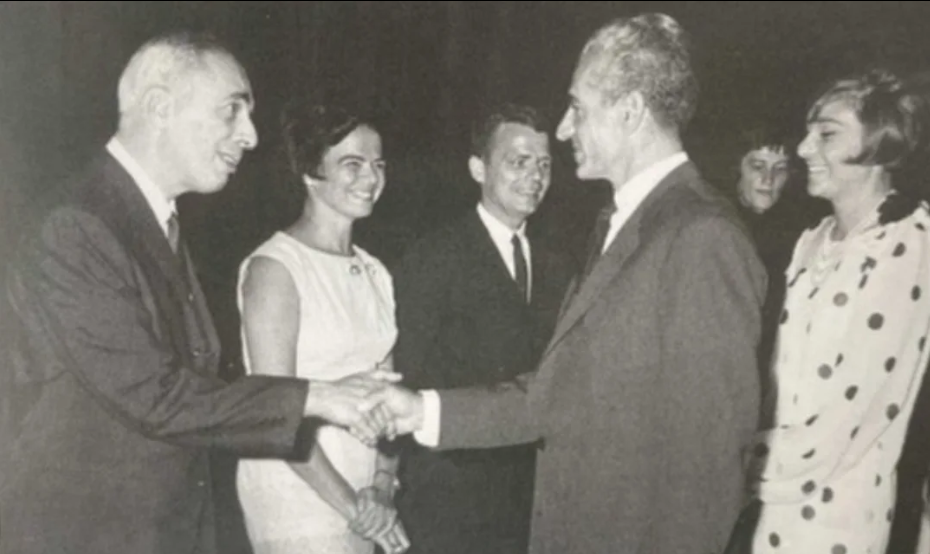
The late Bernard Lewis recorded in his memoir, Notes on a Century: Reflections of A Middle East Historian (2012), meeting the Shah of Iran “a year before” the Islamic Revolution that felled him, thus, some time in early 1978:
When I came in, the first thing he said was, “Why do they keep attacking me?” I hadn’t a clue what he was talking about. So I said very politely, “Who, Your Majesty?” And he ticked them off, “The New York Times, The Washington Post, The London Times, The Manchester Guardian, and Le Monde. The five weird sisters dancing around the doom of the West. Don’t you all realize that I’m the best friend you have in this part of the world? Why all the criticism?”
I said, my sense of mischief welling up, “Well, Your Majesty, you must remember that Western foreign policy is conducted on Marxist principles.” He was very startled at that. Then I said, “I don’t mean Karl, I mean Groucho. You have seen the Marx Brothers films?” He said, “Yes, of course,” and I continued, “Do you remember a moment when Groucho says I wouldn’t want to be a member of any club that would have me as a member? A principle of Western foreign policies is that we do not worry about the friendship of any government that would seek our friendship. It’s only our enemies in whom we are interested.” He said he understood perfectly.
Lewis goes on to note with acid contempt that “the Shah was very unpopular in liberal and enlightened circles. Everybody was in favor of the Revolution, not realizing that Iran’s new rulers were much worse than anything that the Shah could ever have thought of.” Lewis was not being wise in retrospect.
Early in 1978, Lewis had discovered Islamic Government, a book written by the Revolution’s leader, Ayatollah Ruhollah Khomeini, laying out his vision for Iran. It made clear that the unfolding Revolution had nothing to do with freedom or democracy. After several failed efforts to get journalists interested in the story, The Washington Post finally published an article quoting from Khomeini’s tract. The Post authors were called by the Central Intelligence Agency (CIA), which not only doubted the book’s authenticity, but suggested it might be a false flag by one of Khomeini’s enemies, hinting broadly it was Israel. Lewis tried through channels to have the Agency analysts see sense, pointing out that the book was published in 1970, when the Imam was an obscure exile in Iraq; there was not a person in the world who had the foresight to plant discrediting material on Khomeini that far in advance. But unreason took over many in and around Iran in 1978-79, and the CIA was a catastrophic case.
Lewis’s efforts to bring reality to the public were drowned out by a nearly unanimous press corps and “human rights” establishment that settled on a narrative—which still recurs to this day—wherein the Shah was a uniquely monstrous ruler. Looking back, the nature and quantity of the coverage of Iran by major media outlets and the NGOs in the late 1970s, as compared to the scarce and cautious commentary on the genuinely world-historical atrocities then-ongoing in the Khmer Rouge’s Cambodia, is absolutely extraordinary, as is the blind enthusiasm of these liberal institutions for the Iranian Revolution.
Once it was all over—when the Shah, so far from the bloodthirsty tyrant he was portrayed as, proved to be a patriot who would rather surrender his throne than shed the blood of his people, and Khomeini’s regime had drowned Iran in the blood of the innocent and fastened upon the country a pitiless and aggressive totalitarianism—there was no introspection from those who had willed this outcome from the safety of free Western States. The activist-journalists and -academics and “human rights” aficionados reassured themselves that they had meant well, and moved on to their next campaign against a Western-allied government assailed by anti-Western rebels.
It was in judgment of these people that Roger Scruton wrote in 1984, in an article reproduced below. Scruton points out what Lewis had noted in real-time, at that meeting with the Shah in 1978: the virulence of the anti-Shah sentiment within the Western intelligentsia that leads public opinion was not related to anything the Shah had done, but the fact he was pro-Western. Western intellectuals had, long before the 1970s, developed a hatred for the civilisation that shelters them so profound that anyone seeking the friendship of the West, even narrowly in a common cause, let alone anyone seeking to borrow from the West as a model, as the Shah had, was automatically marked as an enemy to be destroyed.
___________________________________________
In Memory of Iran
Roger Scruton
6 November 1984
The London Times
Who remembers Iran? Who remembers, that is, the shameful stampede of Western journalists and intellectuals to the cause of the Iranian Revolution? Who remembers the hysterical propaganda campaign waged against the Shah, the lurid press reports of corruption, police oppression, palace decadence, constitutional crisis? Who remembers the thousands of Iranian students in Western universities enthusiastically absorbing the fashionable Marxist nonsense purveyed to them by armchair radicals, so as one day to lead the campaign of riot and mendacity which preceded the Shah’s downfall?
Who remembers the behaviour of those students who held as hostage the envoys of the very same power which had provided their “education”? Who remembers Edward Kennedy’s accusation that the Shah had presided over “one of the most oppressive regimes in history” and had stolen “umpteen billions of dollars from Iran”?
And who remembers the occasional truth that our journalists enabled us to glimpse, concerning the Shah’s real achievements: his successes in combating the illiteracy, backwardness and powerlessness of his country, his enlightened economic policy, the reforms which might have saved his people from the tyranny of evil mullahs, had he been given the chance to accomplish them? Who remembers the freedom and security in which journalists could roam Iran, gathering the gossip that would fuel their fanciful stories of a reign of terror?
True, the Shah was an autocrat. But autocracy and tyranny are not the same. An autocrat may preside, as the Shah sought to preside, over a representative parliament, over an independent judiciary, even over a free press and an autonomous university. The Shah, like Kemal Atatürk, whose vision he shared, regarded his autocracy as the means to the creation and protection of such institutions. Why did no one among the Western political scientists trouble to point this out, or to rehearse the theory which tells us to esteem not just the democratic process, but also the representative and limiting institutions which may still flourish in its absence? Why did no one enjoin us to compare the political system of Iran with that of Iraq or Syria?
Why did our political scientists rush to embrace the Iranian Revolution, despite the evidence that Revolution under these circumstances must be the prelude to massive social disorder and a regime of terror? Why did the Western intelligentsia go on repeating the myth that the Shah was to blame for this Revolution, when both Khomeini and the Marxists had been planning it for 30 years and had found, despite their many attempts to put it into operation, only spasmodic popular support?
The answer to all those questions is simple. The Shah was an ally of the West, whose achievement in establishing limited monarchy in a vital strategic region had helped to guarantee our security, to bring stability to the Middle East and to deter Soviet expansion. The Shah made the fatal mistake of supposing that the makers of Western opinion would love him for creating conditions which guaranteed their freedom. On the contrary, they hated him. The Shah had reckoned without the great death wish which haunts our civilisation and which causes its vociferous members to propagate any falsehood, however absurd, provided only that it damages our chances of survival.
For a while, of course, those vociferous elements will remain silent on the embarrassing topic of Iran, believing that the collapse of Iranian institutions, the establishment of religious terror, the Soviet expansion into Afghanistan and the end of stability in the region are all due to some other cause than the Iranian Revolution. Those who lent their support to this tragedy simply turned their back on it and went elsewhere, to prepare a similar outcome for the people of Turkey, Nicaragua, El Salvador, Chile, South Africa—or wherever else our vital interests may be damaged.
Of course, it is difficult now for a Western correspondent to enter Iran, and if he did so it would not be for fun. He could not, like the ghouls who send their despatches from Beirut, adopt a public posture of the front-line hero. He would have to witness, quietly and in terror of his life, things which beggar description: the spontaneous “justice” of the Revolutionary Guards, the appalling scenes of violence, torture and demonic frenzy, the public humiliation of women, the daily sacrifice of lives too young to be conscious of the meaning for which they are condemned to destruction.
He would also have to confront the truth which has been staring him in the face for years, and which he could still recognise had the habit of confessing his errors been preserved: the truth that limited monarchy is the right form of government for Iran, which can be saved only by the restoration of the Shah’s legitimate successor. But such a result would be in the interests not only of the Iranian people, but also of the West. Hence few Western journalists are likely to entertain it.
 Kyle Orton's Blog