By Kyle Orton (@KyleWOrton) on 4 April 2023
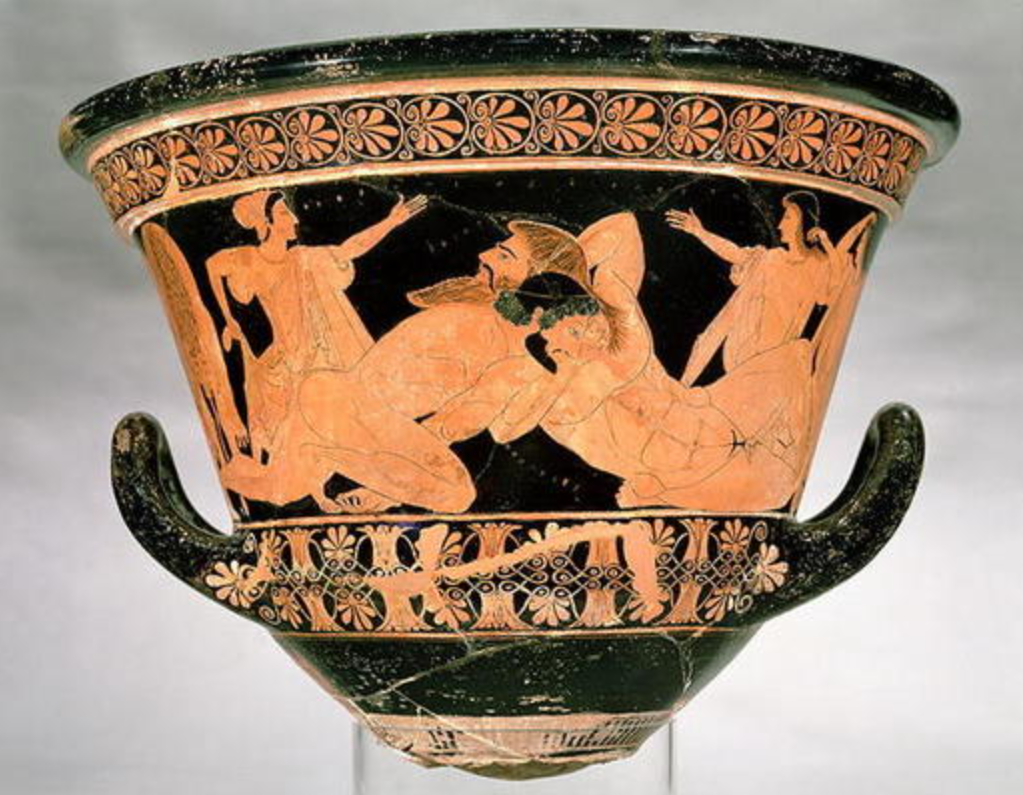
The ancient Greek assumption that physical and moral worth were inherently connected can be seen in the term “kalos”. The word is often translated into English as “beautiful”, which is literally correct but misleading in so far as it implies the word relates solely to visual aesthetics; such an understanding is too narrow and anachronistically imposes divisions between categories that the Greeks did not regard as separate. “Kalos” is better translated as “handsome” and “noble”: it was a term for things “socially sanctioned as excellent”, and axiomatically encompassed a judgment on form and spirit.
This Greek conceptual framework can be seen from the other direction, too. In the Iliad, perhaps the oldest extant work of Greek literature, written in the eighth century BC and attributed to Homer, the most contemptible character, Thersites, is as morally ugly as he is physically deformed. Underlining how the Greeks used “kalos”, when Thersites appears as an antonym for the term in the Trojan War myth, his failings include not only cowardice, which we would still recognise in the “moral” category, but vulgarity in manners, which we would tend now to think of as an aesthetic judgment. (The 2006 movie 300 about the Battle of Thermopylae was ludicrously ahistorical in many respects, but it can be said that the creators were at least being true to the Greek weltanschauung when they took the liberty of transforming Ephialtes, whose betrayal assures the Spartan defeat, into a hideous hunchback.)
The ancient Greeks are famous for being able to make anything into a competition and this certainly included what we might now call “beauty pageants” for men. However, the context for such competitions was usually festivals to the gods, some local (such as the Athenians’ Panathenaea and Theseia) and some pan-Hellenic (like the Olympics), and the metrics on which contestants were judged included more than physical attributes like body size and strength. Tests of mental acuity and moral quality were intrinsic to the contests and winners had to prevail on all metrics.
The fusion of physical and moral beauty in the minds of elite Greeks can be seen in these festivals and the other rituals and practices of the “religious” calendars that governed the Greek City States. It is also endlessly attested in the philosophy of Greece, in its “golden age” and beyond. Plato’s school was located at a gymnasia—as was Aristotle’s and that of the Cynics—and a number of Plato’s dialogues are actually set in gymnasia, a literal manifestation of his view that nature provides for “a beautiful mind in a beautiful body”, a phrase Juvenal would later embed in the Roman world (in Latin: “mens sana in corpore sano”) as an expression of the Romans’ agreement with the Greeks on this point.
That this was the understanding of greatness throughout the entire social fabric of Greece can be seen in the “kalos inscriptions”. These inscriptions of naked youthful males, often in an athletic setting, many of them on vases (see above) and some in graffiti, undoubtedly have an erotic charge, but even the etchings of the Greek lower orders contain the dual assumption that those represented are to be admired because they are bodily and spiritually beautiful. The nudity plays off the context of the Olympic Games as a signifier that the man in question is committed to Greek virtues, notably bravery (by being fully exposed) and military valour, and tied up with this organically is an association between Olympians and the gods (specifically Apollo): “the gods could be nude because they relied on themselves”, and the implication of depicting nude athletes—that they had the courage and piety to do as the gods did—was obvious to all.
When the Greek aristocracy later adopted the title “kaloikagathoi” for itself, derived from “kalos kagathos” (or “kalokagathos”), which is usually translated as “the beautiful and the good”, this was not an indication that a division between physical and moral or intellectual beauty had opened up in their minds. “Good” here meant “well-born”: it was an assertion of social status—and the right to benefit from same—against the mass of the population.
See: Thomas F. Scanlon (2002), Eros and Greek Athletics, pp. 204-07.

