By Kyle Orton (@KyleWOrton) on 23 December 2025
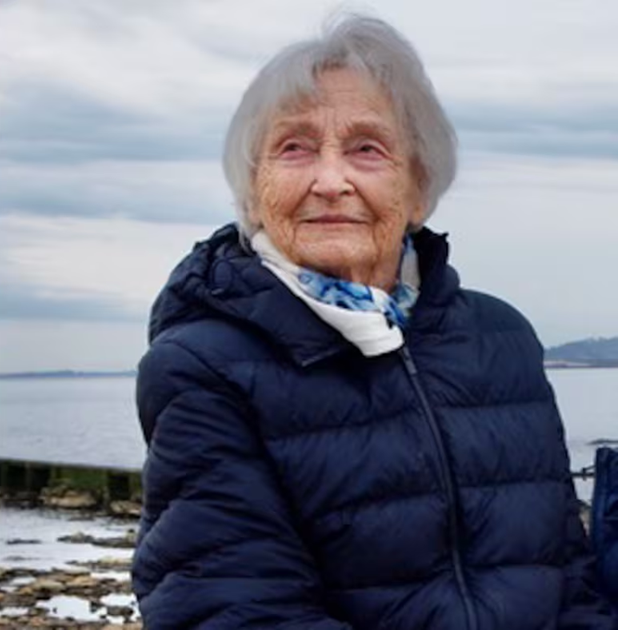
An article appeared today about an interview given by Ruth Morton, an Uruguayan woman of British descent in her late 90s, who says she worked for British intelligence during the Falklands War. Morton, whose family had served the British war effort in the 1940s, says that she was involved in spying on the Argentine submarine base at Mar del Plata, on the coast of north-eastern Argentina, 250 miles south of Buenos Aires, adjacent to the border with Uruguay. A translation of the article is given below.
___________________________
The Falklands War: The Incredible Story of the Spy Who Monitored Submarines Hidden in a Ruined Building in Mar del Plata
Ruth Morton was born in Uruguay, into a family linked to espionage since the Second World War; she is 97 years old and, in an interview with the BBC, spoke for the first time about her days as an agent of British intelligence
23 December 2025
Alejandra Conti
La Nacion
The Gold of the Rhine was the setting of the interview. What better place than the traditional café in the centre of Montevideo to talk about espionage? During the years of the Second World War, spies from different countries used to meet there to have something to drink and stare fixedly at one another over plates of strudel.
“My dad used to bring us here when we were girls,” says Ruth Morton, the interviewee. It makes sense. Her father and her older sisters were spies, she says. Like her.
Ruth is 97-years-old and decided to speak for the first time about how she was recruited by the British intelligence services in 1982, during the Falklands War. About how she, a woman then 53-years-old, operated in Mar del Plata, hidden, according to her account, among the planks of a broken floor in an abandoned building opposite the city’s naval base.
She chose to speak to a Falklander, Graham Bound, founder of Penguin News, the printed newspaper of the islands, whom she knew because he had been a schoolmate of her daughter, Patty, at the British school in Montevideo. In the 1970s, it was common for Falklanders to study in Argentina or Uruguay. The interview was broadcast on the BBC radio programme Outlook and is available on the website only in audio form.
Ruth Morton was born in Uruguay in 1928 and comes from a family of Scottish and English ancestry. Her parents, Eddie and Margaret, were proud of their British heritage, to the point that her mother preferred that Ruth not mix very much with the neighbours’ boys, who were Uruguayan.
British influence was very important in Uruguay, as it was in Argentina, where there were schools, hospitals, railway companies, and banks in the hands of English companies.
The Morton family already had a precedent of espionage, according to Ruth. During the Second World War, the British-owned railway company in Uruguay became a front for that country’s intelligence activities. Ruth’s father, Eddie, who was an employee of the railways, joined what his daughter euphemistically called “war work” and in turn recruited his two older daughters, Babs and Minna. Apparently, the work consisted of intercepting, translating, and transcribing messages.
[Morton was asked:] “Was there any logical reason to involve your sisters?”
[Morton answered:] “He knew their desire to serve the cause and knew that they would do it well. Speaking both languages was a great advantage.”
The Mortons were not the only British spies. Uruguay was neutral during the war and had become Great Britain’s main supplier of meat, grains, leather, and dairy products. In addition, its port was more convenient (technically and politically) than that of Buenos Aires. There were also spies from European countries and from the United States swarming everywhere. That they coincided at the Oro del Rhin was a very badly kept secret.
Ruth, who at that time was 11-years-old, was aware of her sisters’ work. Sometimes she answered the house telephone and had to transcribe coded messages intended for her father or for the girls.
[Morton was asked:] “Did you enjoy it? Did you treat it as a game?”
[Morton answered:] “No, not at all. It was a serious thing. I had to be careful and write word for word.”
The BBC report contends that this family played a decisive role in the fate of the German battleship Graf Spee, in December 1939, since they made calls that they knew could be detected by the Germans in order to make them believe that a large British fleet was approaching. From the Uruguayan coast, together with thousands of people, they saw the result of their operation: the explosion of the ship when its captain, believing himself cornered, decided to sink it rather than allow himself to be captured.
Forty-three years after that episode, in 1982, war returned to the South Atlantic, and someone in London remembered the surname Morton. Minna, Ruth’s sister (who by that time was an accountant at the British Embassy in Montevideo and presumably remained in intelligence), was summoned. She, in turn, recruited Ruth, who was then 53-years-old. Both were sent to Argentina.
Ruth’s mission consisted of travelling to Mar del Plata with the objective of spying on the movements of that city’s submarine base. To do this, she rented a flat far from the sea and every day took the bus to go to the terminal, which was close to the base. Finally, she found an abandoned building on an elevated plot of land. According to Ruth, she would get underneath the floorboards of the building, from where she could see the base perfectly without being seen. To get there she had to crawl along the ground and spent hours watching, lying face down, day and night.
From her account it can be inferred that the building may have been on Alem Street, behind the Mar del Plata Golf Club course, or perhaps on Peralta Ramos Avenue. The Golf Club was created in January 1900, while the Naval Base was founded in 1926, directly opposite. Despite the fact that there are at least 500 metres from where the building is presumed to have been to the breakwater where the submarines were moored, it is very possible that she had a clear view of the movements of the vessels, even without binoculars. However, it is difficult to believe that the base was close enough to allow something to be thrown, as she claims in one part of the article.
In order to report on the movements of the submarines without being tracked, she had to take at least two buses to a place outside the city and use a public telephone to call an Anglo-Argentine contact. This person would usually give her another telephone number, always a different one, to call another person. The latter had a British accent.
Only once did she see a significant movement to report: one night when the three submarines went out at the same time and she did not see them return.
In fact, only two of the three submersibles took part in the Falklands War. One was the ARA Santa Fe, which carried part of the troops who landed on the islands on 2 April [1982, the first day of the Argentina invasion of the British islands]. After a brief return to the Naval Base, it was sent to the South Georgia Islands, where it was captured. The other was the ARA San Luis, which carried out 39 days of patrols and 864 hours of immersion, despite its serious equipment failures. The vessel managed to fire three missiles and evaded several attacks.
The third, the ARA Santiago del Estero, had been deactivated in 1981 and did not participate in the war. However, when Ruth Morton indicates that she saw the three submarines leave together, she may be referring to an episode recounted by [Argentine historian] Jorge Boveda in issue 816 of the Boletín del Centro Naval. He explains that on 22 April 1982 that submarine was taken out together with the other two, sailing on the surface but without being able to submerge, in order to give the impression that all three were operational. In reality, the ARA Santiago del Estero was heading to Puerto Belgrano, where it was hidden.
Spying and Knitting Woollen Caps
Morton’s mission, begun in April [1982], extended until the beginning of June [shortly before the British expelled the Argentine occupiers], in the middle of the southern winter. At one point her Anglo-Argentine contact (whom she did not trust) disappeared. The spy was left without funds for food and, in order to get money, she began to knit caps with the phrase “Mar del Plata” on the front. That activity broke all espionage protocols, but she assures that it was a success. She sold them through the porter of a hotel.
During all that time, she says, her only company was a capybara that came and went. “It was an old and friendly animal, but it smelled horrible, poor thing,” she recalls. Capybaras are not sea animals, but animals of rivers or lagoons. People from Mar del Plata recall that to the south of the port area, around Punta Mogotes, there were capybaras in some rough lagoons, just as currently occurs at Laguna de los Padres.
The ending of the story is striking. Ruth states that one night in June a ship at sea fired directly at her observation point, and killed the capybara. She says that she is convinced that those on the ship had detected her movements and that the animal saved her life, since the shots ceased after it was hit. Whether that was so or not, that was also the end of her mission. Her superiors considered that the situation had become too risky and ordered her to return to Montevideo. It was the first days of June 1982; the end of the conflict was also approaching.
At 97-years-of-age, Ruth believes that she had no choice but to act, says that she never expected any recognition, and that she would do it again if it were necessary.
There is another aspect of the story that remains a mystery. Ruth says that both she and Minna were assigned to Argentina, but she does not clarify what her older sister’s mission was.
“If she was simply supporting Ruth, why did she stay after she returned home?” Bound asks himself. He knows that Minna travelled to London in 1992. “A file of documents found in the family home shows that she was received in the House of Commons and at the prestigious Carlton and Reform Clubs. Most of us would not even be given the time of day by British intelligence, but there was Minna receiving VIP treatment. She even spent a day at number 3 Carlton Gardens, a well-known MI6 [or Secret Intelligence Service (SIS)] building in London’s Mayfair district, where her programme included a talk on ‘Buenos Aires in 1982’. Was she referring to the submarine mission or to an unknown task elsewhere in Argentina?”
Minna died in 2012. Ruth continues to live in Montevideo, where from time to time she goes to have tea at the Oro del Rhin. From one of the café’s walls, a photo of the Graf Spee bears witness to her visits.
 Kyle Orton's Blog