By Kyle Orton (@KyleWOrton) on 25 January 2026
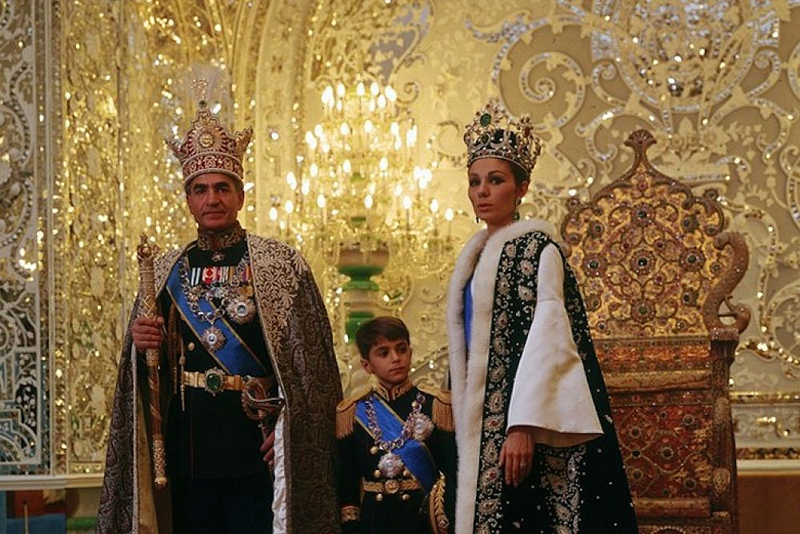
The idea of sacral Monarchy stretches back to the foundations of the Persian Empire under Cyrus the Great, over 2,500 years ago, who ruled as Shahanshah (King of Kings), an office originating with the Zoroastrian deity Ahura Mazda, and all Kingly successes were attributed to this god. It is this sense of Persian Kings as vessels for divine will that explains why they are so anonymous when compared to, say, the Roman Caesars: what mattered was the role, not the idiosyncrasies of the individual playing it.
The Achaemenids (559-330 BC) were undone by Alexander of Macedon and Greek ideas were thereafter infused into the Persian concepts of Kingship.[1] The Parthian or Arsacid Dynasty (247 BC-224 AD) retained some of the Hellenization and continued presenting the Shahs as appointed by the gods.
Part of the way the Sasanians (224-651 AD) built a much more powerful Empire was remaking Zoroastrianism and fusing it with the State in a totalising manner not previously seen. The “Mazda-worshipping” Sasanian Kings whose “seed is from the gods” were hinting at a claim to divinity.[2] The result was that Zoroastrianism could not long outlive the destruction of the Sasanid dynasty when the Arabs overran Persia. “The faith was ruined”, as one mowbed (Zoroastrian priest) lamented after the last Sasanian King was killed.[3] The idea of a holy bloodline with a God-ordained right to rule survived, though, and as the Arab Empire constructed Islam over subsequent centuries it would find echoes in the Shi’a branch of the faith.[4]
The idea of Iranian Sacral Kingship persisted into the Islamic period, but it was difficult and somewhat spectral for the ideological reason that the Caliphs had the claim to be God’s deputy on earth and any claimant to be the “Shadow of God” alongside that risked shirk. More practically, with Iran first consumed by the Umayyad and Abbasid Caliphates, then struggled over by the Seljuks, shattered by the Mongols, and ravaged again by Tamerlane, it was difficult to keep hold of the idea.
The proper revival of the notion came with the re-emergence of Iran under the Safavids (1501-1722), whose missionary Imperium fully embraced the concept of Divine Kingship and tied it once again to a sacred bloodline. The Safavids were Shi’is, and after rapidly converting Iran they could square the circle on idolatry by claiming to be the placeholders for the Hidden Imam. This Mahdism fit naturally into the structure of Shi’ism’s reverence for the Imams.
The Afghan interlude under the Hotaks (1722-36) and the rise and fall of Nader Shah (r. 1736-47) strained the idea of sacral Kingship, and with the advent of the Zand Dynasty (1751-96) it was set aside in favour of a patriarchal-tribal model of leadership—the Zand dynasty’s founder, Karim Khan Zand (r. 1751-79), took the title “Regent of the People” (Vakil-e Ra’aya).[5]
The Qajars (1796-1925) who replaced the Zand dynasty did revive the notion of Sacral Monarchy, particularly under their founder Agha Mohammad Khan Qajar (r. 1794-97), restoring the title, “Shadow of God”, but this faded reasonably quickly and even Agha Mohammad never claimed to be representing the Hidden Imam.
Reza Khan (r. 1925-41) made Divine Kingship an aspect of his Court propaganda, but it is unlikely he personally took it very seriously. An earthy officer and an admirer of Mustafa Kemal Atatürk, sharing his mission to modernise (read: Westernise) and secularise his State and society, Reza Shah, as he became, had few illusions about where the basis of his power lay, namely with the Army. Reza Shah found emphasising the antiquity of Persian Monarchy useful in legitimising his upstart dynasty, for antiquity is a reliable source of esteem,[6] but there was little space for the mystical. Even in practical political terms, Reza Khan had little reason to appease the clergy: those who stood in his way were ruthlessly dealt with.
Reza’s son, Muhammad Reza Pahlavi (r. 1941-79), the last Shah of Iran, was different altogether: personally devout and highly mystical, the Shah believed his life to be guided by God and attributed his survival—of childhood accidents and illnesses, the multiple assassination attempts, and the mutiny of Prime Minister Mohamed Mossadeq that temporarily sent him into exile in 1953—to the intervention of the Lord, who had work for him to do.[7]
In the late 1960s, the Shah told an interviewer that Persian Kings were “a symbol of earthly redemption, perhaps, because the King was the linkage with the Almighty”.[8] The Shah’s belief that he held his office under a mandate from Heaven that was contractual with his people was quite sincere. Over and over, in public and private utterances, the Shah said that monarchy was the only legitimate mode of rule for Iran—and the only possible mode of rule. A country as diverse as Iran, which the Shah always thought of as an Empire, could only be held together by “unity from above”,[9] and for that it required an Emperor at the centre who stood as God’s Shadow and ruled according to the principles of the faith.[10] The Shah was basically correct about this.
The Iranian State in its various forms has always trended towards—and been seen as trending towards—estebdad, literally meaning arbitrary rule, but with a connotation of absolutism, too: the ruler’s theoretical ability to exercise his arbitrary authority was limitless, though this did not always mean centralised, absolute rule. Indeed, it often did not because, unlike the nominally absolutist European systems in the Early Modern period, the “legitimacy” of changing the ruler by force was accepted and in effect “institutionalised”: anyone who was able to get into power was seen to have acquired the farr, divine grace or favour to rule. The incentive for rebellion inherent in this is obvious. Whether a ruler had the farr was ultimately a question of popular perception: Kings capable of sustaining their rule had it by definition, the more so if they brought order and prosperity; weak Kings whose durability was in question would provoke doubts, and, equally, those Kings who did acquire arbitrary and absolute power created resentments that were interpreted cosmically, since there was a sense that God withdrew the farr from rulers who were unjust to the people. The practical outcome in Iran was a system that veered constantly between despotism and chaos.[11]
In terms of Iranian political cultural, the upshot was a popular perception of the State as abusive and corrupt, with periods of calm sustained only by the spectacle of the Good King, an image and symbol separate from and above the State institutions to which people could give their allegiance. When Iranians spoke of “the Shadow of God”, it was to this “image of a divine protector, binding the nation together and validating its mission”, that they referred.
The Shah was a deeply patriotic Iranian and thoroughly Westernised in his sensibilities, a “modern” man simultaneously devoted to what he saw as the ancient and divine pillars of his country, Shi’ism and the Monarchy. This duality applied to his profound attachment to the farr, which the Shah interpreted as a divine gift that relied on a social contract with his people. Ambivalent about democracy in the Western style, the Shah nonetheless saw his legitimacy in effectively democratic terms: he held the farr so long as he had the loyalty (or at least the acceptance) of his people, and that was sustained by acting as a benevolent father, protecting their interests and providing them justice. The implication for the Shah was a belief that displays of mass opposition were an indication the farr was slipping away, and that attempting to hold power by shedding the people’s blood was the surest way to lose the farr and the throne.[12] This outlook was to have global consequences when the Islamic Revolution erupted against the Shah in 1978.
_____________________________
NOTES
[1] The impact of Alexander the Great on Persian Monarchy was more reinforcing than subversive for the simple reason that he took on the role. Pierre Briant famously called Alexander “the last of the Achaemenids”.
[2] Vesta Sarkhosh Curtis and Sarah Stewart [eds.] (2008), The Sasanian Era, pp. 61-64.
[3] Tom Holland (2012), In the Shadow of the Sword: The Battle for Global Empire and the End of the Ancient World, p. 403.
[4] For a full discussion of this dynamic, see: Patricia Crone (2012), The Nativist Prophets of Early Islamic Iran: Rural Revolt and Local Zoroastrianism.
[5] John L. Esposito (2004), The Islamic World: Past and Present, p. 79.
[6] Robert Birkley [ed.] (2017), Botero: The Reason of State, pp. 50-51.
[7] Muhammad Reza Pahlavi (1980), Answer to History, pp. 57-60.
[8] Edward A. Bayne (1968), Persian Kingship in Transition: Conversations with a Monarch Whose Office is Traditional and Whose Goal is Modernization, p. 72.
[9] The Shah, Answer to History, p. 129.
[10] The Shah, Answer to History, p. 60.
[11] Homa Katouzian (2009), The Persians: Ancient, Medieval, and Modern Iran, p. 5.
[12] Andrew Scott Cooper (2016), The Fall of Heaven: The Pahlavis and the Final Days of Imperial Iran, pp. 35-36, 74.
 Kyle Orton's Blog
Very interesting.
How might this ancient but secular custom have influenced Ruhollah Khomeini’s theological concept of velayat-e faqih (vilayet-i-faquih) — that in the absence of the occulted Twelfth Imam (the Shi’a Mahdi), a Shiite “supreme jurist” (the present theocracy’s Supreme Leader) holds utterly supreme political/societal/economic/military/etc. power.
Sounds like Khomeini was tacking onto a historical Persian “TRVTH” in order to empower himself.
LikeLike
Definitely. Was Khomeini’s method all along, though, that as well as tapping into the ancient – he was effectively reprising the Safavid claim to be a placeholder for the Hidden Imam (and, indeed, let stand the idea he was the Mahdi) – he was properly revolutionary. The ulema ruling has no precedent and was quite explicitly rejected for most of Shi’a history, but he was able to package innovation as a logical extension of things everyone accepted were traditional.
LikeLike
“things everyone accepted were traditional” … Very much including the bonyads, which (IIRC) were at the root of the split between Khomeini and Montazeri.
The present regime is utterly corrupt. Back in the day, the children of the clergy were called “The Rich Kids of Tehran”.
The Jamkaran Mosque, south of Qom, is a pious carnival of self-inflated chest-beating, based on an ancient fraud initially designed to make some farmer money off the religious tourist trade.
Elements in the international Muslim press call the Iranian theocracy “Islamic”. Wholly apart from ordinary sectarian differences, doing so is a blood insult to the larger religion.
LikeLike