Category Archives: British Domestic Terrorism

Jihadist Terror Remains a Significant Problem for Britain

By Kyle Orton (@KyleWOrton) on 4 May 2017

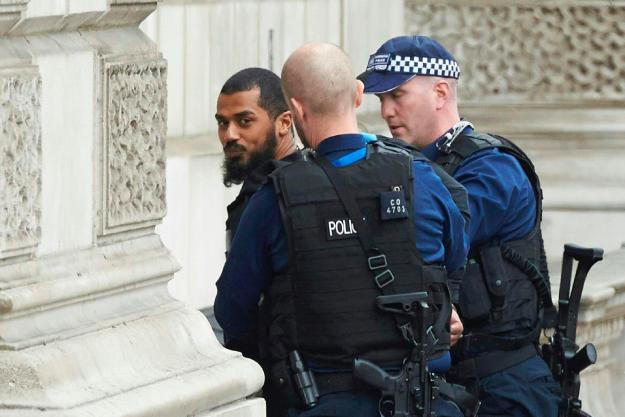
Khalid Mohamed Omar Ali being arrested (image source)

Over the past week, the authorities have disrupted two potential terrorist attacks in London. This follows the Westminster Bridge attack in March, which was claimed by the Islamic State (IS). Britain has been one of the most targeted states by IS’s campaign of global terror, and these latest incidents—whether or not they transpire to be IS-linked—underline the scale of the terrorist threat to Britain. Security forces prevented thirteen attacks in the U.K. between June 2013 and March 2017, and at any one time there are five-hundred live investigations into potential terrorist incidents, with 3,000 Britons believed to be capable of committing an act of domestic terrorism. Continue reading

Don’t Assume the Westminster Terrorist is a ‘Lone Wolf’

By Kyle Orton (@KyleWOrton) on 18 April 2017

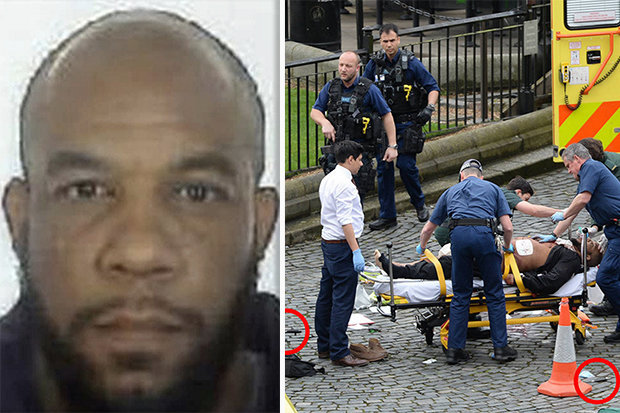
The 22 March attack outside Westminster by Khalid Masood is the most significant act of Islamist terrorism since the 7 July 2005 bombing by al-Qaeda of the London public transport system. Masood’s attack highlights a number of historic trends in British jihadism and starkly poses the question of the extent of IS’s penetration of the United Kingdom. Continue reading

Islamic State Claims the Westminster Attack

By Kyle Orton (@KyleWOrton) on 31 March 2017

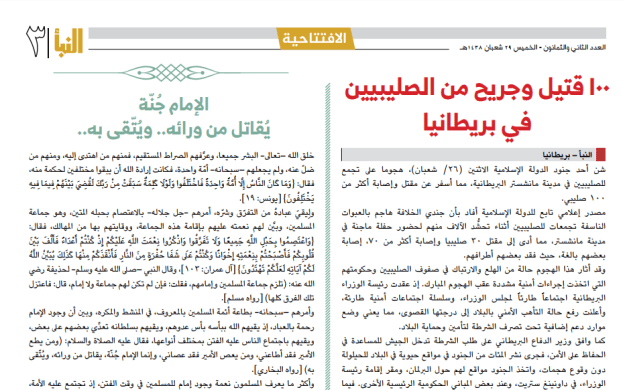
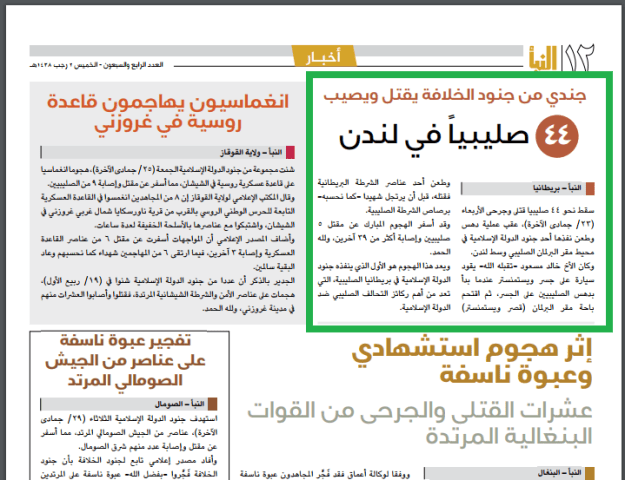
Al-Naba 74, page 12, 30 March 2017

The seventy-fourth edition of al-Naba, the Islamic State’s newsletter, released online on 30 March 2017, reiterated the terrorist group’s 23 March claim via Amaq of the 22 March Westminster attack by Khalid Masood (born: Adrian Russell Ajao). The brief article is reproduced below.
Continue reading

America Sanctions Anjem Choudary and other British Islamic State Jihadists

By Kyle Orton (@KyleWOrton) on 30 March 2017

Anjem Choudary (image source)

The State Department designated five individuals on 30 March 2017 as Specially Designated Global Terrorists (SDGTs), imposing sanctions on them for having “committed, or [for] pos[ing] a significant risk of committing, acts of terrorism that threaten the security of U.S. nationals or the national security, foreign policy, or economy of the United States.” Four of those sanctioned are members of the Islamic State (IS), including two key British operatives in the group’s global network, and the other is a member of al-Qaeda. On the same day, the Treasury Department sanctioned two IS operatives involved in funding and guiding external IS operations in the Far East and Southeast Asia. Continue reading

The Need for Caution in Releasing Guantanamo Inmates

Originally published at The Henry Jackson Society.

By Kyle Orton (@KyleWOrton) on February 21, 2017

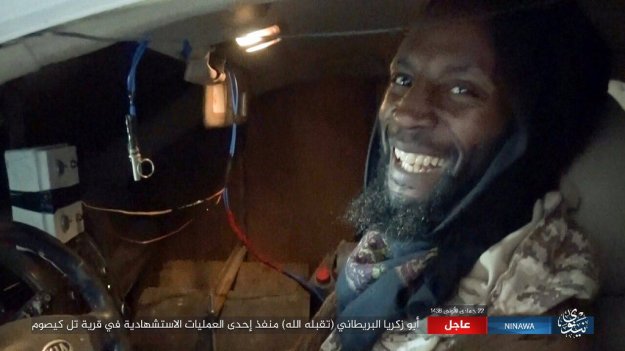
Ronald Fiddler (Abu Zakariya al-Britani)

Ronald Fiddler (Abu Zakariya al-Britani)

Since the offensive against Mosul, the Iraqi capital of the Islamic State (IS), began five months ago, IS has expended a high number of lives quite deliberately in suicide attacks. One of the suicide-attacks conducted on 20 February 2017, a car bombing against an Iraqi base, was by Abu Zakariya al-Britani, a British citizen now identified as Ronald Fiddler from Manchester. In 2002, Fiddler, then calling himself Jamal Udeen al-Harith, was sent to Guantanamo Bay, before being released in 2004 while still protesting his innocence. After suing the British government over his imprisonment, Fiddler received a substantial cash settlement in order to avoid compromising state secrets. Fiddler’s demise invites some revisiting of widely-held assumptions surrounding Guantanamo. Continue reading

Islamic State Guided Plot to Murder American Troops in Britain

By Kyle Orton (@KyleWOrton) on May 13, 2016

Junead Khan (left) and Shazib Khan (right)

Junead Khan (left) and Shazib Khan (right)

Junead Khan, 25, of Marlow Avenue, Luton, was sentenced to life imprisonment—to serve a minimum of twelve years—today for using his job as a delivery driver to scout out an attack on American troops stationed at Lakenheath in Britain. Khan had gathered materials on bomb-making and browsed Amazon for a knife like that used by Mohammed Emwazi (Abu Muharib al-Muhajir), the Islamic State’s British video butcher, widely known as “Jihadi John,” who was killed in a drone strike in November 2015. Khan, who was arrested on 14 July 2015 with his younger uncle, Shazib Khan, 23, intended to fake a road accident and then attack those who came to assist. Junead and Shazib were found guilty of terrorism offences for their plans to travel to Syria and sentenced to seven years each, with an extended period of five years on licence. Continue reading

The Rise and Fall of Mohammed Emwazi

By Kyle Orton (@KyleWOrton) on January 20, 2016

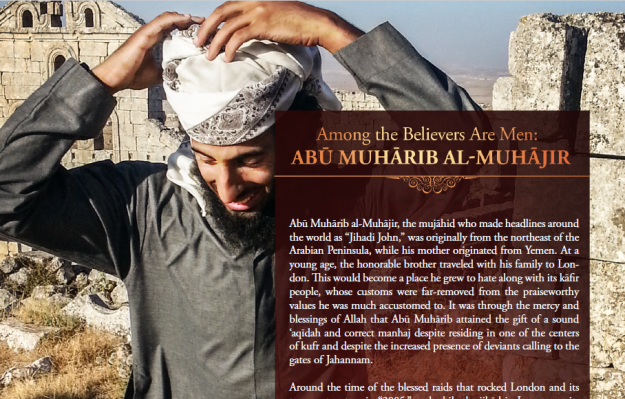
Emwazi

Emwazi’s eulogy picture in Dabiq

Yesterday, the Islamic State (IS) released their thirteenth issue of Dabiq. Among many things, it contained an admission of death for Mohammed Emwazi (“Jihadi John”). Referred to by his kunya, Abu Muharib al-Muhajir, Dabiq said (pp. 22-23) Emwazi had been hit by an “unmanned drone in the city of ar-Raqqah” on November 12, “destroying the car and killing him instantly.” The biography that Dabiq offered gave some intriguing details, confirming some surmises I had made about Emwazi when his identity was revealed last spring, including his early involvement in an al-Qaeda network in London sending fighters to al-Shabab in Somalia—the thing that brought him to the attention of the security services, confirming that the truth was the inverse of CAGE’s infamous claim that harassment by the MI5 had radicalized Emwazi—and that Emwazi had left Britain to do jihad in Syria in the company of another British citizen. Emwazi was also in the thick of it when IS broke from al-Qaeda and offers an interesting and rare example of a European IS fighter entrusted with an internal security role for the caliphate.
Continue reading

An Update On The Anti-Assad Imam Killed In London

By Kyle Orton (@KyleWOrton) on April 13, 2015

Abdul Hadi Arwani

Abdul Hadi Arwani

In Brent, northwest London, in the evening of April 12, a 46-year-old man was arrested as part of the ongoing investigation into the April 7 murder of the Syrian-born imam, Abdul Hadi Arwani, a long-time opponent of the Syrian regime of Bashar al-Assad.

Writing about the murder of Arwani last week, I noted that the available evidence suggested the motivations of the murderer(s) could be:

  • Financial: related to Arwani’s business dealings as the owner of his construction company
  • Other local or personal
  • Far-Right anti-Muslim
  • Intra-Islamist: Arwani had been the director at the Salafist An-Noor Mosque and was himself clearly an Islamist, but Arwani was against the Islamic State (ISIS), for example, which might have made him enemies among some congregants
  • Agents of the Assad regime, conceivably with the complicity of Iran and Russia

Those options still stand, but some important updates over the weekend have helped alter the relative likelihood of each. Continue reading

Who Killed The Anti-Assad Imam In London?

By Kyle Orton (@KyleWOrton) on April 9, 2015

Abdul Hadi Arwani

Abdul Hadi Arwani

Abdul Hadi Arwani, a Syrian-born imam, was found shot dead in his car on Tuesday in Wembley, northwest London. The British police are still refusing to officially name Arwani, but his friends and supporters have done so. Arwani leaves behind six children.

There are many possibilities for who killed Arwani. As the manager of a construction firm, it could be a deal gone wrong. The involvement of anti-terrorism police in the investigation into Arwani’s murder could indicate a far-Right anti-Muslim assailant. However, a source close to the investigation said that Arwani was struck down in an operation that had all the hallmarks of a “State-sponsored assassination“. To find that the long arm of Bashar al-Assad’s mukhabarat had caught up with Arwani would hardly be a surprise. Continue reading

CAGE Still Has Questions To Answer About Mohammed Emwazi (“Jihadi John”)

By Kyle Orton (@KyleWOrton) on April 3, 2015

Moazzam Begg

Moazzam Begg

The outreach director of CAGE (formerly Cageprisoners), Moazzam Begg, went to Syria between October 2012 and April 2013. Begg was arrested in Britain on Feb. 25, 2014, on terrorism-related charges because while in Syria, Begg attended a terrorist training camp. Begg was held in Belmarsh until Oct. 1, 2014. Begg had been due to begin trial on Oct. 5, 2014, but that trial was abandoned because of new evidence that meant there was “no longer a realistic prospect of gaining a conviction,” and Begg was released.

Begg is on record as having said that he “help[ed] to run a training camp in the countryside near Idlib … where opponents of the [Assad] regime could undergo physical exercise and acquire the rudiments of first aid and military training, with fake wooden guns.” There is certainly an ambiguity here: the only real defensive policy for Syria’s civilians is one that overthrows Assad, so Begg’s claim that what he did “was not an act of terrorism, but an attempt to help people defend themselves,” is not, on its face, ridiculous. Begg’s problem is that this was not a camp for Syrians; the camp he “help[ed] to run” was for foreign al-Qaeda members, who have done immense damage to the anti-Assad cause, associating it with fanaticism and atrocity and warding off necessary international support that could have toppled the dictator. Continue reading