Category Archives: Jihadi Output

Islamic State Newsletter Claims Algerian Suicide Bombing

By Kyle Orton (@KyleWOrton) on 9 April 2017

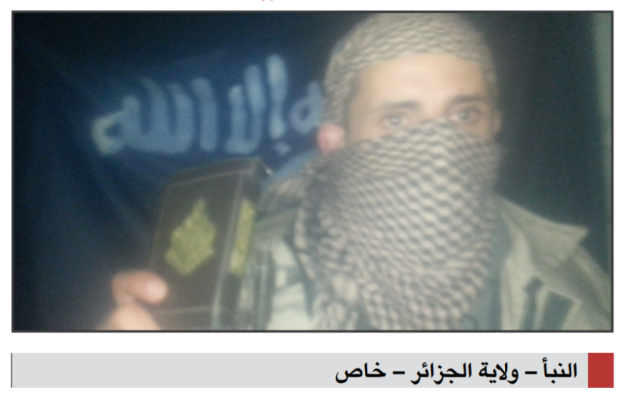
Picture published in Al-Naba 71 of Izzadeen Balqamri, the Islamic State suicide bomber in Constantine, Algeria, on 26 February 2017.

In the seventy-first edition of Al-Naba, the Islamic State’s English-language newsletter, published on 9 March 2017, the organisation claimed responsibility for the suicide bombing outside the police station in Constantine, Algeria, on 26 February. Al-Naba published a picture of the attacker and named him as Izzadeen Balqamri. Continue reading

An American Jihadist At the Top of the Islamic State

Originally published at The Henry Jackson Society

By Kyle Orton (@KyleWOrton) on 9 April 2017

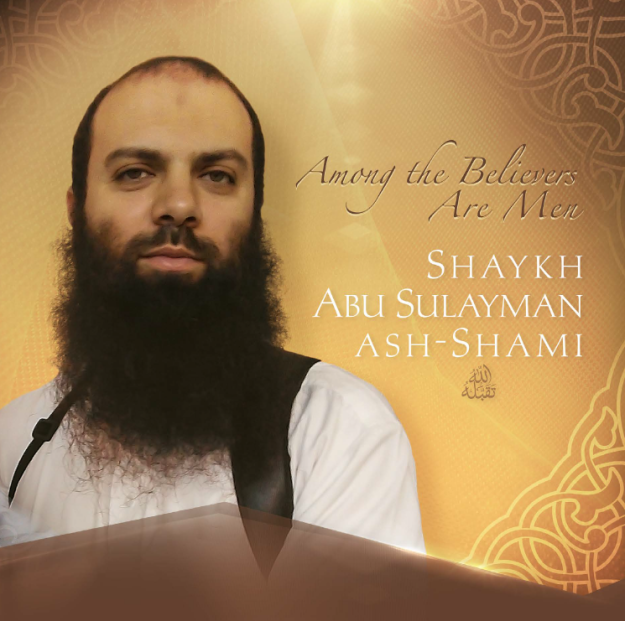
The eighth edition of the Islamic State’s magazine, Rumiyah (Rome), was released on 5 April 2017, and contained an obituary for one of the architects of the magazine itself. Named by his kunyas, Abu Sulayman al-Shami, Abu Sulayman al-Halabi, Abu Maysara al-Shami, and Ahmad Abdul-Badi Abu Samrah, the jihadist referred to is Ahmad Abousamra, a U.S.-Syrian dual citizen. Abousamra is quite possibly the most senior American ever to have been in IS’s ranks, and the Rumiyah article gives a very interesting glimpse more generally of IS’s hierarchy. Continue reading

Rumiyah Profiles Ahmad Abousamra, A Senior American in the Islamic State

By Kyle Orton (@KyleWOrton) on 8 April 2017

The eighth edition of the Islamic State’s magazine, Rumiyah (Rome), was released on 5 April 2017, and contained an obituary for one of the architects of the magazine itself. Named by his kunyas, Abu Sulayman al-Shami, Abu Sulayman al-Halabi, and Ahmad Abdul-Badi Abu Samrah, the jihadist referred to is Ahmad Abousamra, a U.S.-Syrian dual citizen. Abousamra is quite possibly the most senior American ever to have been in IS’s ranks, and the Rumiyah article gives a very interesting glimpse more generally of IS’s hierarchy, particularly the importance of its media and the late emir of that department, Abu Muhammad al-Furqan. The Rumiyah article is reproduced below with some editions in transliteration, occasional explanatory notes, and interesting or important aspects highlighted. Continue reading

Islamic State Spokesman Attacks Trump, Says Enemies Will Be Defeated

By Kyle Orton (@KyleWOrton) on 7 April 2017

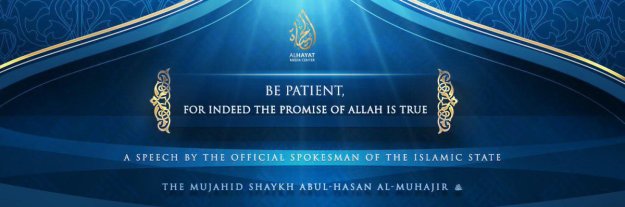
The Islamic State’s (IS) official spokesman, Abu Hassan al-Muhajir, released a speech on 4 April 2017, his second. An English transcript of the speech, entitled, “So Be Patient. Indeed, the Promise of Allah is Truth” or “Patience, the Promise of God is True”, was released by al-Hayat Media Center and is reproduced below. Continue reading

Islamic State Claims the Westminster Attack

By Kyle Orton (@KyleWOrton) on 31 March 2017

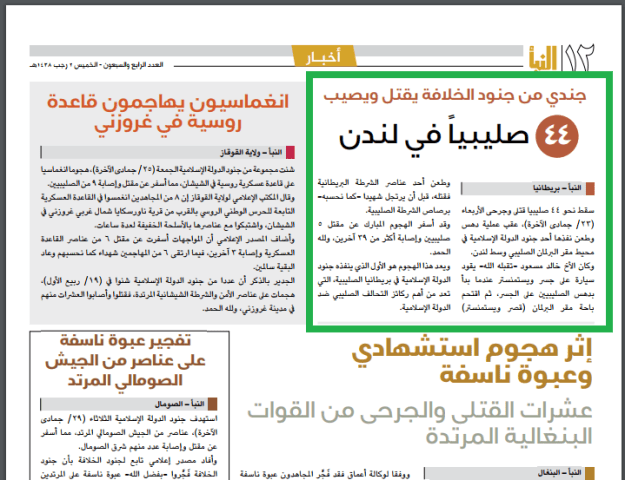
Al-Naba 74, page 12, 30 March 2017

The seventy-fourth edition of al-Naba, the Islamic State’s newsletter, released online on 30 March 2017, reiterated the terrorist group’s 23 March claim via Amaq of the 22 March Westminster attack by Khalid Masood (born: Adrian Russell Ajao). The brief article is reproduced below.
Continue reading

Australian Jihadi Spokesman Distances Hay’at Tahrir al-Sham From Al-Qaeda, Criticises America

By Kyle Orton (@KyleWOrton) on 20 March 2017

Mostafa Mahamed on Sky News, August 2016

Mostafa Mahamed (Abu Sulayman al-Muhajir) is a U.S.-designated terrorist, an al-Qaeda operative who has formally resigned from al-Qaeda’s branch in Syria, Jabhat Fatah al-Sham (JFS), which was previously Jabhat al-Nusra and has now reorganized itself as Hay’at Tahrir al-Sham (HTS). Earlier this month, on 11 March, Michael Ratney, the U.S. special envoy to Syria, released an open letter (in Arabic) labelling all constituents of HTS as terrorists seeking to exploit the Syrian opposition, and incited divisions within the Islamist sections of the insurgency by including Ahrar al-Sham—heretofore a close HTS ally, though recently involved in clashes with the group—as part of the Syrian revolution. HTS issued a formal response on 12 March and, on 20 March, Mahamed issued his own response, which is reproduced below. The main themes were anti-Americanism and dissuading the Syrian armed opposition that the U.S. was an ally; arguing that HTS was different than JFS and unconnected to al-Qaeda; and the strong impression of a threat should the U.S. move against HTS—while explicitly denying that such a threat was being made.
Continue reading

Al-Qaeda in Syria Denounces America, Claims to Be the Revolution

By Kyle Orton (@KyleWOrton) on March 13, 2017

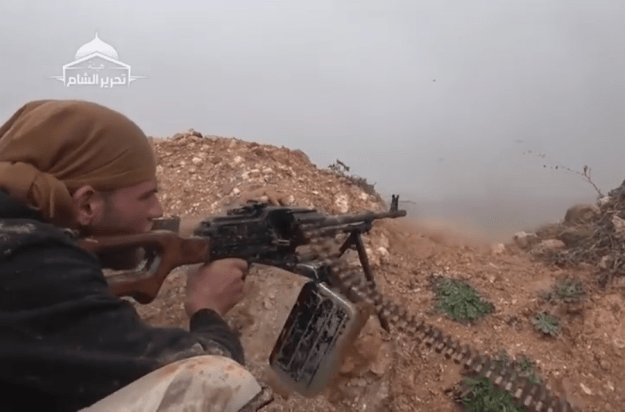
Hay’at Tahrir al-Sham fighter engaging the Assad regime

Michael Ratney, who has been the United States Special Envoy for Syria since July 2015, wrote a public letter , released on 11 March 2017, which labelled all constituent parts of Hay’at Tahrir al-Sham (HTS) as members of al-Qaeda and therefore as terrorists.[1] On 12 March, HTS’s “Administration of Political Affairs”—its newly-minted political office, perhaps evidence of an evolution in HTS’s thinking about an endgame in Syria—issued a statement in reply, which is reproduced below.
Continue reading

The Islamic State’s Shadow War With Israel

By Kyle Orton (@KyleWOrton) on March 5, 2017

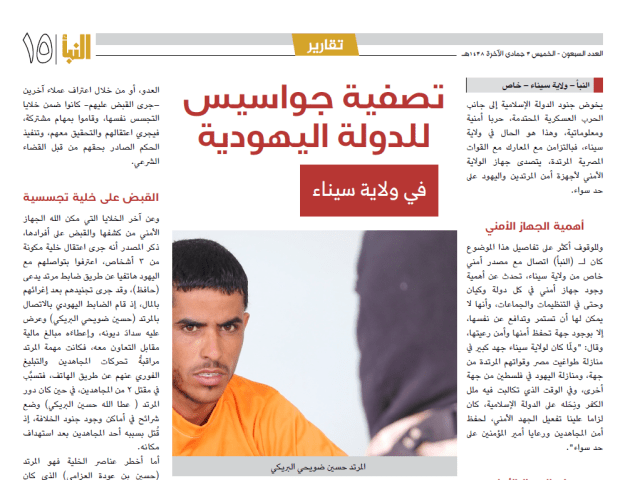
Al-Naba 70, released on 2 March 2017, p. 15. The caption under the picture says: “The apostate Husayn Duwayhi al-Bareeki”

In the 70th edition of Al-Naba, the weekly newsletter of the Islamic State (IS), entitled, “The Liquidation of Spies for the Jewish State” (tasfiya juwasees lil-dawla al-yahudiya), which did include a description of IS’s Wilayat Sinai having eliminated an Israeli spy network, but also included more general information about the IS security structure in Egypt. Continue reading

Jihadi Cleric Calls for Al-Qaeda’s Leader in Syria To Be Put on Trial

By Kyle Orton (@KyleWOrton) on March 3, 2017
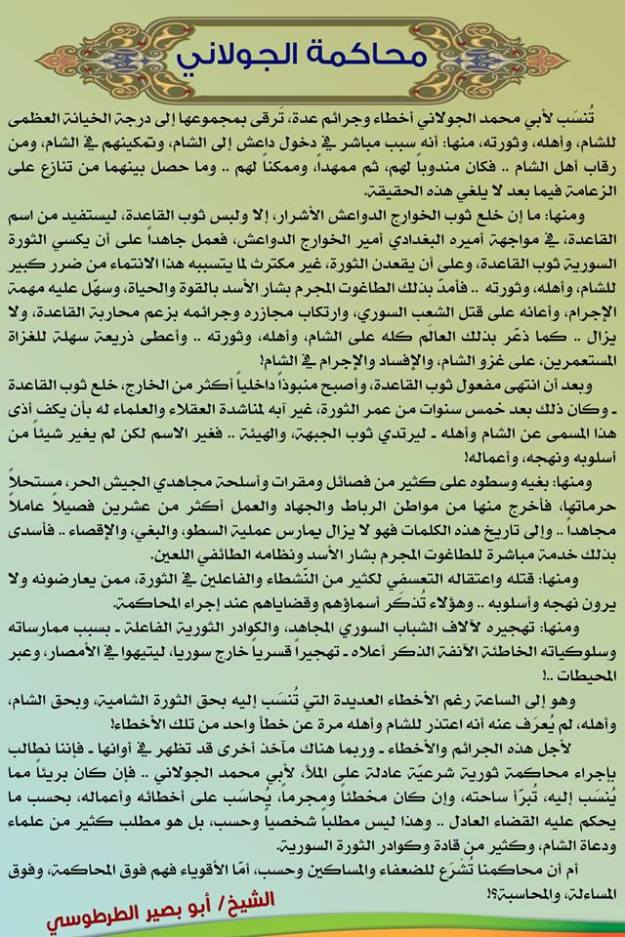
Abdul Munim Halima (Abu Basir al-Tartusi), a Syrian previously based in London, is an important jihadi-salafist scholar, who has diverged from some aspects of jihadism since the 7 July 2005 massacre on the London subway system by al-Qaeda. As the Syrian rebellion has progressed, Halima has departed even further from key jihadi ideologues that continue to take al-Qaeda’s line and support its branch in the country, Jabhat al-Nusra, which formed as a splinter from the Islamic State and has now rebranded itself as Hay’at Tahrir al-Sham. Halima has long expressed the view that al-Nusra and its leader, Ahmad al-Shara (Abu Muhammad al-Jolani), were insufficiently focused on Syrian needs. Halima tended to favour Ahrar al-Sham, an insurgent group with deep links to al-Qaeda, but which has presented its jihadism within a more nationalistic framework. Halima retains sway over Islamist opinion, especially in Syria, so his fatwa today calling for al-Shara to be put on trial for crimes against the Syrian revolution is noteworthy. Halima was especially exercised that the recent attempts by al-Shara to separate his organization from al-Qaeda came so long—and so unconvincingly—after so many had begged him for so long to carry out this policy. Instead, says Halima, al-Shara bullied and dominated the Syrian insurgency in the north under the flag of al-Qaeda, providing the regime of Bashar al-Assad with an alibi for his barbaric conduct in suppressing the insurrection. This is one of several “crimes” Halima says al-Shara should face a court for. The fatwa is reproduced below with some editions to transliteration and syntax.
Continue reading

When the Islamic State’s Founder Clashed with an Al-Qaeda Cleric

By Kyle Orton (@KyleWOrton) on February 12, 2017

Abu Musab al-Zarqawi [left] and Abu Muhammad al-Maqdisi [right]

Al-Qaeda’s expulsion of the Islamic State (IS) from its ranks three years ago did not come from nowhere. IS had always been problematic and the dispute in the months leading up to the decisive break was far from the first time that Al-Qaeda “central” had clashed with the Iraq-based group. Continue reading