Category Archives: Naba

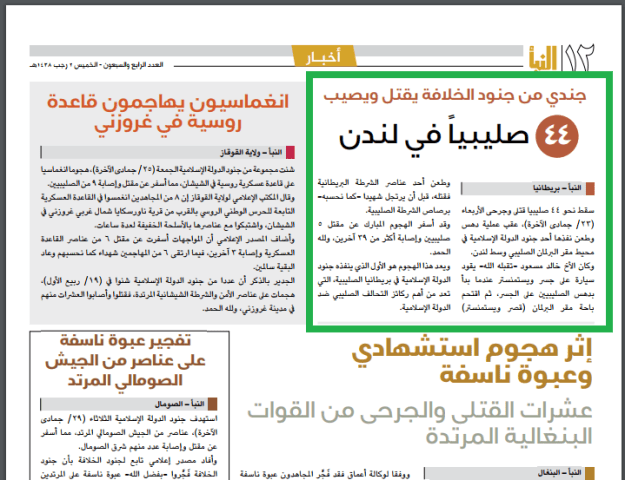
Islamic State Claims the Westminster Attack

By Kyle Orton (@KyleWOrton) on 31 March 2017

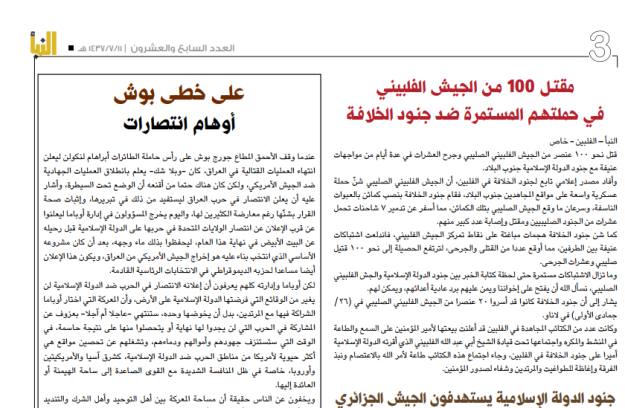
Al-Naba 74, page 12, 30 March 2017

The seventy-fourth edition of al-Naba, the Islamic State’s newsletter, released online on 30 March 2017, reiterated the terrorist group’s 23 March claim via Amaq of the 22 March Westminster attack by Khalid Masood (born: Adrian Russell Ajao). The brief article is reproduced below.
Continue reading

The Islamic State’s Shadow War With Israel

By Kyle Orton (@KyleWOrton) on March 5, 2017

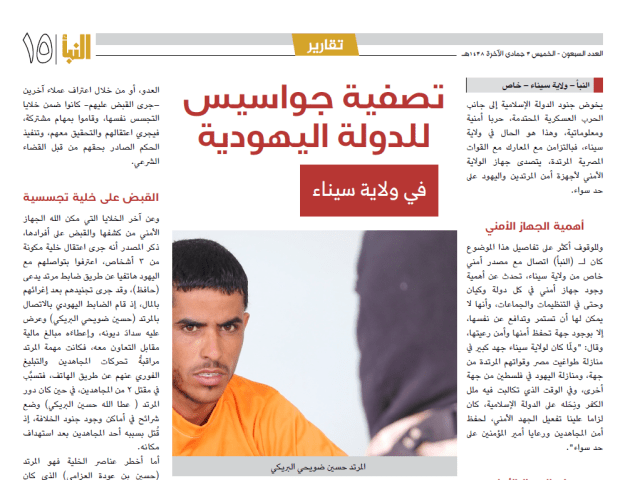
Al-Naba 70, released on 2 March 2017, p. 15. The caption under the picture says: “The apostate Husayn Duwayhi al-Bareeki”

In the 70th edition of Al-Naba, the weekly newsletter of the Islamic State (IS), entitled, “The Liquidation of Spies for the Jewish State” (tasfiya juwasees lil-dawla al-yahudiya), which did include a description of IS’s Wilayat Sinai having eliminated an Israeli spy network, but also included more general information about the IS security structure in Egypt. Continue reading

The Islamic State’s Official Biography of the Caliph’s Deputy

By Kyle Orton (@KyleWOrton) on December 18, 2016

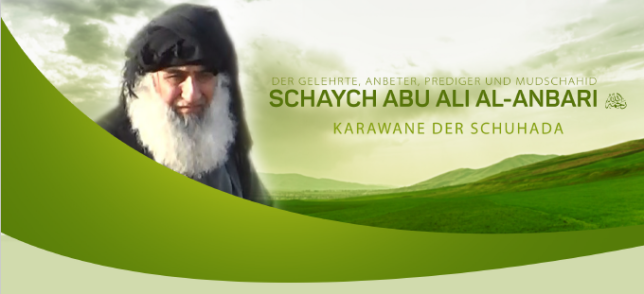
Obituary for Abdurrahman al-Qaduli in the German version of Rumiya, 11 November 2016

Obituary for Abdurrahman al-Qaduli in the German version of Rumiya, 11 November 2016

The forty-first edition of the Islamic State’s newsletter, al-Naba, released within the territory of the caliphate on 30 July 2016 and released online on 2 August, and the forty-third edition (released 13 and 16 August), contained a two-part obituary for Abd al-Rahman al-Qaduli (Abu Ali al-Anbari), the caliph’s deputy when he was killed on 24 March. The obituaries, entitled, “The Devout Scholar and Mujahid Preacher: Shaykh Abu Ali al-Anbari”,[1] make clear that al-Qaduli was one of the most consequential jihadists in the history of the Islamic State movement. Below is a translation, with some interesting and/or important sections highlighted in bold. The biography resolves some long-standing mysteries, and some of the claims are dubious in light of other evidence we have: these issues, and other points of context and explanation, are in the footnotes. The subheadings are mine, added to signpost the narrative and break it up into more manageable chunks.
Continue reading

Ahrar al-Sham and Al-Qaeda

By Kyle Orton (@KyleWOrton) on August 12, 2016

The Islamic State’s (IS) weekly newsletter, al-Naba, interviewed a high-ranking al-Qaeda defector, Abu Ubayda al-Lubnani, across two issues in February and March 2016. Abu Ubayda announced his defection from al-Qaeda to IS in April 2014 via al-Battar and Abu Ubayda’s name appeared on a list of prominent clerics supporting IS’s caliphate declaration that was circulated not long after the declaration. Abu Ubayda is described by al-Naba—as best as can be told accurately—as having been a member of al-Qaeda’s Shura or Consultation Council, a training officer in its Military Committee, and a counter-intelligence officer. Abu Ubayda is advertised as speaking about many secret aspects of al-Qaeda.

Among the topics Abu Ubayda covers is the alleged infiltration and manipulation of al-Qaeda by foreign intelligence services, specifically Pakistan’s Inter-Services Intelligence (ISI), which is not only a violation of jihadist doctrine by collaborating with an “infidel” and illegitimate state but led to the deaths of a number of senior al-Qaeda leaders.

Perhaps the most intriguing aspect of what Abu Ubayda has to say relates to al-Qaeda’s attempt to take advantage of the Syrian revolution. This persistent campaign has followed a pattern of disguising al-Qaeda’s presence and attempting to influence and eventually co-opt the rebellion against Bashar al-Assad’s regime. One lever al-Qaeda relied upon, according to Abu Ubayda, was Ahrar al-Sham, an organization that disclaims all connections to al-Qaeda and dissimulates about its ideology. Whatever Ahrar’s dominant ideology, it is simply a fact that it has served as the bridge between the foreign-led jihadists and Syrian Islamists, and its connections to al-Qaeda are evident enough. Abu Ubayda suggests Ahrar’s connections to al-Qaeda are even deeper than they appear. Continue reading

Long-Term Islamic State Operative Carries Out Suicide Bombing in Ansbach

By Kyle Orton (@KyleWOrton) on July 27, 2016

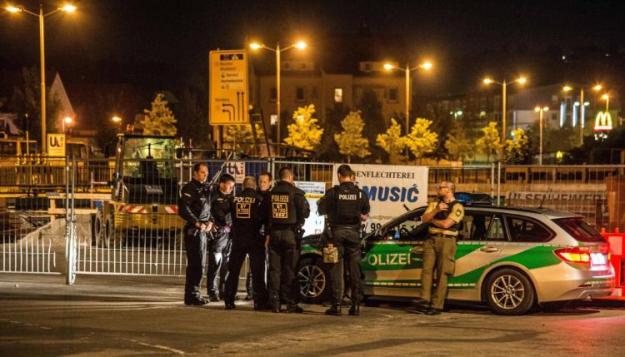
The German police secure the area surrounding the crime scene after the suicide attack in Ansbach

The German police secure the area surrounding the crime scene after the suicide attack in Ansbach

In Ansbach in Bavaria State, southern Germany, a suicide bomber blew himself up at a wine bar not far from the Ansbach Open music festival during the final concert around 22:10 on the evening of 24 July 2016. Fifteen people were injured, three gravely. The suicide-killer, who had wandered around the entranceway with a backpack, was soon identified as a twenty-seven-year-old Syrian refugee, Mohammad Daleel, who came to Germany in 2014. Daleel “lived in an old hotel that was converted into a refugee shelter”. Daleel had been rejected as an asylum seeker in Germany, where he was known to the authorities for petty criminality. Daleel was scheduled to be deported to Bulgaria within thirty days, though the deportation had been temporarily suspended while Daleel underwent a medical evaluation, and had been placed in a psychiatric clinic. Daleel had allegedly tried to commit suicide twice before the bombing. Continue reading

The Islamic State’s Newsletter Prepares for the End of the Caliphate

By Kyle Orton (@KyleWOrton) on June 9, 2016

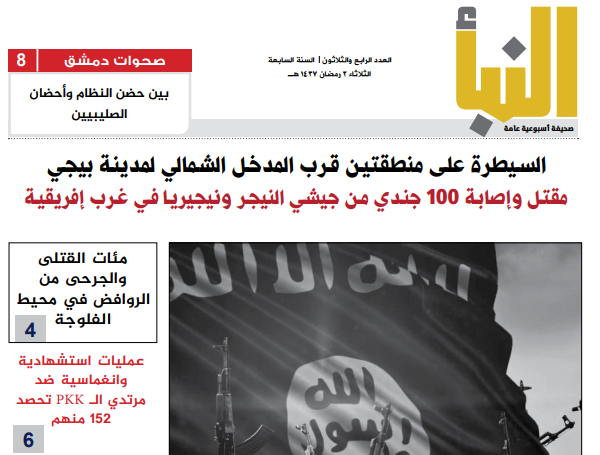
First page of the 34th edition of the Islamic State newsletter, al-Naba

The Islamic State’s (IS) spokesman, Taha Falaha (Abu Muhammad al-Adnani), gave a speech on 21 May that prepared the ground ideologically for the end of IS’s statelet and a return to the deserts where the organization survived after the surge-and-sahwa drove it from the urban zones of Iraq in 2007-08. Al-Naba, IS’s newsletter, is printed within the caliphate on Saturdays and distributed online on Tuesdays. Al-Naba’s 34th edition, published within the territories on 4 June and put on the internet on 7 June, echoed Falaha’s theme that the caliphate was a cause that would outlast the loss of territory since it was now embedded in the hearts of a generation of Muslims, and al-Naba also took a swipe at al-Qaeda and jihadi groups like Ahrar al-Sham that believe the path to an Islamist polity is bottom-up, through the building of popular consent. The Naba editorial is reproduced below with some important sections highlighted in bold.
Continue reading

The Islamic State, Territory, and a Change of Tone

By Kyle Orton (@KyleWOrton) on May 26, 2016

The Islamic State’s spokesman, Taha Falaha (Abu Muhammad al-Adnani), released a speech on 21 May that prepared the ideological ground for the loss of territory by underlining something the Islamic State has long maintained: the caliphate is more a cause than a location. This was a departure, however, from the confident messaging that the Islamic State had emphasized since it announced the caliphate in June 2014. Just a month before Falaha’s speech, on 16 April, the twenty-seventh edition of al-Naba, the Islamic State’s weekly newsletter, carried an editorial that was triumphalist about the march of the jihadists—despite the losses in the prior eight weeks, of Ramadi in early February, al-Shadadi later in February, Palmyra on 27 March, and al-Qaryatayn on 3 April. That editorial from al-Naba 27 is reproduced below. Continue reading

Islamic State Denounces Those Who Make Palestine the Foremost Muslim Cause

By Kyle Orton (@KyleWOrton) on April 2, 2016

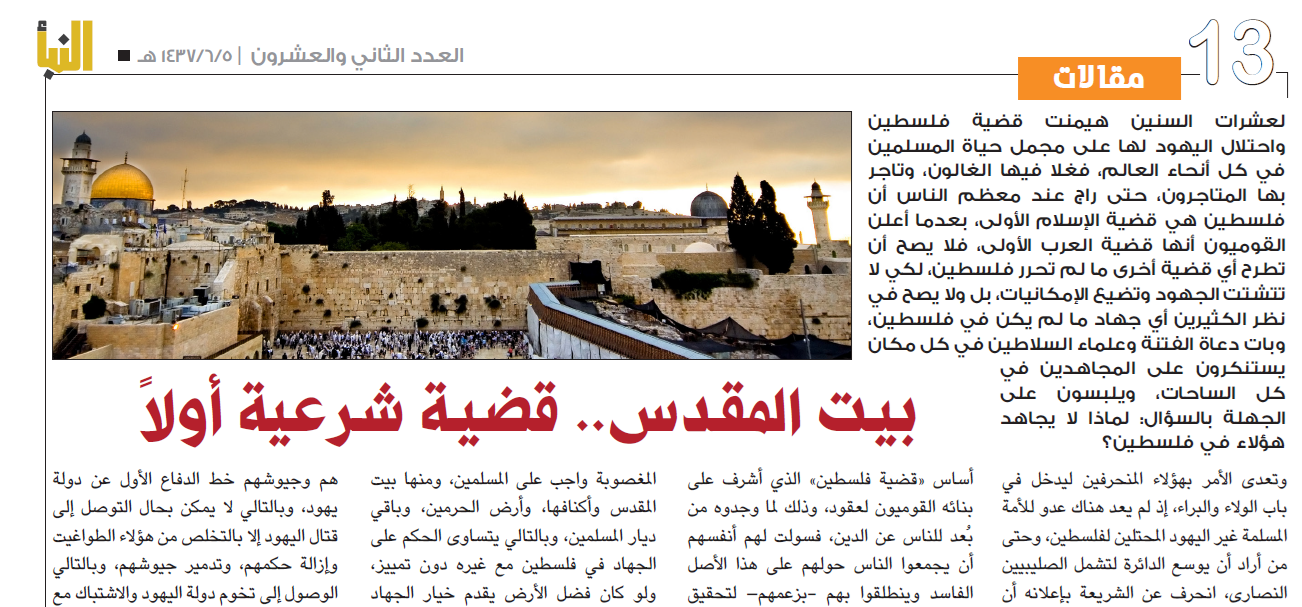
An article in the twenty-second edition of al-Naba, the Islamic State’s (IS) newsletter, released on 15 March 2016, explained why the group has not made fighting Israel a priority.

Continue reading

The Rise and Fall of Mohammed Emwazi

By Kyle Orton (@KyleWOrton) on January 20, 2016

Emwazi

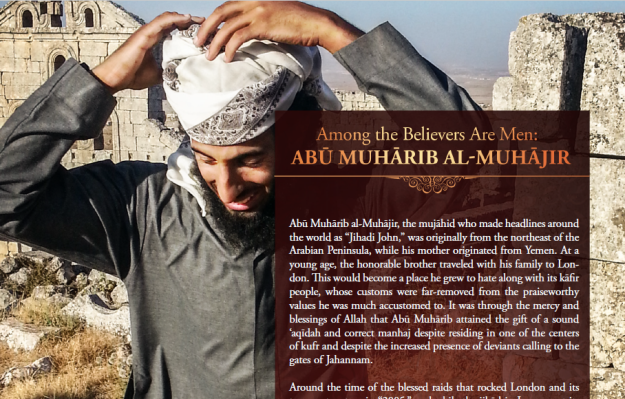
Emwazi’s eulogy picture in Dabiq

Yesterday, the Islamic State (IS) released their thirteenth issue of Dabiq. Among many things, it contained an admission of death for Mohammed Emwazi (“Jihadi John”). Referred to by his kunya, Abu Muharib al-Muhajir, Dabiq said (pp. 22-23) Emwazi had been hit by an “unmanned drone in the city of ar-Raqqah” on November 12, “destroying the car and killing him instantly.” The biography that Dabiq offered gave some intriguing details, confirming some surmises I had made about Emwazi when his identity was revealed last spring, including his early involvement in an al-Qaeda network in London sending fighters to al-Shabab in Somalia—the thing that brought him to the attention of the security services, confirming that the truth was the inverse of CAGE’s infamous claim that harassment by the MI5 had radicalized Emwazi—and that Emwazi had left Britain to do jihad in Syria in the company of another British citizen. Emwazi was also in the thick of it when IS broke from al-Qaeda and offers an interesting and rare example of a European IS fighter entrusted with an internal security role for the caliphate.
Continue reading