Category Archives: Russia

Syria Continues to Unravel as External Powers Dominate

By Kyle Orton (@KyleWOrton) on 1 March 2018

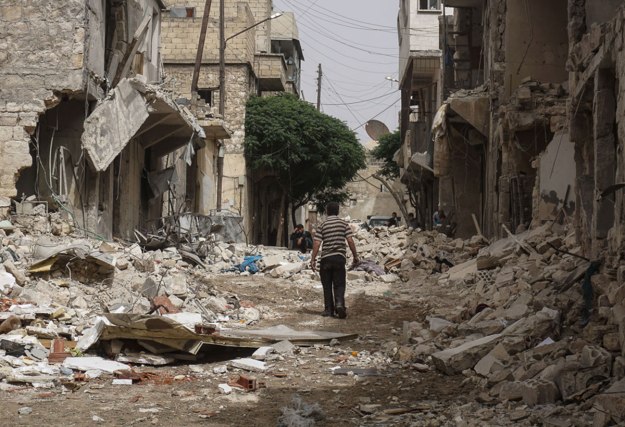
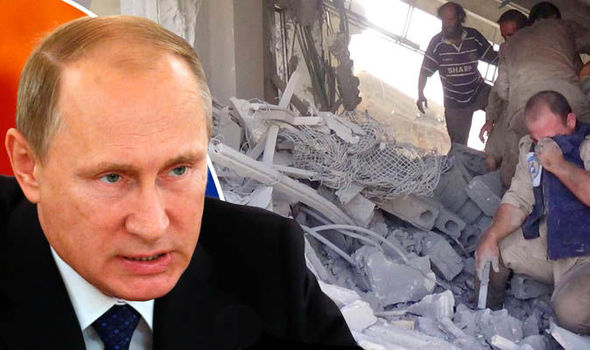
Aftermath of a pro-Asad coalition bombing in Hamouria, in besieged Eastern Ghuta, near Damascus, 22 February 2018. (AFP)

In the summer and autumn of 2017, it was claimed Syria’s civil war was winding down, but the nearly seven-year conflict is nowhere near to finished, and recent events suggest it could even escalate. Continue reading

Russia’s Plans in Syria Falter, Opening Chance for the West

By Kyle Orton (@KyleWOrton) on 29 December 2017

The Astana track of Syrian “peace” negotiations began on 23 January 2017, under Russian guidance in the Kazakh capital, with Iran and Turkey also invited as “guarantor countries” of the various sides in Syria. The process, initiated in the shadow of the savage conquest of Aleppo city in December 2016 that signalled the total strategic defeat of the insurrection against the Bashar al-Asad regime, was an attempt by Moscow to convert the military gains it had enabled by Asad and Iran on the ground into political facts that could then be imported into the internationally-recognized Geneva process. This “Astana-isation of Geneva” was Russia’s bid to take control of the political process and redefine it: rather than having Asad’s removal as its end-goal, it would set the terms of reintegration into the Asad state. Abetted by a purblind Western campaign against the Islamic State (IS) and a strategic reorientation in Turkey, the pro-Asad coalition has more or less had its way for the last year. But there are now signs that this approach is beginning to unravel. Continue reading

Russia Takes Advantage of the Schism in NATO Between America and Turkey

Originally published at The International Business Times

By Kyle Orton (@KyleWOrton) on 9 October 2017

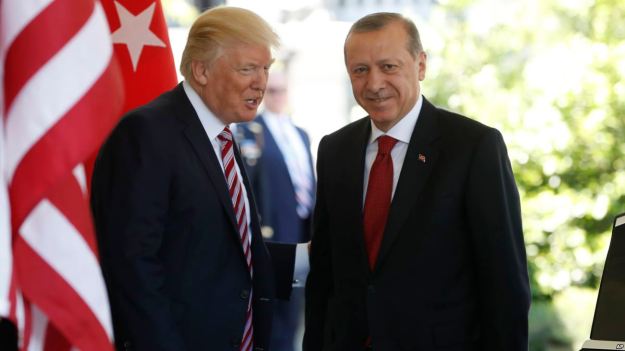
President Donald Trump meets Turkey’s President Recep Tayyip Erdogan at the White House, 16 May 2017. (AP Photo/Pablo Martinez Monsivais)

Relations between Turkey and the United States hit a new low on Sunday 8 October. The U.S. State Department suspended “all non-immigrant visa services at all U.S. diplomatic facilities in Turkey”.

The Turkish government retaliated—citing concerns about the “commitment of the government of the United States to the security of the Turkish Mission facilities and personnel”—by “suspend[ing] all non-immigrant visa service[s] at all Turkish diplomatic facilities in the U.S..” Continue reading

Russia Tries To Succeed Where the West Fails in Libya

By Kyle Orton (@KyleWOrton) and Lincoln Pigman on 14 September 2017

Libya, which has been wracked by instability and violence since 2011, is re-emerging as a geopolitical hotspot. With opposing forces fighting for control of the war-torn country—the main two being the U.N.-backed Government of National Accord (GNA) and the Libyan National Army (LNA)—foreign powers have begun taking sides, internationalizing the conflict. For Western observers, the growing involvement of Russia, a major ally of LNA commander Khalifa Haftar, represents a particular concern.

Coming on the heels of the Russian military intervention in Syria, Moscow’s role in Libya’s civil war may seem, at first glance, like déjà vu. Once again, it appears that the Kremlin is working to consolidate the power of a pro-Russian regional strongman and establish a “crescent of Russian influence” across the Middle East. And given the similarities between Haftar and Syrian President Bashar al-Assad, some degree of anxiety is understandable. Like Assad, who has long appealed to foreign governments by referring to Syrian rebels as terrorists, Haftar often frames himself as a bulwark against violent extremism in Libya, where the Islamic State remains active and Islamists have formed powerful militias and entered mainstream politics. Continue reading

Chelsea Manning is a Traitor, Not a Hero

Published at The International Business Times

By Kyle Orton (@KyleWOrton) on January 18, 2017

Chelsea Manning (REUTERS/U.S. Army)

It might have been thought that a consistent opposition to treason was not all that difficult. But President Barack Obama’s surprise decision last night to commute the sentence of Bradley, now Chelsea, Manning, showed how deeply political partisanship has penetrated into areas like national security, where ideally country would be put before party or ideology. Continue reading

Assad and Russia Losing Palmyra is No Surprise: They Cannot Defeat Jihadism in Syria

Published at The International Business Times

By Kyle Orton (@KyleWOrton) on December 12, 2016

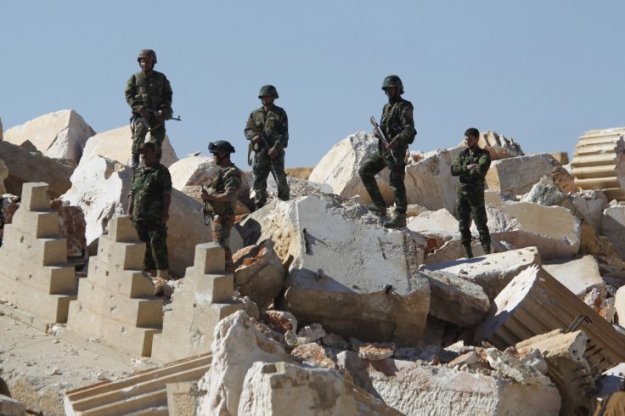
Syrian regime army soldiers stands on the ruins of the Temple of Bel in Palmyra, 1 April 2016 (REUTERS/Omar Sanadiki)

The Islamic State (IS) is supposed to be on its way to defeat. IS is under assault in Mosul and the operation to evict it from Raqqa began a month ago. Just this morning, Turkish-backed rebel forces in Syria have reportedly pierced IS’s defences in al-Bab, IS’s most important city outside of its twin capitals. But on Sunday, after a four-day offensive, IS seized Palmyra. How to explain this? Continue reading

Russia Moves in For the Kill in Syria

Originally published at The Henry Jackson Society

By Kyle Orton (@KyleWOrton) on October 21, 2016

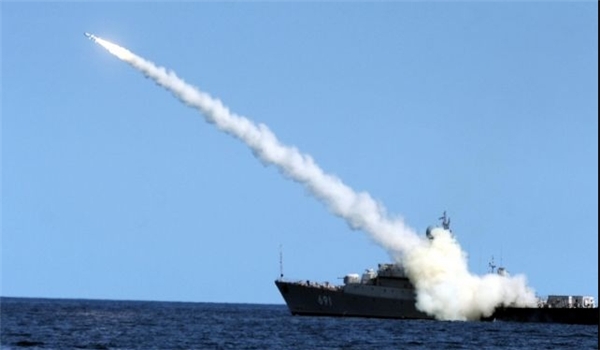
Vladimir Putin’s Russia is “deploying all of the Northern fleet and much of the Baltic fleet in the largest surface deployment since the end of the Cold War,” a NATO diplomat told Reuters on Wednesday night. These Naval assets are designed to buttress a final offensive by the remnants of Bashar al-Assad’s regime in Syria, which is effectively controlled on the ground by the Islamic Republic of Iran and an assortment of foreign Shi’a jihadists, against the insurgent-held east of Aleppo city, crushing once and for all the strategic threat posed by the rebellion to the regime, a threat that had already been all-but ended in the first months of Russia’s intervention. Nearly a year ago the U.S. began a political process with the Russians intended to end the war and begin a political transition. Moscow has subverted this process, using force to buttress its political efforts to secure Assad in power. The timing of this attack is seemingly intended as one final humiliation for President Barack Obama. Continue reading

Russia Needs the Islamic State to Save Assad

By Kyle Orton (@KyleWOrton) on June 20, 2016

Cross-posted at The Interpreter.

After a coalition supporting the regime of Syrian ruler Bashar al-Assad conquered the city of Palmyra from the Islamic State (IS) in late March, suggestions were made that this demonstrated the efficacy of the pro-Assad coalition in fighting IS, and doubtless the same will be said if and when the pro-regime forces conquer Tabqa. It isn’t true. From the time of Russia’s direct intervention in Syria on 30 September 2015 to Moscow’s announcement on 14 March 2016 that it was withdrawing “the main part” of its “military” from Syria, IS was almost untouched and al-Qaeda was barely damaged, while the Assad regime was bolstered and the moderate opposition, particularly those components supported by the West, were gravely weakened.

Despite Moscow’s claims that its mission was fighting IS or “terrorism,” Russia’s real goals can be summarized as three:

  1. Rescue the Assad regime, which was assessed to be in mortal peril
  2. Damage the mainstream armed opposition, especially those elements supported by the West, in order that Russia can …
  3. Rehabilitate the Assad regime internationally by inter alia leaving only extremists as its opponents, depriving the international community of credible interlocutors, and therefore strengthening the Russian hand to make peace talks an instrument for re-legitimizing Assad, rather than removing him

In recent days, this basic war strategy has been seen again in southern Syria. Continue reading

Russia is No Partner Against the Islamic State

By Kyle Orton (@KyleWOrton) on February 12, 2016

1

This morning, Russia ostensibly agreed to help the U.S. impose a ceasefire in Syria within a week—on the way to a negotiated settlement. This could not work right now, even if Russia intended it to. But Russia does not. Russia’s role since intervening in Syria in late September 2015 has been to bolster the regime of Bashar al-Assad and a primary tactic in that overarching strategic aim has been the attempt to destroy all opposition to Assad that the international community could possibly deal with, and to create a binary situation where there is only the regime and jihadi-Salafist terrorists, primarily the Islamic State (IS), and secondarily—in areas where they do not threaten key regime interests—Jabhat an-Nusra (al-Qaeda). Moscow will eventually turn on IS, but in the short-term Russia has engaged in indirect coordination with IS to weaken the rebels and push them out of key strategic areas, notably in eastern Aleppo where Russia bombed rebels out of the way who had been holding IS out for years. On Tuesday, Foreign Policy reported on another aspect of this Russia-IS collaboration that aims to empower the takfiris in the short-term as part of the long-term plan, also supported by Iran, to secure the Assad regime in power. Continue reading

Litvinenko Verdict: What Happens Now?

By Kyle Orton (@KyleWOrton) on January 25, 2016

Published at Left Foot Forward.

The British inquiry into the death of Alexander Litvinenko concluded on Thursday, making official what everyone already knew: the Russian intelligence services, “probably” at the direct order of Russian President Vladimir Putin, murdered Litvinenko in London in November 2006.

Welcome as it is to have this on the record and to have Litvinenko’s killers named for all the world to see, it now leaves questions, primarily:

Will similar forensic scrutiny be brought to bear on several other odd instances of political and other crime in Russia?

And what does the British government intend to do now that the Kremlin is carrying out assassinations on its territory again? Continue reading