Pakistan and the Taliban

By Kyle Orton (@KyleWOrton) on 17 August 2021

Afghan government forces guarding Taloqan, Takhar province, Afghanistan // July 2021 // AFP photo

Kabul fell to the Taliban on 15 August. There is so much more to be said about the disastrous decisions the United States that precipitated this calamity, not least the so-called peace process whose only concrete effects were to weaken and demoralise the Afghan government, while bolstering the ranks of the Taliban by forcing the release of thousands of jihadists. The chaotic Saigon scenes have testified to the incompetence of Joe Biden’s administration, even at administrative tasks, and the horrors are only just beginning.

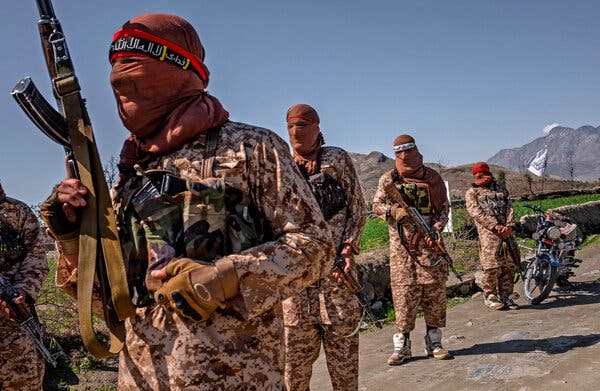
This post has a slightly different focus, namely the role of Pakistan, specifically its military and Inter-Services Intelligence (ISI), as the author and operator of the Taliban and allied jihadists. This factor—absolutely fundamental to the conflict—has been, for twenty years, bizarrely absent in much of the coverage, and suggestions recur to this day that the Taliban is actually a problem for Pakistan. When the Pakistan dimension does come up, it will either be to note that Pakistan has some kind of role in funding or otherwise “supporting” the Taliban, and at its strongest the Taliban will be called a “proxy” of the ISI.

Even the word “proxy”, however, underplays the extent to which the Taliban is Pakistan, a wing of its (deep) state power. Continue reading

Joe Biden Chose Disaster in Afghanistan

By Kyle Orton (@KyleWOrton) on 16 August 2021

The Taliban took over Afghanistan’s capital on Sunday after a nine-day offensive captured one provincial capital after another. The United States had already decided to abandon the country, and without the US the other NATO states had no choice but to leave. It was quite clear that the Afghan state would crumble in the absence of a Western presence, though it seems President Joe Biden thought he would have a longer “decent interval” before the Saigon evacuation scenes and the massacres began. Continue reading

The Trouble With “Ending Forever Wars”

By Kyle Orton (@KyleWOrton) on 12 August 2021

In early July, President Joe Biden confirmed his intention to withdraw all American troops from Afghanistan by September 2021. Biden cited a February 2020 U.S. “agreement” with the Taliban that he had “inherited” from the Trump administration. In truth, President Donald Trump had made no agreement. He had already begun pulling troops out by October 2019 and signed a fig leaf to cover his unconditional withdrawal.

Biden reassessed other Trump policies and could have reassessed this one, not least since the Taliban were in violation even of their vague paper promises — most notably on their commitment to deny space to al Qaeda and negotiate peace in good faith. The truth is that Biden is ideologically committed, as Barack Obama and Trump were, to ending American involvement in “forever wars.” Regardless, this does not mean those wars end or the threats that drew the United States in actually go away. Continue reading

The Role of the “Fraternal Parties” in the Soviet Union’s Global Mission

By Kyle Orton (@KyleWOrton) on 9 August 2021

Bolshevism, 1919

After the post looking at the relationship of Reuben Falber and the Communist Party of Great Britain (CPGB) to the Soviet Union—namely the total subservience of the former to the latter—a follow-up was intended on the broader issue of the how the KGB and its predecessors interacted with the “fraternal” Parties around the world. Eighteen months later, this is that post. Let’s blame COVID.

The accusation that the Communist Parties around the world were fronts for the KGB was often derided as “McCarthyism” while the Cold War was going on. Arguments about that term in general to one side,[1] it certainly did not apply in this case. The accusations as stated were entirely factual. Continue reading

Spywar and Strategy: The Israel-Iran Contest in the Middle East

By Kyle Orton (@KyleWOrton) on 29 June 2021

Members of the Ezzedine al-Qassam Brigades, the military wing of Hamas, at a memorial in Gaza, 31 January 2017. Photo by Abed Rahim Khatib, Flash90.

The May 2021 round of fighting in Gaza brought with it the upending of the unspoken understanding between Israel and Hamas and a level of intercommunal violence within Israel that has not been seen in quite some time. The scale of the rocket attacks on the Jewish state must also be counted among the unusual elements of this latest flare-up, with Iran clearly identifiable as the enabling state behind Hamas and Palestinian Islamic Jihad (PIJ), the two primary factions behind these attacks. Continue reading

General Franco’s Intentions in the Second World War

By Kyle Orton (@KyleWOrton) on 25 June 2021

Writing recently about the first meeting between Adolf Hitler and Francisco Franco at Hendaye on 23 October 1940, where the Führer tried to enlist Spain into the Axis, I concluded, drawing on Franco: The Man and His Nation by George Hills, a former BBC journalist and Fellow of the Royal Historical Society:

Continue reading

Fifth Speech of the Islamic State Spokesman: Provinces, Prison Breaks, and Palestine

By Kyle Orton (@KyleWOrton) on 22 June 2021

The fifth speech of the Islamic State’s spokesman, Abu Hamza al-Qurayshi, was released earlier today by Al-Furqan Media under the title, “You Are Most Exalted If You Are [True] Believers” (وأنتم متفوقون إذا كنتم مؤمنين), drawn from Qur’an 3:139. Continue reading

Dating the Gospels

By Kyle Orton (@KyleWOrton) on 19 June 2021

The dates that the four canonical Gospels of the New Testament were composed has a great impact for Christians, of course, but also for historians, particularly on the matter of whether Jesus ever existed, and really for everybody living in the civilisation this religion has built. Continue reading

Franco and Hitler: A Meeting and its Consequences

By Kyle Orton (@KyleWOrton) on 17 June 2021

By the autumn of 1940, the entirety of Western Europe except Spain and Portugal lay under Nazi control, as did much of the Centre and parts of the East: Austria, Czechoslovakia, Poland, Denmark, Norway, the Netherlands, Belgium, Luxembourg, and France had all fallen without serious resistance, and Britain’s refusal to take the German offer of leaving the Continent to the Nazis and the Nazis would leave the British with India had incurred the wrath of the Luftwaffe with night after night of air-raids.

It was in this context that a meeting was held, on 23 October 1940, between Adolf Hitler and Spain’s ruler, Francisco Franco. The meeting, taking place at the railway station in Hendaye, within conquered France, on the western-most point of the Franco-Spanish border, was also attended by the foreign ministers, Ramón Serrano Súñer (Spain) and Joachim von Ribbentrop (Germany). The Germans arranged the meeting to try to get Spain into the war, and General Franco attended the meeting intent on refusing—politely. Continue reading

When Did the “Roman” Empire Become the “Byzantine” Empire?

By Kyle Orton (@KyleWOrton) on 12 June 2021

A painting representing the Byzantines use of “Greek fire” to repel the Arab siege of Constantinople, 674-78

The use of the word “Byzantium” for the Eastern Roman Empire is inescapable, though it is best thought of as a term of convenience rather than definition. For one thing, the inhabitants never called themselves “Byzantines”: they always thought of themselves as “Romans”, though using the Greek work “Romaioi”. The easiest way to see the problem is to ask: When did the Byzantine Empire begin? Continue reading