As its Insurgency Gathers Pace, Islamic State Wants to Further Intensify Operations

By Kyle Orton (@KyleWOrton) on 26 April 2018

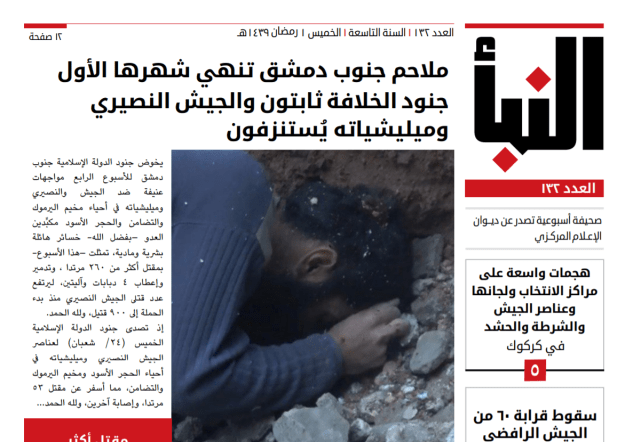
A-Naba 125

The Islamic State (IS) formally turned from statehood to insurgency last October. The 125th edition of Al-Naba, IS’s weekly newsletter, released on 29 March 2018, contained a number of indicators that the jihadists’ guerrilla warfare is gaining considerable steam—and that IS thinks it should gain more. Continue reading

French Leftists with the “Syrian Kurds” Threaten Terrorism Against France

By Kyle Orton (@KyleWOrton) on 23 April 2018

The Facebook group for the Antifascist Forces in Afrin (AFFA) posted a video message and transcript yesterday, which was dated 12 April, threatening terrorist attacks against two NATO states, France and Turkey. AFFA, announced in February, comprises French-speaking Left-wing extremists, who are part of the foreign fighter brigades within the Kurdistan Workers’ Party (PKK) command structure in Syria. A rough translation of the statement (and the original) are reproduced below, with the key sections highlighted in bold. Continue reading

The Islamic State Spokesman Directs His Fury At Regional Governments

By Kyle Orton (@KyleWOrton) on 22 April 2018

An audio statement by the official spokesman of the Islamic State (IS), Abu Hassan al-Muhajir,[1] was released today. The speech was entitled, “By their example, be guided” or “So From Their Guidance Take An Example”—drawn from Qur’an 6:30. Abu Hassan continued the themes that have been cropping up in IS messaging and propaganda for the last few months that have more firmly reoriented IS away from its foreign attacks campaign toward a more local focus in the Middle East. IS has been stressing its post-caliphate insurgency—concentrated at the present time in Iraq, but with notable operations in Syria—and its war for influence with regional rivals for Muslim loyalty, whether governments such as Egypt and particularly Saudi Arabia, or other Islamist movements like Harakat al-Muqawama al-Islamiyya (HAMAS) in Gaza. Continue reading

Islamic State Reacts to Western Strikes on the Syrian Regime

By Kyle Orton (@KyleWOrton) on 21 April 2018

Al-Naba 128, page 11

The 128th edition of Al-Naba, the Islamic State’s (IS) weekly newsletter, released on 20 April, contained in its concluding, “Events of the Week” section, the organisation’s reaction to the 14 April military strikes by America, Britain, and France against the Bashar al-Asad regime for its use of poison gas in Duma. This short comment is reproduced below. Continue reading

Islamic State Admits to Colluding with the Syrian Regime

By Kyle Orton (@KyleWOrton) on 20 April 2018

Since the uprising in Syria began in 2011, Bashar al-Asad’s regime has followed a tried and trusted script to destroy the opposition by eliminating all engageable elements, creating a binary choice for the population and the world—the despotism or a terrorist takeover.

Asad bolstered extremists within the insurgency: letting Islamists out of prison while imprisoning secular activists, pushing a peaceful protest movement into violence, heightening sectarian tensions, and financial schemes of various kinds. Asad then then left IS alone for a year to build its caliphate, while obliterating rebel-held areas that could provide an attractive alternative to the dictatorship. Continue reading

What Is Trump Thinking About Syria?

By Kyle Orton (@KyleWOrton) on 18 April 2018

Egyptian ruler Abdelfattah al-Sisi, Saudi King Salman, and President Donald Trump in Riyadh on 22 May 2017 (image source)

Two days ago, The Wall Street Journal reported that President Donald Trump has been exploring plans to replace American troops in the areas of Syria held by the Coalition partner force, the “Syrian Democratic Forces” (SDF), with troops from the Arab states. The problems with this proposal, even in the rudimentary form it is presented, are manifold. It also feeds into the broader problem of Trump’s inconsistent messaging about Syria—or, more precisely, his failed efforts to balance domestic messaging, which calls for what was once referred to as “nation building … at home”, and his foreign messaging that needs to emphasise U.S. constancy to see through the mission to defeat the Islamic State (IS) by, among other things, stabilising and reconstructing Syria. Continue reading

Trump’s Syria Strike Upheld an Important International Norm, But Did No More

A version of this article was published at The Sunday Express

By Kyle Orton (@KyleWOrton) on 15 April 2018

Britain joined the United States and France in a round of punitive military strikes in Syria on Friday night. The Coalition was retaliating for a poison gas attack by Bashar al-Assad’s regime in the Duma area of Damascus on 7 April. The three targets the Allies went after were related to his chemical weapons program. This was a just operation that upheld the norms of the international system, but there are disturbing signs that it will not be linked to a course correction in Syria. Continue reading

Saudi Newspaper: Make Peace with Israel, Confront Iran

By Kyle Orton (@KyleWOrton) on 14 April 2018

Negev Desert, Israel (image source)

Al-Riyadh is the leading daily newspaper in Saudi Arabia. While Al-Riyadh’s exact status is contested, there is little doubt it is close to the Saudi government and some identify it as a “semi-official” in the Kingdom. It was therefore very interesting that the paper hosted an opinion editorial by Dr. Ahmad al-Jamiya on 14 April, republished below, which made the case for the House of Saud to make peace with the State of Israel as part of a policy to halt and reverse the Iranian revolution in the Middle East. Continue reading

Trump Should Not Fear Russia In Responding to Assad’s Chemical Attack

By Kyle Orton (@KyleWOrton) on 10 April 2018

A child receiving oxygen after a poison gas attack in Douma, near Damascus, Syria | SYRIAN CIVIL DEFENSE WHITE HELMETS VIA AP

A year to the day after the United States struck at a Syrian airbase to punish Bashar al Assad for a chemical weapons attack, the regime has suspectedly carried out another devastating chemical atrocity. Signs are that the United States will, again, respond with force, attempting to rescue some part of the fraying international taboo against the use of poison gas. The larger question remains how Assad has gotten away with this for so long—and why murder only with certain categories of munitions prompts retaliation. Continue reading

Islamic State Newsletter Claims the Trèbes Supermarket Siege

By Kyle Orton (@KyleWOrton) on 5 April 2018

Arnaud Beltrame, Radouane Lakdim (image sources: one, two)

In Trebes, a small town of 5,000 people in southern France near Carcassonne, at 11 a.m. on 23 March 2018, a 25-year-old Moroccan-born man, Radouane Lakdim, walked into a “Super U” supermarket and opened fire, killing two people immediately, an attendant and a customer.

An hour earlier, Lakdim had hijacked a car on the outskirts of Carcassonne, killing the passenger by shooting him to death and seriously wounding the driver.

Lakdim then drove five miles to Trebes, appeared to stop outside a military barracks, before stopping outside a riot police centre and shooting at a group of four officers from 200 yards away, seriously injuring one. Continue reading