Paris Attackers Had Already Appeared in the Islamic State’s Propaganda

By Kyle Orton (@KyleWOrton) on January 25, 2016

1

It has already been established that the on-the-ground leader of the Islamic State’s atrocities on Paris on November 13, Abdelhamid Abaaoud (Abu Umar al-Baljiki), had already been promoted in IS’s media. Abaaoud appeared in the February 2015 edition of IS’s Dabiq magazine. It now seems likely that at least one more of the Paris attackers, Foued Mohamed Aggad (Abu Fu’ad al-Faransi), had appeared in IS media already—the November 2014 video that was the fifth (of seven) in the series fronted by Mohammed Emwazi (“Jihadi John”), IS’s British executioner. The November 2014 video showed the slaughter of around twenty men, supposedly soldiers and airmen of the Assad regime, in the village of Dabiq, and the beheading of American aid worker Abdul-Rahman (Peter) Kassig. It is also possible that two further Paris attackers, Bilal Hadfi (Abu Mujahid al-Faransi) and Brahim Abdeslam (Abul-Qa’qa al-Baljiki), appeared in the November 2014 video. Continue reading

From Bosnia to Guantanamo

By Kyle Orton (@KyleWOrton) on January 23, 2016

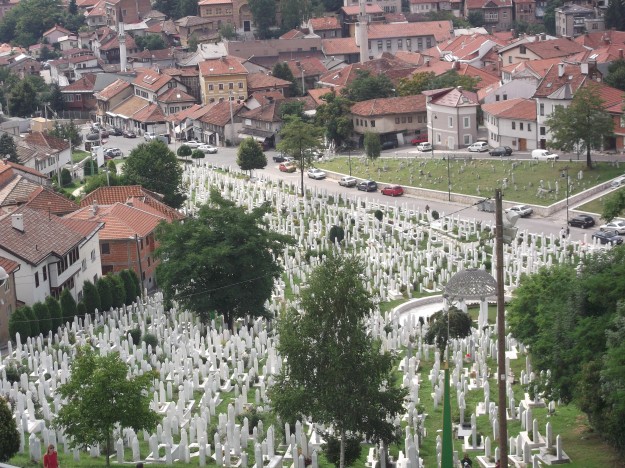
War cemetery in Sarajevo (personal picture, July 2011)

War cemetery in Sarajevo (personal photograph, July 2011)

It was announced on Thursday that Guantanamo inmates Tariq Mahmoud Ahmed as-Sawah and Abd al-Aziz Abduh Abdallah Ali as-Suwaydi had been transferred to Bosnia and Montenegro respectively. Sawah’s path to jihadi-Salafism allows a window into the Bosnian jihad, a much-underestimated factor in shaping al-Qaeda, its offshoots, and the wider jihadist movement. In that story is an examination of the role certain States have played in funding and otherwise helping the jihadists. It also leaves some questions about whether emptying Guantanamo of its dangerous inhabitants is the correct policy.
Continue reading

Chattanooga Attack: The Islamic State Inspires An American Terrorist

By Kyle Orton (@KyleWOrton) on January 21, 2016

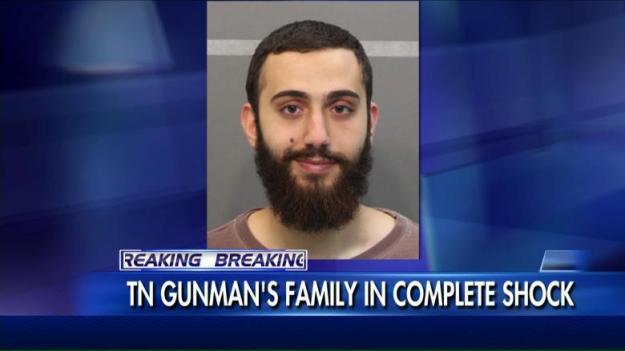
Muhammad Abdulazeez

Muhammad Abdulazeez

In Chattanooga, Tennessee, on 16 July 2015, Muhammad Youssef Abdulazeez carried out a drive-by shooting against an Army recruitment centre and then stormed a Naval and Marine reserve centre. Abdulazeez murdered five people before he was killed. Though there was some initial doubt, it is now clear this was an attack inspired by the Islamic State (ISIS). Continue reading

The Rise and Fall of Mohammed Emwazi

By Kyle Orton (@KyleWOrton) on January 20, 2016

Emwazi

Emwazi’s eulogy picture in Dabiq

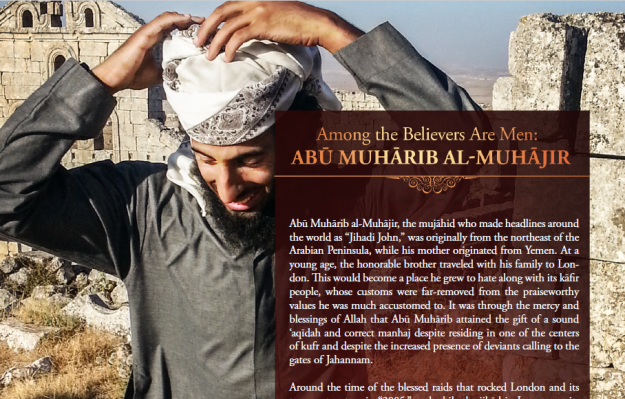
Yesterday, the Islamic State (IS) released their thirteenth issue of Dabiq. Among many things, it contained an admission of death for Mohammed Emwazi (“Jihadi John”). Referred to by his kunya, Abu Muharib al-Muhajir, Dabiq said (pp. 22-23) Emwazi had been hit by an “unmanned drone in the city of ar-Raqqah” on November 12, “destroying the car and killing him instantly.” The biography that Dabiq offered gave some intriguing details, confirming some surmises I had made about Emwazi when his identity was revealed last spring, including his early involvement in an al-Qaeda network in London sending fighters to al-Shabab in Somalia—the thing that brought him to the attention of the security services, confirming that the truth was the inverse of CAGE’s infamous claim that harassment by the MI5 had radicalized Emwazi—and that Emwazi had left Britain to do jihad in Syria in the company of another British citizen. Emwazi was also in the thick of it when IS broke from al-Qaeda and offers an interesting and rare example of a European IS fighter entrusted with an internal security role for the caliphate.
Continue reading

The Iranian Nuclear Deal and North Korea

By Kyle Orton (@KyleWOrton) on January 18, 2016

1

In the last few days, the international sanctions against the Islamic Republic of Iran’s nuclear program were lifted, which will allow Tehran access to $30 billion immediately and more than $100 billion will become available in short order. There are many fears about the uses Iran will put this money to, whether on the nuclear program itself, in aiding Iran’s imperial policy in the region, now proceeding with assistance from Russia, or perhaps exporting terrorism further abroad. An under-examined potential use of this money, highlighted by new sanctions the United States applied to Iran over its ballistic missile program, is to purchase weapons from North Korea. Pyongyang has already conducted what it claims is a hydrogen bomb test this year; fuelled by Iranian money the Hermit Kingdom might yet make more trouble for its neighbours and beyond. Continue reading

Al-Qaeda Leader Focuses on Main Enemies: Saudi Arabia and the Islamic State

By Kyle Orton (@KyleWOrton) on January 13, 2016

1

As-Sahab Foundation for Islamic Media Publication, al-Qaeda’s media outlet, produced an English translation of a speech by the organization’s leader, Ayman al-Zawahiri, on 13 January 2016. The speech was entitled, “Syria Is Entrusted Upon Your Necks”. The speech does focus on the West, particularly its de facto alliance with the pro-Assad coalition—namely Russia and Iran—and calls for the Syrian rebellion to unite with al-Qaeda to resist this conspiracy. What is more noticeable, however, is the two enemies on whom Dr. al-Zawahiri really focuses: Saudi Arabia and the Islamic State. The Saudis are accused—not without reason—of having been allied closely to the West and thwarting the jihadist projects at every turn. And al-Zawahiri makes a fierce ideological assault on the Islamic State, comparing them with the Khawarij and the Armed Islamic Group (GIA), whose conduct in Algeria in the 1990s and their justifications for it took Islamist extremism to new depths. The speech is reproduced below with some minor editions, to transliteration and punctuation, and some interesting and important sections highlighted in bold.
Continue reading

Response to Response: Yes, Saddam Laid the Groundwork for the Islamic State

By Kyle Orton (@KyleWOrton) on January 12, 2016

Iraqi army MIA1 Abrams tanks march under the victory Arch landmark during a parade to mark the 91st Army Day in Baghdad on January 6, 2012, weeks after US troops completed their pullout. The Armed Forces Day display by the fledgling 280,000-strong security force completely reformed after the US-led invasion of 2003. AFP PHOTO/ALI AL-SAADI (Photo credit should read ALI AL-SAADI/AFP/Getty Images)

The “Victory Arch,” which Saddam built after the war with Iran. (January 2012)

About three weeks ago I wrote a piece for The New York Times explaining the evolution of Saddam Hussein’s regime away from the hard-secularism of its Ba’athist origins, and how this had prepared the ground for the Islamic State (IS). I received much positive feedback, but the social media reaction was inevitable: little thought and much anger, particularly from people who view Iraqi history through a political prism and felt I was trying to exculpate George W. Bush. With rare exceptions, the critique could hardly be called thoughtful. So it is nice to finally have such a critique to deal with, from Samuel Helfont and Michael Brill in today’s Foreign Affairs. Continue reading

Islamic State Leaders Fall, Islamic State Remains

By Kyle Orton (@KyleWOrton) on December 30, 2015

Charaffe al-Mouadan

Abdelhamid al-Abaaoud and Charaffe al-Mouadan

Last night, Steve Warren, the American colonel who is the spokesman for the international campaign against the Islamic State (IS), the U.S.-led Operation INHERENT RESOLVE, announced that between December 7 and December 27, ten IS “leaders” had been killed. Col. Warren adumbrated the positions of the IS leaders, allowing the conclusion that five had been part of IS’s external operations wing, which conducts international terrorism, and five were part of IS’s internal operations, i.e. part of the military operations and security infrastructure that helps IS maintain and expand its statelet in Syria and Iraq. Col. Warren presented this as an important blow to IS that had assisted in inflicting the recent territorial losses on IS. There is reason for scepticism on these points.  Continue reading

Propaganda and the War Against Independent Media in Syria

By Kyle Orton (@KyleWOrton) on December 29, 2015

In the last month, the Islamic State (IS) has been waging a concerted campaign to shut down all independent sources of information emanating from its statelet. IS’s focus has been on Raqqa is Being Slaughtered Silently (RBSS), an activist group that began in April 2014 in IS’s de facto capital in northern Syria. RBSS has published information—including pictures and videos, much of it via Twitter—on the crimes of the “caliphate”. IS has now murdered at least five RBSS journalists and activists, two of them on foreign soil in Turkey, plus the father of one of RBSS’s founders. (The sixth case, also in Turkey, is more murky.) The suppression of independent media by IS is necessary to allow the group to maintain social control of the areas it rules and to sustain the narrative that it is building utopia on earth, which attracts in the foreign fighters that help IS maintain and expand its territory.
Continue reading

Islamic State Leader Threatens Saudi Arabia and Israel

By Kyle Orton (@KyleWOrton) on December 28, 2015

Ibrahim al-Badri (Abu Bakr al-Baghdadi), the leader of the Islamic State, gave a speech, “So Wait, We Too are Waiting with You” (or “We, Too, Will Wait With You”), on December 26, 2015. The title is drawn from Qur’an 9:52. This is al-Badri’s fifth speech since the declaration of the caliphate in June 2014, and his tenth speech since becoming leader in 2011. The speech acknowledged some struggles for the “caliphate” and made a rare threat against Israel. Al-Furqan Media released a transcript of the speech, which is reproduced below. Continue reading