Tag Archives: Ahmad al-Khalayleh

Saddam Hussein Prepared the Ground for the Islamic State

By Kyle Orton (@KyleWOrton) on April 26, 2016
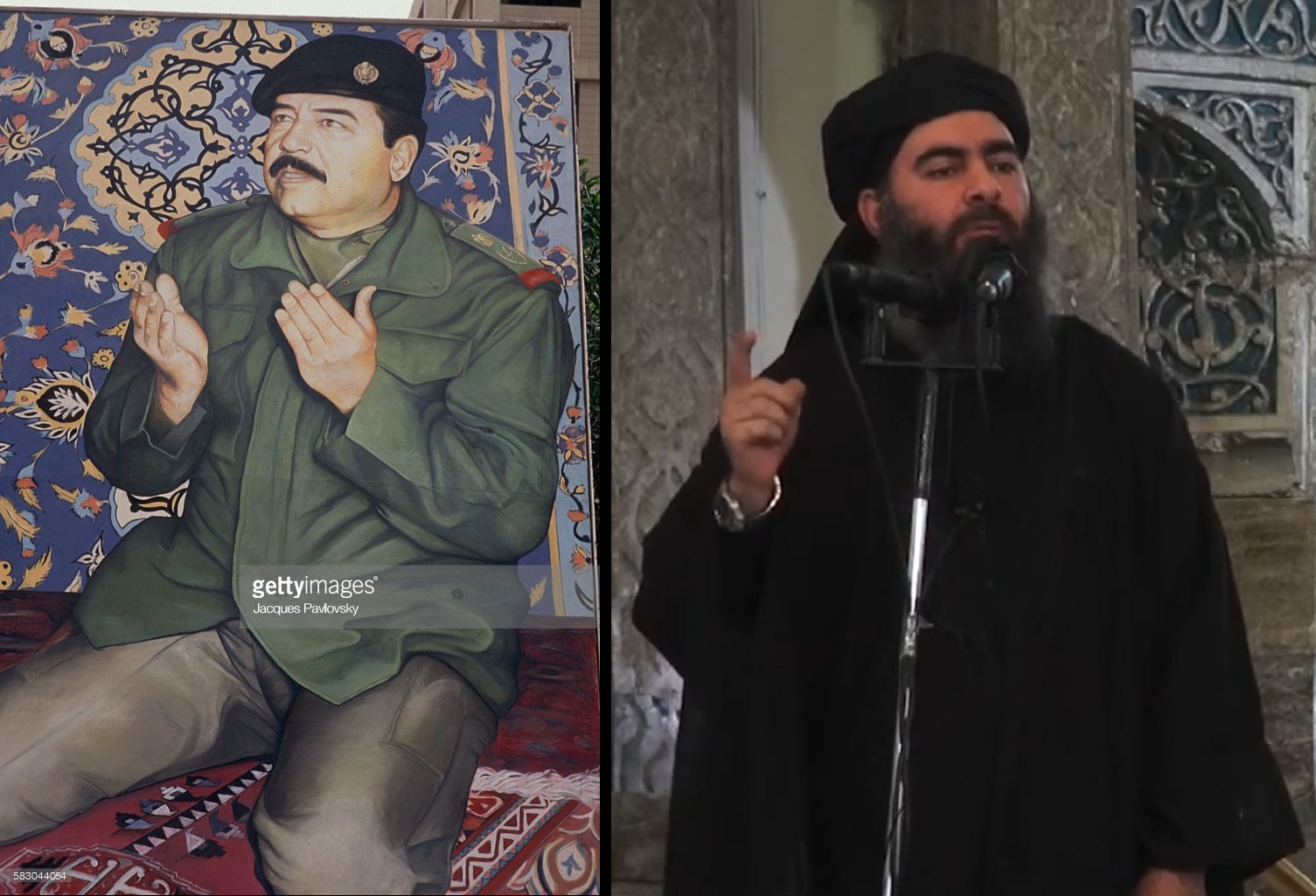
This essay, written to tie together my work on the relationship between the Saddam Hussein regime and the Islamic State, was completed last summer and submitted to an outlet, where it entered a form of development hell. After giving up on that option late last year, the opportunity arose to get a shorter version published in The New York Times in December. But I procrastinated too long over what to do with the full essay and a recent change in my work situation means I no longer have the bandwidth to go through the process of finding it a new home, so here it is.

“Abu-Bakr al Baghdadi is a product of the last decade of Saddam’s reign,” argues Amatzia Baram, a scholar of Iraq. He is correct in at least three ways. First, in its last decade in power, the Iraqi Ba’ath regime transformed into an Islamist government, cultivating a more religious, sectarian population on which the Islamic State (ISIS) could draw. Part of Saddam Hussein’s “Faith Campaign” also involved outreach to Islamist terrorists, including al-Qaeda, which meant that the synthesis of Ba’athism and Salafism that fused into the Iraqi insurgency after the fall of Saddam was already well advanced by the time the Anglo-American forces arrived in Baghdad in 2003. Second, the ISIS leadership and military planning and logistics is substantially reliant on the intellectual capital grown in the military and intelligence services of the Saddam regime. And finally, the smuggling networks on which ISIS relies, among the tribes and across the borders of Iraq’s neighbours, for the movement of men and materiel, are directly inherited from the networks erected by the Saddam regime in its closing decade to evade the sanctions. The advantages of being the successor to the Saddam regime make ISIS a more formidable challenge than previous Salafi-jihadist groups, and one that is likely to be with us for some time.

Continue reading

Islamic State Denounces Those Who Make Palestine the Foremost Muslim Cause

By Kyle Orton (@KyleWOrton) on April 2, 2016

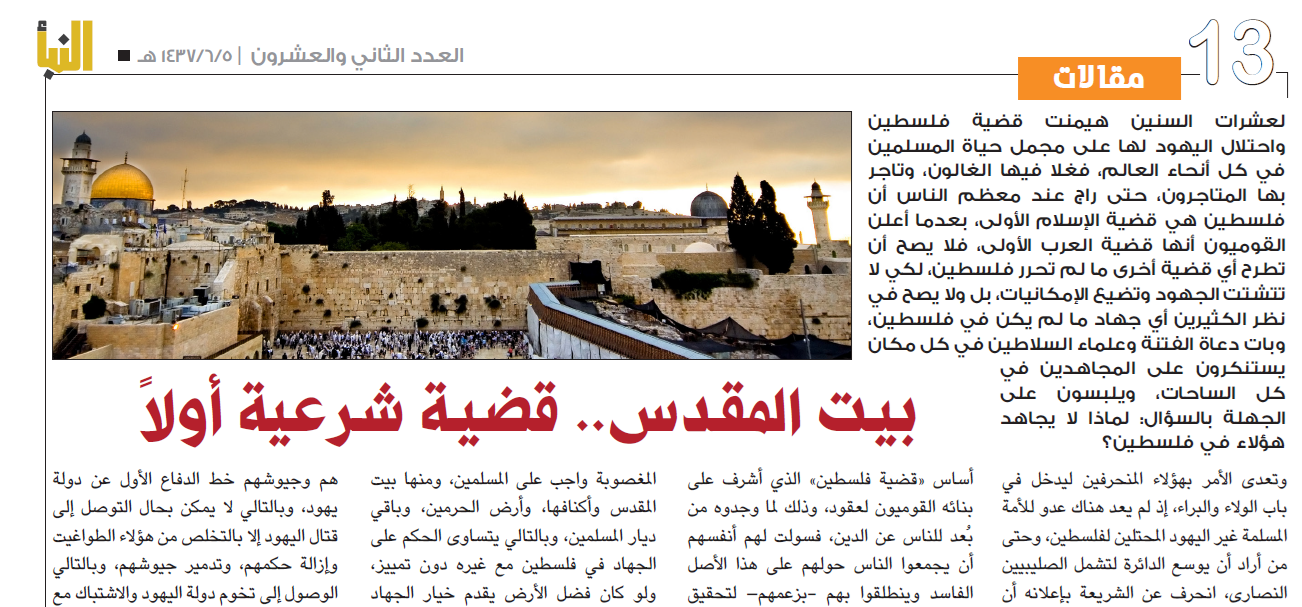
An article in the twenty-second edition of al-Naba, the Islamic State’s (IS) newsletter, released on 15 March 2016, explained why the group has not made fighting Israel a priority.

Continue reading

Another Legacy of the Bosnian Jihad

By Kyle Orton (@KyleWOrton) on February 5, 2016

Mirsad Bektašević

Mirsad Bektašević (2005)

I recently wrote about the jihad in Bosnia. This much-neglected aspect of the war in the 1990s was crucial in shaping al-Qaeda, and global jihadism more broadly, providing this movement, and Clerical Iran, with a staging post in Europe, not least because Tehran’s spy-terrorist capabilities had been deployed to bring many of the jihadists into the country and train them in the first place. While Islamist militancy and terrorism were brought to Bosnia largely as imports, their entry was facilitated by the Party of Democratic Action (SDA), the ruling party to this day. While the war itself trained many jihadist “graduates,” almost all of whom were allowed to stay (or at least received Bosnian passports that gave them that right), the entry of extremist charities/missionaries to lead the rebuilding, many of them bankrolled by Saudi Arabia, entrenched the jihadists and spread their form of Islam in Bosnia after the war. As such, Bosnia became a hospitable operating environment for Islamist recruitment and training and both veterans of the war and people radicalized in Bosnia since have continued to show up in the ranks of international terrorism. It is of interest, therefore, to have an important old case re-emerge in a new way in the last few days, that of Mirsad Bektašević, which again highlighted Bosnia’s importance in the formulation of the infrastructure that underpins the jihadi-Salafist movement, the less-than-clear division between al-Qaeda and the Islamic State (IS) when it comes to the European facilitation networks, and the dangers of seeing Iran as a partner in stability. Continue reading

A Myth Revisited: “Saddam Hussein Had No Connection To Al-Qaeda”

Book Review: The Connection: How al-Qaeda’s Collaboration With Saddam Hussein Has Endangered America (2004) by Stephen Hayes


By Kyle Orton(@KyleWOrton) on June 21, 2015


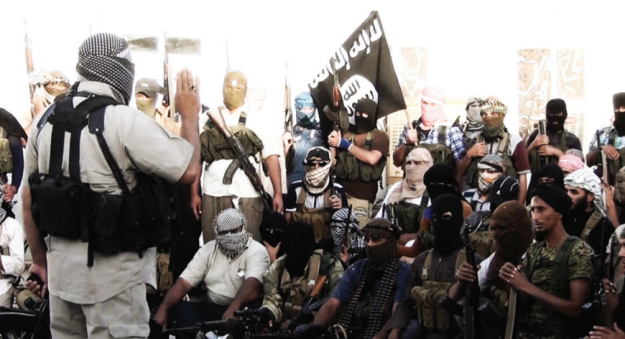
More than twelve years after the fall of Saddam Hussein, the conventional wisdom is that Saddam’s regime had no connection with al-Qaeda, and such “evidence” as was adduced was tortured out of Ibn al-Shaykh al-Libi in the Bush administration’s desperation to cobble together a casus belli. But if one puts ideology on hold, and considers the evidence of Stephen Hayes’ The Connection, a rather different picture emerges. Continue reading

Former Islamic State Leader Advises on Jihadist Conduct

By Kyle Orton (@KyleWOrton) on January 6, 2015

dabiq-6

The sixth edition of the Islamic State’s English-language magazine, Dabiq, published on 29 December 2014, reproduced a “speech” by Abu Hamza al-Muhajir, entitled, “Advice for the Soldiers of the Islamic State”, which dates from 23 September 2007.[1] It is reproduced below with some editions in transliteration and some important sections highlighted in bold. Continue reading

Islamic State Biography of the Spokesman: Abu Muhammad al-Adnani

By Kyle Orton (@KyleWOrton) on November 8, 2014

Picture of Abu Muhammad al-Adnani from the second edition of Dabiq magazine (July 27, 2014)

A Bahraini jihadist ideologue, Turki al-Binali, who has become a cleric in the Islamic State, put out a profile of the Islamic State’s official spokesman, Abu Muhammad al-Adnani, on November 1. By this account, al-Adnani took up jihadism in 2000 and was among a small cadre of people who joined the Islamic State’s founder, Ahmad al-Khalayleh, the infamous Abu Musab al-Zarqawi, when he journeyed through Syria on a recruitment-drive in 2002. Learned in Islamic jurisprudence and rigid in doctrinal literalness, al-Adnani was associated with some of the titans of the Islamic State’s legend like Abu Muhammad al-Lubnani and Abu Anas al-Shami. Appointed as emir of a small town in Anbar, Haditha, the first leader after the declaration of “the State” in 2006, Hamid al-Zawi (Abu Umar al-Baghdadi), worked under al-Adnani’s command. Al-Adnani then moved on to be an ideological instructor. Such was al-Adnani’s status, he did not have to consult al-Zarqawi before ordering operations; he only had to brief al-Zarqawi afterwards. Al-Adnani was arrested by the Americans in Iraq in May 2005, thereafter spending six years behind the wire, though never giving up his missionary activity. Indeed, the profile says al-Adnani developed the first full training program, academic and physical, for jihadi inmates. Upon release, al-Adnani took the post of official spokesman and has maintained it ever since. This profile is reproduced below with some minor editions for transliteration, syntax, and spelling. Continue reading

ISIS Announces the Restoration of the Caliphate

By Kyle Orton (@KyleWOrton) on June 29, 2014

The Islamic State of Iraq and Syria (ISIS) announced that it had restored the caliphate on 29 June 2014. ISIS’s name was changed to simply the Islamic State (I.S.), and its leader, Abu Bakr al-Baghdadi, abandoned his kunya and proclaimed himself Caliph Ibrahim, his real name being Ibrahim al-Badri. The statement announcing that the areas I.S. rules in Syria and Iraq are now a caliphate, entitled “This Is The Promise of Allah [God],” was given by the group’s official spokesman, Abu Muhammad al-Adnani, and was distributed by al-Hayat Media in Arabic, English, Russian, French, and German. The English version is reproduced below with some editions for transliteration and some interesting or important sections highlighted in bold. The speech lays out how the state should and will be governed—in other words, what I.S. envisions for its utopia. Continue reading

ISIS’s Spokesman Denounces Al-Qaeda’s Leader, Claims ISIS Is The Victim

By Kyle Orton (@KyleWOrton) on May 13, 2014

The spokesman of the Islamic State of Iraq and Syria (ISIS), Abu Muhammad al-Adnani, gave a speech via audio message on 11 May 2014, entitled “‘Adhr’a emir al-Qaeda” (Apologies, emir of al-Qaeda). Al-Qaeda’s leader, Ayman al-Zawahiri, disowned ISIS, al-Qaeda’s prior Iraqi branch, in February, and then gave an extended statement a few days ago that placed blame for the schism squarely on ISIS. Al-Adnani’s speech was a response to al-Zawahiri, and it was among ISIS’s most stern attacks on al-Qaeda so far. Al-Adnani denounced al-Zawahiri for allegedly deviating from the outlook of Usama bin Ladin. Al-Adnani called on al-Zawahiri to reverse his ruling that accepted Jabhat al-Nusra’s split from ISIS. Al-Nusra has rebelliously broken its pledge of allegiance to ISIS, al-Adnani says, and al-Zawahiri’s duty was to side with ISIS against this renegade—not to join in a campaign of sedition and conspiracy against ISIS. Most intriguingly, al-Adnani denied that ISIS had ever been, in a formal sense, subordinate to al-Qaeda. Rather, says al-Adnani, ISIS had placed itself in a position of voluntarily labelling themselves as al-Qaeda and accepting the advice of the “elders of jihad” in order to unite the ranks of the jihadists. But, says al-Adnani, this was not a command relationship for ISIS’s internal affairs: witness, al-Adnani says, ISIS’s refusal to listen to al-Qaeda’s order to cease attacking Shi’i civilians. Though, says al-Adnani, ISIS did obey al-Qaeda in external matters, specifically not targeting Iran, where al-Qaeda has an important facilitation network that serves as its supply line from Afghanistan-Pakistan to the Arab world. Al-Adnani’s speech was translated today by Musa Cerantonio, an Australian convert to Islam who is one of ISIS’s most important international propagandist-recruiters. Al-Adnani’s speech is reprinted below. Continue reading

The Spokesman of ISIS Says Al-Qaeda is Deviant

By Kyle Orton (@KyleWOrton) on April 17, 2014

The spokesman of the Islamic State of Iraq and Syria (ISIS), Abu Muhammad al-Adnani, gave a speech on 17 April 2014, “This Is Not Our Methodology, Nor Will It Ever Be”. This was released by  al-Furqan Media, which also produced an English-language version, reproduced below.

Al-Adnani delivered the most ferocious attack from ISIS against al-Qaeda so far. Al-Adnani said that the dispute is not related to pledges of allegiance, which he says ISIS never had to al-Qaeda, but to al-Qaeda under Ayman al-Zawahiri deviating from the path of Usama bin Ladin, encouraging collaboration with heretics and unbelievers, and inciting divisions within the ranks of the jihadists, particularly by accepting the bay’a (pledge of allegiance) from the leader of Jabhat al-Nusra, Abu Muhammad al-Jolani, whom al-Adnani says owed his allegiance to ISIS.
Continue reading