Tag Archives: Awakening

The Islamic State Announces the “Axe of al-Khalil Campaign” to Destroy the “Idol” of Democracy

By Kyle Orton (@KyleWOrton) on 19 March 2021

Hamid al-Zawi, the leader of the Islamic State movement from 2006 to 2010, known only as Abu Umar al-Baghdadi during his lifetime, gave a speech on 19 March 2010 entitled, “The Soldiers’ Sermon for the Axe of al-Khalil Campaign” (Khutba al-Jund bi-Hamlat Fa’s al-Khalil). It was Al-Zawi’s twenty-second and, as it turned out, penultimate speech. Al-Zawi was killed almost exactly a month later, on 18 April 2010, alongside his deputy and “war minister”, Abd al-Munim al-Badawi (Abu Hamza al-Muhajir). A translation of the speech is published below.

Continue reading

The Islamic State’s Acknowledgement of the Deaths of Abu Umar al-Baghdadi and Abu Hamza al-Muhajir

By Kyle Orton (@KyleWOrton) on 18 March 2021

Continue reading

Islamic State Announces the “Harvest of the Good” Campaign

By Kyle Orton (@KyleWOrton) on 17 March 2021

Abu Umar al-Baghdadi, the implied caliph of the Islamic State movement between 2006 and 2010, gave his sixteenth speech on 17 March 2009. The title of the speech was, “Harvest of the Good (The Gathering Will Be Defeated, and They Will Turn Their Backs and Flee)”.[1]

Continue reading

The Dissolution of Al-Qaeda in Iraq

By Kyle Orton (@KyleWOrton) on 17 January 2021

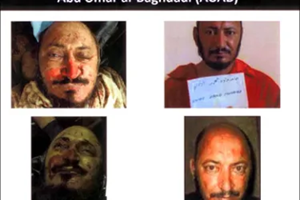
One of the few pictures in existence of Abd al-Munim al-Badawi (Abu Hamza al-Muhajir)

Abd al-Munim al-Badawi (Abu Hamza al-Muhajir) had become the leader of Al-Qaeda in Mesopotamia (AQM) after its founder, Ahmad al-Khalayleh, much better known as Abu Musab al-Zarqawi, had been killed in June 2006. AQM was the dominant faction within the Islamic State (IS) when it was announced in October 2006 as a merger of jihadist insurgents, and for that reason most analysts at the time considered IS a “front” for AQM. When IS’s emir, Hamid al-Zawi (Abu Umar al-Baghdadi), made his first speech in December 2006 affirming the statehood declaration, most read this as the foreign-led AQM putting an Iraqi face on their enterprise. In fact, as can now be seen, dynamics were essentially as presented by the jihadists.

Crucial was a speech Al-Badawi gave on 10 November 2006, his fifth of what would prove to be fifteen, released by Al-Furqan Media Foundation within IS’s “ministry of information”, entitled, “I’na al-Hukm I’la Allah” (إن الحكم إلا لله), something like “Judgment is Only for God” or “Judgment is God’s Only”, where he gave his bay’a (oath of allegiance) to Al-Zawi, put AQM’s troops under Al-Zawi’s command, and effectively dissolved Al-Qaeda’s presence in Iraq. A transcript of the speech is available here, and a summary of the speech is below. Continue reading

Losing in Yemen, Winning in Afghanistan, Islamic State Weighs in on Arab-Israeli Peace

By Kyle Orton (@KyleWOrton) on 22 August 2020

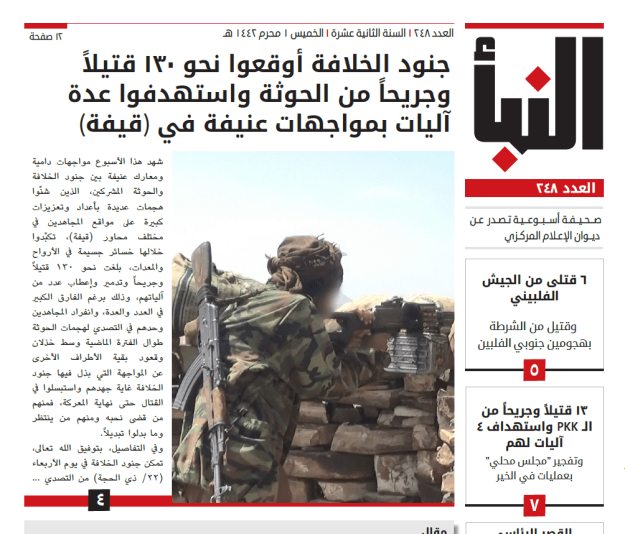
Al-Naba 248

The Islamic State (IS) produced the 248th edition of Al-Naba, its newsletter, on 20 August. The front page was devoted to recent events in Yemen, which had not gone well for IS—although one could easily miss that fact when reading a story that a focuses almost entirely on enemy casualties and the failures of others. IS is, of course, not pleased about the Israeli normalisation of relations with the United Arab Emirates, but Al-Naba makes clear that it is more perturbed that Muslims should believe Turkey or Qatar are any better than the U.A.E., despite their different approach to Islamists. Al-Naba 248 documents IS’s continuing advances in Afghanistan—and, indeed, Iraq, Syria, Africa (the Sahel), and Egypt. There is also a report of insurgent activity in the Philippines. Continue reading

Islamic State Spokesman Vows Revenge Against Enemies, Plays the Israel Card

By Kyle Orton (@KyleWOrton) on 21 February 2020

The Islamic State’s (IS) spokesman, Abu Hamza al-Qurayshi, gave his second speech on 27 January 2020. The speech was entitled, “Allah Destroyed Everything Over Them, and for the Kafireen is Something Comparable”, by IS’s official English translation. The title is drawn from the Qur’an, the Surah of Muhammad (47), verse 10. The verse can be rendered as, “God Destroyed Them Completely, and a Similar Fate Awaits the Disbelievers”. Below is a copy of the transcript of Abu Hamza’s speech, with some editions for transliteration and translation, and some interesting sections highlighted in bold. Continue reading

The First Speech of Islamic State Spokesman Abu Muhammad al-Adnani

By Kyle Orton (@KyleWOrton) on 7 November 2019

Taha Falaha (Abu Muhammad al-Adnani) [right] appearing in an Islamic State video alongside Tarkhan Batirashvili (Abu Umar al-Shishani, 3 June 2017, displaying a scene from 2014 when IS demolished the borders between Iraq and Syria. Falaha was killed in August 2016. It is common for IS to hold back pictures and footage of its leaders for time-spans that can reach over a decade.

Taha Falaha was the effective deputy of the Islamic State (IS) when he was killed on 30 August 2016, by which time he was also overseeing the foreign attacks campaign by IS and serving as governor of the IS-held areas in Syria. Likely, however, Falaha, is best-known internationally by his kunya, Abu Muhammad al-Adnani, and for his role as IS’s official spokesman, particularly his speech in September 2014 inciting Muslims in the West to commit terrorist attacks against their native countries. Falaha had been recruited in Aleppo in 2002 by IS’s founder, Ahmad al-Khalayleh (Abu Musab al-Zarqawi) and steadily advanced through IS’s media department, eventually being announced as the official spokesman with his first speech, released on 1 August 2011. An English-language transcript of that first speech, an hour-long audio message entitled, al-Dawlat al-Islam Baqiya (“The Islamic State Remains” or “The Islamic State Endures”), was released by “Ansar al-Mujahideen English Forum Language and Translation Department” and was posted to their forum on 4 March 2012. The transcript is reproduced below with some editions from the Arabic transcript and some important parts highlighted in bold. Continue reading

Islamic State Profiles the Leadership

By Kyle Orton (@KyleWOrton) on 6 April 2019

Islamic State flag in front of the main gate of Saddam Husayn’s palace in Tikrit, 5 April 2015 // AFP PHOTO / MOHAMMED SAWAF

A lengthy document—roughly sixty pages and 12,000 words—was published online on 21 February 2019 containing biographies of twenty-seven senior Islamic State (IS) officials, past and more recent. Those bios that are dated were written between October 2018 and the time of publication, with one exception that was written in the summer of 2018. The author claims to be an IS veteran. While longevity is difficult to prove, the fact that the author provides heretofore unseen images of some of the IS leaders suggests that at a minimum he is an IS operative. Continue reading

A Rare Video Statement From An Islamic State of Iraq Leader: Chief Judge Abu Sulayman al-Utaybi

By Kyle Orton (@KyleWOrton) on 8 November 2018

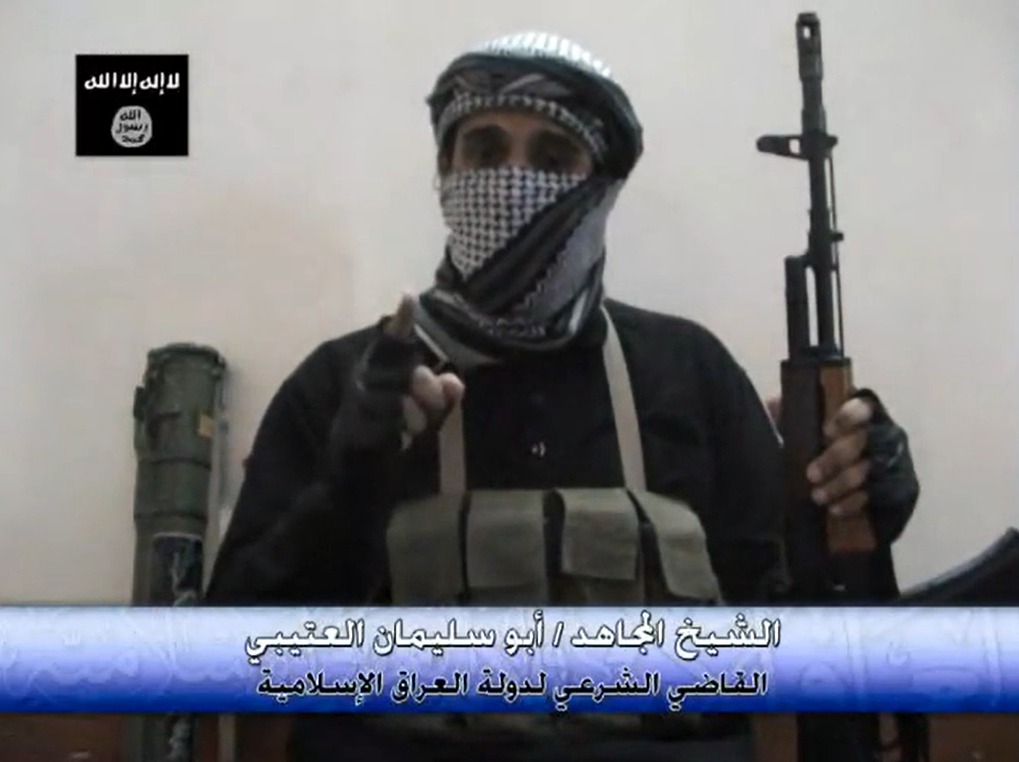
As explained in a previous post, Abu Sulayman al-Utaybi, the Chief Judge of the Islamic State of Iraq (ISI) from early April to late August 2007, has become an important character in many accounts of the history of the Islamic State movement because his abrupt removal from office was followed by his defection from ISI and a journey to Al-Qaeda’s central leadership in Pakistan, where he provided a testimony against his former bosses. If interested in an assessment of that testimony and the whole saga around how it has been used—by Western scholars, Al-Qaeda, and other critics of the Islamic State—check out the prior post. This post reproduces the transcript for what is, as far as I can tell, Abu Sulayman’s first media product for ISI, a twenty-minute video speech released by Al-Furqan Foundation for Media Production on 11 April 2007, entitled, “Why Do We Wage Jihad?”

Continue reading

Testimony of Islamic State Defector Abu Sulayman al-Utaybi

By Kyle Orton (@KyleWOrton) on 6 November 2018

Abu Sulayman al-Utaybi, a Saudi who abandoned his Islamic studies to journey to Iraq in 2006, was appointed chief judge, of the Islamic State movement in March 2007, six months after the Statehood declaration. Between April and June 2007, Abu Sulayman released some public sermons—the picture above is from the first—for what was then called the Islamic State of Iraq (ISI), which had publicly dissolved its bonds to Al-Qaeda when it became a “State” in October 2006, while in fact retaining its bay’a (oath of allegiance) to Al-Qaeda in private.

Continue reading