Tag Archives: Evno Azeff

How Russia Manipulates Islamic Terrorism

By Kyle Orton (@KyleWOrton) on September 8, 2015
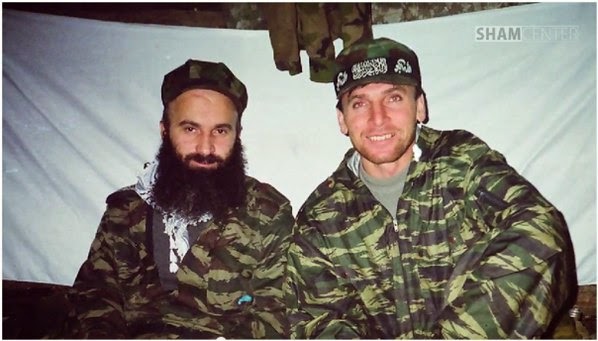
Shamil Basayev and Murad Margoshvili (a.k.a. Muslem al-Shishani)

Shamil Basayev and Murad Margoshvili (a.k.a. Muslem a-Shishani)

Last year I wrote about the murky role Russia was playing in the Syrian war, bolstering the Bashar al-Assad tyranny while facilitating the rise of the Islamic State (ISIS) and other Salafi-jihadists as a means of dividing and discrediting the Syrian opposition. This strategy and the associated tactics—infiltrating the insurgency, facilitating the arrival of al-Qaeda and other global jihadists to displace the nationalists, and in general driving the rebellion into the political dead-end of extremism and barbaric atrocities—has worked in other States where the intelligence services were trained by Moscow, and it worked internally to defeat the separatist movement in Chechnya. In Syria, Russia is reinforcing an old client regime, which has staked its life on the proposition that it is the last line of defence against a terrorist takeover and a genocide against the minorities, a policy now largely directed on-the-ground by Iran, to whom Assad surrendered sovereignty some time ago. New evidence has emerged to underline these points. Continue reading
Russia’s Secret Police

By Kyle Orton (@KyleWOrton) on August 1, 20151

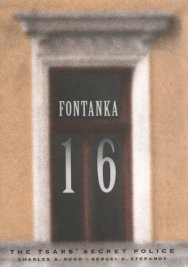
Charles Ruud’s and Sergei Stepanov’s Fontanka 16: The Tsar’s Secret Police traces the evolution of political policing in Russia, focusing on the Okhranka, the final incarnation of the secret police before the Russian Revolution in 1917, and along the way puts paid to a whole array of myths about the pre-Bolshevik Russian government, especially as regards the Jewish Question.

The growth of the Russian political police occurred in four major stages. The first phase lasted from the founding of the Russian State by Ivan the Terrible (1533-84) after the expulsion of the Tatars to the opening of the “Third Section” in 1826 as a reaction to the Decembrist revolt the previous year—the first time the Imperial State security services were housed at Fontanka 16 in St. Petersburg—which intended to (and succeeded in, as 1848 would demonstrate) extirpate the liberal spirit that challenged the autocracy. The third phase saw the Third Section become the Department of Police at the onset of a crackdown after the assassination of Alexander II in 1881, who had enacted broad liberal reforms on censorship and serfdom. The elite secret police force grew out of the palace guard, becoming known as the Okhranka (though this is more usually rendered in English as Okhrana). The final phase began in 1906, after the 1905 revolution, when the Okhranka worked to stop a liberal-radical coalition building. Continue reading