By Kyle Orton (@KyleWOrton) on 3 May 2025
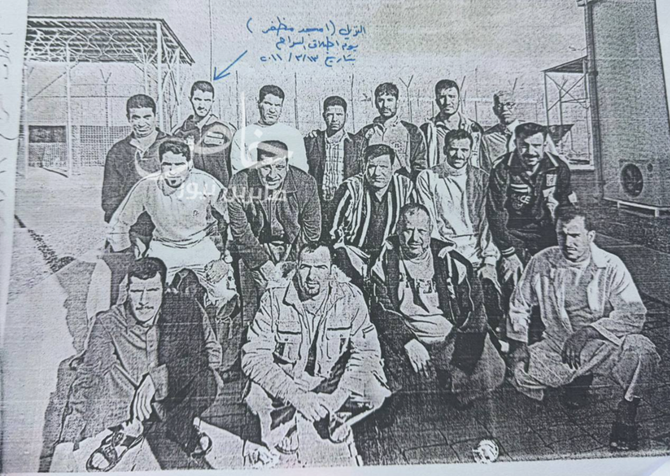
By Kyle Orton (@KyleWOrton) on 3 February 2022
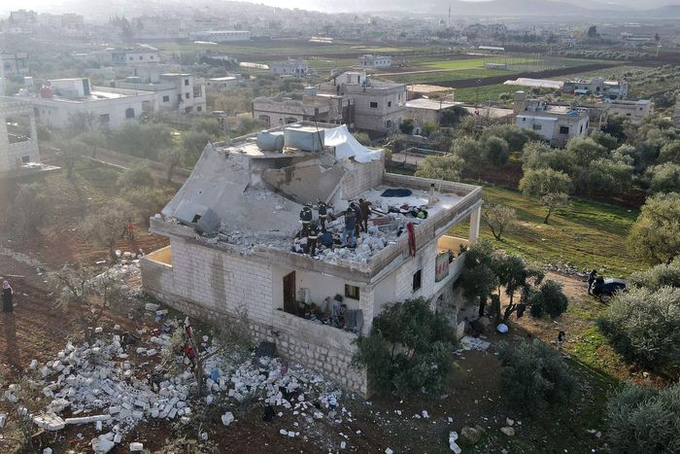
The compound where Islamic State leader Amir Muhammad al-Mawla killed himself, 3 February 2021 || Image taken from social media
By Kyle Orton (@KyleWOrton) on 8 May 2021
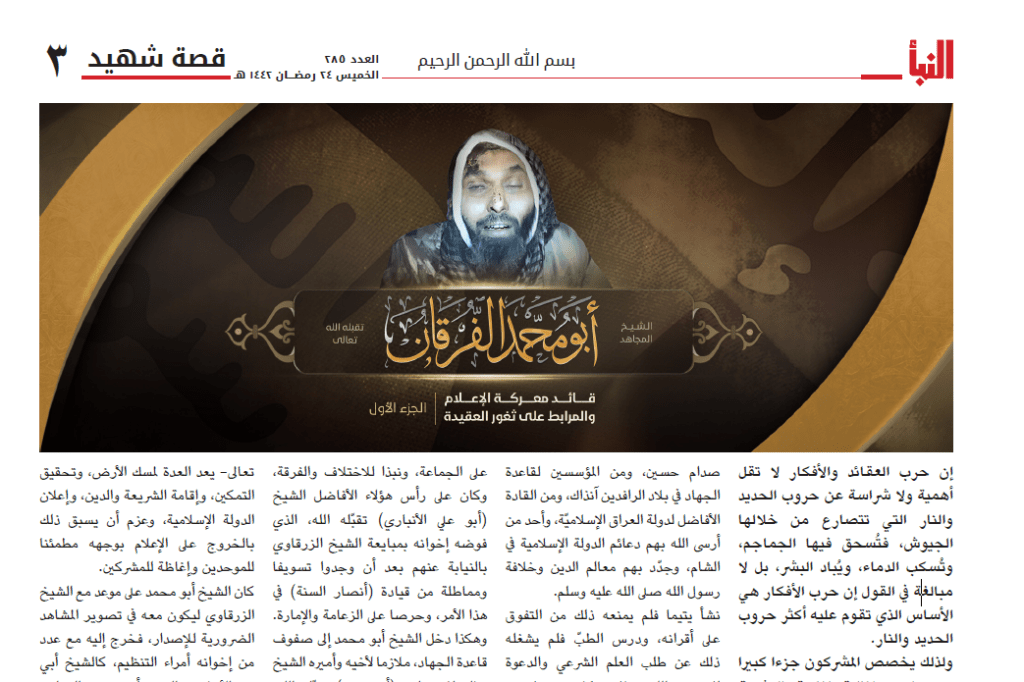
Wael al-Ta’i (Abu Muhammad al-Furqan), Al-Naba 285, p. 3
The 285th edition of Al-Naba, the weekly newsletter of the Islamic State (IS), released on 6 May, had a biography of Abu Muhammad al-Furqan, one of the most important IS leaders, the head of its Central Media Department and its operational ruler when he was killed in September 2016. Continue reading
By Kyle Orton (@KyleWOrton) on 23 May 2020
There is now, with various caveats, a general agreement that the Islamic State (IS) is on the upswing—in Iraq, particularly, but also in the Badiya, the desert regions of eastern Syria, and more recently in the south of Syria around Deraa. Still, there have been some recent notable gains against the terrorist group. Continue reading
By Kyle Orton (@KyleWOrton) on 6 April 2019

Islamic State flag in front of the main gate of Saddam Husayn’s palace in Tikrit, 5 April 2015 // AFP PHOTO / MOHAMMED SAWAF
A lengthy document—roughly sixty pages and 12,000 words—was published online on 21 February 2019 containing biographies of twenty-seven senior Islamic State (IS) officials, past and more recent. Those bios that are dated were written between October 2018 and the time of publication, with one exception that was written in the summer of 2018. The author claims to be an IS veteran. While longevity is difficult to prove, the fact that the author provides heretofore unseen images of some of the IS leaders suggests that at a minimum he is an IS operative. Continue reading
By Kyle Orton (@KyleWOrton) on 2 December 2018
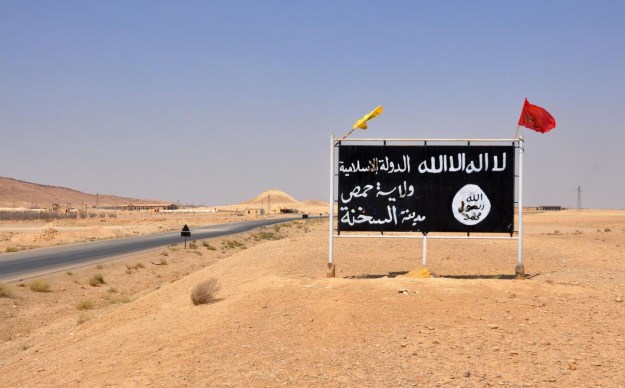
An Islamic State poster near al-Sukhna in the eastern Homs desert, Syria, August 2017 (source)
Over the past week, two members of the Islamic State (IS) have been arrested—a rarity in itself during the Coalition campaign against the group—and both in different ways give a glimpse of archetypes that have made up the organisation, from its inception to its expansion into Syria. Continue reading
By Kyle Orton (@KyleWOrton) on 9 September 2018
The United States has launched at least five raids into Syria to date, all of them against the Islamic State (IS).[1] The second such raid, on 15 May 2015, killed Fathi al-Tunisi (Abu Sayyaf al-Iraqi, Abu Muhammad al-Iraqi, or Abd al-Ghani), who oversaw critical revenue-generating criminal schemes for the group. Al-Tunisi was primarily responsible for the oil industry in eastern Syria, in which capacity he collaborated with Bashar al-Asad’s regime, and he worked as head of the Antiquities Division of IS Diwan al-Rikaz, which translates literally as the “Department of Precious Things That Come Out of the Ground”, usually given as the “Department of Natural Resources”. Al-Tunisi was what is sometimes termed a “middle manager”: the connective tissue between the most senior levels of the leadership and local administrators, ensuring smooth coordination between the two by inter alia keeping the books. In short, the kind of terrorist operative that keeps an organisation going. Continue reading
By Kyle Orton (@KyleWOrton) on 11 September 2017
In his twelfth speech since the founding of “the State,” on 24 September 2008, Hamid al-Zawi (Abu Umar al-Baghdadi), listed the “commander in chief”, or chief of staff, Abu al-Bashair al-Jiburi, as among the top heroes of the Islamic State of Iraq (ISI). Al-Zawi said that Abu al-Bashair had been recently martyred.
In an interview released on 28 October 2008, Abdul Munim al-Badawi (Abu Hamza al-Muhajir), al-Zawi’s deputy and the “war minister” of ISI, said that Abu al-Bashair was an Iraqi and a former colonel in Saddam Husayn’s army. Continue reading


 Kyle Orton's Blog