Tag Archives: Iran

Al-Qaeda Leader Says America is the Main Enemy

By Kyle Orton (@KyleWOrton) on 11 September 2018

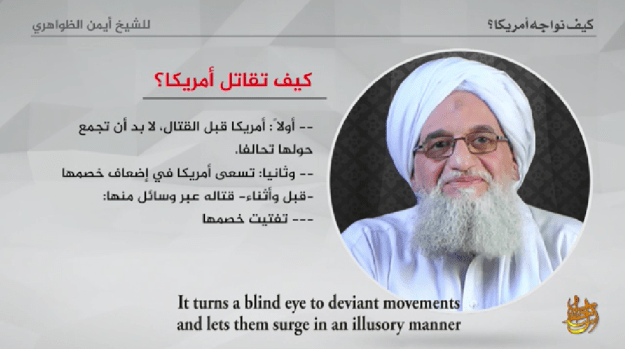
Al-Qaeda’s emir, Ayman al-Zawahiri, released a half-hour video speech today, entitled, “How to Confront America”. Al-Zawahiri’s speech mentions in passing the move of the U.S. Embassy in Israel from Tel Aviv to Jerusalem, but this—and the increasing relations of the Gulf states with the Jewish state—are held to be mere examples of the rot spread by America. Despite the lessening of Christian belief in the West, says Al-Zawahiri, the inhabitants of what was once called Christendom remain “Crusaders” at heart, with a fierce hatred for Islam and Muslims. Perhaps worse than any physical attack on the jihadists, however, is the ideological challenge of America’s secularism, Al-Zawahiri adds. An English transcript of the speech was released by As-Sahab Media and is reprinted below. Continue reading

America Sanctions the Syrian Regime for Funding the Islamic State—Again

By Kyle Orton (@KyleWOrton) on 7 September 2018

The U.S. Treasury Department sanctioned four individuals and five entities connected to the Syrian regime of Bashar al-Asad on 6 September 2018. The most interesting was Muhammad al-Katerji, who has been involved in trade with the Islamic State (IS). A relative of his, Hussam al-Katerji, has previously been revealed as funding the jihadists on behalf of the regime, and the U.S. has previously sanctioned another Kremlin-linked Asad regime oligarch, George Haswani, for financing IS. “The United States will continue to target those who facilitate transactions with the murderous Asad regime and support ISIS”, said U.S. Treasury Secretary Steven Mnuchin. Continue reading

What Questions Remain About 9/11?

By Kyle Orton (@KyleWOrton) on 5 September 2018

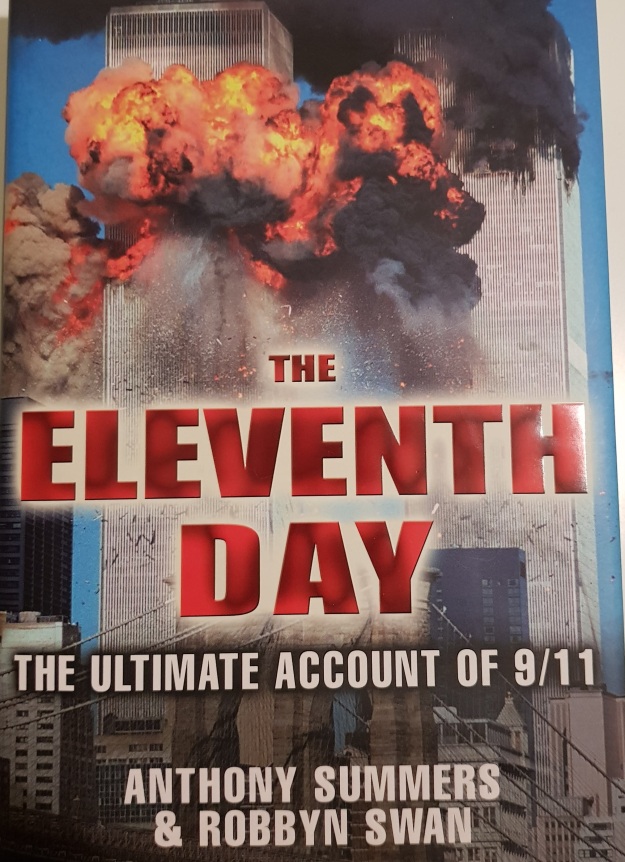
In less than a week, it will be the seventeenth anniversary of al-Qaeda’s “Plane’s Operation”, the assault on the United States. It is a vertiginous enough reflection that many of us have been alive more years since 11 September 2001 than before it, and positively alarming that many of those who will soon move into the government, media, and other leading societal institutions will have been born after an event that still shapes so much of the international scene. As Anthony Summers and Robbyn Swan put it in The Eleventh Day: The Ultimate Account of 9/11 (2011), we are left with “the brief name ‘9/11’,” the context and meaning stripped away all this time later. The book is a useful overview of an event that should always be to some degree fresh in mind, though it is not without its problems in its analytical sections. Continue reading

The State of Play in Syria and Iraq on the Eve of the Idlib Offensive

By Kyle Orton (@KyleWOrton) on 29 August 2018

Two ideas that have become quite prevalent are that the Islamic State is defeated or on its way to defeat and that the Syrian war is winding down. Both are gravely mistaken. Continue reading

Islamic State Leader in Afghanistan Killed

By Kyle Orton (@KyleWOrton) on 26 August 2018

Islamic State in Afghanistan (image source)

Attaullah Khogyani, a spokesman from Nangarhar province, says—and the spokesman for American forces in Afghanistan, Lt. Col. Martin O’Donnell, confirmed—that the leader of the Islamic State in Khorasan (ISK), Sad Arhabi, was killed in an airstrike in his province last night. It seems another ten ISK jihadists were killed alongside Arhabi. Continue reading

Islamic State Leader Urges Patience as the Path to Victory

By Kyle Orton (@KyleWOrton) on 22 August 2018

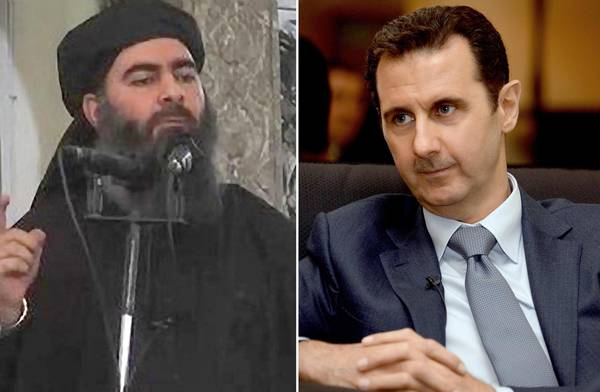
The leader of the Islamic State (IS), Ibrahim al-Badri (Abu Bakr al-Baghdadi), released a nearly 55-minute audio statement today, his first statement for eleven months, which in turn came eleven months after the prior speech. This is al-Badri’s thirteenth speech since he became leader of the IS movement in May 2010 and the eighth since IS declared the restoration of the caliphate in June 2014. The title of today’s speech, “Give Glad Tidings to the Patient”, is drawn from a verse of the Qur’an that promises “glad [or good] tidings” in Paradise to those who remain steadfast on the path of faith in life, which is very much the theme al-Badri sticks to. Continue reading

Turkey’s War Against the PKK on the Near Abroad

By Kyle Orton (@KyleWOrton) on 21 August 2018

Ismail Özden (image source)

Turkey killed a senior operative of the Kurdistan Workers’ Party (PKK), the internationally-recognised terrorist organisation and narcotics trafficking entity that has been at war with the Turkish state since 1984, in Iraq last week. Turkey launched a wave of airstrikes against PKK targets in Syria and Iraq in April 2017 and for the last several months Ankara has been widening its campaign against the PKK outside Turkey’s borders, particularly in Iraq, where the PKK is not protected by the United States, as it is in eastern Syria. Having feinted in June toward an attack on the historic PKK headquarters in the Qandil Mountains—a somewhat symbolic target at this stage, with the bulk of the PKK’s leadership and resources in Syria—it appears the Turks have opted for a more targeted approach.

This operation underscores the continuance of U.S.-Turkey relations, and the mutual benefits of the relationship, even in its current damaged state, where both sides have a laundry list of legitimate grievances with the other. If a formula for normalisation can be found, the potential to contain and weaken some of the worst, most destabilising elements in the region, saliently the PKK and the Iranian regime, is within reach. Continue reading

Australia’s No-Nonsense Approach to the PKK

By Kyle Orton (@KyleWOrton) on 17 August 2018

Funeral for the victims of the TAK/PKK terrorist attack on the Besiktas football stadium in Istanbul, December 2016. Photograph: Sedat Suna/EPA

The Kurdistan Workers’ Party (PKK), the separatist group in Turkey that is a designated terrorist organisation across much of the West, has always used a vast array of front-groups in the West to raise funds and recruit. After 9/11, with the advent of the War on Terror, the PKK switched tactics in the region to try to conceal its operations and avoid the “terrorism” label. This involved rebranding its operations in Iraq, Syria, and Iran, and setting up a special forces-style urban terrorism wing, the Kurdistan Freedom Falcons (TAK), to deniably carry out its most atrocious activities. The PKK’s rebranding has not been without success. In Australia, however, the government has refused to accept the PKK’s propaganda about TAK and lists it, quite correctly, as simply an alias for the PKK. Continue reading

The Fall of Southern Syria and Israel’s Reliance on Russia

A version of this article was published in The Arab Weekly

By Kyle Orton (@KyleWOrton) on 3 August 2018

An Israeli Merkava tank patrols on the border between Israel and Syria, on 20 July 2018. (AFP)

Israel has been conflicted on the Syrian rebellion: some saw Bashar al-Assad’s reliance on Iran and thus favoured his departure; some, especially once the uprising militarized and jihadi-Salafists made their appearance among the insurgents, favoured a let-them-both-lose policy; and some saw the risk of chaos and jihadists and preferred to stick with what they knew.

The official Israeli policy, stated in the early months of the protests, was to side with the people “demonstrating for freedoms” since “the devil we know in Syria [i.e. Assad] is worse than the devil we don’t”. Continue reading

The Left’s Extremism Problem

By Kyle Orton (@KyleWOrton) on 3 August 2018

Jeremy Corbyn’s on Iran’s state television station, Press TV, 2012 (source)

The unexpected victory of Alexandria Ocasio-Cortez in the Democratic primary in The Bronx in June caused quite a stir, given her membership of the Democratic Socialists of America and her controversial policy positions. Nonetheless, she has been enthusiastically embraced as “the future” by the chairman of the Democratic National Committee. Events in Britain suggest Democrats might want to exercise some caution here before they go all in. Continue reading