Tag Archives: Iran

Assad and Academics: Disinformation in the Modern Era

By Kyle Orton (@KyleWOrton) on February 22, 2016
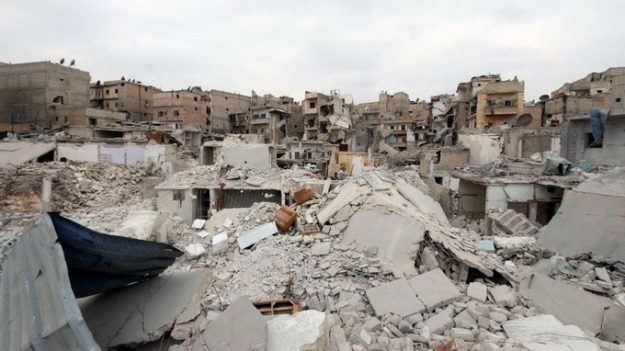
Aleppo City

Aleppo City after the destruction of the Asad regime, Iran, and Russia

Introduction

From the beginning of Syria’s war, the regime of Bashar al-Assad, enabled by Iran and Russia, has run a very elaborate media war to portray itself as the victim of an international conspiracy, wherein its only opponents are terrorists from al-Qaeda and its offshoots who are being used by foreigners—namely the Gulf States, Turkey, Israel, and the United States—to overthrow a defiant “resistance” State.

The other part of this strategic messaging is aimed at the West, which Assad otherwise accuses of supporting jihadi-Salafist terrorism against him: Assad is the only alternative to the terrorists, it says, so the West should support him. War criminal he might be, he will protect the minorities—his role in endangering them by starting a sectarian war against the Sunni majority and bolstering the takfiris within the insurgency to cannibalize all legitimate or engageable armed opposition, notwithstanding—and has no immediate plans to fly planes into Western skyscrapers. (That the leading edge of Assad’s ground forces are made up of radically sectarian, foreign Shi’a jihadists under Iran’s control, some of them Iraqis responsible for killing a quarter of the 4,000 U.S. soldiers who fell in Mesopotamia, and are integrated into a State-run terrorist network that has struck Western and Jewish targets the world over, gets left out.)

For Assad and his allies, it helps if this propaganda is not only delivered by regime spokesman but independent analysts, journalists, academics, and politicians. In the last ten days two salient examples have emerged: Stephen Kinzer, a veteran journalist, including for The New York Times, who wrote in The Boston Globe, and Jeffrey Sachs, an academic economist working at Columbia University, who wrote in The Huffington Post. Mixing together conspiracy theories, half-truths, and outright lies—disinformation, to give it an old name—both Kinzer and Sachs told a version of the regime’s narrative. Why they did this is best-known to them. Continue reading

America Picked the Wrong Allies Against the Islamic State

By Kyle Orton (@KyleWOrton) on February 17, 2016

Article published at NOW Lebanon

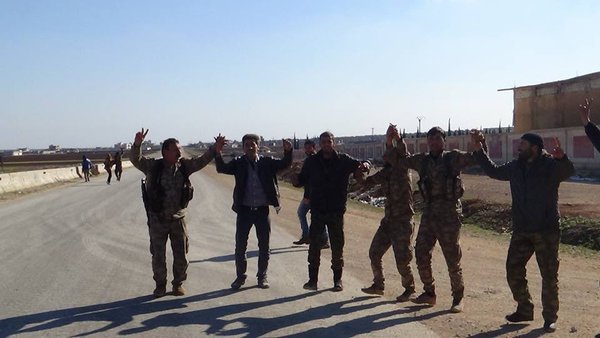
PYD/PKK fighters after they took over the Mannagh airbase on February 10, 2016.

PYD/PKK fighters after they took over the Mannagh airbase on February 10, 2016.

Over the last six weeks the regime of Bashar al-Assad—which by this point means in most areas Iranian-run ground forces and Russian air power—have made territorial gains in northern Syria that threaten the existence of the armed opposition in the area. This threat has been compounded by the Kurdish Democratic Union Party (PYD) and allies, which have also drawn on Russian airstrikes to attack the rebellion in the same areas. The U.S.-led coalition against the Islamic State (ISIS) has made the PYD its main proxy inside Syria—the only force that can call in coalition airstrikes. This policy was obviously flawed given the view of the PYD by necessary anti-ISIS allies like Turkey and the demographic realities of ISIS, which require Sunni Arabs to be able to police their area, and ensure that ISIS begins to look like a protector of Sunnis if Kurds occupy Arab areas; the PYD now attacking the crucial anti-ISIS demographic in alliance with the regime underlines that fact. Continue reading

How Russia and Iran Took Advantage of Syrian Peace Talks to Choke Aleppo

By Kyle Orton (@KyleWOrton) on February 16, 2016

Published at The Independent, submitted February 12.

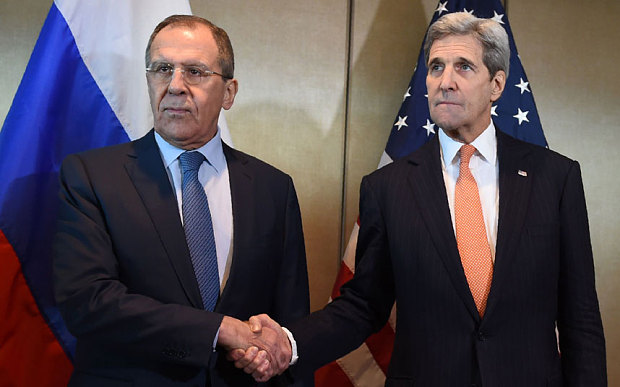
Kerry-Lavrov 'ceasefire'

In the coming days and weeks many people will weep for the fate of Aleppo. Many of these people will also continue to support the nuclear deal, which has facilitated this U.S.-Iran détente and supplied Iran the resources to make war. They will still consider it a triumph of diplomacy over military action—and never be called to account for the obvious contradiction.

The Geneva III peace process is the most immediate cause for this latest offensive against Aleppo, led on the ground by Iran’s Islamic Revolutionary Guard Corps (IRGC) and its proxies, as well as Russian airstrikes. The regime and Russia have used it as a cover to gain ground. Continue reading

The Assad Regime’s War Against Syria’s People

By Kyle Orton (@KyleWOrton) on February 8, 2016

Viewing the pictures smuggled out of Syria by "Caesar" of prisoners tortured and murdered by the Assad regime (source)

Viewing the pictures smuggled out of Syria by “Caesar” of prisoners tortured and murdered by the Assad regime (source)

The Office of the United Nations High Commissioner for Human Rights (OHCHR) released a report earlier today documenting the Assad regime’s “systematic and widespread attack against [the Syrian] civilian population.” The report is meticulously compiled from reams of internal documents and the evidence of 621 witnesses who have been in Assad’s prisons, covering the period March 10, 2011, to November 30, 2015. Two-hundred of these witnesses personally saw somebody murdered. The report is focussed on the mass-murder of prisoners and the evidence leads to the conclusions that the Assad regime has committed extermination, murder, rape, torture, imprisonment, enforced disappearance, and other inhumane acts as crimes against humanity, as well as a raft of at least six separate counts of war crimes. Continue reading

Another Legacy of the Bosnian Jihad

By Kyle Orton (@KyleWOrton) on February 5, 2016

Mirsad Bektašević

Mirsad Bektašević (2005)

I recently wrote about the jihad in Bosnia. This much-neglected aspect of the war in the 1990s was crucial in shaping al-Qaeda, and global jihadism more broadly, providing this movement, and Clerical Iran, with a staging post in Europe, not least because Tehran’s spy-terrorist capabilities had been deployed to bring many of the jihadists into the country and train them in the first place. While Islamist militancy and terrorism were brought to Bosnia largely as imports, their entry was facilitated by the Party of Democratic Action (SDA), the ruling party to this day. While the war itself trained many jihadist “graduates,” almost all of whom were allowed to stay (or at least received Bosnian passports that gave them that right), the entry of extremist charities/missionaries to lead the rebuilding, many of them bankrolled by Saudi Arabia, entrenched the jihadists and spread their form of Islam in Bosnia after the war. As such, Bosnia became a hospitable operating environment for Islamist recruitment and training and both veterans of the war and people radicalized in Bosnia since have continued to show up in the ranks of international terrorism. It is of interest, therefore, to have an important old case re-emerge in a new way in the last few days, that of Mirsad Bektašević, which again highlighted Bosnia’s importance in the formulation of the infrastructure that underpins the jihadi-Salafist movement, the less-than-clear division between al-Qaeda and the Islamic State (IS) when it comes to the European facilitation networks, and the dangers of seeing Iran as a partner in stability. Continue reading

From Bosnia to Guantanamo

By Kyle Orton (@KyleWOrton) on January 23, 2016

War cemetery in Sarajevo (personal picture, July 2011)

War cemetery in Sarajevo (personal photograph, July 2011)

It was announced on Thursday that Guantanamo inmates Tariq Mahmoud Ahmed as-Sawah and Abd al-Aziz Abduh Abdallah Ali as-Suwaydi had been transferred to Bosnia and Montenegro respectively. Sawah’s path to jihadi-Salafism allows a window into the Bosnian jihad, a much-underestimated factor in shaping al-Qaeda, its offshoots, and the wider jihadist movement. In that story is an examination of the role certain States have played in funding and otherwise helping the jihadists. It also leaves some questions about whether emptying Guantanamo of its dangerous inhabitants is the correct policy.
Continue reading

The Rise and Fall of Mohammed Emwazi

By Kyle Orton (@KyleWOrton) on January 20, 2016

Emwazi

Emwazi’s eulogy picture in Dabiq

Yesterday, the Islamic State (IS) released their thirteenth issue of Dabiq. Among many things, it contained an admission of death for Mohammed Emwazi (“Jihadi John”). Referred to by his kunya, Abu Muharib al-Muhajir, Dabiq said (pp. 22-23) Emwazi had been hit by an “unmanned drone in the city of ar-Raqqah” on November 12, “destroying the car and killing him instantly.” The biography that Dabiq offered gave some intriguing details, confirming some surmises I had made about Emwazi when his identity was revealed last spring, including his early involvement in an al-Qaeda network in London sending fighters to al-Shabab in Somalia—the thing that brought him to the attention of the security services, confirming that the truth was the inverse of CAGE’s infamous claim that harassment by the MI5 had radicalized Emwazi—and that Emwazi had left Britain to do jihad in Syria in the company of another British citizen. Emwazi was also in the thick of it when IS broke from al-Qaeda and offers an interesting and rare example of a European IS fighter entrusted with an internal security role for the caliphate.
Continue reading

The Iranian Nuclear Deal and North Korea

By Kyle Orton (@KyleWOrton) on January 18, 2016

1

In the last few days, the international sanctions against the Islamic Republic of Iran’s nuclear program were lifted, which will allow Tehran access to $30 billion immediately and more than $100 billion will become available in short order. There are many fears about the uses Iran will put this money to, whether on the nuclear program itself, in aiding Iran’s imperial policy in the region, now proceeding with assistance from Russia, or perhaps exporting terrorism further abroad. An under-examined potential use of this money, highlighted by new sanctions the United States applied to Iran over its ballistic missile program, is to purchase weapons from North Korea. Pyongyang has already conducted what it claims is a hydrogen bomb test this year; fuelled by Iranian money the Hermit Kingdom might yet make more trouble for its neighbours and beyond. Continue reading

Al-Qaeda Leader Focuses on Main Enemies: Saudi Arabia and the Islamic State

By Kyle Orton (@KyleWOrton) on January 13, 2016

1

As-Sahab Foundation for Islamic Media Publication, al-Qaeda’s media outlet, produced an English translation of a speech by the organization’s leader, Ayman al-Zawahiri, on 13 January 2016. The speech was entitled, “Syria Is Entrusted Upon Your Necks”. The speech does focus on the West, particularly its de facto alliance with the pro-Assad coalition—namely Russia and Iran—and calls for the Syrian rebellion to unite with al-Qaeda to resist this conspiracy. What is more noticeable, however, is the two enemies on whom Dr. al-Zawahiri really focuses: Saudi Arabia and the Islamic State. The Saudis are accused—not without reason—of having been allied closely to the West and thwarting the jihadist projects at every turn. And al-Zawahiri makes a fierce ideological assault on the Islamic State, comparing them with the Khawarij and the Armed Islamic Group (GIA), whose conduct in Algeria in the 1990s and their justifications for it took Islamist extremism to new depths. The speech is reproduced below with some minor editions, to transliteration and punctuation, and some interesting and important sections highlighted in bold.
Continue reading

In View of Vienna

By Kyle Orton (@KyleWOrton) on December 15, 2015

Published at NOW Lebanon.

1

So the Syrian opposition can unite. Foreign powers have been the major cause of rebel discord. Previous rebel unity initiatives like the Joint Command were pulled apart by the competition between the insurgency’s sponsors—Saudi Arabia and Qatar primarily—and the last rebel umbrella group, the Supreme Military Council, which was identified with Western power, collapsed after President Barack Obama decided not to punish Bashar al-Assad for the massive chemical weapons attack on the population of Ghouta. But under Saudi auspices, an opposition “team” was announced on December 10 after a three-day conference in Riyadh, which includes the political and military opposition and groups with varying ideologies and patrons. This is an achievement. Unfortunately, this team’s task is an impossible one: intended to partake in the Vienna process begun in October, ostensibly to negotiate an end to the war, Syria is not, at present, in a condition where a political agreement can be made and implemented, not least because the Assad regime and its supporters in Iran and Russia have doubled down, and the opposition continues to receive insufficient support to pressure the regime enough to force an agreement. Continue reading