Published at The Arab Weekly
By Kyle Orton (@KyleWOrton) on 27 January 2019

Israeli Prime Minister Binyamin Netanyahu and Chadian President Idriss Deby meeting in N’Djamena, 20 January 2019 [AFP]
Continue reading
Published at The Arab Weekly
By Kyle Orton (@KyleWOrton) on 27 January 2019
Israeli Prime Minister Binyamin Netanyahu and Chadian President Idriss Deby meeting in N’Djamena, 20 January 2019 [AFP]
A version of this article was published at CapX
By Kyle Orton (@KyleWOrton) on 21 December 2018

President Trump in a Twitter video saying fallen soldiers agree with his plan to withdraw from Syria, 19 December 2018 [image source]
By Kyle Orton (@KyleWOrton) on 18 December 2018
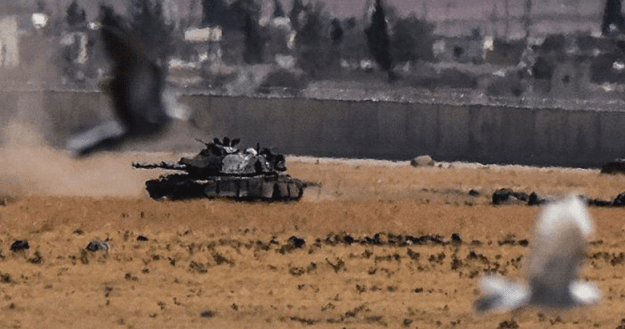
Tel Abyad, Syria [source]
By Kyle Orton (@KyleWOrton) on 15 December 2018

Strasbourg Market, 11 December 2018 [image source]
By Kyle Orton (@KyleWOrton) on 14 December 2018
The United States’ policy in Syria has been, as James Jeffrey, the Special Representative for Syria Engagement, explained recently, focused on “one mission”: the destruction of the Islamic State (Daesh).
The US attempted to pursue this counter-terrorism mission in isolation from the politics of the broader Syrian war. This failed, as it was bound to do, and it has laid the ground for a series of sub-conflicts, another of which might be about to erupt. Continue reading
By Kyle Orton (@KyleWOrton) on 12 December 2018

© AP Photo / Jim Hollander, Pool
Essay: “Zionism is Making Us Stupid”: The Russian Relationship with Israel from the Soviets to Putin Continue reading
By Kyle Orton (@KyleWOrton) on 8 December 2018
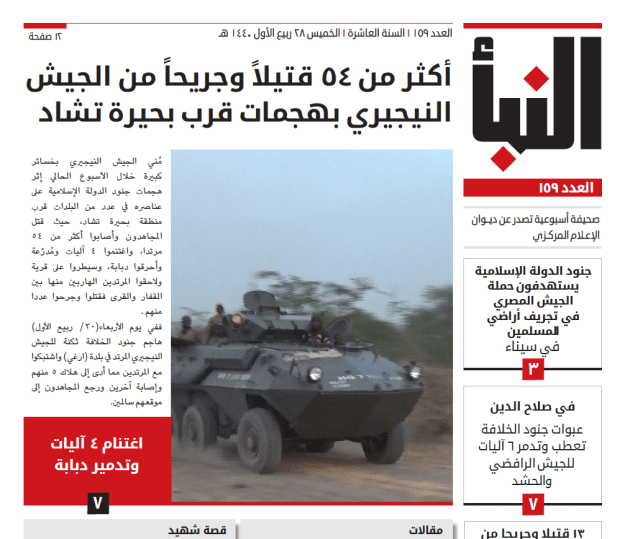
Al-Naba 159
The 159th edition of Al-Naba, the Islamic State’s (IS) newsletter, released on 6 December 2018, had a very interesting story on pages nine and ten about three “repentant officers” (dubat al-tayibeen) from Egypt who joined IS in the Sinai. The two trendlines this story highlighted were: (1) the movement of trained military cadres from the Arab states into IS’s security apparatus, as has been seen with the elements of Saddam Husayn’s fallen regime; and (2) the radicalisation of those Islamists previously prepared to work through the democratic process by the 2013 putsch in Egypt, and the violent crackdown afterwards, which shut down all peaceful paths to change. Al-Qaeda has made this point a staple of its propaganda for some time. Continue reading
By Kyle Orton (@KyleWOrton) on 6 December 2018
This article was originally published at Ahval, headlined, “The Best Bad Outcome for Idlib”

The sun setting over Deraa, in southern Syria, 28 May 2018 (image source)
The Turkey-Russia Sochi Agreement in September won Idlib a reprieve from what had seemed to be an imminent and catastrophic offensive by Syrian President Bashar Assad’s forces and his Russian and Iranian patrons against the last insurgent-held province.
The ceasefire was meant to provide space for Turkey to dismantle the radical insurgents. Instead, those radicals consolidated their dominance in Idlib and the ceasefire has been visibly fraying. How to proceed is a matter of domestic security for the West. Continue reading
By Kyle Orton (@KyleWOrton) on 2 December 2018

An Islamic State poster near al-Sukhna in the eastern Homs desert, Syria, August 2017 (source)
Over the past week, two members of the Islamic State (IS) have been arrested—a rarity in itself during the Coalition campaign against the group—and both in different ways give a glimpse of archetypes that have made up the organisation, from its inception to its expansion into Syria. Continue reading
By Kyle Orton (@KyleWOrton) on 26 November 2018
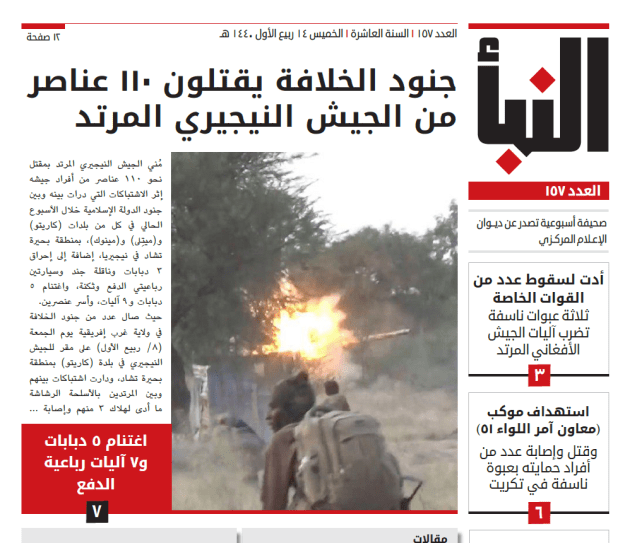
Al-Naba 157
The Islamic State (IS) released the 157th edition of its newsletter, Al-Naba, on 22 November. The content was fairly standard, underlining IS’s ideology, particularly its belief that the current hardships are merely bumps on the road to a victory that has been pre-ordained by God. The bulk of the newsletter is devoted to the fierce insurgent campaign IS is waging in northern Iraq and parts of eastern Syria. Continue reading

 Kyle Orton's Blog