By Kyle Orton (@KyleWOrton) on 9 March 2019
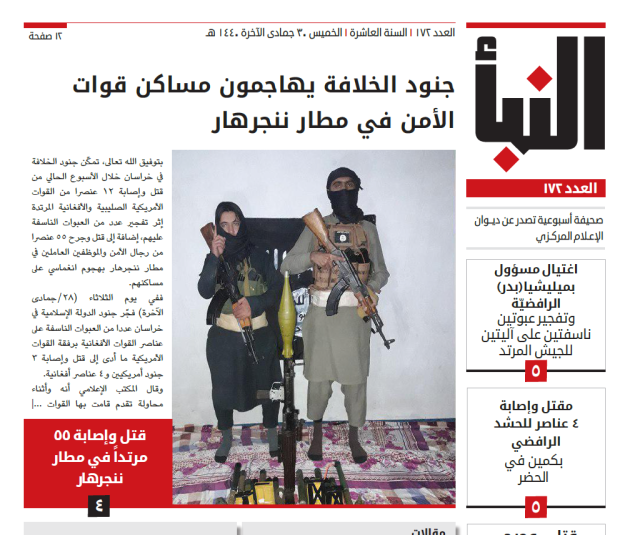
Al-Naba 172 front page
The Islamic State (IS) released the 172nd edition of Al-Naba, its newsletter, on 7 March 2019. Continue reading
By Kyle Orton (@KyleWOrton) on 9 March 2019
Al-Naba 172 front page
The Islamic State (IS) released the 172nd edition of Al-Naba, its newsletter, on 7 March 2019. Continue reading
By Kyle Orton (@KyleWOrton) on 4 March 2019
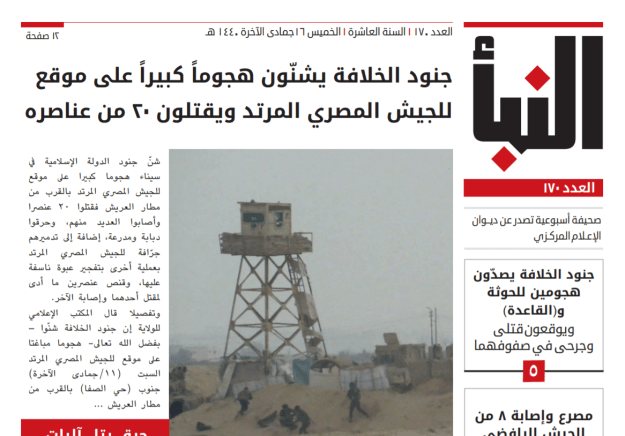
Front page of Al-Naba 170
The 170th edition of Al-Naba, the Islamic State (IS) newsletter, was produced on 21 February 2019. Its main editorial on page 3 focused on the organisation’s apparent “inability to surrender”. Continue reading
By Kyle Orton (@KyleWOrton) on 26 February 2019
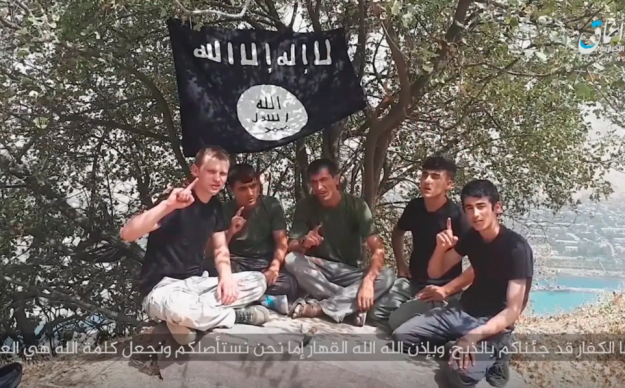
Islamic State terrorists responsible for the Danghara attack in Tajikistan, July 2018 [source]
By Kyle Orton (@KyleWOrton) on 12 February 2019
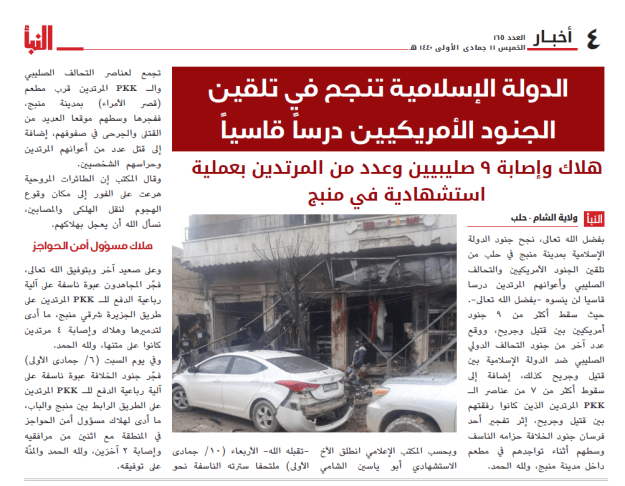
Al-Naba 165, page 4
In the 165th edition of Al-Naba, the weekly newsletter of the Islamic State (IS), was released on 17 January 2019. Al-Naba 165 contained a description of the suicide bombing at the Qasr al-Omara restaurant in Minbij, northern Syria, on 16 January, which killed four Americans: Army Chief Warrant Officer Jonathan Farmer; Navy Chief Petty Officer Shannon Kent; Defence Intelligence Agency (DIA) civilian Scott Wirtz; and Pentagon contractor and linguist Ghadir Taher. At least ten other people were killed, eight civilians and two officials from the “Syrian Democratic Forces“ (SDF). The newsletter also contains an interview with an IS official operating in the Minbij area, who explains how the group’s sleeper cells and surveillance apparatus tracked U.S. movements and made prior attempts to attack the U.S. and its allies. Continue reading
By Kyle Orton (@KyleWOrton) on 5 February 2019
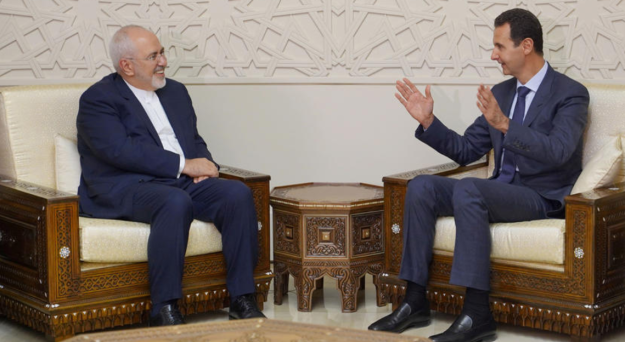
Bashar al-Assad meeting Iranian Foreign Minister Mohammad Javad Zarif, Damascus, Syria, 3 September 2018 // SANA handout to REUTERS
The Syrian regime of Bashar al Assad has nearly collapsed twice under pressure from the armed insurrection, in late 2012 and early 2015. On both occasions, Assad was rescued by outside powers, first Iran and then a joint Iranian-Russian operation. It has been a recurring illusion that there is or will be, a strategic split between Russia and Iran. This prospect has continued to tantalise the US and others, and occasional Moscow-Tehran disagreements are presented as evidence that dynamics are shifting this way. Another round of such speculation is currently underway. Continue reading
This article was published at Ahval under the headline, “Back to the Future for Turkey and Syria?”
By Kyle Orton (@KyleWOrton) on 1 February 2019

American base on the outskirts of Minbij, 26 December 2018. (Photo by Delil souleiman / AFP)
U.S. President Donald Trump’s surprise announcement that U.S. troops would be withdrawn from Syria came with many visible costs. The benefits the anti-Islamic State (ISIS) campaign has delivered to Syrian President Bashar Assad, Iran, and Russia were made permanent. There is also more space for ISIS and greater instability in northeast Syria as Turkey confronts Syrian Kurdish forces. And there is the political cost to the United States of leaving its Kurdish anti-ISIS partner to face Turkey and the pro-Assad coalition alone. Continue reading
Published at The Arab Weekly
By Kyle Orton (@KyleWOrton) on 27 January 2019

Israeli Prime Minister Binyamin Netanyahu and Chadian President Idriss Deby meeting in N’Djamena, 20 January 2019 [AFP]
A version of this article was published at CapX
By Kyle Orton (@KyleWOrton) on 21 December 2018

President Trump in a Twitter video saying fallen soldiers agree with his plan to withdraw from Syria, 19 December 2018 [image source]
By Kyle Orton (@KyleWOrton) on 18 December 2018
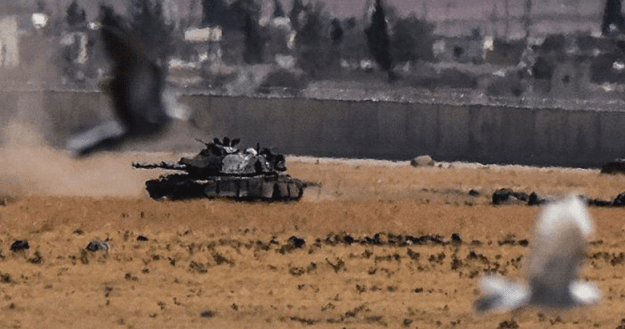
Tel Abyad, Syria [source]
By Kyle Orton (@KyleWOrton) on 15 December 2018
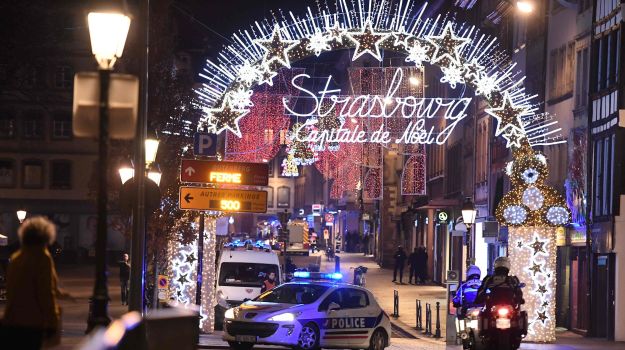
Strasbourg Market, 11 December 2018 [image source]
 Kyle Orton's Blog