Tag Archives: khawarij

Pro-Al-Qaeda Ideologue on Merging With Non-Jihadi Groups

By Kyle Orton (@KyleWOrton) on February 5, 2017

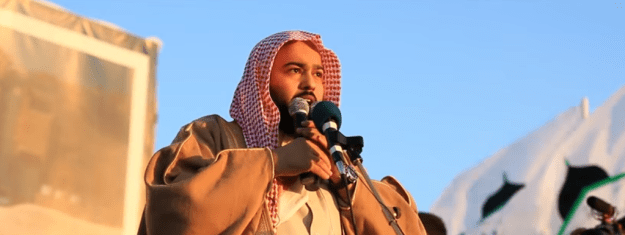
Abdallah al-Muhaysini at a rally for Hay'at Tahrir al-Sham, 3 February 2017

Abdallah al-Muhaysini at a rally for Hay’at Tahrir al-Sham, 3 February 2017

On 28 January, as a part of its long-term strategy of integrating with, and ultimately co-opting, the Syrian rebellion, al-Qaeda shifted ground again and merged into a wider spectrum of insurgent groups, many of them jihadi in character, but many not, united under the banner of Hay’at Tahrir al-Sham (HTS). One of the non-jihadi groups to join HTS was Harakat Nooradeen al-Zengi, which became infamous in July 2016 after it beheaded one of the Bashar al-Assad regime’s child soldiers on video. This has aroused some controversy in jihadi circles, and today a statement by a jihadi ideologue, Abu Mahmud al-Filistini, who lives in London, was circulating explaining why HTS was right to take in al-Zengi. The statement was entitled, “Clearing the Doubts Regarding Nooradeen al-Zengi Uniting with Hay’at Tahrir al-Sham,” and is reproduced below. Continue reading

Al-Qaeda Says Attacking Syrian Rebel Groups Was Self-Defence Against A ‘Conspiracy’

By Kyle Orton (@KyleWOrton) on January 26, 2017

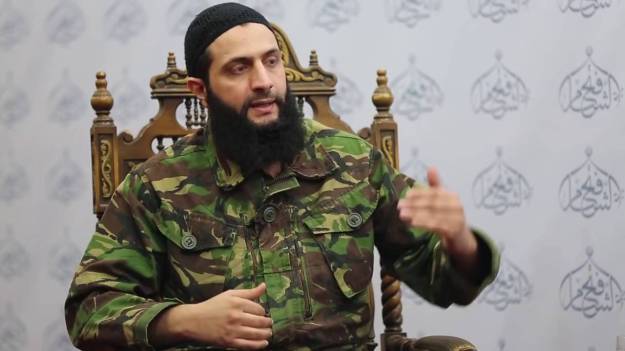
Ahmad al-Shara (Abu Muhammad al-Jolani)

Ahmad al-Shara (Abu Muhammad al-Jolani)

Violence erupted between Jabhat Fatah al-Sham, the rebranded al-Qaeda branch in Syria, and Ahrar al-Sham, its long-time ally and its bridge into the Syrian rebellion, beginning on 19 January. These clashes expanded to encompass the mainstream armed opposition on 23 January. Today, al-Maqalaat, a pro-JFS outlet, published a long statement explaining the fighting from JFS’s point-of-view. The salient points of the argument and other interesting elements are highlighted in bold. Continue reading

Ideologue Laments A Jihadist Joining the Islamic State

By Kyle Orton (@KyleWOrton) on January 9, 2017
2

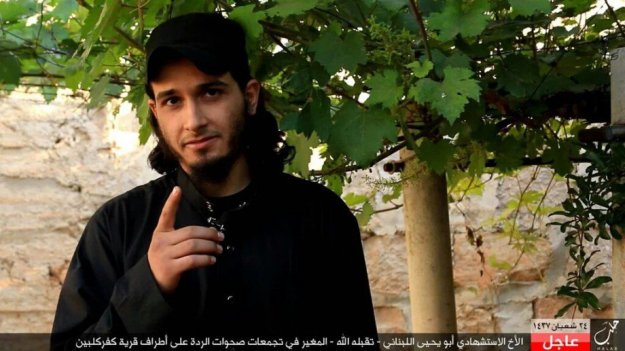
On 6 January 2017, pro-al-Qaeda channels distributed a statement, with the picture above, written by Abu Mahmud al-Filistini.1 Abu Mahmud writes of a young jihadist, Abd al-Rahman, who had, after joining the Islamic State (IS), not been fully seduced by their ideology and had maintained contact with Abu Mahmud. At a certain point, however, Abd al-Rahman accepted IS’s ideology and recently killed himself in a suicide bombing against insurgent forces in Syria. It is not clear whether the insurgents referred to are rebels or Jabhat Fatah al-Sham (JFS), al-Qaeda’s rebranded Syrian branch, which was until recently known as Jabhat al-Nusra. The statement is reproduced below with some minor editions, for the sake of clarity, to transliterations and punctuation. Continue reading

The Islamic State Guided the Normandy Church Attack

By Kyle Orton (@KyleWOrton) on August 22, 2016

Normandy church killers, Adel Kermiche and Abdelmalik Petitjean, swear allegiance to the Islamic State [video, 27 July 2016]

Normandy church killers, Adel Kermiche and Abdelmalik Petitjean, swear allegiance to the Islamic State [video, 27 July 2016]

In Saint-Etienne-du-Rouvray, south of Rouen in Normandy, northern France, on 26 June 2016, two men wielding knives took five hostages in a church around 10:00 local time (just a bit before).[1] Initially there were six hostages consisting of a priest, three nuns, and two worshippers, but one nun managed to escape and alerted the authorities, who surrounded the church.[2] The attackers murdered the priest, Jacques Hamel, 85 (born 30 November 1930[3]), making him kneel on the alter and slitting his throat while preaching in Arabic.[4] One of the nuns present said that while the two killers were initially nervous and aggressive, by the time of the murder they seemed content: one of them gave “a soft smile, that of someone who is happy”.[5] An elderly male worshipper was handed a mobile telephone and made to film the attackers slaughtering the priest, and was himself then slashed and grievously wounded.[6] That footage has not been released, but almost certainly will be at some point. “The two men had cried Allahu Akbar (God is Great) as they left the church with three of the hostages. One man had a fake suicide belt made of aluminium and three knives; the other was carrying a backpack made to look like a bomb and a kitchen timer.” The two attackers were shot dead by police.[7] Continue reading

Al-Qaeda’s Leader Calls for Jihadi Unity in Syria, Building a Caliphate

By Kyle Orton (@KyleWOrton) on May 9, 2016

1

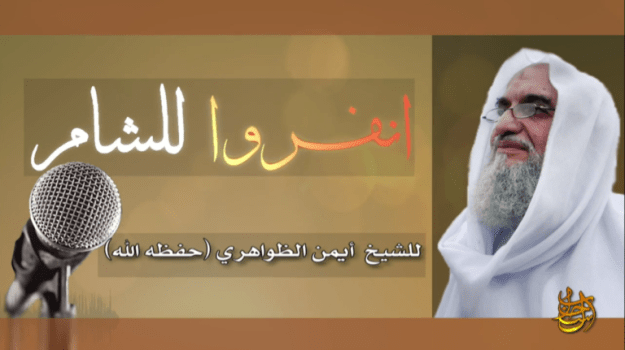
The leader of al-Qaeda, Ayman al-Zawahiri, released an audio statement on 8 May 2016. The speech was entitled, “Hasten to Syria,” “Go Forth to Syria,” or “March Forth to Syria,” depending on translation.[1] An English-language translation has been made available and is reproduced below, with some editions in transliteration and some important sections highlighted in bold. Continue reading

Al-Qaeda Leader Focuses on Main Enemies: Saudi Arabia and the Islamic State

By Kyle Orton (@KyleWOrton) on January 13, 2016

1

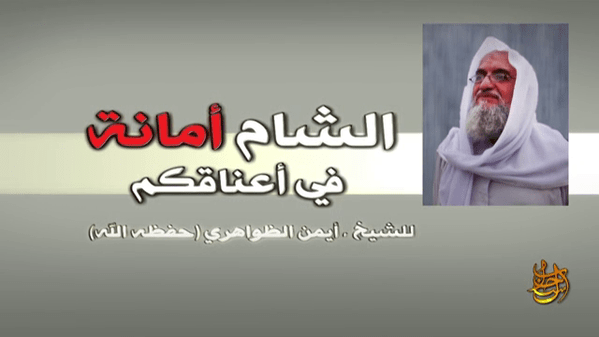
As-Sahab Foundation for Islamic Media Publication, al-Qaeda’s media outlet, produced an English translation of a speech by the organization’s leader, Ayman al-Zawahiri, on 13 January 2016. The speech was entitled, “Syria Is Entrusted Upon Your Necks”. The speech does focus on the West, particularly its de facto alliance with the pro-Assad coalition—namely Russia and Iran—and calls for the Syrian rebellion to unite with al-Qaeda to resist this conspiracy. What is more noticeable, however, is the two enemies on whom Dr. al-Zawahiri really focuses: Saudi Arabia and the Islamic State. The Saudis are accused—not without reason—of having been allied closely to the West and thwarting the jihadist projects at every turn. And al-Zawahiri makes a fierce ideological assault on the Islamic State, comparing them with the Khawarij and the Armed Islamic Group (GIA), whose conduct in Algeria in the 1990s and their justifications for it took Islamist extremism to new depths. The speech is reproduced below with some minor editions, to transliteration and punctuation, and some interesting and important sections highlighted in bold.
Continue reading

Islamic State Spokesman Calls For Immigration to the Caliphate, All Factions To Join

By Kyle Orton (@KyleWOrton) on July 1, 2015

On June 23, 2015, the Islamic State (IS) spokesman Abu Muhammad al-Adnani gave a speech, “O Our People, Respond to the Caller of Allah”. Al-Adnani, noting the coming of Ramadan, called on Muslims to journey to the caliphate, saying that hijra (emigration) in this month—and martyrdom—is the most blessed. Al-Adnani called on Muslims—specifically Iraqi Sunnis and Syrian rebel and Islamist insurgent groups—to unite around IS, which had no theological factions or ethnic distinctions among its membership, being the only pure expression of Islam, ruling by god’s law. Iraqi Sunni militias and Syrian rebels had betrayed the religion by seeking favour from, and even seeking alliance with, Western states. Al-Adnani threatened the town of Haditha, specifically the Jaghayfa clan, that if it surrendered now its repentance would be accepted, but if the town was overrun first then they would be slaughtered. Al-Adnani played heavily on the interlinked themes of anti-Shi’a sectarianism and the spreading influence of Iran and its proxies, repressing Sunnis. The old guard of the jihadi movement—clerics like Abu Muhammad al-Maqdisi and al-Qaeda’s leader Ayman al-Zawahiri (though neither are mentioned by name)—are attacked for not being on the battlefields. Al-Adnani also accepted the allegiance of the Russian-based faction that declared itself under the caliph’s authority, naming the group Wilayat al-Kavkaz. An English transcript of the speech was posted by IS and is reproduced below with some minor editions in transliteration and some interesting sections highlighted in bold. Continue reading

Al-Qaeda in Syria Condemns Al-Qaeda in Yemen’s Softness on the Islamic State

By Kyle Orton (@KyleWOrton) on October 20, 2014

Maysar al-Jiburi (Abu Mariya al-Qahtani) [source]

Al-Qaeda broke relations with the then-Islamic State of Iraq and Syria (ISIS) in February. In June, ISIS declared that it had restored the caliphate and changed its name to simply the Islamic State (IS). Since then, some jihadist groups, including some affiliated with al-Qaeda, have declared their allegiance to IS. With the beginning of American airstrikes against IS, in Iraq on 7 August and extended to Syria on 23 September, the question of where jihadi-salafists stand with regard to IS has become more acute. It was in this predicament that a statement was released today from a leader of al-Qaeda in Syria condemning al-Qaeda’s branch in Yemen for its statement of solidarity with IS in the face of these U.S.-led attacks. By the lights of al-Qaeda in Syria, the Yemeni branch’s statement was too lenient toward IS and will be misinterpreted as support for an organization that has struck down senior officials of al-Qaeda in Syria and remains actively at war with al-Qaeda in that theatre to this hour. Continue reading

Al-Qaeda In Syria Declares War On The Rebellion

By Kyle Orton (@KyleWOrton) on July 13, 2014

The only official picture of Jabhat an-Nusra’s Emir, Abu Muhammad al-Golani, given out by the Iraqi government.

Syria’s rebellion was already fighting for its life, squeezed between the regime and the Islamic State (I.S.) in Aleppo, and on Friday night a new front appeared to open. Jabhat an-Nusra, al-Qaeda’s official branch in Syria, announced that it was forming an Islamic Emirate. According to a translation by Hassan Hassan, Nusra’s commander, Abu Muhammad al-Golani, said that they would now start implementing the shari’a “in the full sense of the word,” and “without compromise, leniency, ambiguity, or politeness.” Golani specifically says that Nusra will begin implementing the hudud, the harsh punishments like amputation for theft, which Nusra has very deliberately not done so far, saying war conditions suspended such punishments according to the Holy Law. At a more material level, it avoided garnering them bad press for savagery against the civilian population. Golani dismissed with contempt the secular rebels as “grovelling” to the West, and declared I.S.’s Caliphate “void” and its members ghulat (extremists).

Continue reading

Who Are The Khawarij?

By Kyle Orton (@KyleWOrton) on April 17, 2014

2016-11-10-is-closing-in-on-palmyra-p10

Since the Syrian rebellion went to war with the Islamic State of Iraq and Syria (ISIS) in January, there has been a parallel campaign of political warfare by the rebels and al-Qaeda’s branch in Syria, Jabhat al-Nusra, to delegitimize ISIS. This has often taken the form of referring to ISIS as Kharijites or the Khawarij.

This Khawarij are an ancient sect who broke from the Rashidun (Rightly-Guided) Caliphate in the name of righteous revolt in 658, and continued their campaign against the caliphate—by then in the hands of the Umayyads—for a century and more. Regarded as perhaps the first terrorists in Islamdom (by another definition it would be the Nizaris, a.k.a. “The Assassins”), the connotations of the Khawarij label are extremism and deviance, particularly a tendency to excommunicate (make takfir against) Muslims not only for sins that do not merit excommunication, but simply for reasons of political exclusivism. Continue reading