Tag Archives: Kurdistan Workers’ Party

The Islamic State Spokesman Directs His Fury At Regional Governments

By Kyle Orton (@KyleWOrton) on 22 April 2018

An audio statement by the official spokesman of the Islamic State (IS), Abu Hassan al-Muhajir,[1] was released today. The speech was entitled, “By their example, be guided” or “So From Their Guidance Take An Example”—drawn from Qur’an 6:30. Abu Hassan continued the themes that have been cropping up in IS messaging and propaganda for the last few months that have more firmly reoriented IS away from its foreign attacks campaign toward a more local focus in the Middle East. IS has been stressing its post-caliphate insurgency—concentrated at the present time in Iraq, but with notable operations in Syria—and its war for influence with regional rivals for Muslim loyalty, whether governments such as Egypt and particularly Saudi Arabia, or other Islamist movements like Harakat al-Muqawama al-Islamiyya (HAMAS) in Gaza. Continue reading

What Is Trump Thinking About Syria?

By Kyle Orton (@KyleWOrton) on 18 April 2018

Egyptian ruler Abdelfattah al-Sisi, Saudi King Salman, and President Donald Trump in Riyadh on 22 May 2017 (image source)

Two days ago, The Wall Street Journal reported that President Donald Trump has been exploring plans to replace American troops in the areas of Syria held by the Coalition partner force, the “Syrian Democratic Forces” (SDF), with troops from the Arab states. The problems with this proposal, even in the rudimentary form it is presented, are manifold. It also feeds into the broader problem of Trump’s inconsistent messaging about Syria—or, more precisely, his failed efforts to balance domestic messaging, which calls for what was once referred to as “nation building … at home”, and his foreign messaging that needs to emphasise U.S. constancy to see through the mission to defeat the Islamic State (IS) by, among other things, stabilising and reconstructing Syria. Continue reading

Turkey’s Progress in Syria

Originally published at Ahval

By Kyle Orton (@KyleWOrton) on 31 March 2018

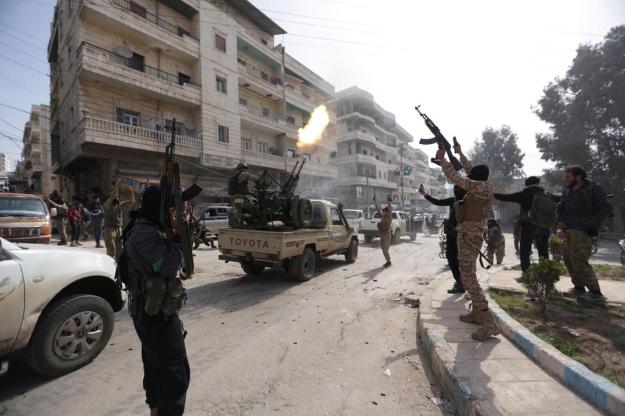
Turkish Armed Forces and allied Syrian Arab fighters capture Efrin city, Syria, 18 March 2018 (Reuters)

Since its incursion into Afrin began in January, Turkey has made significant progress in turning the military landscape in Syria in its favour. Turkish President Recep Tayyip Erdogan has signalled that further operations are to come in Syria, and perhaps in Iraq, too. These next operations would present new challenges, particularly politically, an area where Turkey has not made quite as much progress. Continue reading

The “Syrian Kurds” and Religious Liberty

By Kyle Orton (@KyleWOrton) on 20 March 2018

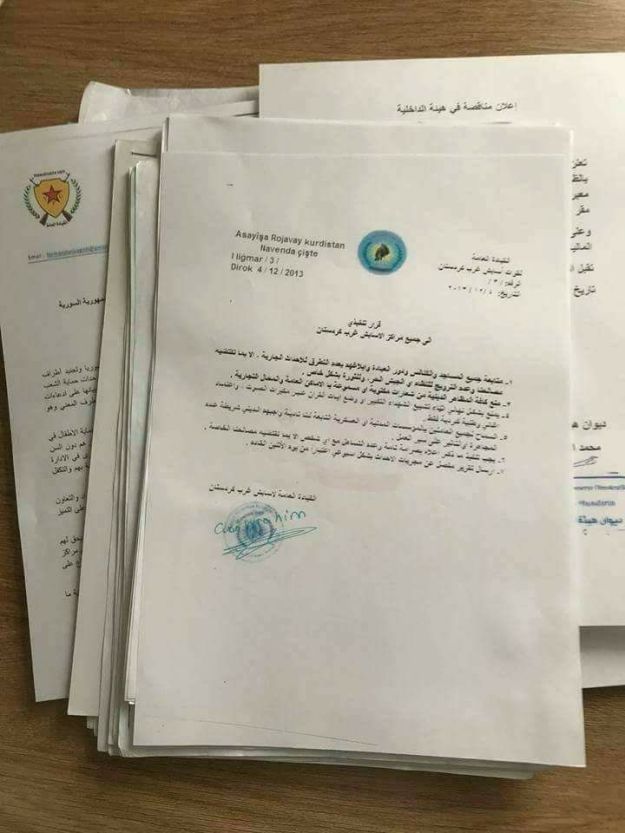
Among the artefacts found in Efrin after the Kurdistan Workers’ Party (PKK), which uses the names Democratic Union Party (PYD) and People’s Protection Units (YPG) in Syria, was pushed out by Turkey and its Arab dependencies in the OLIVE BRANCH operation, is the above document, which sheds some light on how the PKK treated religious institutions in the province. Continue reading

Turkey’s Afrin Operation and an American Opening in Syria

By Kyle Orton (@KyleWOrton) and Oved Lobel on 20 March 2018

Turkey and Syrian rebel allies captured Afrin city in north-western Syria from the Kurdish People’s Protection Forces (YPG) this weekend. The YPG has gained notice as the partner force of the US-led international coalition against the Islamic State. But, as Pentagon spokesman Robert Manning acknowledged on March 6, the YPG has been diverting its troops from the fight against IS in eastern Syria to the war with Turkey on the other side of the country. Manning presented this as a temporary setback, but the shifting dynamics might prove to be the undoing of the Coalition’s mission in Syria. Continue reading

The PKK and Terrorism in Europe

By Kyle Orton (@KyleWOrton) on 16 March 2018

Screenshot from video of a PKK attack on Turkish diplomats in Paris, France (13 March 2018)

A wave of politically motivated violence has swept over Europe in the last few days, carried out by an extremist group and its sympathisers, accompanied by public statements threatening further attacks.

These attacks are intended to change western policy to one more suitable to the attackers.

The conventional term for this is “terrorism”.

These assailants are not Islamist, however; they are from the Kurdish PKK, and this seems to have both reduced the amount of attention this campaign has received, and to have dulled the reaction from some who suggest that perhaps the attackers have a point. Continue reading

Syria’s Revolution Has Been Overtaken By Outside Powers

By Kyle Orton (@KyleWOrton) on 16 March 2018

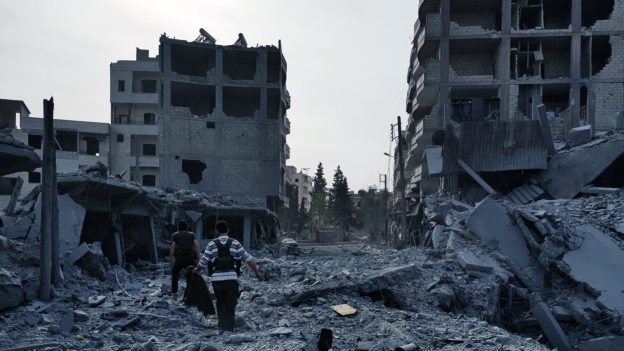
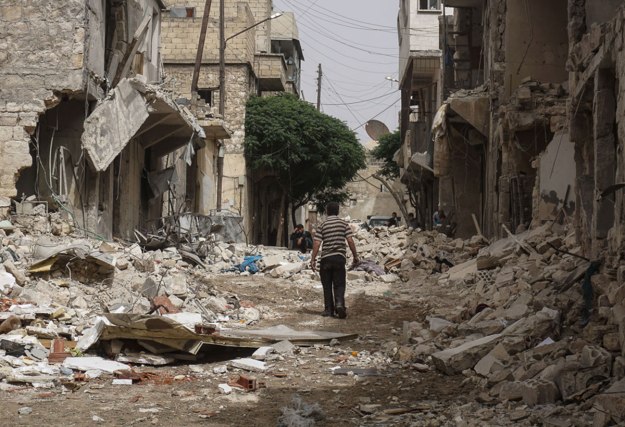
Devastation in Aleppo (image source)

This week marks the seventh anniversary of the Syrian revolution. A movement that began with peaceful street protests calling for reform and—after the government responded with lethal violence—the downfall of the dictator, descended into war that has to this point cost the lives of at least 500,000 people and displaced nearly twelve million others—more than half of Syria’s pre-war population.

In any strategic sense the rebellion has been defeated—it is not able to overthrow Bashar al-Assad by force on its own—and its political cause is increasingly strained as the remnants of the armed opposition are increasingly co-opted by external actors, state and non-state. Continue reading

United Nations Documents Human Rights Abuses By the “Syrian Kurds”

By Kyle Orton (@KyleWOrton) on 8 March 2018

Kurdish YPG/PKK fighters (Rodi Said/Reuters)

The Independent International Commission of Inquiry (IICI) on the Syrian Arab Republic was set up in 2011 by the United Nations Human Rights Council to track human rights abuses in Syria.

Naturally, this has meant that most of the Commission’s work is focused on the industrial-scale crimes against humanity committed by Bashar al-Asad’s regime and his enablers in Russia and Iran. Later, as non-state terrorist and extremist groups intruded into Syria, the Commission documented the atrocities by the Islamic State (IS), al-Qaeda, and the Kurdistan Workers’ Party (PKK), which works under the label of the People’s Protection Units (YPG) in Syria and dominates the so-called Syrian Democratic Forces (SDF) that the U.S.-led Coalition works with against IS. The Commission has also recorded abuses by rebel groups.

The Commission’s latest report, released on 6 March 2018, “draws from more than 500 interviews and encapsulates the trends over the past six months in the Syrian Arab Republic, with particular focus on the impact of the offensive against [the Islamic State] and the use of siege warfare on the civilian population.” The report, therefore, has something of a focus on the SDF/PKK human rights violations, though IS’s horrific treatment of religious minorities and so on, plus the pro-Asad coalition’s ongoing campaign of massacre and displacement in areas such as East Ghuta, are given ample attention. Continue reading

Crisis and Opportunity for Turkey and America: The Minbij Dispute

By Kyle Orton (@KyleWOrton) on 4 March 2018

A version of this article was published in The Arab Weekly

The YPG/PKK Minbij Military Council (image source)

The city of Minbij in northern Syria has become a source of severe political tension between the United States and Turkey. It might also be the key to reducing tensions and normalising relations. Continue reading

Human Rights Abuses in Rojava and the Anti-ISIS War

By Kyle Orton (@KyleWOrton) on 3 March 2018

Guerrillas from the Sinjar Resistance Units (YBS), the name the Kurdistan Workers’ Party (PKK) uses in Sinjar, Iraq, together with operatives from the People’s Defence Forces (HPG), the armed units of the PKK inside Turkey, holding a picture of PKK leader Abdullah Ocalan. (image source)

The American-led Coalition’s partner against the Islamic State (IS) in Syria, the so-called Syrian Democratic Forces (SDF), presents itself, ideologically and in terms of the governance structure it controls, in universalistic liberal and democratic terms, emphasizing ecological and feminist themes. The reality is that the SDF is under the politico-military control of the Kurdistan Workers’ Party (PKK), a designated terrorist organization that has run a four-decade-long insurgency against Turkey. The PKK has brought some measure of stability to the areas it controls, but it continues to struggle for legitimacy and without locally-legitimate government IS and other jihadi-Salafists will find political room to operate. The PKK’s continued monopolization of power and abusive governance practices undermine the chances for the “Rojava” system to evolve into a long-term solution to the jihadist terrorists that have used Syrian territory to threaten the region and the wider world. Continue reading