By Kyle Orton (@KyleWOrton) on 27 August 2024
By Kyle Orton (@KyleWOrton) on 23 January 2020
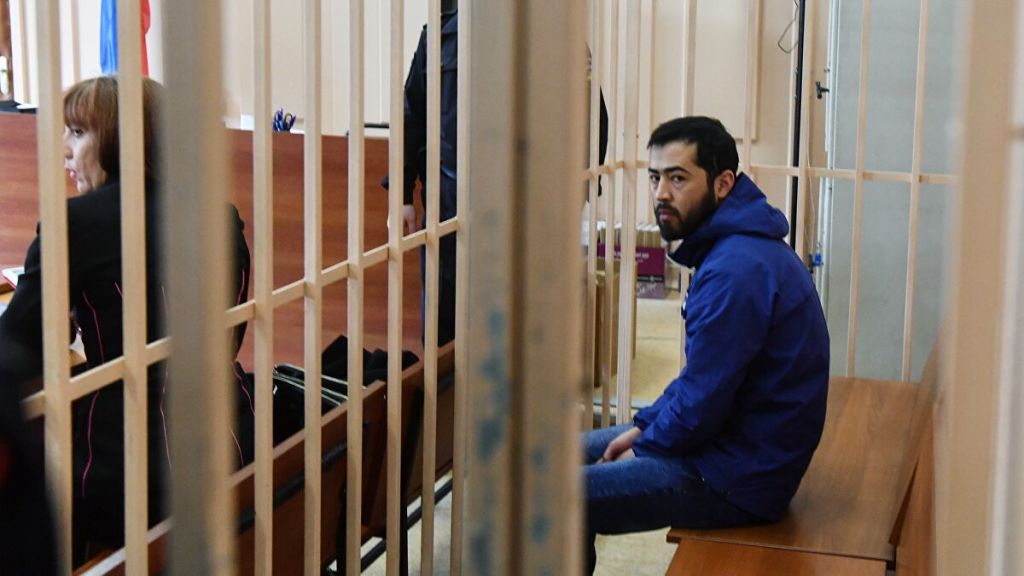
Abror Azimov in detention // Source: Alexey Kudenko
In July 2019, I co-wrote an article for Haaretz about the Russian legal case relating to the alleged suicide bombing of the St. Petersburg metro on 3 April 2017 as it then stood. To make a long story short: none of the “facts” derived from the Federal Security Service (FSB) investigation could be taken at face value—literally none. A key assertion from the Kremlin was that the Petersburg attack was directed from outside by an Al-Qaeda-linked group in Syria, for which no evidence was provided, but the issues with the case went much deeper. As fundamental a fact as the identity of the alleged suicide bomber was in question. Indeed, it was worse than that: the Russian state refused, when questioned, to say whether this “suicide bomber” was dead, raising a question about whether the Petersburg atrocity was a suicide-attack at all. Last month, the Russian government in effect closed the book on this case by sentencing eleven people it claims were implicated in it; none of the questions raised during the trial have been answered, and nor are they ever likely to be now. Continue reading
By Kyle Orton (@KyleWOrton) and Oved Lobel on 14 July 2019
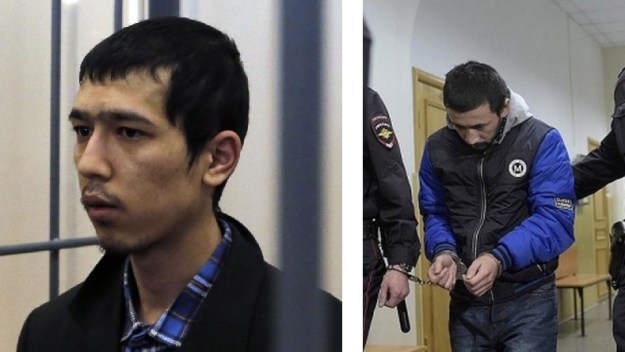
Abror Azimov in court in Moscow in April 2017 [photo source] and Mukhamadyusup Ermatov [photo source]
By Kyle Orton (@KyleWOrton) on 1 October 2017
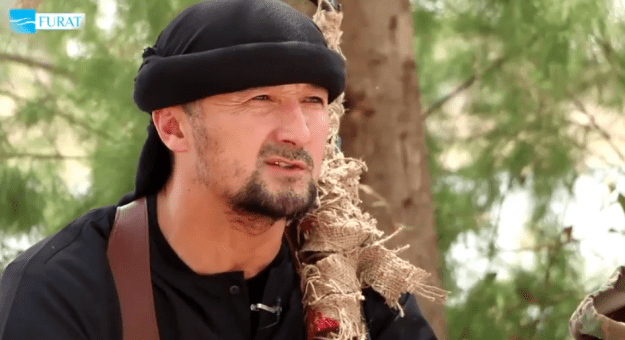
Gulmurod Khalimov
The Islamic State’s (IS) caliph, Ibrahim al-Badri (Abu Bakr al-Baghdadi), appeared on Thursday to deliver his first speech in nearly a year. Other than the contents of the speech, al-Badri’s re-appearance was confirmation that the claim by the Russian government, on 16 June, to have killed al-Badri and 330 other IS jihadists in a 28 May airstrike in Syria, was false.[1] This is far from the first mendacious claim Moscow has made on this topic.
On 8 September, the Russian Ministry of Defence claimed it had killed “four influential field commanders”, one of whom was Tarad al-Jarba (Abu Muhammad al-Shimali), and forty other IS jihadists, in an airstrike near Deir Ezzor city. Later in the day, the Russians claimed day that another of the four commanders was Gulmurod Khalimov (Abu Umar al-Tajiki), named by the U.S.-led coalition as IS’s War Minister. In fact, it is likely that Khalimov was already dead and that al-Jarba is still alive. Continue reading
By Kyle Orton (@KyleWOrton) on 30 June 2017

Abdirahman Sheik Mohamud (source)
In April 2015, a United State Federal Grand jury in Ohio charged Abdirahman Sheik Mohamud, also known as “Ayanle”, with three terrorism-related offences. Yesterday, court records were unsealed that revealed that Mohamud pleaded guilty to all charges, admitting to having fought with a terrorist organization in Syria and returned to the United States with the intention of carrying out an act of domestic terrorism. Mohamud was in contact with foreign terrorist operatives throughout the period he was plotting an attack within the United States. But—and this is the most significant aspect of the case—Mohamud was not in contact with one of the Islamic State’s intelligence operatives, who guide attacks in a manner now relatively well-understood. Instead, Mohamud was in contact with Jabhat al-Nusra, at that time al-Qaeda’s declared branch in Syria. Al-Nusra is now known as Hay’at Tahrir al-Sham (HTS) and claimed in July 2016 to have disaffiliated from al-Qaeda’s “central”, not that this has (nor will nor should) remove HTS from the terrorism list. Regardless of its formal status within al-Qaeda’s command structure, HTS retains significant links with al-Qaeda’s global networks, and a breakaway group from HTS in Syria has reaffirmed its loyalty to al-Qaeda. Mohamud’s case is an extremely important data point in assessing the risk these overlapping and mutually reinforcing entities pose to the West and the wider world. Continue reading
 Kyle Orton's Blog