Tag Archives: Nashwan Abd al-Baqi

The Haqqani Network, Al-Qaeda, and Pakistan’s Jihad in Afghanistan

By Kyle Orton (@KyleWOrton) on 7 September 2021

Anti-Taliban fighters watch U.S. airstrikes at Tora Bora, 16 December 2001 || REUTERS/Erik de Castro

The State Department spokesman Ned Price said, on 27 August, “The Taliban and the Haqqani Network are separate entities”. The next day, the Pentagon Press Secretary John Kirby slightly modulated this, having first tried to dismiss the question, by conceding there was “a certain amount of … commingling … there’s a marbling … of Taliban and Haqqani”, before saying he was “pushing back … [on] the relevance of that discussion”.

What these officials were trying to do was two-fold: (1) to refute press reports that U.S. officials in Kabul had shared “a list of names of American citizens, green card holders, and Afghan allies” with the Taliban, amounting to having “put all those Afghans on a kill list”, as one “defense official” put it; and (2) to deny that the U.S. coordination with the Taliban to evacuate people the jihadists wanted to kill—a surreal enough situation—had involved the additional political and legal problems of coordinating with a formally registered Foreign Terrorist Organization (FTO), as the Haqqani Network is. Continue reading
When Al-Qaeda’s Military Leader Asked The Architect of 9/11 to Resign

By Kyle Orton (@KyleWOrton) on 9 February 2018

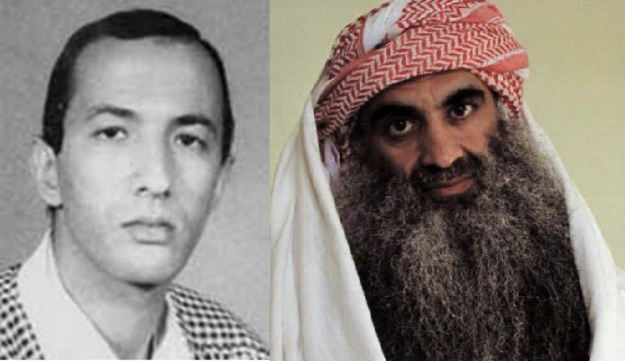
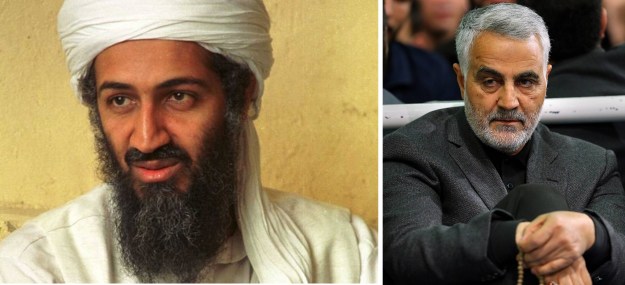
Sayf al-Adel (image source), Khalid Shaykh Muhammad (image source)

Muhammad Saladin Abd al-Halim Zaydan (Sayf al-Adel) wrote a letter on 13 June 2002 to Khalid Shaykh Muhammad (KSM or Mukhtar), the operational planner of the 9/11 massacre. Zaydan criticises KSM’s handling of al-Qaeda in the aftermath of 9/11 and the fall of the Taliban, and calls on him to surrender control to others. At that time the latter was written, Zaydan had been the head of al-Qaeda’s military committee for about seven months, replacing Muhammad Atef (Abu Hafs al-Masri), who was killed by an American airstrike in Afghanistan in November 2001. Zaydan was based then—as he is now—in Iran, with much of al-Qaeda’s senior leadership, at the invitation of Qassem Sulaymani, the head of the Quds Force, the component of the Islamic Revolutionary Guard Corps (IRGC) tasked with exporting the Iran’s Islamist revolution. The letter is reproduced below with the key sections highlighted in bold.

Phrased with much surrounding politeness, Zaydan gets to the point: KSM has been on a spree of external operations—notably with “shoe bomber” Richard Reid and José Padilla (Abdullah al-Muhajir)—that have failed spectacularly and exposed al-Qaeda to ridicule. Instead of learning from his mistakes, KSM has heedlessly rushed to the next plot, says Zaydan. Usama bin Ladin might have signed off on these plots, Zaydan writes, but Bin Ladin is also reckless and refuses to heed advice—instead changing the advisor to get the answer he wants. (Bin Ladin had done this—or tried to—for the 9/11 attack itself, stacking the executive committee with loyalists before the key vote, which he ended up not bothering to hold anyway.) KSM should halt all plots currently underway and resign his duties to others so that stock can be taken of how these disasters have befallen the organisation, Zaydan concludes. Zaydan adds a final note demanding the removal of a post on an al-Qaeda forum that identifies his children by their real names. Continue reading

Al-Qaeda Instructs the Islamic State’s Predecessor Not to Attack Iran

By Kyle Orton (@KyleWOrton) on 21 November 2017

Usama bin Ladin, Qassem Sulaymani

Among the documents recovered from Usama bin Ladin’s compound in Abbottabad was the “Letter to Karim”, dated 18 October 2007. The letter was released in 2015 by the Office of the Director of National Intelligence (ODNI). “Karim” likely refers to Abdul Munim al-Badawi (Abu Hamza al-Muhajir), the leader of al-Qaeda in Mesopotamia (AQM), the predecessor organization to the Islamic State, after the group’s founder, Ahmad al-Khalayleh (Abu Musab al-Zarqawi), was killed in June 2006. The letter is reproduced below with some interesting details highlighted in bold. Continue reading

One More Time on Saddam and the Islamic State

Originally published at The Henry Jackson Society

By Kyle Orton (@KyleWOrton) on 2 September 2017

The most recent issue of Perspectives on Terrorism had a paper by Ronen Zeidel entitled, ‘The Dawa’ish: A Collective Profile of IS Commanders’, which was “the first attempt to provide a comprehensive collective profile of commanders and leaders of the Islamic State (IS)”. Based on “an inventory of over 600 names”, the paper assessed the nationality, ethnicity, and tribal origins not just of the very senior IS commanders, but those lower down, a novel and much-needed line of investigation. Zeidel found that these commanders of the IS movement are or were overwhelmingly Iraqi and Sunni Arab, with an important Turkoman contingent.

Zeidel’s findings are important for drawing attention again to the local-revolutionary character of an organisation that gets a great deal of attention for its foreign fighters and external attacks, especially in the West, but which only a recently acquired global reach—and, indeed, only recently needed to: until 2011, the West was easily reachable since it had troops on the ground in Iraq, so the incentive to invest resources in creating a foreign terrorist apparatus was minimal.

One small part of Zeidel’s work has created something of a storm, however. Zeidel gives the occupation held by these commanders and, for those where this was known, 72% of them were former regime elements (FREs) from the dictatorship of Saddam Husayn. This reignited the argument over how important the FREs have been to IS. Continue reading

An Ideological Founder of Islamic State is Killed in Syria

UPDATE: It has subsequently become clear that the “Abu Abdullah al-Muhajir” who was killed in Syria on 18 November 2016 was not Muhammad al-Saghir, who is profiled below. The slain man, like al-Saghir a veteran of the war get the Soviets out of Afghanistan and an Egyptian jihadist with close links to al-Qaeda, also used the kunya “Abu Afghan al-Muhajir”.

By Kyle Orton (@KyleWOrton) on November 20, 2016

Abu Abdallah al-Muhajir (source)

A week ago, it became clear that the air war being waged by the U.S.-led Coalition, which primarily targets the Islamic State (IS), was going to expand its campaign against the leadership of Jabhat Fatah al-Sham (JFS), al-Qaeda’s rebranded branch in Syria. In the evening of 18 November 2016, the Coalition killed Abu Abdullah al-Muhajir, whose real name is Muhammad Ibrahim al-Saghir. Al-Saghir also uses the name Abd al-Rahman al-Ali. This killing would appear to be part of the Coalition’s new effort.

Al-Saghir has a long record as an important jihadi religious ideologue, though his exact relationship with al-Qaeda’s network remains unclear. Al-Saghir’s most lasting contribution to jihadi-salafism is as a key guide to the founder of IS, Ahmad al-Khalayleh. Continue reading

The Dangers of Emptying Guantanamo

By Kyle Orton (@KyleWOrton) on August 17, 2016

It was announced on 15 August that fifteen more inmates from the Guantanamo Bay detention facility have transferred, twelve Yemenis and three Afghans, to the United Arab Emirates, the largest individual release of the Obama administration. The U.A.E. also took in five “lower-level” Yemeni detainees in November. The Emirates had previously taken in just one—Abdullah al-Hamiri, in 2008—but President Obama leveraged this deal with the Gulf states at the May 2015 meeting when the Khaleejis were deeply concerned about the then-impending Iran nuclear deal, and in exchange for security reassurances, Obama extracted further concessions.

One reason why so many jihadists have been released to the U.A.E., other than having a similar language and culture, is because the U.A.E. has a competent security apparatus to monitor these people. Those released last November were kept in “a custodial rehabilitation program“—a version of house-arrest, basically. The conditions this time around are less clear.

What is clear is just how dangerous the operatives who are being let out of the Guantanamo detention facility are. Every single one of them has been assessed as posing a “high” risk to America, her interests, and her allies. Continue reading