Tag Archives: Osama bin Laden

The Haqqani Network, Al-Qaeda, and Pakistan’s Jihad in Afghanistan

By Kyle Orton (@KyleWOrton) on 7 September 2021

Anti-Taliban fighters watch U.S. airstrikes at Tora Bora, 16 December 2001 || REUTERS/Erik de Castro

The State Department spokesman Ned Price said, on 27 August, “The Taliban and the Haqqani Network are separate entities”. The next day, the Pentagon Press Secretary John Kirby slightly modulated this, having first tried to dismiss the question, by conceding there was “a certain amount of … commingling … there’s a marbling … of Taliban and Haqqani”, before saying he was “pushing back … [on] the relevance of that discussion”.

What these officials were trying to do was two-fold: (1) to refute press reports that U.S. officials in Kabul had shared “a list of names of American citizens, green card holders, and Afghan allies” with the Taliban, amounting to having “put all those Afghans on a kill list”, as one “defense official” put it; and (2) to deny that the U.S. coordination with the Taliban to evacuate people the jihadists wanted to kill—a surreal enough situation—had involved the additional political and legal problems of coordinating with a formally registered Foreign Terrorist Organization (FTO), as the Haqqani Network is. Continue reading

Al-Qaeda Congratulates the Taliban on its Victory in Afghanistan

By Kyle Orton (@KyleWOrton) on 31 August 2021

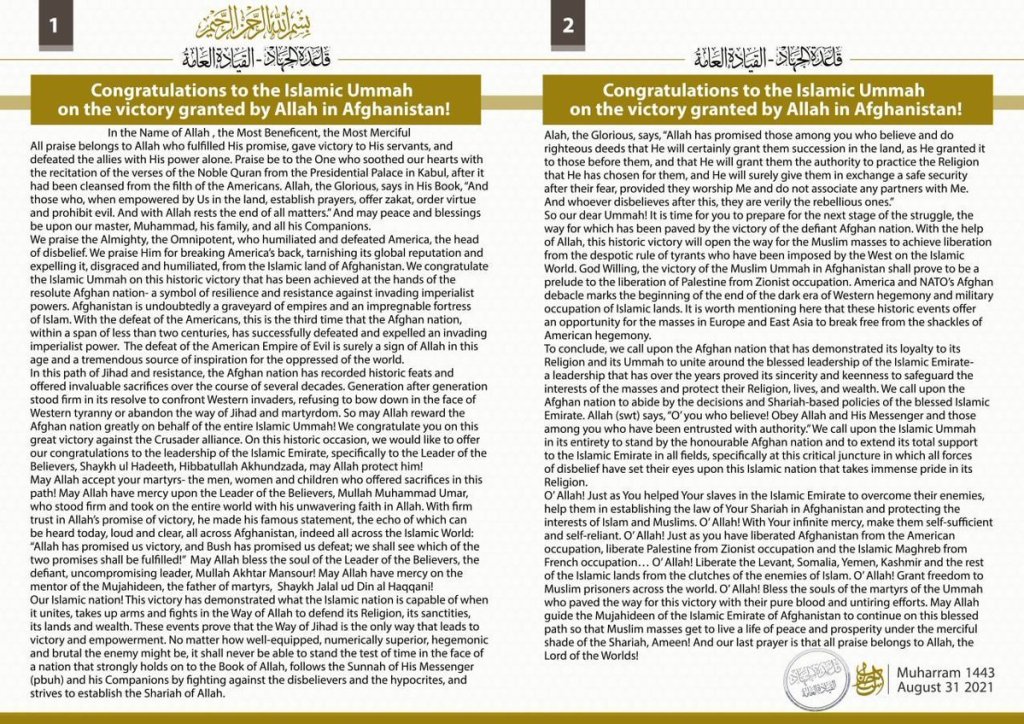
Al-Qaeda’s General Command released a statement earlier today through As-Sahab Media congratulating the Taliban on its victory in Afghanistan. This is the first statement from Al-Qaeda Central since the cataclysmic events in Afghanistan over the past few weeks. The official silence of the organisation heretofore—even as its operatives worked in lock-step with the rest of the coalition of jihadists run by Pakistan’s Inter-Services Intelligence (ISI) to conquer the country—is almost certainly deliberate, to allow the Taliban and the United States political cover to ensure the American departure while avoiding the ramifications of Al-Qaeda controlling the Afghan state, the very thing the mission in Afghanistan was intended to (and had succeeded in, so long as it was sustained) undoing. The statement itself is exactly what one would expect: gloating about the West’s defeat and the damage to American hegemony, saying this proves that jihad is the only way, and that the Taliban’s “Islamic Emirate” is merely the first step in a global campaign to bring the world under the rule of the shari’a. The text of the English-language statement is posted below, with some minor editions for transliteration and translation. Continue reading

Getting Real About Pakistan After the Jihadist Takeover of Afghanistan

By Kyle Orton (@KyleWOrton) on 20 August 2021

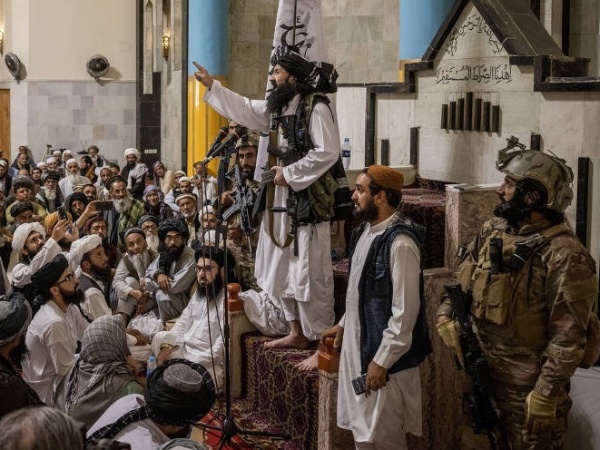
Khalil Haqqani, a senior Taliban leader and simultaneously a leader of Al-Qaeda’s Haqqani Network, leads Friday prayers at the Pul-i-Khishti, the largest mosque in Kabul, 20 August 2021

When the Taliban swept into the capital of Afghanistan on Sunday, little of the coverage focused on Pakistan and yet that was where this victory was made. This is a pattern that has persisted throughout the war. Continue reading

The First Speech of Abu Hamza al-Muhajir as Al-Qaeda in Iraq Emir

By Kyle Orton (@KyleWOrton) on 5 April 2021

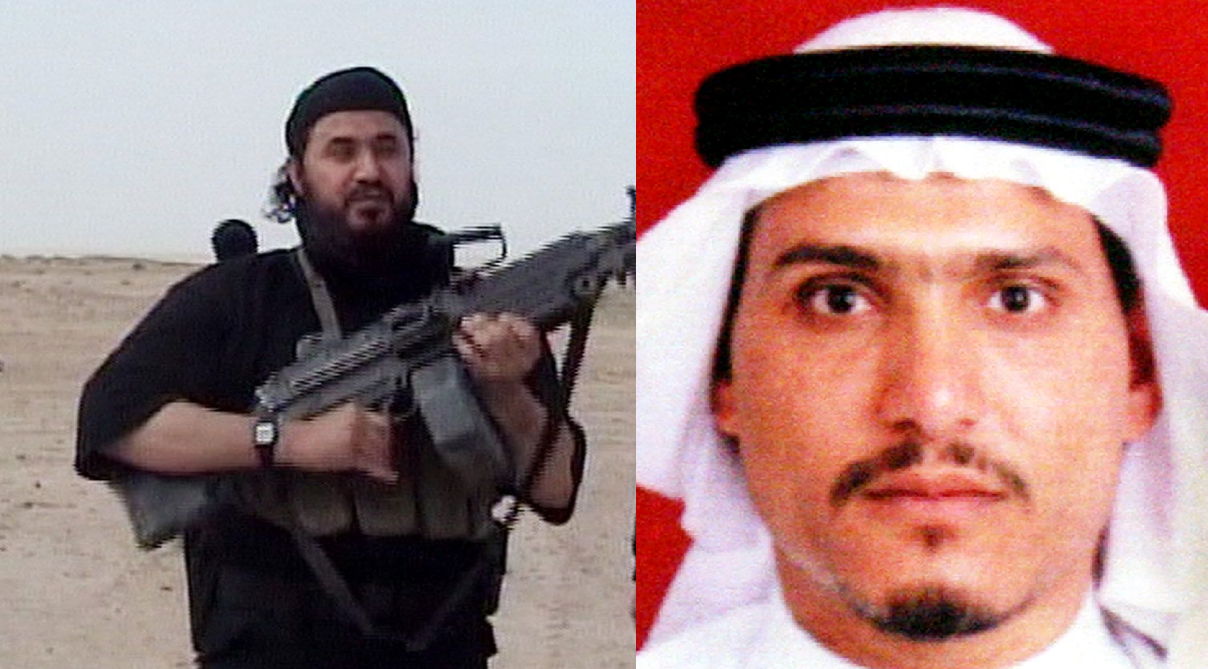
Ahmad al-Khalayleh (Abu Musab al-Zarqawi), the infamous founder of the Islamic State movement, known at the time as Al-Qaeda in Iraq (AQI) and formerly part of the Mujahideen Shura Council (MSC), was killed on 7 June 2006. Zarqawi’s successor was officially announced five days later, in a written statement released on 12 June, as Abu Hamza al-Muhajir, an Egyptian with a long history in and around Al-Qaeda. The next day, 13 June 2006, Abu Hamza gave his first speech as AQI emir, entitled, “The Gathering Will Be Defeated and They Will Turn Their Backs [in Retreat]”, drawn from an ayat of the Qur’an (54:45). The statement and the speech are translated below.

Continue reading

The First “Interview” with the Islamic State’s War Minister (2008)

By Kyle Orton (@KyleWOrton) on 3 April 2021

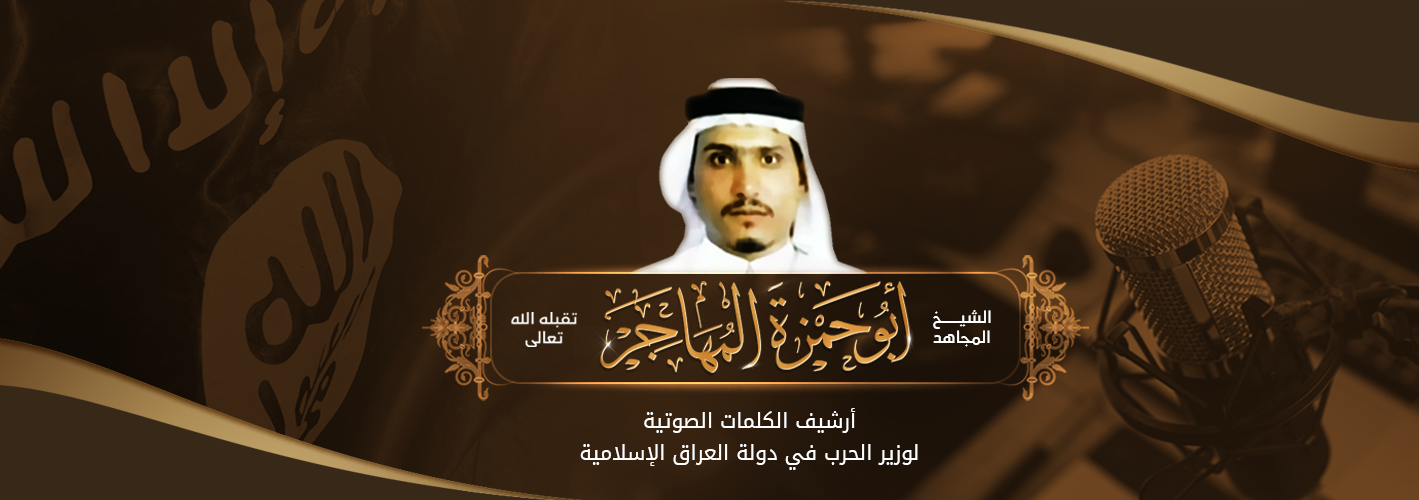
The Islamic State of Iraq (ISI) released a forty-five-minute media product, “The First Audio Interview with Shaykh Abu Hamza al-Muhajir”, on 24 October 2008. A translated transcript of the interview is reproduced below, with some interesting and important sections highlighted in bold.

Continue reading

The Islamic State’s Acknowledgement of the Deaths of Abu Umar al-Baghdadi and Abu Hamza al-Muhajir

By Kyle Orton (@KyleWOrton) on 18 March 2021

Continue reading

New Speech Does Not Provide Proof of Life for Al-Qaeda’s Leader

By Kyle Orton (@KyleWOrton) on 12 March 2021

A nearly-22-minute video was released by As-Sahab, the media wing of Al-Qaeda, on 12 March 2021, entitled, “The Wound of the Rohingya is the Wound of the Umma” or “The Wound of the Rohingya is the Wound of the Islamic Nation”. More than anything actually said or presented, the video itself was the story since it comes after credible reports in November 2020 that Al-Qaeda’s emir, Ayman al-Zawahiri, had died a month earlier. The only question was whether the video would provide proof-of-life for Al-Zawahiri, and it pointedly did not. Continue reading

The Jihad Factor in Bosnia

By Kyle Orton (@KyleWOrton) on 20 January 2021

Last week, as one of his last acts in office, U.S. Secretary of State Mike Pompeo gave a speech about Iran’s collaboration with Al-Qaeda. It was unfortunate that Pompeo did this at this time and in this way, with such blatant political intent, because the factual content of Pompeo’s speech was unassailable: the Islamic Republic’s long relationship with Al-Qaeda does stretch back about three decades, the killing of Al-Qaeda’s deputy Abdullah Ahmed Abdullah (Abu Muhammad al-Masri) in Tehran in August 2020 is demonstrative of a shift in the strategic positioning of the organisation away from Pakistan to Iran, and even the part of Pompeo’s speech that got the most pushback—about Tehran’s contact with the 9/11 killers—is not controversial and is not new.

Unmentioned in Pompeo’s speech was one of the crucibles that forged this relationship, and forged Al-Qaeda into something more than a regional menace, namely the Bosnian war of 1992-5. Continue reading

The Death of Al-Qaeda’s Leaders and the Iran Factor

By Kyle Orton (@KyleWOrton) on 16 November 2020

This article was originally published at European Eye on Radicalization

Abdullah Ahmed Abdullah (Abu Muhammad al-Masri) and Ayman al-Zawahiri. // Image sources: FBI, AFP

Credible reports over the last few days indicate that Al-Qaeda’s leader Ayman al-Zawahiri is dead, and there are even clearer reports that two of his most senior deputies have been killed. The terrorist network itself, however, will survive. Al-Qaeda has, in the last ten years, survived the killing of its charismatic founder Usama bin Laden, the upheaval of the “Arab spring”, and the rise of the Islamic State (IS)—all of them greater challenges than whatever short-term turbulence might attend the succession process.

Continue reading

The Current Condition of Al-Qaeda

By Kyle Orton (@KyleWOrton) on October 4, 2020

A chapter about Al-Qaeda I wrote for the American Foreign Policy Council’s (AFPC) ‘World Almanac of Islamism’ was published today. Do check it out, and the broader site, which is a great, accessible resource. The format of the website necessitated that the chapter as I submitted it was edited, condensed, and split up to fill out the various categories. In case it is of any interest, the original version of the chapter is reproduced below.

Continue reading