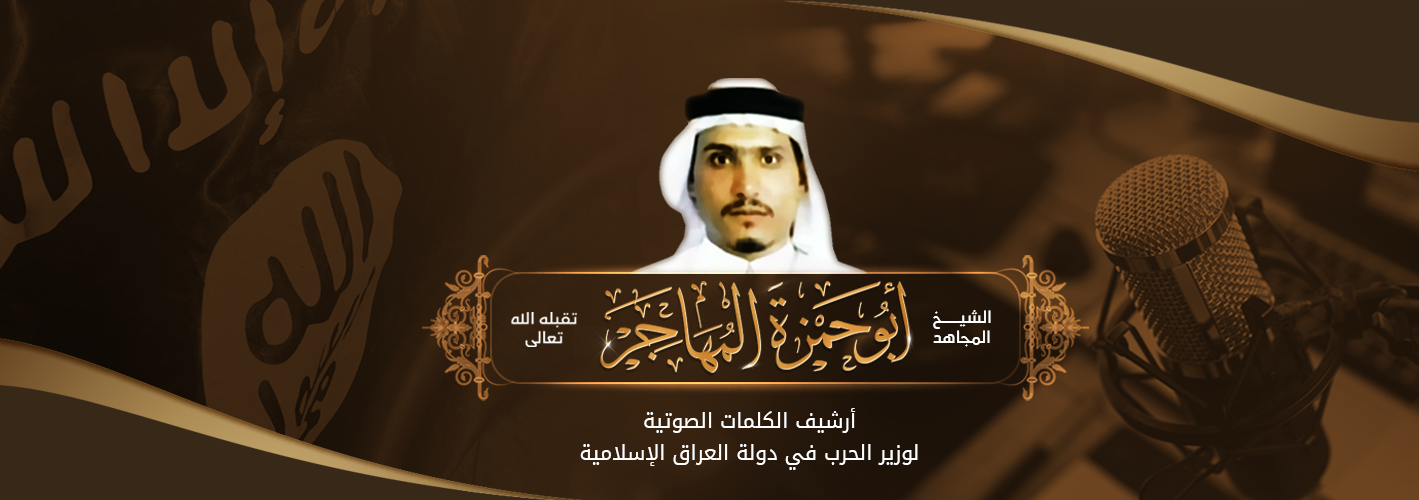
The Islamic State of Iraq (ISI) released a forty-five-minute media product, “The First Audio Interview with Shaykh Abu Hamza al-Muhajir”, on 24 October 2008. A translated transcript of the interview is reproduced below, with some interesting and important sections highlighted in bold.
A nearly-22-minute video was released by As-Sahab, the media wing of Al-Qaeda, on 12 March 2021, entitled, “The Wound of the Rohingya is the Wound of the Umma” or “The Wound of the Rohingya is the Wound of the Islamic Nation”. More than anything actually said or presented, the video itself was the story since it comes after credible reports in November 2020 that Al-Qaeda’s emir, Ayman al-Zawahiri, had died a month earlier. The only question was whether the video would provide proof-of-life for Al-Zawahiri, and it pointedly did not. Continue reading →
Last week, as one of his last acts in office, U.S. Secretary of State Mike Pompeo gave a speech about Iran’s collaboration with Al-Qaeda. It was unfortunate that Pompeo did this at this time and in this way, with such blatant political intent, because the factual content of Pompeo’s speech was unassailable: the Islamic Republic’s long relationship with Al-Qaedadoes stretch back about three decades, the killing of Al-Qaeda’s deputy Abdullah Ahmed Abdullah (Abu Muhammad al-Masri) in Tehran in August 2020 is demonstrative of a shift in the strategic positioning of the organisation away from Pakistan to Iran, and even the part of Pompeo’s speech that got the most pushback—about Tehran’s contact with the 9/11 killers—is not controversial and is not new.
Unmentioned in Pompeo’s speech was one of the crucibles that forged this relationship, and forged Al-Qaeda into something more than a regional menace, namely the Bosnian war of 1992-5. Continue reading →
Abdullah Ahmed Abdullah (Abu Muhammad al-Masri) and Ayman al-Zawahiri. // Image sources: FBI, AFP
Credible reports over the last few days indicate that Al-Qaeda’s leader Ayman al-Zawahiri is dead, and there are even clearer reports that two of his most senior deputies have been killed. The terrorist network itself, however, will survive. Al-Qaeda has, in the last ten years, survived the killing of its charismatic founder Usama bin Laden, the upheaval of the “Arab spring”, and the rise of the Islamic State (IS)—all of them greater challenges than whatever short-term turbulence might attend the succession process.
A chapter about Al-Qaeda I wrote for the American Foreign Policy Council’s (AFPC) ‘World Almanac of Islamism’ was published today. Do check it out, and the broader site, which is a great, accessible resource. The format of the website necessitated that the chapter as I submitted it was edited, condensed, and split up to fill out the various categories. In case it is of any interest, the original version of the chapter is reproduced below.
In writing a chapter earlier this year about the current status of Al-Qaeda, part of the process was reviewing the organisation’s history since its formation in the late 1980s. What really struck me was how extensively Al-Qaeda is now manipulated, under the influence of, and in places even controlled by state powers. To mark the nineteenth anniversary of 9/11, I thought I could give a brief sketch of this development.
The Mujahideen Battalion (El-Mudžahid) in Bosnia in the early 1990s [image source]
The clerical regime in Iran established a relationship with Al-Qaeda shortly after its foundation thirty years ago. One of Tehran’s and Al-Qaeda’s first joint projects was in Bosnia during the war (1992-5), where Iran helped to make Al-Qaeda a truly global phenomenon—with a foothold in Europe. For various reasons—some well-intended, some not—this fact has been either unknown or (shall we say) “controversial” in the West in the decades since. It is, therefore, important to note that there have been several recent revelations from in and around the Iranian regime itself that confirm the Islamic Republic’s involvement in the Balkans in the early 1990s. Continue reading →
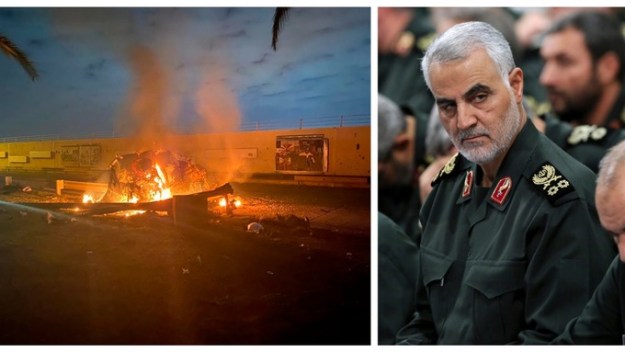
At 1 AM on 3 January, an American drone strike killed the head of Iran’s Quds Force, the division of the Islamic Revolutionary Guards Corps (IRGC) charged with exporting the Islamic revolution, and his Iraqi deputy, Jamal al-Ibrahimi (Abu Mahdi al-Muhandis). Sulaymani was the strategic driver of Iran’s expansionist policy in the Middle East, as well as the orchestrator of its terrorism and assassinations further afield. Unlike with the killing of Al-Qaeda’s Usama bin Laden in 2011 or the Islamic State’s Ibrahim al-Badri (Abu Bakr al-Baghdadi) in October, where the dynamics shifted little, Sulaymani’s death opens up questions about the direction in which the Middle East will now move. Continue reading →
In a long article last week, I looked at why the U.S. ran a formal occupation of Iraq for fourteen months after the fall of Saddam Husayn in April 2003, given that there had been an explicit pre-invasion decision not to have an occupation government. The short answer is that the occupation was installed through deception by the State Department, supported by the Central Intelligence Agency (CIA). State and CIA had argued for a protracted occupation in the Situation Room debates in 2002, but President George W. Bush had sided with the Pentagon, which advocated a rapid transfer of power to Iraqis. Having lost in the formal inter-agency process, the State Department succeeded by subversion in getting its way on the ground in Iraq. The disaster this caused in the mismanagement of post-Saddam Iraq was, as the article explained in detail, only the most serious impact of the toxic schism between State/CIA and the Pentagon, a factor whose import is difficult to overstate when examining how the Bush administration functioned. (This feud also at times drew in the Vice President’s Office, which tended to support the Pentagon.)