By Kyle Orton (@KyleWOrton) on 12 June 2020

Ismail Nazlikul (Kasim Engin) [image source]
By Kyle Orton (@KyleWOrton) on 12 June 2020
Ismail Nazlikul (Kasim Engin) [image source]
By Kyle Orton (@KyleWOrton) on 26 May 2020

Islamic State Wilayat al-Anbar, October 2017
This morning, the Iraqi government announced that Moataz Numan al-Jaburi (Haji Tayseer), a senior member of the Islamic State (IS), had been killed in Deir Ezzor in eastern Syria by an airstrike from the U.S.-led Coalition, utilising intelligence supplied by Iraq’s Counter-Terrorism Service (CTS, Jihaz Mukafahat al-Irhab). Continue reading
By Kyle Orton (@KyleWOrton) on 23 May 2020
There is now, with various caveats, a general agreement that the Islamic State (IS) is on the upswing—in Iraq, particularly, but also in the Badiya, the desert regions of eastern Syria, and more recently in the south of Syria around Deraa. Still, there have been some recent notable gains against the terrorist group. Continue reading
By Kyle Orton (@KyleWOrton) on 6 April 2020
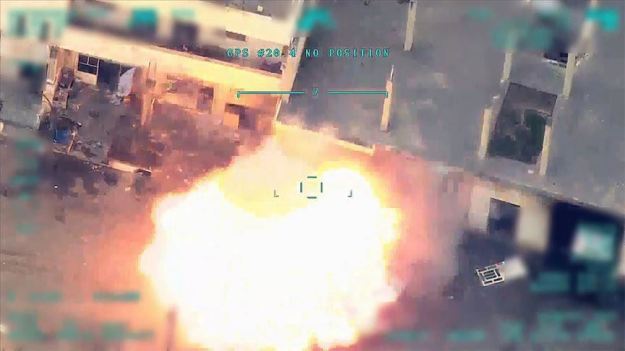
The first quarter of 2020 saw a serious escalation of combat in Syria, albeit without much alteration in the political trends, and the arrival of the novel coronavirus (COVID-19) has exacerbated a fraught situation. Continue reading
By Kyle Orton (@KyleWOrton) on 21 February 2020
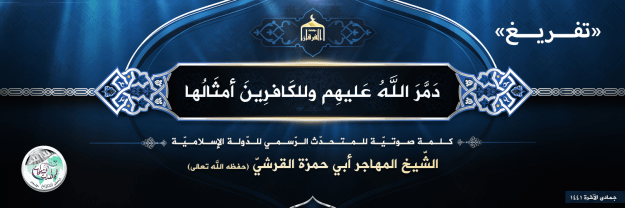
The Islamic State’s (IS) spokesman, Abu Hamza al-Qurayshi, gave his second speech on 27 January 2020. The speech was entitled, “Allah Destroyed Everything Over Them, and for the Kafireen is Something Comparable”, by IS’s official English translation. The title is drawn from the Qur’an, the Surah of Muhammad (47), verse 10. The verse can be rendered as, “God Destroyed Them Completely, and a Similar Fate Awaits the Disbelievers”. Below is a copy of the transcript of Abu Hamza’s speech, with some editions for transliteration and translation, and some interesting sections highlighted in bold. Continue reading
A version of this article was published in The Arab Weekly
By Kyle Orton (@KyleWOrton) on 24 November 2019
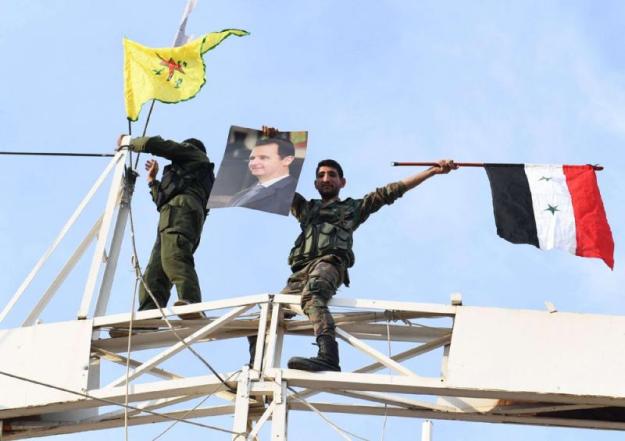
Solider from the Syrian regime holds up a portrait of Bashar al-Asad and a Syrian national flag, another stands by the Kurdish YPG/PKK flag, in Kobani, 18 October 2019. (AFP)
Mustafa Bali, head of the press office for the Syrian Democratic Forces (SDF), the coalition partner against the Islamic State (ISIS) in Syria, sent a tweet on November 14 showing Turkey’s Arab proxies engaged in “ISIS chants.” By this, he meant the takbir, “God is Great,” an expression used by Muslims every day. When criticised, Bali doubled down and blocked many critics. This was a microcosm of one of the darker threads in an SDF messaging strategy that is among the most effective propaganda campaigns on record. Continue reading
By Kyle Orton (@KyleWOrton) on 19 November 2019

President Barack Obama meeting President-elect Donald Trump, 10 November 2016 [image source]
By Kyle Orton (@KyleWOrton) on 18 November 2019
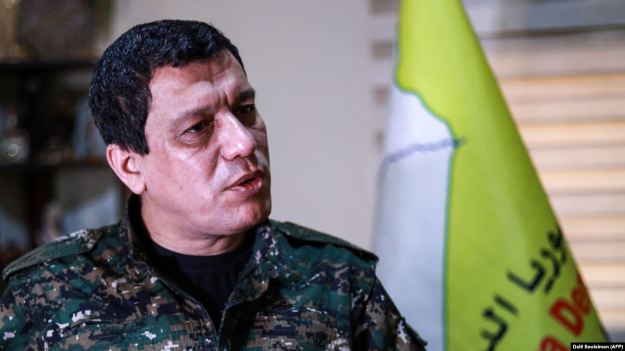
“SDF commander “General Mazlum Kobani” (the PKK executive official Ferhat Abdi Shahin) being interviewed by AFP in Hasaka city, 24 January 2019 [image source]
By Oved Lobel on 18 November 2019

PKK at a terrorist training camp in the Asad regime-held Bekaa Valley of Lebanon, 1991 [source]
The broad outline of the PKK’s relationship with the Soviet Union—and then the Russian Federation—is fairly clear. After the PKK was founded in Turkey in the late 1970s by Ocalan, it was evicted from the country during the 1980 military coup. The PKK moved to Syria, where Ocalan was already based, having fled Turkey in June 1979. From there, the PKK moved into the Bekaa area of Lebanon, at that time controlled by the Syrian regime of Hafez al-Asad, and the Soviets acted through Asad, as they so often did in dealing with terrorist groups, to build the PKK into a fighting force that was then unleashed in 1984 on Turkey, a frontline NATO state in the Cold War. Continue reading
By Kyle Orton (@KyleWOrton) on 12 November 2019

Ahmad al-Hashlum, Hasan Qassab, Hamza al-Malla, Mazen al-Harami
There has been a renewed crackdown on dissent in the areas of Syria run by the Kurdistan Workers’ Party (PKK). While on Syrian soil, the PKK uses the name Democratic Union Party (PYD), and its armed wing is called the People’s Protection Units (YPG). The YPG/PKK is the dominant force in the “Syrian Democratic Forces” (SDF), the U.S.-led international Coalition’s ground partner in Syria against the Islamic State (ISIS). Continue reading

 Kyle Orton's Blog