Tag Archives: Qassem Soleimani

The Iranian Nuclear Deal and North Korea

By Kyle Orton (@KyleWOrton) on January 18, 2016

1

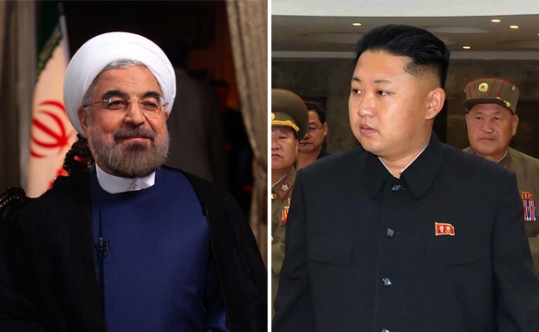
In the last few days, the international sanctions against the Islamic Republic of Iran’s nuclear program were lifted, which will allow Tehran access to $30 billion immediately and more than $100 billion will become available in short order. There are many fears about the uses Iran will put this money to, whether on the nuclear program itself, in aiding Iran’s imperial policy in the region, now proceeding with assistance from Russia, or perhaps exporting terrorism further abroad. An under-examined potential use of this money, highlighted by new sanctions the United States applied to Iran over its ballistic missile program, is to purchase weapons from North Korea. Pyongyang has already conducted what it claims is a hydrogen bomb test this year; fuelled by Iranian money the Hermit Kingdom might yet make more trouble for its neighbours and beyond. Continue reading

In Syria, Russia and Iran Reap the Harvest of Obama’s Failed Foreign Policy

By Kyle Orton (@KyleWOrton) and James Snell on October 1, 2015

Published at National Review.

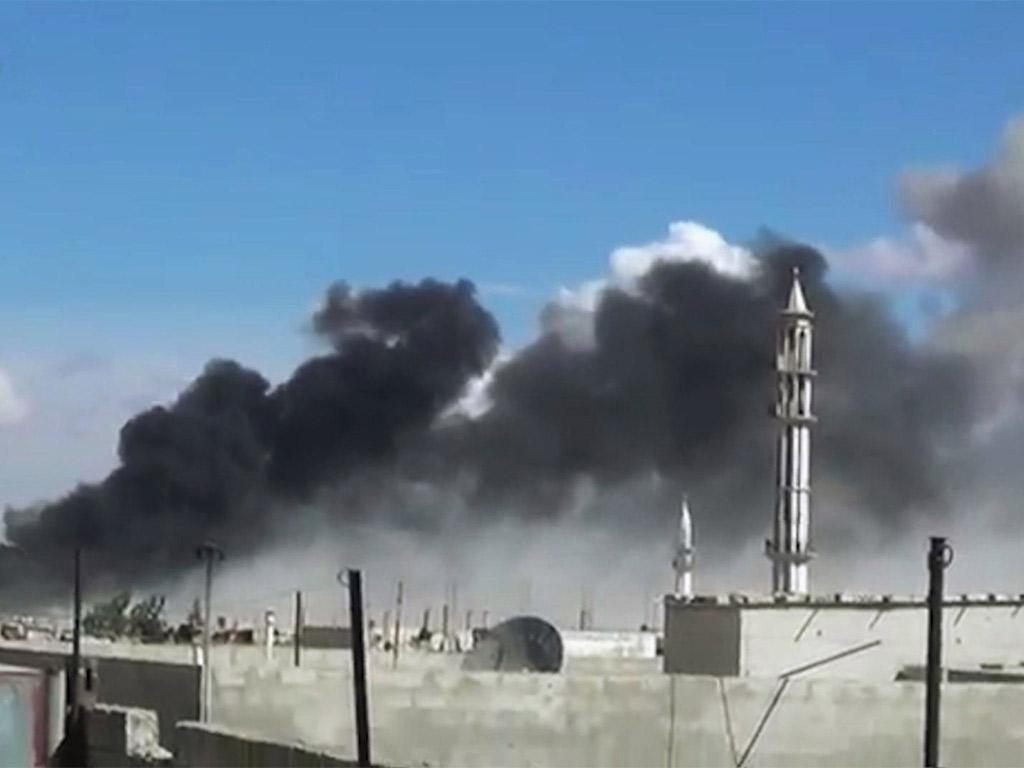
Aftermath of a Russian airstrike against U.S.-supported moderate rebels in Talbiseh, Homs (AP)

Aftermath of a Russian airstrike against U.S.-supported moderate rebels in Talbiseh, Homs (AP)

The situation in Syria could hardly get more desperate. With more than half the population displaced and 300,000 people dead, the civil war in Syria is the greatest humanitarian disaster of our time. But Syria is also a profound challenge to the American-underwritten geopolitical order that aspires toward free institutions and representative rule. As a direct consequence of policies pursued by the Obama administration, Iran and Russia, two enemies of this order, have taken their chance to assert their dominance. Continue reading

A Year Into The War Against The Islamic State, The Coalition Has Little To Show For It

By Kyle Orton (@KyleWOrton) on September 30, 2015

Published at Left Foot Forward

1

A year into the campaign against the Islamic State, the American-led coalition has precious little to show for it. Tactical victories in Kobani, Tikrit and Tel Abyad have been more than offset not only by the negative long-term side-effects of those victories but by direct I.S. military gains in the present—notably the capture of a third provincial capital in Ramadi, the capture of Palmyra and a push into Homs and southern Syria; as well as increasing I.S. infiltration of Idlib, an area cleared entirely of I.S. by a rebel offensive in early 2014. Continue reading

Russia’s War For Assad

By Kyle Orton (@KyleWOrton) on September 30, 2015

1

Russia began airstrikes in Syria today, ostensibly to combat the Islamic State (I.S.). In reality the strikes first hit U.S.-supported moderate rebels and the campaign is intended to buttress the dictatorship of Bashar al-Assad. Continue reading

Britain’s New Syria Policy Concedes to Iran and Russia—and Keeps Assad in Power

By Kyle Orton (@KyleWOrton) on September 11, 2015

Published at Left Foot Forward

1

On 9 September the British government announced a new plan for dealing with Syria and the Islamic State (ISIS):

  1. Airstrikes when necessary into Syria to destroy the leadership of ISIS;
  1. Buttressing the Iraqi government in its fight with ISIS;
  1. Dropping the demand that Syrian dictator Bashar al-Assad step aside immediately and instead allowing Assad to lead a transition, in order that Russia and Iran will agree to Assad going at all.

All three parts of this plan push in a pro-Iran direction, and strengthen Assad. Continue reading

Reassessing the Saudi-led Intervention in Yemen

By Kyle Orton (@KyleWOrton) on July 24, 2015

1

The Saudi-led Operation DECISIVE STORM began in Yemen on March 25 as a campaign of airstrikes against the Iran-backed Houthis, to weaken them and re-install the president, Abd Rabbo Mansour Hadi, who was overthrown by the Houthis last September.

In April, I wrote in support of the Saudi-led operation for: (1) having drawn a line against Iran’s imperialism after Lebanon, Syria, and Iraq; (2) potentially decreasing the growth of the Islamic State (ISIS) by providing Sunnis, in Yemen and beyond, with an alternative form of resistance to Iran’s encroachments; and (3) offering a chance for more stability in Yemen, which was then in free fall with Iran, al-Qaeda, and ISIS capitalizing on the chaos. Continue reading

The Iran Deal: More Terrorism And An Eventual Bomb—And That’s If It Holds

By Kyle Orton (@KyleWOrton) on July 17, 2015

Published at The Independent

1

With all the leaks and the numerous “interim” deals, the nuclear deal—the Joint Comprehensive Plan of Action (JCPOA)—made with Iran on July 14 contained few surprises. The deal makes Iran a threshold nuclear-weapons regime for its duration and smooths the path to an overt nuclear-weapons capacity afterward. In the meantime, it has given Iran extra resources for the export of terrorism. And that’s just if Iran keeps the deal. Continue reading

Obama’s Iran Deal Increases Nukes, Terrorism, and Instability

By Kyle Orton (@KyleWOrton) on April 28, 2015

1

The key thing to understand about the Joint Comprehensive Plan of Action (JCPOA), the nuclear accord announced on April 2 between the P5+1 and Iran, is that it does not exist. The British Foreign Secretary Philip Hammond said at one point, “We envisage being able to deliver a narrative,” adding that this might not be written and—these being forgiving times—Iran’s narrative need not match the West’s. In other words, nothing was signed or agreed to. This is the reason for the wild discrepancies between the American and Iranian JCPOA “factsheets”: both are drawing from a rolling text that is ostensibly to lead to a “final” or “comprehensive” deal and spinning it to their own respective advantage. The administration has as much as said so with its mantra that “nothing is agreed until everything is agreed”.

The purpose of the announcement of the JCPOA therefore was, charitably, to “build political momentum toward a final agreement“. Less charitably it was intended to “demonstrate progress in order to fend off congressional action,” as Obama’s former nuclear adviser Gary Samore put it. In that at least it was successful. Continue reading

The Local And Regional Implications From The Fall Of Idlib

By Kyle Orton (@KyleWOrton) on March 31, 2015

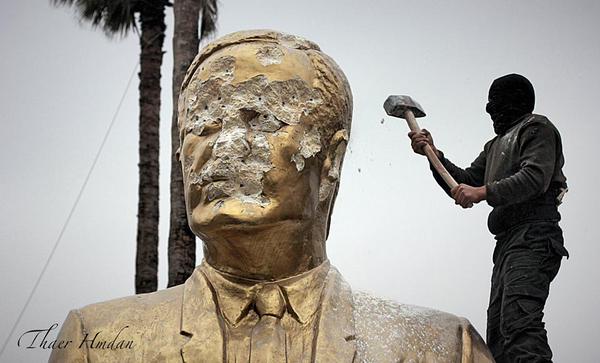
Statue of Hafez al-Assad defaced after Idlib City falls, March 29, 2015

Statue of Hafez al-Assad defaced after Idlib City falls, March 29, 2015

After an insurgent offensive began on March 24, Idlib City fell on March 29, making it only the second—of Syria’s fourteen—provincial capitals to slip from the control of Bashar al-Assad’s regime, the last one being Raqqa City on March 4, 2013. The regime has been on borrowed time in Idlib City since Wadi al-Deif to the south, near Maarat an-Numan, fell in mid-December.

In a scene reminiscent of Raqqa—and indeed the fall of Baghdad—a statue of Hafez al-Assad was destroyed. The insurgents broke open some secret prisons, while finding that in a final act of needless cruelty the regime had murdered other prisoners in the cells before retreating.

An operations room, Jaysh al-Fatah (Army of Conquest), organised this offensive, and is composed of: Faylaq a-Sham (Sham Legion), Liwa al-Haq, Ajnad a-Sham, Jaysh al-Sunna, Ahrar a-Sham, Jund al-Aqsa (JAA), and al-Qaeda’s Syrian branch, Jabhat an-Nusra. Continue reading

Amerli Shows The Futility Of Aligning With Iran To Defeat The Islamic State

By Kyle Orton (@KyleWOrton) on March 18, 2015

Badr Corp commander Hadi al-Ameri

Badr Corp commander Hadi al-Ameri

This morning Human Rights Watch released a report, “After Liberation Came Destruction: Iraqi Militias and the Aftermath of Amerli.”

Amerli is a town of about 25,000 people, mostly Shi’a Turcomen, in the east of Saladin Province, close to Diyala Province, sixty miles from the Iranian border.

The Islamic State (ISIS) invaded Iraq from Syria, conquering Mosul on June 10, 2014, then swept across central Iraq into Diyala. In a situation not dissimilar to the Assad regime’s terror-sieges and ISIS surrounding of the Yazidis on Sinjar Mountain, ISIS imposed a siege on the population of Amerli on June 14.

By the time the Iraqi government forces and Hashd al-Shabi (a.k.a. the Popular Mobilization Units, PMUs), the Shi’ite militias that are largely Iran proxies, broke the siege on August 31, with the help of airstrikes from the American-led Coalition, “at least 15 civilians in Amerli, including newborn infants, had died from lack of food, water or medical treatment, and more than 250 children were suffering from severe malnutrition and dehydration,” HRW reports. On Sept. 1, the militias and Iraqi Security Forces (ISF) entered Amerli. Continue reading