By Kyle Orton (@KyleWOrton) on 25 May 2018
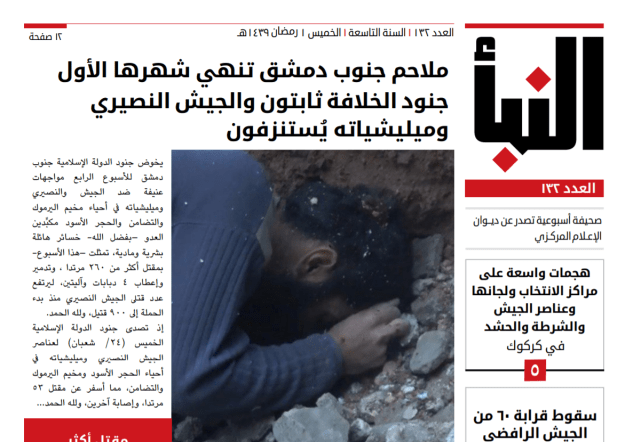
Al-Naba 132
The Islamic State released the 132nd edition of Al-Naba, its newsletter, on 18 May. Continue reading
By Kyle Orton (@KyleWOrton) on 25 May 2018
Al-Naba 132
The Islamic State released the 132nd edition of Al-Naba, its newsletter, on 18 May. Continue reading
By Kyle Orton (@KyleWOrton) on 23 May 2018
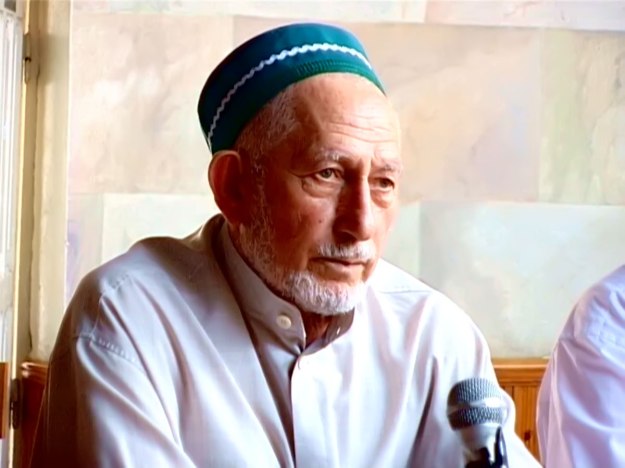
Said Afandi al-Chirkawi (image source)
The Islamic State (IS) laid claim, in two recent issues of its newsletter, Al-Naba, to three recent attacks in Russia. Continue reading
By Kyle Orton (@KyleWOrton) on 16 May 2018
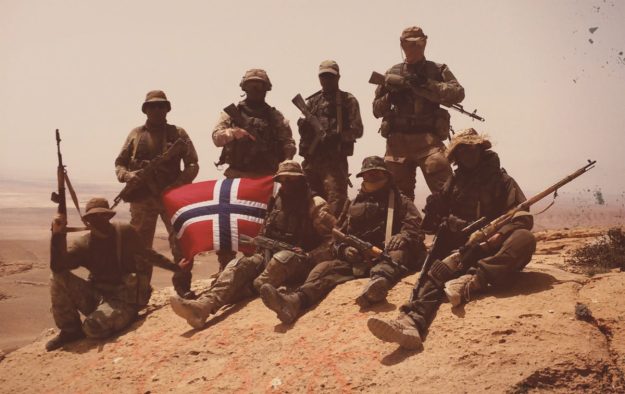
Skandinaviska Förbundet (Scandinavian League) fighters in Syria, where they fought under Russian command // Picture via Skandinavisk Frihet
The Norwegian news portal AldriMer reported on 11 May about a group of far-Right Scandinavians who fought under Russian command for the pro-regime coalition in Syria.
AldriMer was relaying an interview published last month by Skandinavisk Frihet (Scandinavian Freedom), a website that describes itself as attached to the Skandinaviska Förbundet (Scandinavian League), a far-Right group based primarily in Sweden. The interview is with a member of Skandinaviska Förbundet who fought in Syria. Continue reading
By Kyle Orton (@KyleWOrton) on 14 May 2018

United Nations in East Ghouta, Syria (image source)
At best, the United Nations has been impotent as Syria was destroyed. But when the U.N.’s role is examined more closely it looks more like a collaborator, than a bystander, to that destruction. Continue reading
A version of this article was published in CapX
By Kyle Orton (@KyleWOrton) and James Snell on 8 May 2018

The Barzeh chemical weapons facility in Damascus, Syria, demolished by U.S. cruise missiles on 14 April 2018 (image source)
The United States and its allies, Britain and France, launched over 100 missiles at the Syrian regime of Bashar al-Assad in the early hours of 14 April. This was retaliation for the regime’s use of poison gas in the town of Douma, east of the capital, Damascus, exactly a week earlier, which massacred at least 43 people and wounded 500 more. The military strikes were an important signal and will likely be some deterrent against the future use of chemical weapons in Syria, but ultimately this was another missed opportunity by the West to meaningfully affect the course of the war. Continue reading
By Kyle Orton (@KyleWOrton) on 5 May 2018

Syrians being deported from East Ghuta after the regime conquest, 15 March 2018 // Credit Louai Beshara, Agence France-Presse
There has been an unprecedented wave of assassinations, and assassination attempts, in Idlib, beginning on 26 April and lasting about two days, targeting mainstream, Free Syrian Army-branded rebels, opposition activists, and journalists, as well as Islamist and jihadist insurgents.
By Kyle Orton (@KyleWOrton) on 29 April 2018
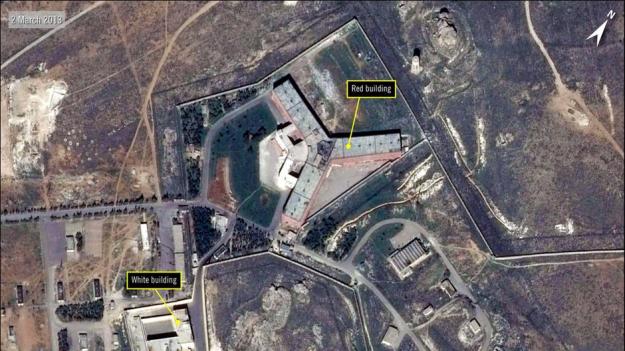
A satellite image of Sednaya prison, about 20 miles north-east of the presidential palace. CNES and ASTRIUM / Amnesty International via AFP
To accompany the release of “Syria’s Slaughterhouses”, a film by TRT World’s “Off The Grid”, I was asked to give an overview of the available evidence of the Assad regime’s crimes against humanity.
The launching of a limited punitive raid against the Syrian regime of Bashar al Assad for the use of poison gas has brought some attention to the regime’s crimes. The regime’s visible crimes are numerous and devastating.
In addition to using weapons of mass destruction, fighter jets have levelled ancient cities, sieges have starved populations into submission, and improvised explosives like barrel bombs have maimed thousands. These tactics are part of what UN investigators have called a “systematic and widespread attack against [the Syrian] civilian population”.
The UN commission recently noted that what the Assad regime has done amounts to crimes against humanity, including extermination, murder, rape, and torture.
What does not get enough attention is the part of Assad’s criminality that is most difficult to see: that which takes place in the prisons, a vast network of concentration camps where torture and murder is routine. Continue reading
By Kyle Orton (@KyleWOrton) on 18 April 2018

Egyptian ruler Abdelfattah al-Sisi, Saudi King Salman, and President Donald Trump in Riyadh on 22 May 2017 (image source)
Two days ago, The Wall Street Journal reported that President Donald Trump has been exploring plans to replace American troops in the areas of Syria held by the Coalition partner force, the “Syrian Democratic Forces” (SDF), with troops from the Arab states. The problems with this proposal, even in the rudimentary form it is presented, are manifold. It also feeds into the broader problem of Trump’s inconsistent messaging about Syria—or, more precisely, his failed efforts to balance domestic messaging, which calls for what was once referred to as “nation building … at home”, and his foreign messaging that needs to emphasise U.S. constancy to see through the mission to defeat the Islamic State (IS) by, among other things, stabilising and reconstructing Syria. Continue reading
By Kyle Orton (@KyleWOrton) on 10 April 2018
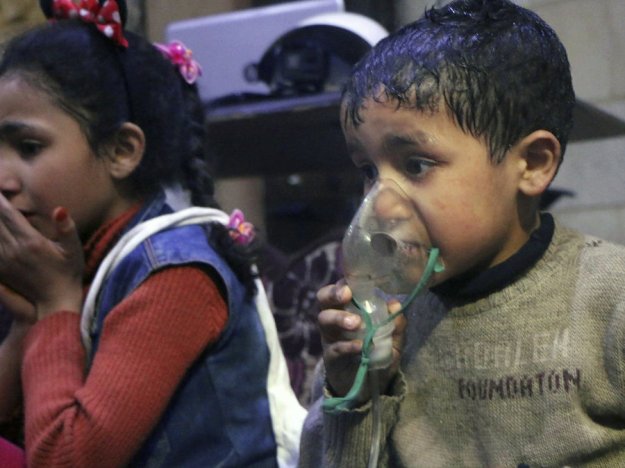
A child receiving oxygen after a poison gas attack in Douma, near Damascus, Syria | SYRIAN CIVIL DEFENSE WHITE HELMETS VIA AP
A year to the day after the United States struck at a Syrian airbase to punish Bashar al Assad for a chemical weapons attack, the regime has suspectedly carried out another devastating chemical atrocity. Signs are that the United States will, again, respond with force, attempting to rescue some part of the fraying international taboo against the use of poison gas. The larger question remains how Assad has gotten away with this for so long—and why murder only with certain categories of munitions prompts retaliation. Continue reading
Originally published at Ahval
By Kyle Orton (@KyleWOrton) on 31 March 2018
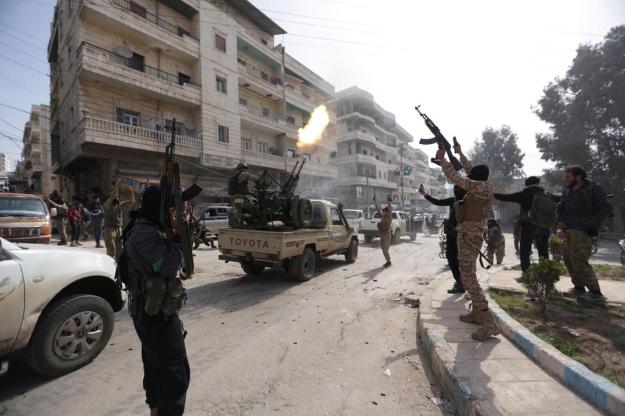
Turkish Armed Forces and allied Syrian Arab fighters capture Efrin city, Syria, 18 March 2018 (Reuters)
Since its incursion into Afrin began in January, Turkey has made significant progress in turning the military landscape in Syria in its favour. Turkish President Recep Tayyip Erdogan has signalled that further operations are to come in Syria, and perhaps in Iraq, too. These next operations would present new challenges, particularly politically, an area where Turkey has not made quite as much progress. Continue reading

