Tag Archives: Shi’a militias

Coalition Allies Play Into Islamic State’s Hands

By Kyle Orton (@KyleWOrton) on November 14, 2016
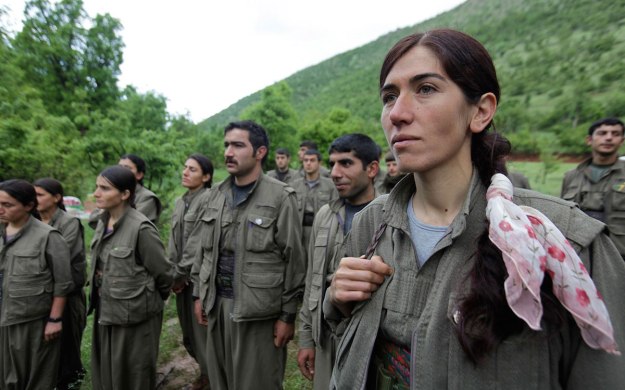
Kurdistan Workers’ Party (PKK) fighters in Dohuk in northern Iraq, 14 May 2013, Azad Lashkari/Reuters

Last week, a member of the Kurdish militia that is the primary instrument the U.S.-led Coalition is using in Syria to defeat the Islamic State (IS) was killed. Examining his biography underlined that this militia is the Syrian wing of the Kurdistan Workers’ Party (PKK), a Marxist-separatist group that is registered as a terrorist organization by the United States, the European Union, and Turkey. The Western powers continue to obfuscate, if not outright deny, this fact, but Coalition support for the PKK—questionable morally and legally in and of itself—is producing negative results on the ground that help IS over the long-term. Continue reading

America Escalates the War Against Al-Qaeda in Syria

By Kyle Orton (@KyleWOrton) on November 11, 2016

On the right: Abdullah al-Muhaysini (source)

The United States and therefore the international Coalition is about to step up its operations against Jabhat Fatah al-Sham (JFS), al-Qaeda’s recently rebranded Syrian branch. This is a necessary policy, but pursued in isolation—without replacing the capacities that JFS provides to the insurgency—this action will strengthen the coalition supporting the regime of Bashar al-Assad, the actors chiefly responsible for the humanitarian abomination in Syria that has deliberately given rise to the security menace of the Islamic State (IS) and the flow of refugees into Europe that has destabilized Western security. Assad’s coalition also includes the Islamic Republic of Iran, a more significant global terrorism threat than IS which has repeatedly attacked the West. Continue reading

Al-Qaeda Signals A Return to Iraq, Incites Against An American-Iranian Conspiracy

By Kyle Orton (@KyleWOrton) on November 4, 2016

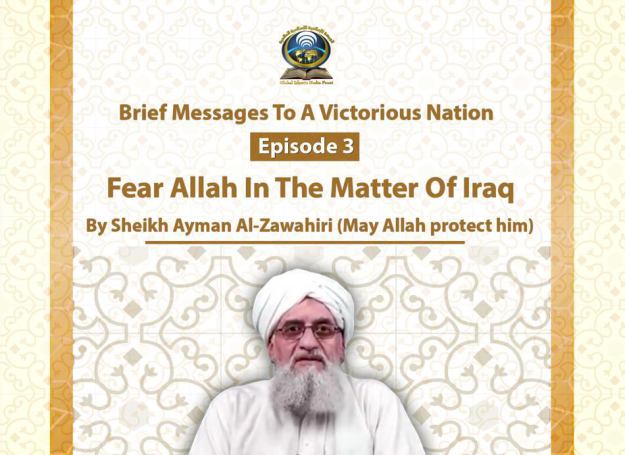
Al-Qaeda’s leader, Ayman al-Zawahiri, gave a speech on August 25, 2016, entitled, “Fear Allah in the Matter of Iraq” (or “Fear Allah in Iraq”). Released by al-Qaeda’s As-Sahab Media Foundation, the speech is the third installment of the “Brief Messages To A Victorious Nation” (or “Brief Messages To A Victorious Umma”) series. A translation of the speech was released by Al-Muwahideen Media, a pro-Qaeda channel, last month and is reproduced below with some editions in transliteration and important sections highlighted in bold. Continue reading

Coalition Prepares the Ground for Mosul Offensive


By Kyle Orton (@KyleWOrton) on October 9, 2016

U.S.-led Coalition airstrikes against the Islamic State (AFP)

Raqqa is Being Slaughtered Silently (RBSS) is an activist group working from within the capital of the Islamic State (or so-called capital of the so-called Islamic State, if you prefer) to bring news to the outside world of the horrors therein. For this they have paid a heavy price. On 22 September, RBSS published a list on Twitter of eighteen Islamic State (IS) operatives who had been killed by the U.S.-led Coalition between 20 August and 21 September 2016. This list, presented below with some notes and context, shows the preparations being made for the rapidly-approaching offensive on IS’s Iraqi capital. Continue reading

Abandoning Syria to Assad Helps Al-Qaeda

By Kyle Orton (@KyleWOrton) on September 23, 2016

2

The deeply problematic attempted Syrian ceasefire agreement between the United States and Russia last week never really took hold and was finally torn asunder on Monday by Russia and the regime of Bashar al-Assad blitzing an aid convoy and launching massive, indiscriminate aerial attacks on rebel-held areas in Aleppo. Last night, the pro-Assad coalition commenced a renewed assault on Aleppo actually as the parties met to discuss putting the ceasefire back online.

It had been surreal that it was the U.S. insisting that “The ceasefire is not dead”. What it exposed was the lack of Western will to restrain the Assad regime, which al-Qaeda, especially, is exploiting, offering its services in the fight against Assad, and building a sustainable presence in Syria that will threaten the West for many years to come. Continue reading

Moscow Rules in Syria, Again

By Kyle Orton (@KyleWOrton) on September 11, 2016

1

In Geneva on 9 September 2016, the United States and Russia announced an agreement to implement a ceasefire—formally a “cessation of hostilities” (CoH)—in Syria, which is intended to allow humanitarian access and restart the political process to end of the war, and then to begin jointly targeting the Islamic State (IS) and al-Qaeda’s Syrian branch, formerly Jabhat al-Nusra, recently rebranded Jabhat Fatah al-Sham (JFS).

There is reason to wonder if the deal will ever take effect and the lack of an enforcement mechanism against Bashar al-Assad’s regime leaves open the possibility that the pro-regime coalition will, as it did after the February ceasefire, abuse this process to their advantage.

Most dauntingly, if this process worked to the letter it will legitimate the gains of the regime’s aggression, carried out under the cover of the last ceasefire, and has the potential to weaken the insurgency and embolden the regime, strengthening radicalism on all sides, pushing a political settlement further away, and thus protracting the war. Continue reading

Is This the Beginning of the End for the Islamic State?

By Kyle Orton (@KyleWOrton) on September 8, 2016

Screenshot of an Islamic State video displaying captured materials from the New Syrian Army, 27 July 2016

Screenshot of an Islamic State video displaying captured materials from the New Syrian Army, 27 July 2016

City AM asked for contributions on the above question, and I took the “no” side. As can be seen from the below, however, this was very much a matter of interpretation since both sides gave roughly the same answer: the Islamic State’s statelet is coming to an end, but the group will survive, morphing back into a prior stage.  Continue reading

The End of the Islamic State by Christmas?

By Kyle Orton (@KyleWOrton) on September 5, 2016

1

Last week it was reported by The Daily Beast that United States defence and political leaders believe they can at least begin the operation to remove the Islamic State (IS) from its Iraqi capital, Mosul, before President Barack Obama leaves office on 20 January 2017. This seems unlikely. More to the point, if it is true it is highly dangerous, both in the short-term and especially over the long-term. Continue reading
The Islamic State is Losing Militarily, Gaining Politically

By Kyle Orton (@KyleWOrton) on June 29, 2016

The New York Post had a symposium on the progress of the U.S.-led campaign against the Islamic State. This is my contribution:

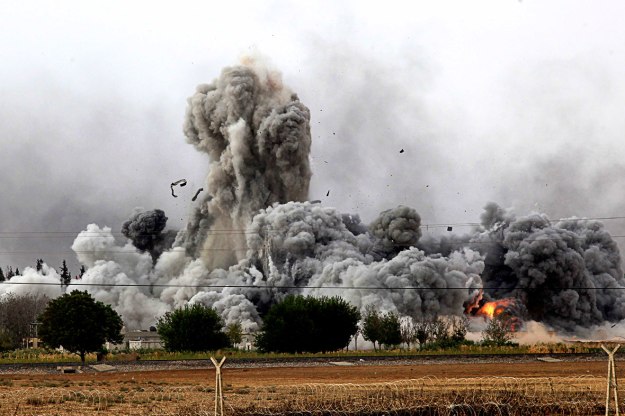
The American-led effort to defeat the Islamic State is yielding significant tactical and military results. But the campaign is deeply flawed: It’s being waged as if the politics can be worked out after the fall of ISIS’s statelet, and in the process providing ISIS the conditions that will ensure its revival. Continue reading

Russia Needs the Islamic State to Save Assad

By Kyle Orton (@KyleWOrton) on June 20, 2016

Cross-posted at The Interpreter.

After a coalition supporting the regime of Syrian ruler Bashar al-Assad conquered the city of Palmyra from the Islamic State (IS) in late March, suggestions were made that this demonstrated the efficacy of the pro-Assad coalition in fighting IS, and doubtless the same will be said if and when the pro-regime forces conquer Tabqa. It isn’t true. From the time of Russia’s direct intervention in Syria on 30 September 2015 to Moscow’s announcement on 14 March 2016 that it was withdrawing “the main part” of its “military” from Syria, IS was almost untouched and al-Qaeda was barely damaged, while the Assad regime was bolstered and the moderate opposition, particularly those components supported by the West, were gravely weakened.

Despite Moscow’s claims that its mission was fighting IS or “terrorism,” Russia’s real goals can be summarized as three:

  1. Rescue the Assad regime, which was assessed to be in mortal peril
  2. Damage the mainstream armed opposition, especially those elements supported by the West, in order that Russia can …
  3. Rehabilitate the Assad regime internationally by inter alia leaving only extremists as its opponents, depriving the international community of credible interlocutors, and therefore strengthening the Russian hand to make peace talks an instrument for re-legitimizing Assad, rather than removing him

In recent days, this basic war strategy has been seen again in southern Syria. Continue reading