By Kyle Orton (@KyleWOrton) on January 20, 2017
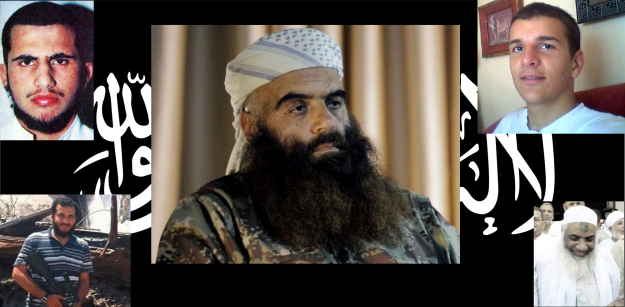
Muhsin al-Fadhli [top-left]; Abdul al-Sharikh (Sanafi an-Nasr) [bottom-left]; Radwan Nammous (Abu Firas al-Suri) [centre]; David Drugeon [top-right]; Rifai Taha (Abu Yasser al-Masri) [bottom-right]
By Kyle Orton (@KyleWOrton) on January 20, 2017
Muhsin al-Fadhli [top-left]; Abdul al-Sharikh (Sanafi an-Nasr) [bottom-left]; Radwan Nammous (Abu Firas al-Suri) [centre]; David Drugeon [top-right]; Rifai Taha (Abu Yasser al-Masri) [bottom-right]
By Kyle Orton (@KyleWOrton) on January 19, 2017
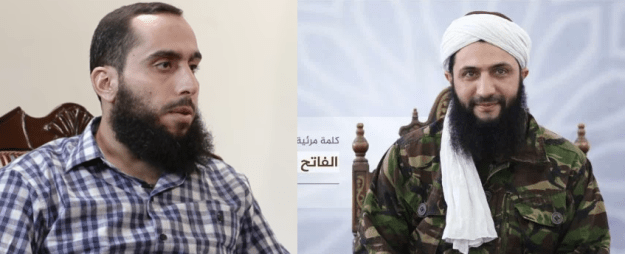
The leader of Ahrar al-Sham, Ali al-Umar (Abu Ammar); the leader of Jabhat Fatah al-Sham, Ahmad al-Shara (Abu Muhammad al-Jolani)
Clashes have erupted today between al-Qaeda’s Syrian branch, Jabhat Fatah al-Sham (JFS), and its heretofore-inseparable ally, Ahrar al-Sham. For the overall insurgency, the bodes ill, in the short-term, but there might be some long-term political advantages if JFS isolates itself from the wider opposition. Continue reading
By Kyle Orton (@KyleWOrton) on January 16, 2017
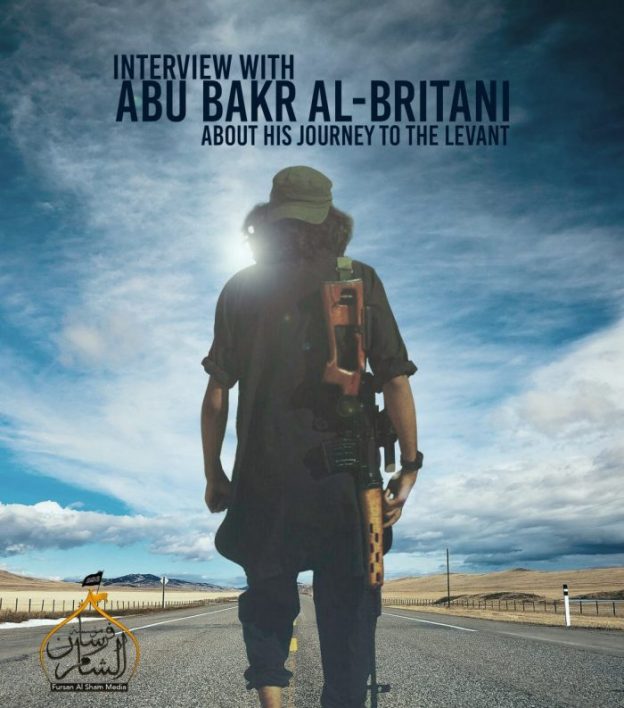
Fursan al-Sham Media was set up in September 2016 as a messaging outlet from inside Syria for the jihadist groups in the insurgency, notably Jabhat Fatah al-Sham (JFS), the rebranded al-Qaeda branch in Syria, and Ahrar al-Sham.[1] On 14 January 2017, Fursan al-Sham Media had an interview with Abu Bakr al-Britani, a British jihadist who had journeyed to Syria and presumably joined JFS. The interview is reproduced below. Continue reading
By Kyle Orton (@KyleWOrton) on January 14, 2017
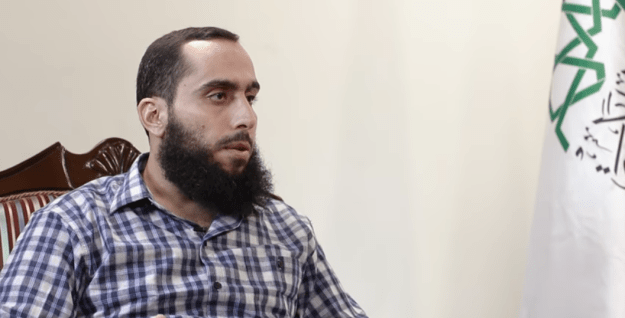
Ahrar al-Sham’s leader, Ali al-Umar (Abu Ammar)
The Syrian media activist Hadi al-Abdullah interviewed Ahrar al-Sham’s leader, Ali al-Umar (Abu Ammar al-Umar), in a video released on 11 January 2017. The focus was the ongoing negotiations with Jabhat Fatah al-Sham (JFS), al-Qaeda’s rebranded Syrian branch, to create an insurgent merger. The question has caused intense turmoil within Ahrar. Continue reading
By Kyle Orton (@KyleWOrton) on January 13, 2017

(source)
Yesterday, the United States Treasury Department imposed sanctions on eighteen senior officials in the regime of Bashar al-Assad. The sanctions come in response to reports in August and October 2016 by the Organization for the Prohibition of Chemical Weapons (OPCW), the United Nations investigative body, which found that found “the Syrian government, specifically the Syrian Arab Air Force, was responsible for three chlorine gas attacks in Talmenes on April 21, 2014, and in Qmenas and Sarmin on March 16, 2015.” This is three years after the Assad regime was spared punitive military strikes for its use of chemical weapons under a Russian-orchestrated “deal” that ostensibly disarmed Assad of such weapons. Continue reading
By Kyle Orton (@KyleWOrton) on January 11, 2017
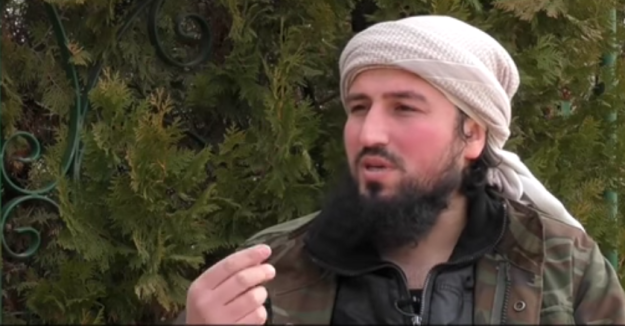
On The Ground News (OGN) interviewed Abu al-Abed Ashidaa on 10 January 2017. Abu al-Abed was appointed to lead all insurgents in the besieged areas of eastern Aleppo City on 1 December 2016. Aleppo City fell to the pro-regime coalition after a months-long campaign of siege, bombardment, and atrocity on 12 December, with the final deportation of the insurgency and tens of thousands of civilians—a crime against humanity in itself—on 22 December.
OGN is an outlet operating inside Syria that is best known for featuring American activist, Bilal Abdul Kareem. The organization claims independence but is clearly within the milieu of the more hardline insurgent forces in northern Syria, and in fact appears to favour the political line of Jabhat Fatah al-Sham (JFS), al-Qaeda’s rebranded presence in Syria, against even other extremist Salafi groups like Ahrar al-Sham.
It was Kareem who interviewed Abu al-Abed. The transcript is below. Continue reading
By Kyle Orton (@KyleWOrton) on January 10, 2017
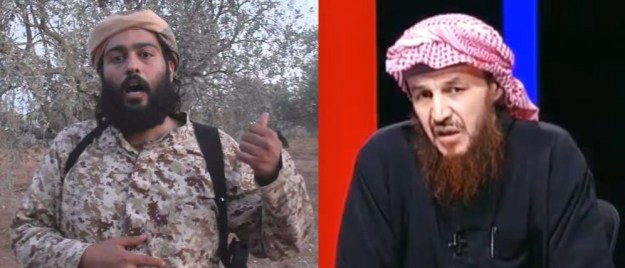
Abdallah al-Muhaysini, Issam al-Barqawi (Abu Muhammad al-Maqdisi)
In Syria, negotiations continue for a merger between Jabhat Fatah al-Sham (JFS), the rebranded al-Qaeda branch in the country, and other insurgent groups in the north, particularly Ahrar al-Sham. Two Jihadi-Salafi clerics have offered very different proposals for the way forward in the last couple of days. Continue reading
By Kyle Orton (@KyleWOrton) on January 8, 2017
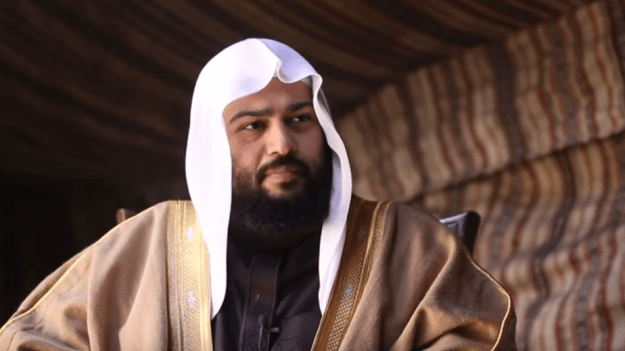
On 5 January 2016, Abdallah al-Muhaysini appeared on episode sixty of Sham Weekly, an interview series, to lament the failure of the Syrian insurrectionists to merge with Jabhat Fatah al-Sham (JFS), al-Qaeda’s rebranded presence in Syria. Al-Muhaysini places the blame for the failure to merge squarely on Ahrar al-Sham. Continue reading
By Kyle Orton (@KyleWOrton) on January 7, 2017

Abdulkadir Masharipov (source)
It was an hour into 2017 that the Islamic State (IS) carried out its first act of mass-murder: an IS jihadist attacked the Reina nightclub in Istanbul, massacring thirty-nine people. IS has been attacking Turkey with increasing frequency over the last two years and, since Turkey intervened directly in Syria in August, IS’s media output has elevated the Turks into a priority target for terrorism. The public claim of responsibility by IS for the Reina attack suggests that we are moving into a new era in terms of how IS treats Turkey. Turkey’s increasingly warm relations with Russia have angered many Muslims around the world, providing jihadists an incentive and opportunity, and providing al-Qaeda political space it seemed to have lost to co-opt the Syrian rebellion. It is therefore likely that more bloodshed is to come for Turkey. Continue reading
By Kyle Orton (@KyleWOrton) on January 6, 2017
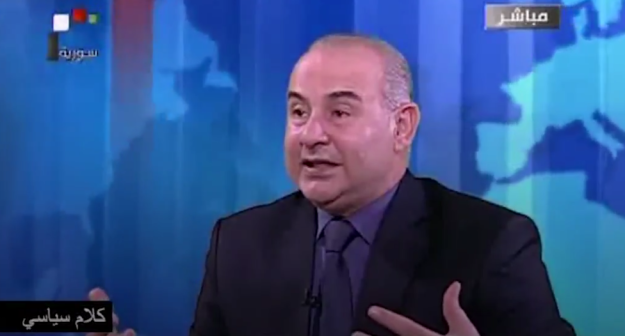
Khaled Abboud
From the beginning of the uprising in Syria in 2011, there have been accusations that Bashar al-Assad’s regime was in a de facto partnership with the Islamic State (IS) against the mainstream opposition. These accusations have a considerable basis in fact: during the entirety of the Anglo-American occupation of Iraq, Assad collaborated with IS jihadists in the destabilization of Iraq, killing thousands of Iraqi civilians and hundreds of American and British troops. Once the Syrian uprising was underway, the regime undertook various measures to bolster extremists in the insurgency. Assad and IS worked in tandem to leave Syria as a binary choice between themselves: Assad was sure this would rehabilitate him in the eyes of the world and transform his criminal regime into a partner of the international community in suppressing a terrorist insurgency, and IS wanted to rally Sunnis to its banner. The Secretary of the Syrian Parliament has now come forward to underline this. Continue reading

