Tag Archives: Taha Subhi Falaha

‘Lone Wolf’ Attacks in Europe Are Nothing of the Sort

By Kyle Orton (@KyleWOrton) on July 29, 2016

Published in The Telegraph

Muhammad Riyad (Wurzburg) [top left], Mohammed Daleel (Ansbach) [top right], Adel Kermiche (Normandy) [bottom left], Abdelmalik Petitjean (Normandy) [bottom right]

Since early 2014, at the latest, the Islamic State (IS) has been plotting terrorist attacks in Europe. There has been a tendency, including during the wave of attacks in the last month in Europe, to favour the “lone wolf” explanation for IS-claimed terrorist attacks, where the killer’s only connection to IS is to be “inspired” by their online propaganda, but in reality the institutions of the caliphate stand behind this campaign.

The infiltration of IS’s enemies for the purposes of espionage and terrorism, whether this is government-held areas of Iraq and Syria or Western Europe, is led by Amn al-Kharji, the foreign service within IS’s sophisticated intelligence apparatus, as explained in a new report by The Henry Jackson Society. Continue reading

The Caliphate at Two

By Kyle Orton (@KyleWOrton) on July 16, 2016

A version of this article was published at Radio Free Europe/Radio Liberty, “Under the Black Flag

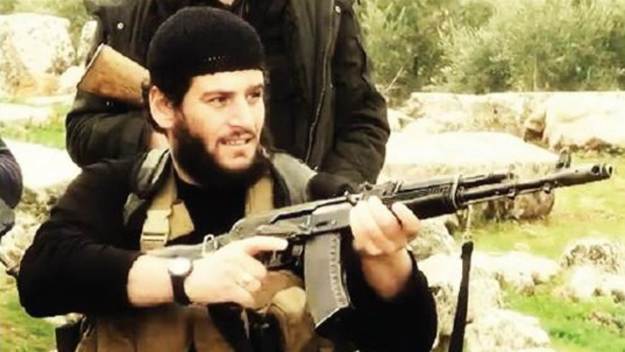
Islamic State's spokesman and Syrian governor, Taha Subhi Falaha (Abu Muhammad al-Adnani)

Islamic State’s spokesman and Syrian governor, Taha Subhi Falaha (Abu Muhammad al-Adnani)

The extremist group now known as Islamic State (IS) first claimed statehood, with clear pretentions to a new caliphate, in 2006—and eight years later made it explicit.

“Now the dream has become a reality,” Taha Falaha (Abu Muhammad al-Adnani) said in his speech on June 29, 2014, declaring that the territory IS held in Syria and Iraq constituted the rebirth of the caliphate. “The State will remain.”

Two years later, this looks like an unsafe proposition. Continue reading

Is the Islamic State About to Kill Itself?

By Kyle Orton (@KyleWOrton) on June 7, 2016

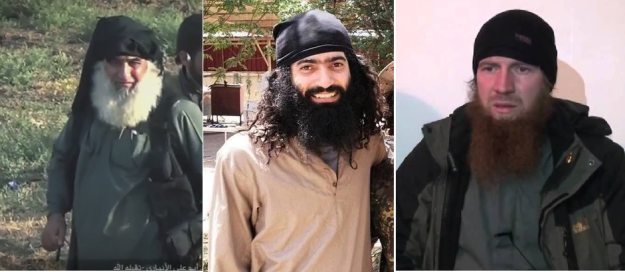
Abd al-Rahman al-Qaduli, Amr al-Absi, Tarkhan Batirashvili

Abd al-Rahman al-Qaduli, Amr al-Absi, Tarkhan Batirashvili

The Associated Press reported on Sunday that after a senior Islamic State (IS) commander was struck down by the international coalition in March it set off a witch-hunt inside the organization that led to the killing of thirty-eight IS jihadists at the hands of their own leaders. By AP’s account, IS is now consumed with internal suspicion. The story has some problems, however. Continue reading

The Islamic State, Territory, and a Change of Tone

By Kyle Orton (@KyleWOrton) on May 26, 2016

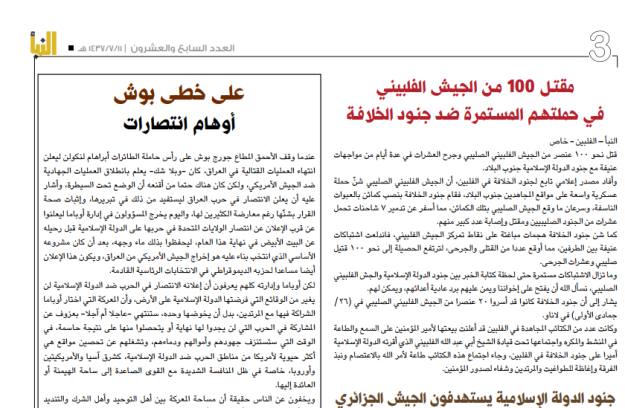
The Islamic State’s spokesman, Taha Falaha (Abu Muhammad al-Adnani), released a speech on 21 May that prepared the ideological ground for the loss of territory by underlining something the Islamic State has long maintained: the caliphate is more a cause than a location. This was a departure, however, from the confident messaging that the Islamic State had emphasized since it announced the caliphate in June 2014. Just a month before Falaha’s speech, on 16 April, the twenty-seventh edition of al-Naba, the Islamic State’s weekly newsletter, carried an editorial that was triumphalist about the march of the jihadists—despite the losses in the prior eight weeks, of Ramadi in early February, al-Shadadi later in February, Palmyra on 27 March, and al-Qaryatayn on 3 April. That editorial from al-Naba 27 is reproduced below. Continue reading

Islamic State Prepares for Retreat, Calls for Foreign Terrorism

By Kyle Orton (@KyleWOrton) on May 23, 2016

1

Taha Falaha (Abu Muhammad al-Adnani) is the governor Islamic State-held territory in Syria and oversees the foreign attacks, a roster of duties which indicates that Falaha so powerful that he is effectively the caliph’s deputy after the demise of Abd al-Rahman al-Qaduli (Abu Ali al-Anbari) in March. Falaha is also IS’s official spokesman, and on 21 May 2016 he gave a very significant speech entitled, “That They Live By Proof”. The speech, released by Al-Hayat Media Centre, is reproduced below with some minor alterations in transliteration, some important sections highlighted in bold, and some notes added for explanation.

Falaha made three major points. First, Falaha was especially adamant that territorial control by IS should not be considered a measure of IS’s success: it lost all urban holdings and went into the deserts last time, after the strategic defeat in 2008, but it held to its cause and America withdrew, and this ideological cohesiveness and determination led it to be more powerful than ever within five years. Second, Falaha made use of the savage conduct of the coalition made up of the Assad regime, Iran, and Russia—and the Western indifference to same—to argue for Sunnis to see IS as a protective barrier against such sectarian foes. And, third, Falaha called for foreign attacks by Western Muslims, saying that if IS’s loyalists were unable to journey to IS-held areas this should not be considered a problem since attacks in the West are “more beloved to [IS] than the biggest act done [within the caliphate]”. Continue reading

Obituary: Abd al-Rahman Mustafa al-Qaduli (Abu Ali al-Anbari)

By Kyle Orton (@KyleWOrton) on March 25, 2016

1

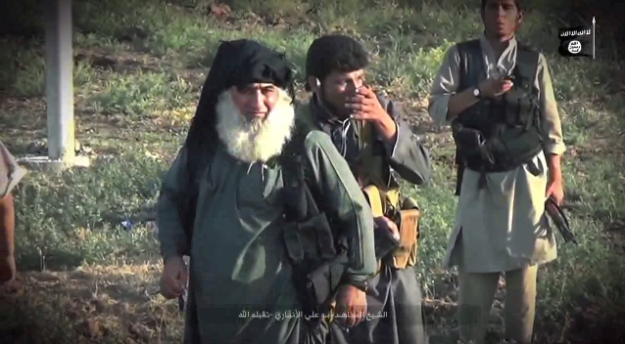
Abd al-Rahman al-Qaduli (Abu Ali al-Anbari) in an Islamic State video in May 2016

United States Secretary of Defense Ashton Carter announced this morning that he believed Abd al-Rahman Mustafa al-Qaduli, a senior leader of the Islamic State (IS), had been killed in a U.S. raid into Syria earlier this week. Al-Qaduli was “serving as a finance minister” and had been “responsible for some external affairs and plots,” said Carter. America is “systematically eliminating ISIL’s cabinet,” Carter went on, noting the alleged killing of Tarkhan Batirashvili (Abu Umar al-Shishani) two weeks ago, adding that al-Qaduli’s removal will “hamper” IS in conducting operations inside and outside its caliphate. Continue reading

Assad Cannot Keep Europe Safe From the Islamic State

By Kyle Orton (@KyleWOrton) on March 24, 2016

Article published at NOW Lebanon

1

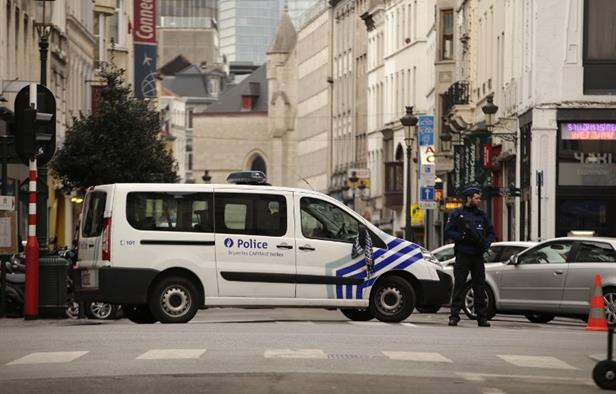
The long arm of the Islamic State (ISIS) has struck again. Tuesday morning, Zaventem airport in Brussels was hit by two suicide bombers and soon after a third man detonated at Maelbeek metro station, not far from the headquarters of the European Union. At least 31 people were slaughtered and around 270 were injured. Belgium has a long history as a hub of global jihadism and some of its citizens were key in forming ISIS’s statelet. In the wake of the attack, as Western governments look for ways to hasten the demise of ISIS, it will likely be said—again—that the quickest way to do that is by striking a devil’s bargain with the regime of Bashar al-Assad in Syria. From Assad’s role in helping ISIS lay its groundwork in Iraq even before the U.S. invasion to Assad’s help, by omission and commission, in nurturing ISIS in the years since the uprising against him began as a means of defeating the opposition to Assad’s deliberate incitement of a sectarian war, there is nothing that could be further from the truth. While Assad remains in power, ISIS will remain alive. Continue reading

Another Legacy of the Bosnian Jihad

By Kyle Orton (@KyleWOrton) on February 5, 2016

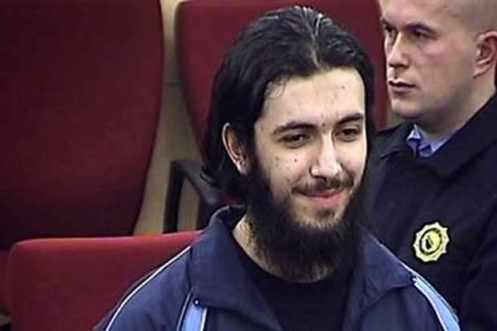
Mirsad Bektašević

Mirsad Bektašević (2005)

I recently wrote about the jihad in Bosnia. This much-neglected aspect of the war in the 1990s was crucial in shaping al-Qaeda, and global jihadism more broadly, providing this movement, and Clerical Iran, with a staging post in Europe, not least because Tehran’s spy-terrorist capabilities had been deployed to bring many of the jihadists into the country and train them in the first place. While Islamist militancy and terrorism were brought to Bosnia largely as imports, their entry was facilitated by the Party of Democratic Action (SDA), the ruling party to this day. While the war itself trained many jihadist “graduates,” almost all of whom were allowed to stay (or at least received Bosnian passports that gave them that right), the entry of extremist charities/missionaries to lead the rebuilding, many of them bankrolled by Saudi Arabia, entrenched the jihadists and spread their form of Islam in Bosnia after the war. As such, Bosnia became a hospitable operating environment for Islamist recruitment and training and both veterans of the war and people radicalized in Bosnia since have continued to show up in the ranks of international terrorism. It is of interest, therefore, to have an important old case re-emerge in a new way in the last few days, that of Mirsad Bektašević, which again highlighted Bosnia’s importance in the formulation of the infrastructure that underpins the jihadi-Salafist movement, the less-than-clear division between al-Qaeda and the Islamic State (IS) when it comes to the European facilitation networks, and the dangers of seeing Iran as a partner in stability. Continue reading

The Rise and Fall of Mohammed Emwazi

By Kyle Orton (@KyleWOrton) on January 20, 2016

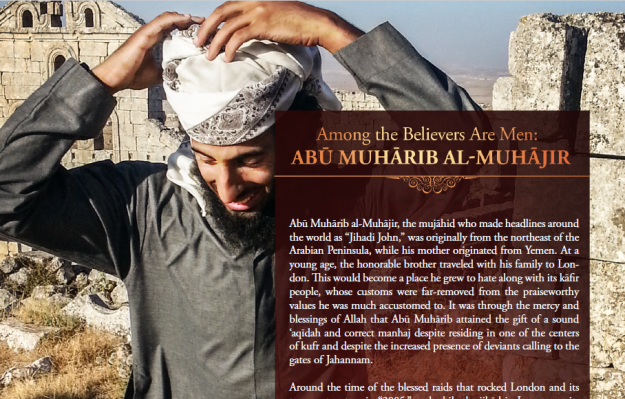
Emwazi

Emwazi’s eulogy picture in Dabiq

Yesterday, the Islamic State (IS) released their thirteenth issue of Dabiq. Among many things, it contained an admission of death for Mohammed Emwazi (“Jihadi John”). Referred to by his kunya, Abu Muharib al-Muhajir, Dabiq said (pp. 22-23) Emwazi had been hit by an “unmanned drone in the city of ar-Raqqah” on November 12, “destroying the car and killing him instantly.” The biography that Dabiq offered gave some intriguing details, confirming some surmises I had made about Emwazi when his identity was revealed last spring, including his early involvement in an al-Qaeda network in London sending fighters to al-Shabab in Somalia—the thing that brought him to the attention of the security services, confirming that the truth was the inverse of CAGE’s infamous claim that harassment by the MI5 had radicalized Emwazi—and that Emwazi had left Britain to do jihad in Syria in the company of another British citizen. Emwazi was also in the thick of it when IS broke from al-Qaeda and offers an interesting and rare example of a European IS fighter entrusted with an internal security role for the caliphate.
Continue reading

The Islamic State Was Coming Without the Invasion of Iraq

By Kyle Orton (@KyleWOrton) on December 12, 2015

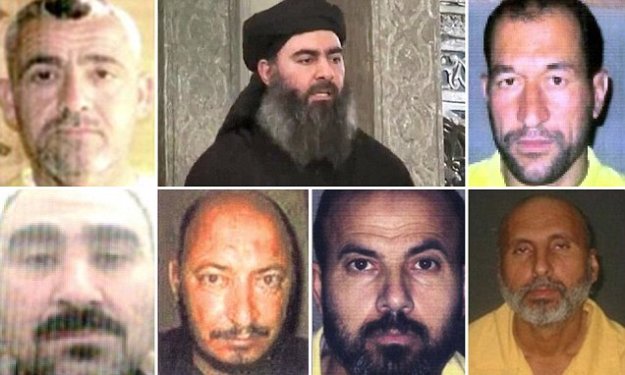
From top left clockwise: Fadel al-Hiyali, Ibrahim al-Badri (Abu Bakr al-Baghdadi), Adnan al-Bilawi, Samir al-Khlifawi (Haji Bakr), Adnan as-Suwaydawi (Abu Ayman al-Iraqi), Hamid az-Zawi (Abu Omar al-Baghdadi), Abu Hajr as-Sufi

From top left clockwise: Fadel al-Hiyali, Ibrahim al-Badri (Abu Bakr al-Baghdadi), Adnan al-Bilawi, Samir al-Khlifawi (Haji Bakr), Adnan as-Suwaydawi (Abu Ayman al-Iraqi), Hamid az-Zawi (Abu Omar al-Baghdadi), Abu Hajr as-Sufi

Yesterday, Reuters had an article by Isabel Coles and Ned Parker entitled, “How Saddam’s men help Islamic State rule“. The article had a number of interesting points, but in its presentation of the movement of former (Saddam) regime elements (FREs) into the leadership structure of the Islamic State (IS) as a phenomenon of the last few years, it was a step backward: the press had seemed to be recognizing that the Salafization of the FREs within IS dates back to the Islamization of Saddam Hussein’s regime in its last fifteen years, notably in the 1990s after the onset of the Faith Campaign. Continue reading