The State Department designated five individuals on 30 March 2017 as Specially Designated Global Terrorists (SDGTs), imposing sanctions on them for having “committed, or [for] pos[ing] a significant risk of committing, acts of terrorism that threaten the security of U.S. nationals or the national security, foreign policy, or economy of the United States.” Four of those sanctioned are members of the Islamic State (IS), including two key British operatives in the group’s global network, and the other is a member of al-Qaeda. On the same day, the Treasury Department sanctioned two IS operatives involved in funding and guiding external IS operations in the Far East and Southeast Asia. Continue reading →
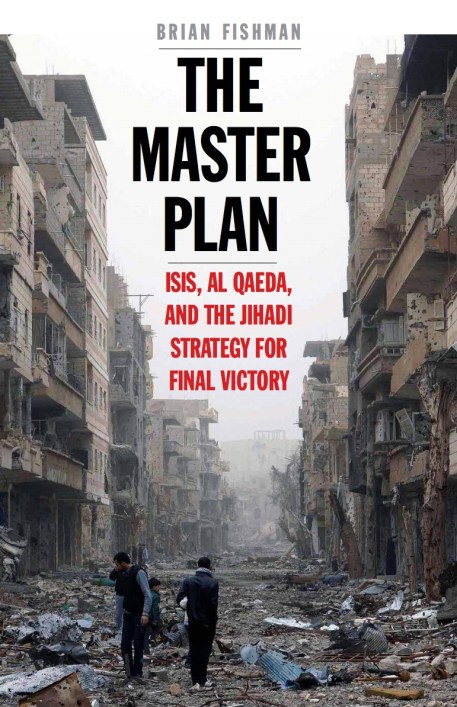
Brian Fishman’s The Master Plan provides a comprehensive history of the Islamic State’s (IS) strategic evolution, covering the personalities and events that shaped one of the most feared terrorist-insurgent groups that has ever existed. Eminently readable, in places even amusing—no small feat in a book about IS—Fishman flips with ease between the overview and the granular to demonstrate his points, using new sources that will allow as much supplementary research as a reader could wish for, and ties it together in a narrative that will be of use to both specialists and generalists. Continue reading →
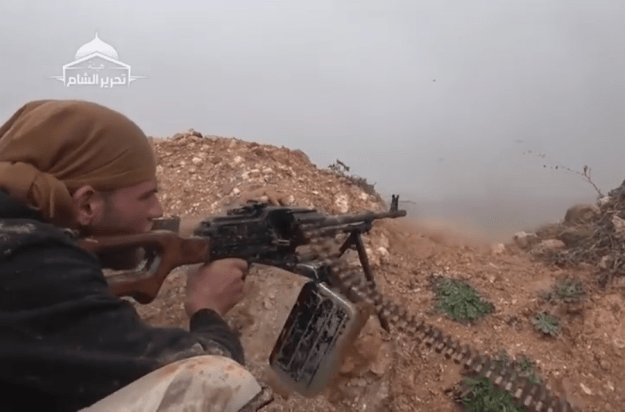
Hay’at Tahrir al-Sham fighter engaging the Assad regime
Michael Ratney, who has been the United States Special Envoy for Syria since July 2015, wrote a public letter , released on 11 March 2017, which labelled all constituent parts of Hay’at Tahrir al-Sham (HTS) as members of al-Qaeda and therefore as terrorists.[1] On 12 March, HTS’s “Administration of Political Affairs”—its newly-minted political office, perhaps evidence of an evolution in HTS’s thinking about an endgame in Syria—issued a statement in reply, which is reproduced below. Continue reading →
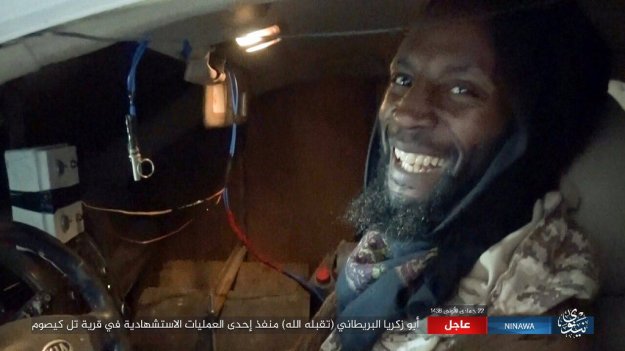
Since the offensive against Mosul, the Iraqi capital of the Islamic State (IS), began five months ago, IS has expended a high number of lives quite deliberately in suicide attacks. One of the suicide-attacks conducted on 20 February 2017, a car bombing against an Iraqi base, was by Abu Zakariya al-Britani, a British citizen now identified as Ronald Fiddler from Manchester. In 2002, Fiddler, then calling himself Jamal Udeen al-Harith, was sent to Guantanamo Bay, before being released in 2004 while still protesting his innocence. After suing the British government over his imprisonment, Fiddler received a substantial cash settlement in order to avoid compromising state secrets. Fiddler’s demise invites some revisiting of widely-held assumptions surrounding Guantanamo. Continue reading →
The Islamic State (IS) has named a new official spokesman, Abu Hassan al-Muhajir. Abu Hassan is the fourth man to hold the position of spokesman within the IS movement, and the third since it declared statehood in 2006. Very little is known about Abu Hassan but assessing the history of IS’s media enterprise offers some hints about his profile. In this regard, a new paper by Dr. Craig Whiteside of the International Centre for Counter Terrorism Terrorism is instructive. Looking forward, examining Abu Hassan’s inaugural speech offers some clues about the direction IS’s messaging and behaviour will take now as its statelet shrinks under pressure from the U.S.-led Coalition. Continue reading →
UPDATE: It has subsequently become clear that the “Abu Abdullah al-Muhajir” who was killed in Syria on 18 November 2016 was not Muhammad al-Saghir, who is profiled below. The slain man, like al-Saghir a veteran of the war get the Soviets out of Afghanistan and an Egyptian jihadist with close links to al-Qaeda, also used the kunya “Abu Afghan al-Muhajir”.
A week ago, it became clear that the air war being waged by the U.S.-led Coalition, which primarily targets the Islamic State (IS), was going to expand its campaign against the leadership of Jabhat Fatah al-Sham (JFS), al-Qaeda’s rebranded branch in Syria. In the evening of 18 November 2016, the Coalition killed Abu Abdullah al-Muhajir, whose real name is Muhammad Ibrahim al-Saghir. Al-Saghir also uses the name Abd al-Rahman al-Ali. This killing would appear to be part of the Coalition’s new effort.
Al-Saghir has a long record as an important jihadi religious ideologue, though his exact relationship with al-Qaeda’s network remains unclear. Al-Saghir’s most lasting contribution to jihadi-salafism is as a key guide to the founder of IS, Ahmad al-Khalayleh. Continue reading →
Mohamedou Ould Salahi, a Mauritanian, was released from Guantanamo Bay back to his home country on Monday. This comes as part of Barack Obama’s effort to drive the number of inmates at the detention centre down as far as possible before his Presidency ends. Salahi is the first detainee transferred since the mass-exodus in August, leaving sixty men at Guantanamo, nineteen of them already approved for transfer. Salahi is among the many detainees who claims he is innocent and that he has been maltreated in custody, and he has written a book, Guantánamo Diary, to that effect. The known facts about Salahi’s pre-detainment behaviour suggest caution should be exercised in accepting his version of events. Continue reading →
It was announced on 15 August that fifteen more inmates from the Guantanamo Bay detention facility have transferred, twelve Yemenis and three Afghans, to the United Arab Emirates, the largest individual release of the Obama administration. The U.A.E. also took in five “lower-level” Yemeni detainees in November. The Emirates had previously taken in just one—Abdullah al-Hamiri, in 2008—but President Obama leveraged this deal with the Gulf states at the May 2015 meeting when the Khaleejis were deeply concerned about the then-impending Iran nuclear deal, and in exchange for security reassurances, Obama extracted further concessions.
One reason why so many jihadists have been released to the U.A.E., other than having a similar language and culture, is because the U.A.E. has a competent security apparatus to monitor these people. Those released last November were kept in “a custodial rehabilitation program“—a version of house-arrest, basically. The conditions this time around are less clear.
What is clear is just how dangerous the operatives who are being let out of the Guantanamo detention facility are. Every single one of them has been assessed as posing a “high” risk to America, her interests, and her allies. Continue reading →
The Islamic State’s (IS) weekly newsletter, al-Naba, interviewed a high-ranking al-Qaeda defector, Abu Ubayda al-Lubnani, across two issues in February and March 2016. Abu Ubayda announced his defection from al-Qaeda to IS in April 2014 via al-Battar and Abu Ubayda’s name appeared on a list of prominent clerics supporting IS’s caliphate declaration that was circulated not long after the declaration. Abu Ubayda is described by al-Naba—as best as can be told accurately—as having been a member of al-Qaeda’s Shura or Consultation Council, a training officer in its Military Committee, and a counter-intelligence officer. Abu Ubayda is advertised as speaking about many secret aspects of al-Qaeda.
Among the topics Abu Ubayda covers is the alleged infiltration and manipulation of al-Qaeda by foreign intelligence services, specifically Pakistan’s Inter-Services Intelligence (ISI), which is not only a violation of jihadist doctrine by collaborating with an “infidel” and illegitimate state but led to the deaths of a number of senior al-Qaeda leaders.
Perhaps the most intriguing aspect of what Abu Ubayda has to say relates to al-Qaeda’s attempt to take advantage of the Syrian revolution. This persistent campaign has followed a pattern of disguising al-Qaeda’s presence and attempting to influence and eventually co-opt the rebellion against Bashar al-Assad’s regime. One lever al-Qaeda relied upon, according to Abu Ubayda, was Ahrar al-Sham, an organization that disclaims all connections to al-Qaeda and dissimulates about its ideology. Whatever Ahrar’s dominant ideology, it is simply a fact that it has served as the bridge between the foreign-led jihadists and Syrian Islamists, and its connections to al-Qaeda are evident enough. Abu Ubayda suggests Ahrar’s connections to al-Qaeda are even deeper than they appear. Continue reading →
This essay, written to tie together my work on the relationship between the Saddam Hussein regime and the Islamic State, was completed last summer and submitted to an outlet, where it entered a form of development hell. After giving up on that option late last year, the opportunity arose to get a shorter version published in The New York Times in December. But I procrastinated too long over what to do with the full essay and a recent change in my work situation means I no longer have the bandwidth to go through the process of finding it a new home, so here it is.
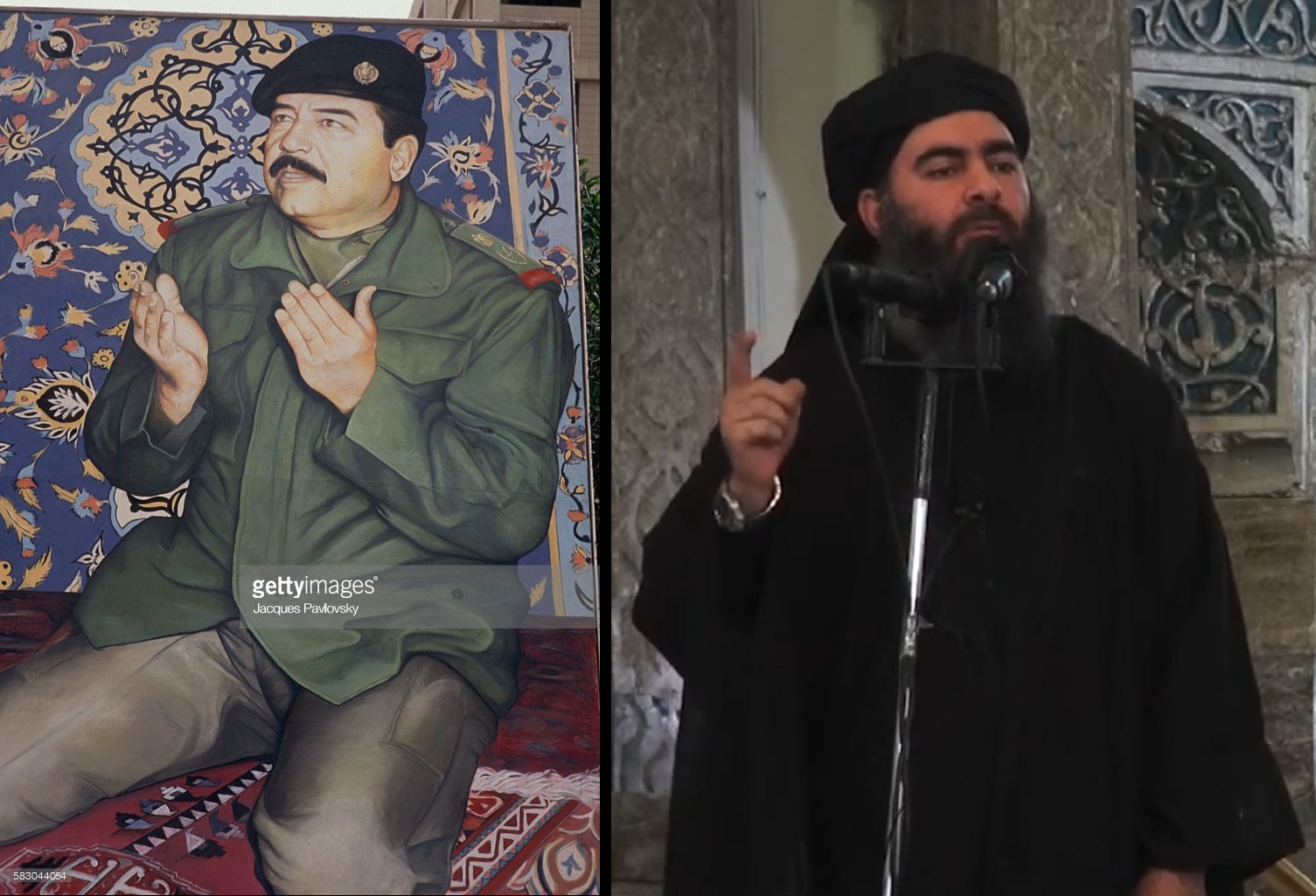
“Abu-Bakr al Baghdadi is a product of the last decade of Saddam’s reign,” argues Amatzia Baram, a scholar of Iraq. He is correct in at least three ways. First, in its last decade in power, the Iraqi Ba’ath regime transformed into an Islamist government, cultivating a more religious, sectarian population on which the Islamic State (ISIS) could draw. Part of Saddam Hussein’s “Faith Campaign” also involved outreach to Islamist terrorists, including al-Qaeda, which meant that the synthesis of Ba’athism and Salafism that fused into the Iraqi insurgency after the fall of Saddam was already well advanced by the time the Anglo-American forces arrived in Baghdad in 2003. Second, the ISIS leadership and military planning and logistics is substantially reliant on the intellectual capital grown in the military and intelligence services of the Saddam regime. And finally, the smuggling networks on which ISIS relies, among the tribes and across the borders of Iraq’s neighbours, for the movement of men and materiel, are directly inherited from the networks erected by the Saddam regime in its closing decade to evade the sanctions. The advantages of being the successor to the Saddam regime make ISIS a more formidable challenge than previous Salafi-jihadist groups, and one that is likely to be with us for some time.





 Kyle Orton's Blog