By Kyle Orton (@KyleWOrton) on 9 March 2019

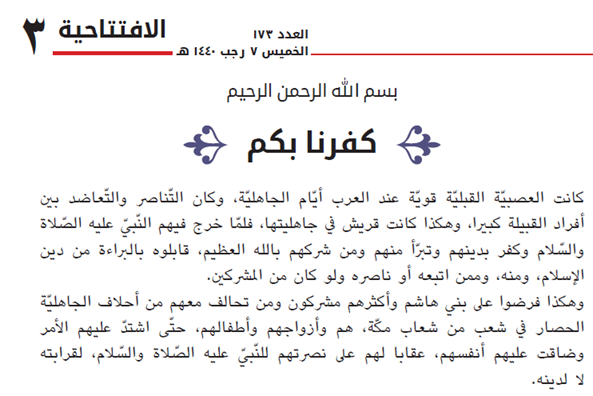
Al-Naba 172 front page
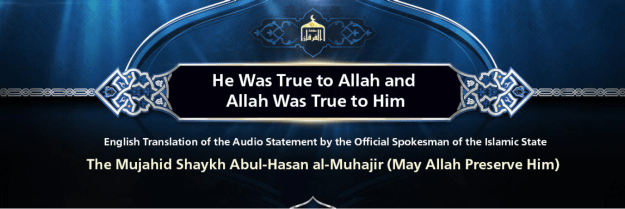
The Islamic State (IS) released the 172nd edition of Al-Naba, its newsletter, on 7 March 2019. Continue reading
By Kyle Orton (@KyleWOrton) on 9 March 2019

Al-Naba 172 front page
The Islamic State (IS) released the 172nd edition of Al-Naba, its newsletter, on 7 March 2019. Continue reading
By Kyle Orton (@KyleWOrton) on 26 February 2019

Islamic State terrorists responsible for the Danghara attack in Tajikistan, July 2018 [source]
By Kyle Orton (@KyleWOrton) on 16 February 2019

Front page Al-Naba 169
The Islamic State (IS) released the 169th edition of its newsletter, Al-Naba, on 14 February 2019. Al-Naba 169 leads with the attack on the governor of Borno in Nigeria by IS’s branch in that country. In terms of volume, much of the focus remains on the guerrilla campaign in Iraq and Syria, though there is an item on the last stand of the caliphate in Baghuz, the final village in eastern Syria. IS highlights its clashes with al-Qaeda in Yemen. There is a profile of a Russian-speaking atheist-turned-jihadist who was killed in Egypt. And perhaps most notable is an essay on Saudi Arabia, where IS has a terrorist infrastructure that is instructed to be patient. It is a question that likely is unanswerable until it is too late how strong IS is in Saudi Arabia. Continue reading
By Kyle Orton (@KyleWOrton) on 12 February 2019

Al-Naba 165, page 4
In the 165th edition of Al-Naba, the weekly newsletter of the Islamic State (IS), was released on 17 January 2019. Al-Naba 165 contained a description of the suicide bombing at the Qasr al-Omara restaurant in Minbij, northern Syria, on 16 January, which killed four Americans: Army Chief Warrant Officer Jonathan Farmer; Navy Chief Petty Officer Shannon Kent; Defence Intelligence Agency (DIA) civilian Scott Wirtz; and Pentagon contractor and linguist Ghadir Taher. At least ten other people were killed, eight civilians and two officials from the “Syrian Democratic Forces“ (SDF). The newsletter also contains an interview with an IS official operating in the Minbij area, who explains how the group’s sleeper cells and surveillance apparatus tracked U.S. movements and made prior attempts to attack the U.S. and its allies. Continue reading
Published at The Arab Weekly
By Kyle Orton (@KyleWOrton) on 3 February 2019

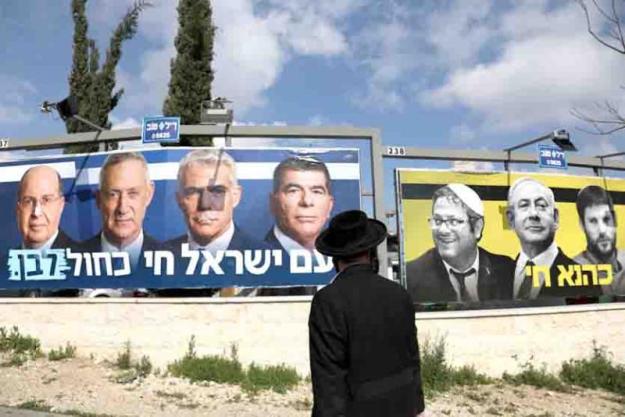
Benny Gantz, Binyamin Netanyahu [image source]
Published at The Arab Weekly
By Kyle Orton (@KyleWOrton) on 27 January 2019

Israeli Prime Minister Binyamin Netanyahu and Chadian President Idriss Deby meeting in N’Djamena, 20 January 2019 [AFP]
By Kyle Orton (@KyleWOrton) on 26 January 2019

Mavi Marmara arrives at Sarayburnu port as people wave Turkish and Palestinian flags, 26 December 2010 [source]
By Kyle Orton (@KyleWOrton) on 24 January 2019

CCTV footage of the Londonderry bombing, 19 January 2019 [source]
By Kyle Orton (@KyleWOrton) on 17 January 2019

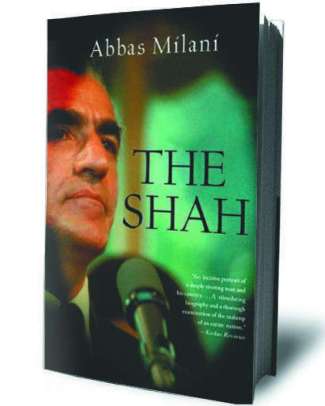
Forty years ago yesterday, Muhammad Reza Pahlavi, the Shah (King) of Iran, left his country for the last time as a year-long revolution crested. A month later, the remnants of the Imperial Government collapsed and Grand Ayatollah Ruhollah Khomeini was swept to power after his long exile, establishing the first Islamist regime. Andrew Scott Cooper’s 2016 book, The Fall of Heaven: The Pahlavis and the Final Days of Imperial Iran, charts how this happened. Continue reading
Published at the New York Post
By Kyle Orton (@KyleWOrton) on 10 January 2019

Rally for MEK in Villepinte, near Paris, in June 2018. Photograph: Regis Duvignau/Reuters
The nuclear deal was supposed to chart a new course for Iran. But the Tehran regime remains as it ever was, including when it comes to committing acts of terror in Western homelands. Just don’t expect Europe to reconsider its policy of preserving the nuclear deal at any cost. Continue reading