Tag Archives: war crimes

British Parliament Examines Implications of Supporting “the Kurds” in Syria

By Kyle Orton (@KyleWOrton) on 11 February 2018

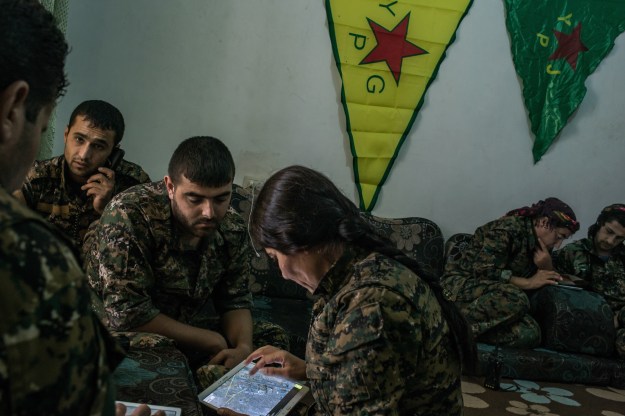
YPG check maps ahead of calling in an American airstrike, Hasaka, Syria (picture by Mauricio Lima for The New York Times)

The British Parliament has released a report today, entitled, “Kurdish aspirations and the interests of the UK”, which examines the implications for the United Kingdom of having supported various Kurdish groups and parties as part of the Coalition against the Islamic State (IS). Continue reading

The End of the Line for “The Beatles” of the Islamic State

By Kyle Orton (@KyleWOrton) on 9 February 2018

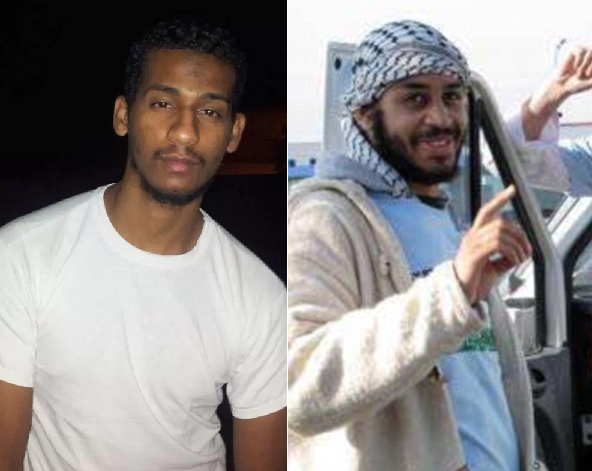
El Shafee Elsheikh (image source) and Alexanda Kotey (image source)

Last night, The New York Times reported and Reuters confirmed that two British Islamic State (IS) jihadists, El Shafee Elsheikh and Alexanda Kotey, both of them designated terrorists by the United States, have been arrested in Syria. Kotey and Elsheikh, along with the late Mohammed Emwazi (Abu Muharib al-Muhajir) and Aine Davis, formed a four-man cell that has become known as “The Beatles”—hence Emwazi being near-universally known as “Jihadi John”—that guarded, abused, and murdered hostages for IS from before the “caliphate” was founded in 2014. Continue reading

Syria’s Rebels Reject the Russian-Organized “Peace” Conference in Sochi

By Kyle Orton (@KyleWOrton) on 29 December 2017

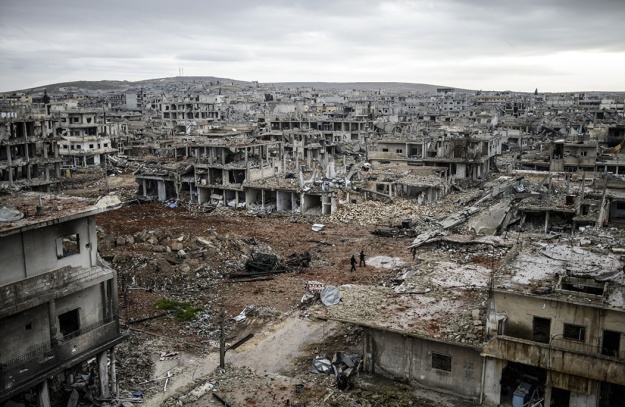
Aleppo city (source)

The Syrian opposition released a statement on 25 December 2017 making official its rejection of the upcoming Sochi conference, which, overseen by the Russian government, is intended to continue shaping the terms of a settlement in Syria. A translation of the statement was made by TNT and is reproduced below. Continue reading

Is Britain Cracking Down on PKK Terrorist Activity?

Originally published at The Henry Jackson Society

By Kyle Orton (@KyleWOrton) on 16 December 2017

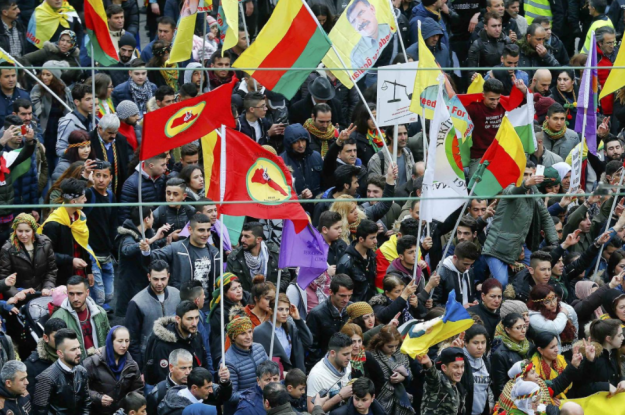
Pro-PKK demonstrators in Frankfurt, Germany, 18 March 2017, REUTERS / Ralph Orlowski

The BBC reported yesterday that on 7 December the Metropolitan Police Service arrested four people—two 17-year-old boys, a 38-year-old woman, and a 50-year-old woman—were arrested in the Haringey area of north London as part of a probe into terrorist fundraising, through money laundering and fraud. The terrorist group at issue is the Kurdistan Workers’ Party (PKK), and those arrested are believed to have contributed to the PKK’s finances through sale and distribution of one of the PKK’s most important propaganda instruments, the Yeni Ozgur Politika (New Free Politics) newspaper. Time will tell if this is a one-off or the beginning of a serious and long-overdue attempt to curtail the PKK’s propaganda-recruitment activity and fundraising in the West. Continue reading

By Strengthening Iran, the Coalition Has Ensured the Islamic State’s Survival

Published at The Telegraph

By Kyle Orton (@KyleWOrton) on 6 October 2017

The “defeat” of the Islamic State (ISIL), signified by its eviction from Mosul in July, its impending loss of Raqqa, and an apparent resurgence of Bashar al-Assad’s regime in Syria, seemed to augur a new era of stability for the Middle East. The jihadists would be gone and Iranian-backed governments in Syria and Iraq consolidated.

True, Assad murdering those who resisted him with poison gas and concentration camps, and hiding the evidence by installing crematoria, would nag at our conscience. But foreign policy is a cold-blooded business and it has been decreed that ISIL is the greatest—really the only—threat emanating from the region.

It would not be justice, but it would be peace. Or something like that. Continue reading

The Role of Turkey in Syria

By Kyle Orton (@KyleWOrton) on 16 August 2017

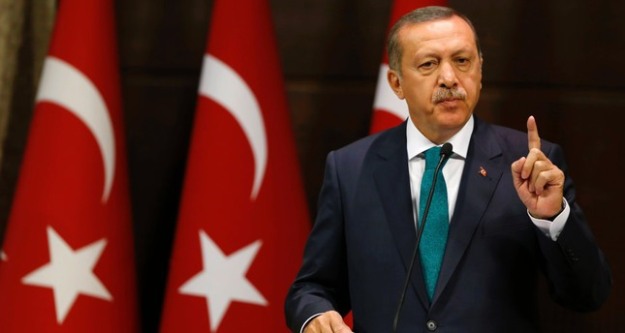
Recep Tayyip Erdogan (image source)

The Turkish government has gotten more and more deeply involved in Syria since the uprising began in 2011. But Turkey now finds its original aim, namely the overthrow of Bashar al-Assad’s regime, unattainable, creating tensions with the Syrian armed opposition, its primary lever inside Syria, and there are considerable problems stabilizing the zone of Syria that came under Turkish occupation after Ankara’s direct intervention in 2016. The defeat of Turkey’s primary objective has been accompanied by the rise of further problems, notably the exacerbation of its longest-standing internal security threat, that posed by the Kurdistan Workers’ Party (Partiya Karkerên Kurdistan – PKK), and the generation of new internal threats, from the Islamic State (IS) and potentially from al-Qaeda-linked groups. The options for solving these problems are constrained and unpalatable. Continue reading

The Horrors in Assad’s Prisons Are Beyond the Cruelty of the Islamic State

By Kyle Orton (@KyleWOrton) on 12 July 2017

In Syria, the West has been keen not to repeat the mistakes of Iraq—defined as being drawn into an open-ended ‘war of choice’ in the Middle East. This insight led to watching with folded arms as the regime of Bashar al-Assad massacred peaceful protesters and depopulated ancient cities with fighter jets and poison gas, an exodus that spread instability into Europe and allowed menacing strategic adversaries like Iran and Russia to gain footholds that Western policy had heretofore denied them. Continue reading

Raqqa Doesn’t Want to Be Liberated By the West’s Partners

By Kyle Orton (@KyleWOrton) on 30 May 2017

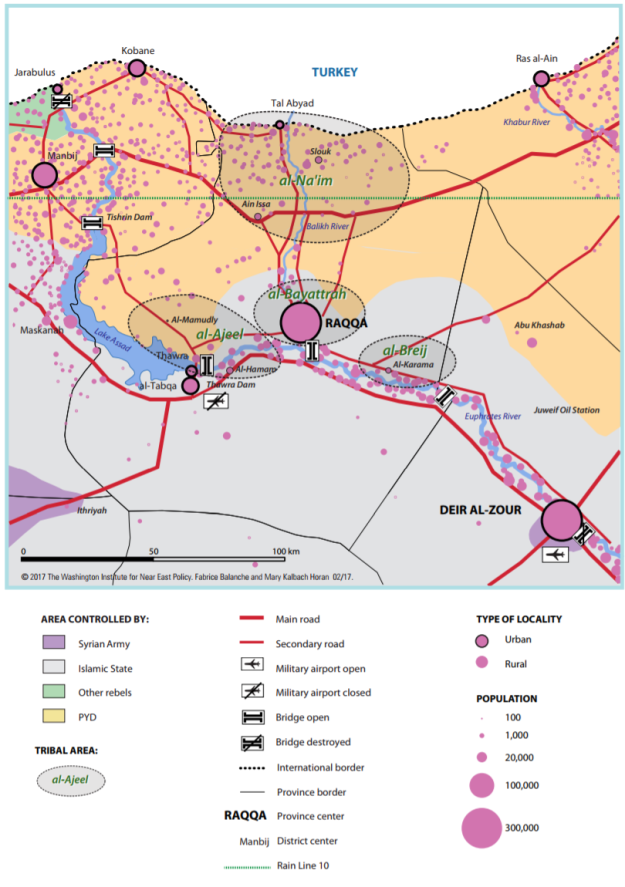
Map of the tribes around Raqqa city (source: WINEP report)

We are now on the eve of the operation to evict the Islamic State (IS) from its Syrian capital, Raqqa, and, as expected, the United States will partner with the Syrian Democratic Forces (SDF), the front-group for the Democratic Union Party (PYD) and its armed wing, the People’s Protection Units (YPG), which President Donald Trump’s administration has committed to directly arming.

Many of the doubts voiced about this course relate to Turkey, since the PYD/YPG is—despite continued efforts to obfuscate the fact—the Syrian department of the Kurdistan Workers’ Party (PKK), the premier internal security threat to Turkey for many decades. The discussion then tends to fall into one of two grooves. Continue reading

Islamic State Attacks Have Sown Division in France, Marine Le Pen Would Sow More

Published at The Telegraph

By Kyle Orton (@KyleWOrton) on 21 April 2017

Security forces stand guard after attack in Paris, 20 April 2017 (CREDIT: ETIENNE LAURENT/EPA)

In Paris last night a gunman parked his car, stepped out, and opened fire on a police van outside a Marks & Spencer’s on the Champs Élysées. One policeman was murdered; two were wounded. A female tourist was also injured. The attacker was killed by police as he tried to flee and continue his rampage. Within two hours, the Islamic State (ISIL) had claimed the attack via its Amaq News Agency, and, rather unusually, had named the killer: “Abu Yusuf al-Baljiki”.

It has been widely reported that “Abu Yusuf the Belgian” is really Karim Cheurfi the Frenchman, a 39-year-old imprisoned for fifteen years after being convicted for three counts of attempted murder in 2001. Notably, two of his intended victims were police officers. French media has reported that Cheurfi was briefly arrested on 23 February after expressing an intent to kill law-enforcement officials, but released due to lack of evidence; the Interior Ministry refused to comment. Continue reading

The West’s Inconsistent Approach To Foreign Fighters in Syria

Originally published at The Henry Jackson Society

By Kyle Orton (@KyleWOrton) on 10 April 2017

The Kurdistan Workers’ Party (PKK), the Turkey-based Kurdish Marxist-nationalist insurgent group, which is listed as a terrorist organization by Britain, the United States, NATO, and Turkey, created a new foreign fighter unit in Syria on 31 March. In Syria, the PKK uses the name People’s Protection Units (YPG), and the new organization, mostly composed of Europeans, is called the International Revolutionary People’s Guerrilla Forces (IRPGF). In addition to underlining some interesting points about the PKK and Western strategy in the fight against the Islamic State (IS), the IRPGF also underlines the different approach the West has taken to foreign fighters flowing to various groups during the Syrian war. Continue reading