By Kyle Orton (@KyleWOrton) on September 6, 2015
BACKGROUND
Chechnya declared and established de facto independence in 1991, after the dissolution of the Soviet Union. Unable to undo the declaration through diplomacy or subversion, Russia tried to restore sovereignty by force in late 1994, initiating a bloody war that failed by late 1996. For the three years after that, while the Russian State extended an ambiguous recognition to the “Chechen Republic of Ichkeria”, the issue smouldered in Russian society. Secessionism is rarely popular, and never in Russia, where the law of her history is the expansion of the frontiers. It also struck a raw nerve in the context of the 1990s, amid the deprivation, disorder, and diminished status of the country: Chechnya was one humiliation too far.
By 1999, the issue was not just one of wounded pride. Islamists had quickly overshadowed the more nationalist Chechen rebels, and the province had become a magnet for foreign jihadists—one of the “ABC” jihads of the 1990s, with Algeria and Bosnia, a theatre for veterans of the anti-Soviet jihad in Afghanistan, for younger men inspired by the example of the “Arab-Afghans” (and/or lamenting missing out on the experience), and a refuge for terrorists on the run from the security services in their home countries, including the Egyptian Ayman al-Zawahiri, the current leader of Al-Qaeda, who was Osama bin Laden’s deputy and roving international ambassador when he arrived in Chechnya in December 1996, four months after the Chechens had effectively won the war for independence.
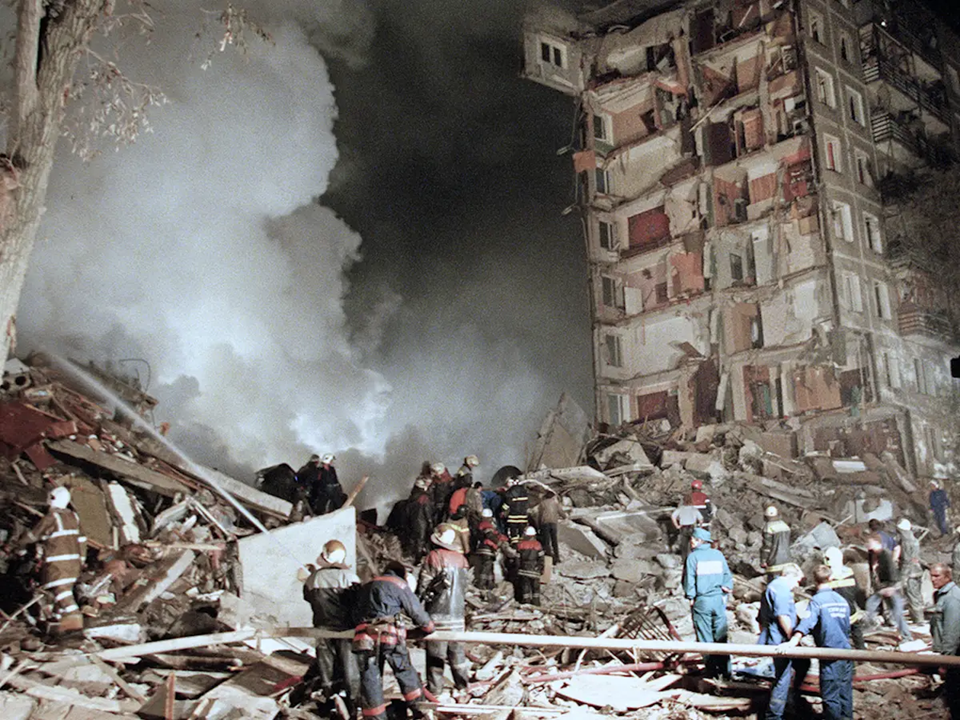
Chechnya was a haven for people who did not recognise any borders, and they behaved accordingly, creating security problems for Russia. After multiple cross-border attacks, in early August 1999, one of the most extreme Chechen leaders, Shamil Basayev, led an invasion into Dagestan. A month into the effective resumption of war, in September 1999, there were a series of apartment bombings in Russia that killed 300 people and wounded over 1,000. The bombings hit Dagestan, Rostov, and—what really counted—Moscow. The shock and outrage in Russia was of a 9/11 kind, and the government soon announced terrorists were responsible.
Then-Prime Minister Vladimir Putin took centre stage in officially declaring and waging the war that followed, and when President Boris Yeltsin stepped aside on New Year’s Eve 1999, Putin took over amid a wave of patriotic unity. Putin memorably said, days after the apartment bombings, “We will pursue the terrorists everywhere. You will forgive me, but if we catch them on the toilet, we will wipe them out in the outhouse.” After enduring one humiliation after another under Yeltsin, whom many Russians saw as more interested in keeping the Americans happy than standing up for the country, Putin struck exactly the right tone and substance.
Putin promised vengeance and the restoration of order under a strong, centralised hand—which is what most Russians wanted. Whether liberalism and democracy ever stood a chance in Russia, they had been discredited by the dismal results of the 1990s; the damage from Bolshevism had been too great to make that leap in one go, and the yearning for security drowned out all other priorities. Within two months, Grozny, the Chechen capital, was razed and re-conquered, and the secessionist republic liquidated. The human toll did not register outside the liberal intelligentsia: this was victory of a kind Russia had been too long denied, and Putin had delivered it—swiftly and overwhelmingly. The prestige won in the Second Chechen War is a significant part of why Putin provoked so little popular resistance as he cemented his autocracy in the years afterwards.
AND THEN THERE WERE NONE
From early on, there have been those, in Russia and abroad, who saw the sequence of events between the apartment bombings and Putin’s rise to supremacy as no accident.
Journalist and historian David Satter made the case perhaps most comprehensively in Darkness at Dawn: The Rise of the Russian Criminal State (2003). As an American, Satter had a measure of protection even while working in Russia. Mikhail Trepashkin, veteran KGB/FSB officer, did not enjoy these protections: naming the lead culprit of the apartment bombings as an FSB agent tied to organised crime—the distinction between the intelligence services and the mafia can get hazy in Russia—Trepashkin was arrested the day before he proposed to put this to a Russian court in 2003, and spent years in jail. He was the lucky one.
Another former KGB/FSB officer, Alexander Litvinenko, defected to Britain in 2000 and claimed publicly that the Russian government executed a false-flag operation in September 1999 so Putin could restart the war in Chechnya and secure himself in power. Putin’s answer was to irradiate Litvinenko in November 2006, in London, marking a return to external assassinations on a scale not seen since Stalin’s time.
Location aside, Litvinenko’s fate was the more usual for Russians who questioned the official narrative of the apartment bombings.
Artyom Borovik, an investigative journalist and the editor in chief of Sovershenno Sekreto, was one of the most high-profile critics of the Kremlin in the early months of Putin’s reign. Borovik had published a series of articles about official corruption in the military and special services, and was an outspoken opponent of the government’s policy in Chechnya. Borovik was known to be investigating the apartment bombings—and, because of his prior work, to have been suspicious of the FSB’s role—when he died in a mysterious plane crash in March 2000, in a period where other people Putin found awkward were dying off.
In April 2003, Sergei Yushenkov, a liberal Duma deputy and member of the official Russian investigative committee looking into the apartment bombings, was shot dead outside his home in Moscow. Hours earlier, Yushenkov had registered his Liberal Party, and, having made clear he thought the official investigation was a sham, promised to fight the then-upcoming Russian Duma election on the issue of getting a proper independent investigation of the apartment bombings. Yushenkov’s murder was ultimately pinned on Mikhail Kodanev, a rival within the Liberal Party. Kodanev, who protested his innocence all the way along, was taken to the prison infirmary a year later due to poisoning—reported by the Russian State to be a suicide attempt.
Three months later, Yuri Shchekochikhin, a Russian investigative journalist who had publicly accused the State of complicity in the apartment bombings—and was, by some accounts, about to share his evidence with America—died suddenly after the onset of a hideous malady: “In just two weeks, a man who was barely over fifty turned into a frail old man … One by one, all his internal organs failed, his skin peeled off in patches, his hair fell out, his entire body burned as if it had been scorched, and breathing became impossible because it felt as if molten metal was filling his lungs”. At the time, nobody knew to suspect radioactive poisoning.
The murder of investigative journalist and human rights advocate Anna Politkovskaya in Moscow on October 7, 2006—Putin’s birthday—is almost always interpreted as retaliation for her exposure of the Russian military’s criminality in Chechnya. It is often forgotten that Politkovskaya worked on the apartment bombings and came to similar conclusions to Shchekochikhin, with whom she “worked closely”, until she fled the country in 2001 after receiving credible evidence a contract had been taken out on her life. Politkovskaya returned to Russia in late 2004 to cover the gruesome Beslan school siege, though she never got there: she drank a cup of tea on the plane from Moscow and woke up days later in hospital. Politkovskaya was begged to leave by family and friends. Instead, while knowing it was probably hopeless and that she was risking death in the attempt, Politkovskaya showed that baffling bravery and determination that recurs throughout the history of the Russian opposition in staying to try to tie up the loose ends of her earlier reporting.
The most unnerving case in some ways is Vladimir Golovlyov, a liberal politician, shot down in the street while walking his dog in Moscow in August 2002. Golovlyov’s murder had been somewhat lost to history, generally buried in the pile of contract killings of Russian politicos in the period. To the extent a motive could be discerned, most pointed to Golovlyov’s role in the privatisation of State enterprises after the Soviet collapse, and the grudges some of the warring oligarchs held about decisions he had made. There was, however, an indication that Golovlyov’s killing was different: Golovlyov, known as a foe of corruption, was under a fairly obviously politicised investigation for corruption at the time of his murder. In itself, this means he was on Putin’s radar.
There is reason to think Golovlyov had already drawn Putin’s attention because of his links to those challenging the Kremlin’s narrative over the apartment bombings. Unlike those mentioned above, who were active and public opponents of the official explanation for the 1999 events, Golovlyov was much quieter and more marginal, but he had served on the Duma’s official investigative committee, and seems to have taken his job seriously, rather than just rubber stamping what the government had said. More importantly, when Yushenkov tried to bring Assassination of Russia—a film based on a book by Russian-American historian Yuri Felshtinsky and Litvinenko called, Blowing Up Russia: Terror from Within—to Russia, Golovlyov had put up the money to distribute the film within Russia.
The connection to Felshtinsky’s book might seem too thin a reed to explain what sealed Golovlyov’s fate, but the book really annoyed the Kremlin—it remains on the list of banned extremist materials—and, when you look closely, the book and the derivative film form the link between most of these murders: Yushenkov tried to import the film to Russia, Litvinenko co-wrote the book (and advised on the film), and Shchekochikhin had published chapters of the book before it was completed in a special issue of Novaya Gazeta in August 2001. It is, therefore, possible to see death finding Golovlyov despite the tenuousness of his connection to the project as the point: a warning to anybody else in Russia tempted to look too closely.
 Kyle Orton's Blog